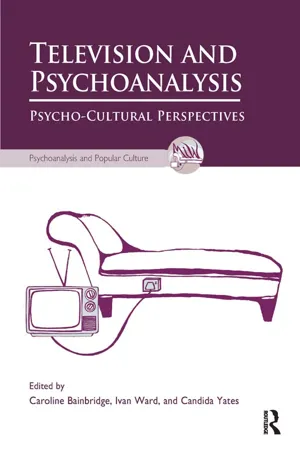
eBook - ePub
Television and Psychoanalysis
Psycho-Cultural Perspectives
- 220 pages
- English
- ePUB (mobile friendly)
- Available on iOS & Android
eBook - ePub
Television and Psychoanalysis
Psycho-Cultural Perspectives
About this book
Despite the prominence of television in our everyday lives, psychoanalytic approaches to its significance and function are notoriously few and far between. This volume takes up perspectives from object relations theory and other psychoanalytic approaches to ask questions about the role of television as an object of the internal worlds of its viewers, and also addresses itself to a range of specific television programmes, ranging from Play School, through the plays of Jack Rosenthal to recent TV blockbuster series such as In Treatment. In addition, it considers the potential of television to open up new public spaces of therapeutic experience. Interviews with a TV producer and with the subject of a documentary expressly suggest that there is scope for television to make a positive therapeutic intervention in people's lives. At the same time, however, the pitfalls of reality programming are explored with reference to the politics of entertainment and the televisual values that heighten the drama of representation rather than emphasising the emotional experience of reality television participants and viewers.
Information
CHAPTER ONE
Psychoanalysis and television: notes towards a psycho-cultural approach
There is much written within the field of media and cultural studies about the pleasure and influence of television in everyday life, including its role as a purveyor of ideology and cultural struggle (Brooker & Jermyn, 2003; Newcom, 2000; Seiter, Borchers, Kreutzner & Warth, 1992; Storey, 2006). Yet an understanding of television as an object of unconscious fantasy and emotional experience remains under-researched. This anthology sets out to develop such an understanding, by exploring the relationships between psychoanalysis and television. The aim of this chapter is to introduce the reader to some of the themes raised subsequently in the book by discussing ideas taken from the fields of psychosocial, cultural, and media studies with a view to developing a new psycho-cultural approach to the study of television as an object of psychological, social, and cultural significance. The chapter draws attention to the insights of psychoanalytic theory for an understanding of television culture past and present, and the view taken here is that the study of television needs to take account of the identifications and fantasies that take place between and within the viewers, the text, and the lived experience of the immediate environment, and also the wider context of culture and society (Yates, 2010a, p. 405). Holding in mind Freud’s (1900a) concept of “psychical reality”, and an awareness of the unconscious processes that mediate everyday experience, this psycho-cultural perspective also challenges the conceptual duality of screen studies that pitches the processes of fantasy in opposition to the experience of “reality”, away from the film or television screen. Instead, I argue that the relationship between television and the shaping of subjectivity is complex, ongoing, and mutually constituted within the viewing habits of everyday life.
The media sociologist, Roger Silverstone (1994, p. 3), argues that the psychosocial and cultural processes that underpin the relationship between television and subjectivity take place on a number of levels, and he cites three areas of particular significance. First, he points to the “cognitive significance” of television as a source of information; second, he cites its “political significance” as a source of ideology, and third, he discusses its “emotional significance” as a “disturber and comforter”. As Silverstone reminds us:
Watching television and discussing television and reading about television takes place on an hourly basis: the result of focused or unfocused, conscious or unconscious attention. Television accompanies us as we wake up, as we breakfast, as we have our tea and as we drink in bars. It comforts us when we are alone. It helps us sleep. It gives us pleasure, it bores us and sometimes it challenges us. It provides us with opportunities to be both sociable and solitary. Although of course, it was not always so, and although we have had to learn how to incorporate the medium into our lives, we now take television entirely for granted in a way similar to how we take everything for granted. (ibid., p. 3)
Silverstone’s insights regarding the emotional and unconscious dynamics of our engagement with television remain important for the development of a psycho-cultural approach to the study of television, and they provide a useful point of reference from which to develop an understanding of television, psychoanalysis, and the inner world. As I discuss, while the development of a psycho-cultural approach owes much to earlier studies that applied psychoanalytic understandings to the study of film and television, the approach taken here is one that draws mainly on the psychoanalytical tradition of object relations, using its ideas to discuss the emotional significance of television as a psychological object that provides a link between internal and external worlds.
To explore these themes, the chapter begins by contextualising the development of a psycho-cultural approach to television, providing a social, cultural, and historical analysis of the relationships between television, emotion, and what is often referred to as “therapy culture” (Bainbridge & Yates, 2011). I then discuss the application of psychoanalytic theories to television and popular culture in both clinical contexts and the academic fields of psychosocial and media studies. The chapter then returns to questions of television and the inner world and the kind of therapeutic work that may take place in the new psychological spaces opened up for viewers in contemporary television cultures.
Television, emotion, and therapy culture
When discussing the relationships between television and psychoanalysis, it is useful to take account of psychosocial and cultural developments in the study of what is often referred to as “therapy” or “therapeutic” culture (Richards, 2007; Richards & Brown, 2011; Yates, 2011). As recent scholarly research in the field demonstrates, the therapeutic turn in Western popular culture and the media is characterised by a heightened preoccupation with emotional experience and of the “feelingful” self in everyday life (Bainbridge & Yates, 2011, 2012). Today, it is often argued that the idea of the “affective self” has become reified, as the truth of life is represented mainly as residing in feelings and relationships, with the consumption of highly emotive television shows exemplifying this trend (Biressi & Nunn, 2005). The therapeutic turn in television is linked to wider historical developments in twentieth century culture and society defined by Cas Wouters (2007) as “informalisation”, a process which led to the “emancipation of emotions” in the 1960s and to the “emotionalisation of the public sphere” more generally (Richards, 2007). As discussed elsewhere (Yates, 2010b), the foregrounding of emotions in popular media is also linked to the history of psychoanalysis and popular culture, where from cinema to advertising, the language, practice, and imagery of psychoanalysis and its concerns are evoked. Today it is widely argued that we live in a confessional culture, in which an “ego-driven sense of self has gradually predominated” (Evans, 2009, p. 77), and where the traditional boundaries between what formerly constituted public and private life are now perceived as less distinct (Evans, 2009; Yates, 2011). This development is reflected in the exchange of practices and values between the different spheres of therapy and the media, where in television, the language of emotions and psychotherapy is extensively used and applied. The emotionalisation of television output is illustrated in an example provided by Wouters:
During the 1990–91 Gulf War, fighter pilots, interviewed for TV in their planes before taking off, admitted to being afraid. They did this in a matter-of-fact way. This would have been almost unthinkable in the Second World War, when such behaviour would have been equated almost automatically with being fear-ridden. (2011, p. 141)
Barry Richards (2007, p. 31) has documented the rise of what he calls “therapeutic culture” through his study of television “schedules and ratings” and he sees the popularity of soap operas and reality television shows as being highly significant indicators in this respect. One can cite the growth of reality television in its different formats from the Big Brother UK franchise (Channel 4, 2000–2010; Channel 5, 2011–present) to talent shows such as the The X Factor (2004–present), in which the emotional journeys of the protagonists signal the therapeutic potential of such shows, courting the attention of viewers who identify with the personal ups and downs of their life histories. The confessional style of various documentary formats and so-called “tabloid talk shows” such as The Jerry Springer Show (1991–present) or The Jeremy Kyle Show (2005–present), or self-help family programmes such as Supernanny (2004–2011) or Honey We’re Killing The Kids (2005–2007), provides examples of the expansion of the therapeutic ethos on television and elsewhere today. The influence of therapy culture is not only confined to the more populist formats associated with celebrity culture and “tabloid TV” (Biressi & Nunn, 2005). One can also see the representation of psychotherapy or group therapy in television drama, as in US shows such as Mad Men (2007–present), The Sopranos (1999–2007), and Breaking Bad (2008–present), and as Caroline Bainbridge discusses in this volume, the series In Treatment (2008–present). In the UK, the characters in the BBC1 series, Mistresses (2008–present), visit Relate councillors, and in the recent highly successful BBC drama series, Sherlock (2010–2012), even “Sherlock Holmes’s” sidekick, “John Watson”, sees a therapist, presumably as a means of contemporising his identity through reference to the traumas of the Afghan War. Televised political culture has also followed a therapeutic trend in its focus on the emotional vulnerabilities of politicians, providing an imagined sense of authenticity to their public performances by including the personal narratives of their family life (Yates, 2012).
The emotionalisation of broadcast news, with its focus on the so-called “war on terror” since 9/11, has also been discussed by Richards (2007), who applies the ideas of Melanie Klein and the psychoanalytic object relations tradition to its coverage in order to explore the therapeutic potential of working through psycho-cultural anxieties about contemporary geo-politics. Richards argues that therapeutic culture is not just about the representation of therapy, as some more reductive accounts of therapy culture would have it (see for example, Furedi, 2004), but rather it connotes the potential therapeutic process of engaging with media, described by John Ellis (2000) as a form of “working through”. As Ellis himself acknowledges, “the arduous task” of “working through the resistances” was first explored by Freud in his essay “Remembering, Repeating and Working Through” (Freud, 1914g, p. 155). Richards develops these themes and applies the work of psychoanalyst, Melanie Klein, to argue that the media has the potential to provide containing structures through which people can work through personal and cultural anxiety, and he cites the emotionalisation of broadcast television entertainment as being significant in this respect. Richards (2007) argues that therapy culture is not just about the sentimental expression of feelings, but rather signifies a potentially more complex set of psychosocial therapeutic processes, including a new reflexivity, and the development of a greater psychological awareness. As Sue Vice reminds us in Chapter Five of this volume, the everyday “taken for granted” nature of television may belie the more hidden, emotional work that takes place when watching and engaging with its programmes. As she goes on to argue in her discussions of Jack Rosenthal’s television dramas, even the most “gentle” of comedies may facilitate the working through of “disruptive and uncomfortable truths”.
Both Richards’s and Ellis’s discussion of the emotional dynamics of television engagement challenge a tradition of audience research that presents television-watching as a mindless, passive activity. In Chapter Six, Jo Whitehouse-Hart’s innovative audience research challenges this stereotypical image of the “couch potato” when she stresses the active and ongoing emotional conflicts and pleasures that are experienced when watching a favourite television programme and which may be repeated as a source of comfort on a regular basis. As I discuss later in this chapter, this raises a number of questions about the unconscious processes at work when engaging with television. It may be that, in some contexts, returning to a programme on a repeated basis can imply a creative form of emotional work associated with psychoanalytic theories of transformational objects and transitional phenomena (Bollas, 1987, 1992; Winnicott, 1974). Yet in other settings, repeated television viewing can also be explained in terms first discussed by Freud (1927e) and later by film scholars such as Laura Mulvey (1975) as “fetishism”, as a repetitive desire to master the psychological traumas encountered in early childhood.
In Chapter Seven, film-maker and television producer Richard McKerrow argues that programme-making can work as a form of “docutherapy” for both programme participants and members of the audience who may identify with the “emotional journey” of the protagonists telling their story. In that same chapter, documentary participant, Jonathan Phang, also takes up this theme in his discussion about his experience of taking part in the television documentary The Marchioness: A Survivor’s Story (2009). Like McKerrow, Phang highlights the necessity of taking into account the importance of ethical production values in relation to protagonists and sees such an approach as being key to the development of an emotionally responsible approach to film-making in the future. As Ivan Ward argues in Chapter Eight, the values required for making “good television” often mitigate against a disinterested concern for the welfare of participants or the pursuit of truth.
What we hope to sketch out in this collection of essays are the beginnings of a psycho-cultural approach to the study of television that may be applied to the processes of both the production and the consumption of television. Vice’s chapter on the work of Jack Rosenthal shows us that forms of representation are also significant when exploring the psycho-cultural processes of television, as they prompt and encourage the fantasies and identifications th...
Table of contents
- Cover Page
- Half Title
- Psychoanalysis and Popular Culture Series
- Title Page
- Copyright Page
- Contents
- ACKNOWLEDGEMENTS
- ABOUT THE EDITORS AND CONTRIBUTORS
- SERIES PREFACE
- PREFACE
- CHAPTER ONE Psychoanalysis and television: notes towards a psycho-cultural approach — Candida Yates
- PART I: THE VIEW FROM THE COUCH
- PART II: TELEVISION AS TRANSITIONAL OBJECT
- PART III: TELEVISION EXPERIENCES
- INDEX
Trusted by 375,005 students
Access to over 1.5 million titles for a fair monthly price.
Study more efficiently using our study tools.
Frequently asked questions
Yes, you can cancel anytime from the Subscription tab in your account settings on the Perlego website. Your subscription will stay active until the end of your current billing period. Learn how to cancel your subscription
No, books cannot be downloaded as external files, such as PDFs, for use outside of Perlego. However, you can download books within the Perlego app for offline reading on mobile or tablet. Learn how to download books offline
Perlego offers two plans: Essential and Complete
- Essential is ideal for learners and professionals who enjoy exploring a wide range of subjects. Access the Essential Library with 800,000+ trusted titles and best-sellers across business, personal growth, and the humanities. Includes unlimited reading time and Standard Read Aloud voice.
- Complete: Perfect for advanced learners and researchers needing full, unrestricted access. Unlock 1.5M+ books across hundreds of subjects, including academic and specialized titles. The Complete Plan also includes advanced features like Premium Read Aloud and Research Assistant.
We are an online textbook subscription service, where you can get access to an entire online library for less than the price of a single book per month. With over 1.5 million books across 990+ topics, we’ve got you covered! Learn about our mission
Look out for the read-aloud symbol on your next book to see if you can listen to it. The read-aloud tool reads text aloud for you, highlighting the text as it is being read. You can pause it, speed it up and slow it down. Learn more about Read Aloud
Yes! You can use the Perlego app on both iOS and Android devices to read anytime, anywhere — even offline. Perfect for commutes or when you’re on the go.
Please note we cannot support devices running on iOS 13 and Android 7 or earlier. Learn more about using the app
Please note we cannot support devices running on iOS 13 and Android 7 or earlier. Learn more about using the app
Yes, you can access Television and Psychoanalysis by Caroline Bainbridge, Ivan Ward, Candida Yates, Caroline Bainbridge,Ivan Ward,Candida Yates in PDF and/or ePUB format, as well as other popular books in Psychology & History & Theory in Psychology. We have over 1.5 million books available in our catalogue for you to explore.