- 240 pages
- English
- ePUB (mobile friendly)
- Available on iOS & Android
eBook - ePub
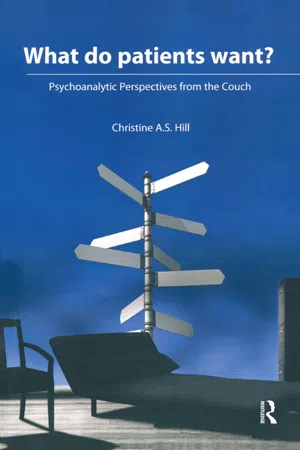
About this book
This book allows patients to speak for themselves about their psychoanalytic experiences. It challenges the preconceived perception that the analytic practitioner "knows best" when it comes to treatment, and responds to the growing sophistication of those seeking the treatment.
Information
Chapter One
Meeting the challenge
“Psychoanalytic practitioners sometimes slip into a position of arrogance, that of thinking they know best. Thus, when something goes wrong in an analysis, it is often the patient who is held accountable for this, the analyst assuming it to be an expression of the patient’s pathology rather than perhaps (at least) due to some fault of the analyst’s”
(Casement, 2002, p. xiii)
If you were a patient seeking psychoanalytic treatment, what would you think of Casement’s statement? Or, if an analytic trainee, how would you process the notion that even experienced analysts can confuse, or fail to understand, an inadequacy in their style of working which is then falsely attributed to the patient’s pathology? How many people have actually listened to patients and really understood what the experience of analysis was like for them? These are some of the questions addressed in this book.
Casement’s (2002) statement struck me as both honest and provocative, and encouraged my growing interest in exploring psychoanalysis from the patient’s perspective. How could I find ways to understand the psychoanalytic process as it unfolds within the transference-countertransference relationship, and in the privacy of the consulting rooms? In seeking an answer to this question I decided to ask patients, who had been in an analysis, what led them into this journey of discovery and what the experience was like for them. Did the analysis meet their expectations, or not and how did they understand what it was that made the difference?
One of the central aims of psychoanalysis is to provide a therapeutic treatment that enables patients to come to a deeper awareness of enduring and pathological patterns of behaviour influencing life situations. I believed, therefore, that one of my tasks was to find a common definition of psychoanalysis that related to this work. Issues that were raised in interviews with the patients, and reading material focused on this area, also motivated me.
Another factor was my attendance at the International Psychoanalytical Association (IPA) Congress in Nice, 2001, entitled “Psychoanalysis: Method and Application”, where diversity was the prevailing element. The common feature of these three experiences was the increasing awareness that psychoanalysis is extremely difficult, if not impossible, to define because of its multi-faceted nature, which encompasses theory, research, and diverse applications to its clinical practice.
In meeting these challenges, I saw the importance of briefly touching upon some of the trends throughout the history of psychoanalysis that have contributed to difficulties in a working definition. Therefore, I looked at die literature related to the development and growth of psychoanalysis from the time of Freud, examining the nature of the process, its changing aims, and relatedness to effective treatment and outcome.
Psychoanalysis: the “impossible” definition
Bachrach, Galatzer, Skolnikoff, and Waldron (1991) and Waldron (1997) argue convincingly that defining psychoanalysis has always been problematic. One recent study (Vaughan, Spitzer, Davies, and Roose, 1997) involved interviews with senior training analysts from the Columbia Centre for Psychoanalytic Training and Research, who were asked how they would define and assess the analytic process. No meaningful consensus was found within this group. The authors discussed the implication of this finding, suggesting that it might translate across to other core concepts such as transference and countertransference (discussed in the Introduction).
Psychoanalysis has been defined as a dynamic form of treatment, a method for the scientific study of the personality, and a system of scientific psychology to predict human behaviour (Berne, 1957; Chaplin 1975). Psychoanalysis, however, is not merely a therapeutic method, but an enormously complex, dynamic system of psychology, based originally on Freud’s tripartite model of the mind. From the early beginnings of Freud’s work, the psychoanalytic method has undergone idealization and collapsed into perplexity. Psychoanalysts are no longer in agreement as to the mechanisms of development or the conduct of psychoanalysis as a treatment method.
In his keynote address to the American Psychological Association on 16 April 1999, Peter Fonagy opened with “It would be a brave or foolhardy man (or woman) who would stand in front of an audience of psychoanalysts and psychotherapists and announce that he (or she) had the ‘definitive model’ of therapeutic action”. This viewpoint is also clearly demonstrated in the psychoanalytic literature, which provides no consensus as to the nature of psychoanalysis or its essential components of theory and practice, even among seasoned analysts (Bachrach, Galatzer, Skolnikoff, & Waldron, 1991; Perelberg, 2005; Vaughan, Spitzer, Davies, & Roose, 1997; Waldron, 1997). Tuckett (2001) stated that knowledge about psychoanalysis and its practical application, in spite of 100 years of practice, is still very much in doubt within the discipline. Perhaps this is a result of Freud’s thinking when he said, “It [psychoanalysis] gropes its way forward by the help of experience, is always incomplete and always ready to correct or modify its theories” (Fieud, 1923b, p. 253).
The IPA Congress (2001) took up the challenge of addressing confusion around psychoanalysis when they chose the theme for their Nice Congress. Representatives from various analytic institutions throughout the world repeatedly debated the question of diversity; they presented this as a dilemma for more than forty-two Congresses since the time of Freud (Guerrero, 2001). Two central points were raised about the current state of psychoanalysis: (1) how it was highly subjective in its specificity of method, and, hence, lacked the capacity for useful dialogue among clinicians; (2) that it had no internal consistency, therefore presented a difficulty to the clinician in recognizing his/her fundamental task (IPA Congress papers, 2001).
The above concerns offered analysts the challenge to find ways of effectively communicating with those not only within their own discipline, but outside of it as well Jiménez (2001), a speaker at the Congress, emphasized that unless there was coherence and inner consistency, analysts could find merely what they were seeking, hence turning psychoanalysis into a self-fulfilling prophecy rather than exploring differences.
One of the main problems in searching for a consensus on psychoanalysis seemed related to Freud’s continual vacillation over what he considered as the important elements and central aims of analysis. Freud lived in an era profoundly different from today’s world, with markedly different social and cultural mores, and influenced by the scientific empiricist thinking of that period. Coming from a medical background, the focus for Freud’s learning was through the description and explanation of empirical facts, relying on theories of disease, aetiologies, clinical histories, diagnosis and cure. (Freud, however, was quite clear in his writings [1913c, 1937c] that psychoanalysis needed to be kept out of the medical/psychiatry profession.) The evolving medical paradigm, particularly in that historical period and enduring until recent years, has relied upon a power differential between doctor and patient Freud’s powerful, paternalistic position of authority, which was characteristic of his era, is demonstrated in the following quotes from Freud, “When there is a dispute with the patient whether or how he has said some particular thing, the doctor is usually in the right” (1912e, p. 113), and also, “One must be especially unyielding about obedience to that rule …” (ibid., p. 119). The awe in which physicians and other experts were held in the time of Freud has gradually diminished over the years, with patients becoming more critical of the doctor’s authority because of their increased knowledge and preparedness to make choices. Living in a different culture, with access to better education, knowledge, and the influence of globalization, patients want aspects of their life outside the analysis understood and addressed.
Freud’s original aim, symptom removal, changed repeatedly as he revised his theory of the mind and the analytic process to structural change, and as he became interested in analysis as a method of scientific research. During his vacillations, Freud suggested that preoccupation with achieving a cure could be detrimental to the psychoanalytic process and, in fact, hinder the effectiveness of the method. The contradictions inherent in his works would seem to have contributed markedly to the confusion that has followed. Freud did, however, identify an important transferential component by which the analyst becomes the centre of the patient’s preoccupations. The recognition and working with the transference has remained an essential technique in psychoanalytic practice, although, as explained in the Introduction, there are variations in its definition.
Why these vacillations from Freud? According to Holt (1987), Freud had an amazing capacity for tolerating inconsistencies. Holt believed this was the result of the enormous amount of writing produced by Freud, and because Freud liked to give himself up freely to his thinking to see where it might lead him. Freud illustrates this in a letter to Andreas-Salomé in 1917, when he wrote, “You have observed how I work, step by step, without the inner need for completion, continually under the pressure of the problems immediately on hand and taking infinite pains not to be diverted from the path” (Freud, 1960, p. 319).
This, however, has created considerable problems for later generations of analysts and academics, and potential patients, especially when the patient’s need is understood as more specific and immediate.
Holt (1987) described how Freud tended to add things to previous publications without any fundamental reconsideration and little synthesis. He believed that Freud’s superb command of written communication meant that he rarely had to polish even his first drafts, thus, he did not pay thorough attention to the internal consistency or logic of his works as they went through new editions. Holt illustrates this argument when he writes:
Freud built theory, then, much as Franklin D. Roosevelt constructed the Executive branch of the government when something wasn’t working very well, he seldom reorganized; he just supplied another agency—or concept—to do the job. To tolerate this much inconsistency surely took an unusual capacity to delay the time when gratification of an orderly, internally consistent, logically coherent theory might be attained. [Holt 1987, p. 37]
Perhaps this explains some of the more specific ambiguity and theoretical diversity encountered by followers of Freud. For example, a review of empirical studies conducted by Henry, Strupp, Schact, and Gaston (1994) generated evidence of no universally agreed upon definitions of “transference” and “interpretation”, concepts which are considered the cornerstone of most analytic methods. According to Sandler, Holder Kawenoka, Kennedy, and Neurath (1969), and verified with later studies (Luborsky, Barber, & Crits-Christoph, 1990), definitions of “transference” vary as widely as the relationships included in the concept, and do not merely include the analyst/therapist. The understanding of the concept of “interpretation” varies even more widely (Piper, Debbane, Bienvenu, & Garant, 1987) while the combination of both terms generates a number of possibilities. These concepts are discussed further in the Introduction.
Kächele and Thomä (1999) drew attention to another important aspect of psychoanalysis when they argued that psychoanalysis had lost its prime therapeutic position over the 100 years from its inception. They stated that it has had to actively fight for its special place among a host of other treatments that have evolved, while systematic studies have inadequately supported the increasing variety of psychoanalytic truths. These researcher-clinicians highlighted the impact of new developmental studies as a prime example of why therapists and patients may not want to depend on loose patterns of theorizing to give them credence.
In this section I have addressed the issue “what is psychoanalysis?”, arguing that there are a number of understandings. This situation would seem to have been created by the founder of psychoanalysis, who did not develop the theory logically, therefore his work led to multiple interpretations. I was hoping to have a working definition of psychoanalysis and its main theoretical components to use when interpreting the patients’ material, so formed one from the following components that I found most useful. The definition incorporates the essential elements of psychoanalysis as presented by the Australian Psychoanalytical Society (APAS website, 2005); they also have links with communications from the patients in this research.
Keeping in mind the difficulties presented in formulating a definition of psychoanalysis, I have chosen to limit my working definition for this research to the therapeutic aspect of Freud’s tripartite model of the mind (Berne, 1957; Chaplin, 1975). In simple terms, I define psychoanalysis as a process by which patients seek to understand the unconscious determinants of enduring and problematic patterns of behaviour and human emotions. These are explored through an intense therapeutic relationship with a trained psychoanalyst, and conducted under particular conditions that favour the uncovering of the unconscious. For the psychoanalytic process to work, it must acknowledge the following components: human emotions and behaviour are influenced by the unconscious; symptoms are the manifestation of the unconscious; the work of analysis takes place within the transference-countertransference relationship; the “human” characteristics of both analyst and patient have an impact upon the quality of the engagement; and particular conceptual issues such as free association, resistance, technical neutrality, and interpretation have a significant function. These later concepts are defined in detail in the next chapter.
Complexities compounded by the transference relationship
It is important that any exploration of the unique psychoanalytic relationship between the patient and analyst captures the complexities of the clinical situation (Perron, 2001; Roth & Fonagy, 1996). From my psychoanalytic knowledge base, critical reading, and therapeutic experience, I was aware that the reader would raise questions as to whether the patients’ accounts could be considered “trustworthy”, particularly with complications inherent in the transference relationship. In simple terms, this relationship can be understood as the patient transferring thoughts and feelings from their own significant early relationships to the person of the analyst, who, as a result, then becomes the vehicle for many projections and understandings of meaning.
Because of this theoretical approach, the analyst’s interpretation of what happens in the analytic encounter can be very different from that of the patient’s perceived experience. This often reinforces the traditional belief that how die analyst describes the particular treatment is the only true version. An example of this privileging of one account over another occurs for women in patriarchal societies who have posed threats to males when trying to claim a voice, as in feminist movements in the 1960s; a second example is the experience of children not being listened to or believed when speaking of abuse carried out in the family. Within such traditions of doubt about the credibility of the “unempowered voice”, I was aware of the challenge of presenting patients’ narratives that would be considered credible in an environment where analysts’ accounts have generally been privileged.
Matthis and Szecsödy (1998) maintained that “truth” should be understood as a social phenomenon to be continuously explored and transformed. They stated that objectivity is provided by the will and ability to unremittingly question beliefs and assumptions, and emphasized how psychoanalytic “knowledge” or theory was so difficult to test empirically—what changes, how it changes, and why, in the clinical setting. Matthis (1998) described Freud’s attempts, often unsuccessful, to present his views and theories to a wider public, and stated that the ambiguities pertaining to the opening up of the closed doors were still prevalent today. He wrote, “Behind these closed doors the clinical psychoanalytic work continues … The fact that stormy weather may accompany an opening up of these hitherto sheltered chambers should not be accepted as a good reason for keeping the doors dosed” (Matthis (1998, p. xiv).
Questions around the complexities of understanding the transference from the perspectives of both patient and clinician have been raised in this section. I have argued that the trustworthiness of patients’ accounts, within the context of powerful transferences, is often questioned. In this exploration of their stories, I am, therefore, choosing to give a voice to their accounts, viewing them with a different lens. In the following chapters of this book, I present the analyses from their experiences.
The impact of unconscious factors
Another difficulty in deciding how to approach this work was related to the value given to specific “truths” or authority from within a psychoanalytic perspective. For example, as argued previously, some analysts believe that patients do not or cannot know what they want from analysis because of the unconscious factors involved; they claim that patients may only know that they want something. Based on this premise, it could be stated that it is only through the analytic process that the real reasons that led patients into treatment will emerge. This question was explored by Hinshelwood (1997) who stated,
If the psychoanalyst’s aim is that the patient should know his/her own mind better than before the analysis, can that be achieved by the analyst knowing better what the patient should think and decide? If the psychoanalyst knows for the patient, does this in the long run contribute to the patient knowing better for him/herself? It becomes a paradox. [Hinshelwood, 1997, p. 105]
To consider the above argument in the context of the question “What do patients want?” challenged me to understand the patients’ stories almost outside the psychoanalytic relationship, or outside the confines of psychoanalytic concepts that negate the patient’s authority to know.
Keeping these challenges in mind, I set out to explore psychoanalysis from the patient’s perspective, at the same time “holding” the paradox.
Table of contents
- Cover
- Half Title
- Title
- Copyright
- CONTENTS
- ACKNOWLEDGEMENTS
- ABOUT THE AUTHOR
- Dedication
- PREFACE
- INTRODUCTION: Central conceptual issues
- CHAPTER ONE Meeting the challenge
- CHAPTER TWO Beginning the analytic journey
- CHAPTER THREE Working with the transference
- CHAPTER FOUR The quality of engagement
- CHAPTER FIVE The paternal transference
- CHAPTER SIX Ending the analysis
- CHAPTER SEVEN Post analytic reflections
- CHAPTER EIGHT A difficult question; to recommend analysis or not?
- CHAPTER NINE Drawing together key findings
- CHAPTER TEN Clinical implications for psychoanalytic practice
- REFERENCES
- INDEX
Trusted by 375,005 students
Access to over 1.5 million titles for a fair monthly price.
Study more efficiently using our study tools.
Frequently asked questions
Yes, you can cancel anytime from the Subscription tab in your account settings on the Perlego website. Your subscription will stay active until the end of your current billing period. Learn how to cancel your subscription
No, books cannot be downloaded as external files, such as PDFs, for use outside of Perlego. However, you can download books within the Perlego app for offline reading on mobile or tablet. Learn how to download books offline
Perlego offers two plans: Essential and Complete
- Essential is ideal for learners and professionals who enjoy exploring a wide range of subjects. Access the Essential Library with 800,000+ trusted titles and best-sellers across business, personal growth, and the humanities. Includes unlimited reading time and Standard Read Aloud voice.
- Complete: Perfect for advanced learners and researchers needing full, unrestricted access. Unlock 1.5M+ books across hundreds of subjects, including academic and specialized titles. The Complete Plan also includes advanced features like Premium Read Aloud and Research Assistant.
We are an online textbook subscription service, where you can get access to an entire online library for less than the price of a single book per month. With over 1.5 million books across 990+ topics, we’ve got you covered! Learn about our mission
Look out for the read-aloud symbol on your next book to see if you can listen to it. The read-aloud tool reads text aloud for you, highlighting the text as it is being read. You can pause it, speed it up and slow it down. Learn more about Read Aloud
Yes! You can use the Perlego app on both iOS and Android devices to read anytime, anywhere — even offline. Perfect for commutes or when you’re on the go.
Please note we cannot support devices running on iOS 13 and Android 7 or earlier. Learn more about using the app
Please note we cannot support devices running on iOS 13 and Android 7 or earlier. Learn more about using the app
Yes, you can access What do Patients Want? by Christine A. S. Hill in PDF and/or ePUB format, as well as other popular books in Psychology & Mental Health in Psychology. We have over 1.5 million books available in our catalogue for you to explore.