eBook - ePub
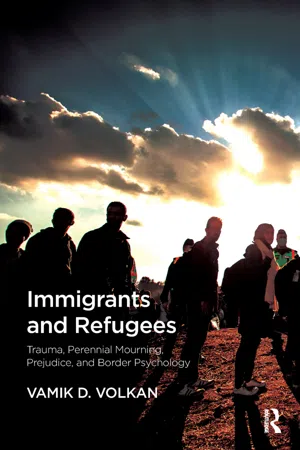
Immigrants and Refugees
Trauma, Perennial Mourning, Prejudice, and Border Psychology
- 142 pages
- English
- ePUB (mobile friendly)
- Available on iOS & Android
eBook - ePub
About this book
Aside from the many political, cultural and economic aspects of the present refugee crisis in Europe, it is also crucial to consider the psychological element. In our fast-changing world, globalisation, advances in communication technology, fast travel, terrorism and now the refugee crisis make psychoanalytic investigation of the Other a major necessity. Psychoanalyst Vamik Volkan, who left Cyprus for the US as a young man, brings his own experiences as an immigrant to bear on this study of the psychology of immigrants and refugees, and of those who cross paths with them. In Part 1, case examples illustrate the impact of traumatic experiences, group identity issues, and how traumas embedded in the experience of immigrants and refugees can be passed down from one generation to the next. Part 2 focuses on the host countries, considering the evolution of prejudice and how fear of newcomers can affect everything from international politics to the way we behave as individuals. Volkan also considers the psychology of borders, from the Berlin Wall to Donald Trump.
Information
PART I
NEWCOMERS
CHAPTER ONE
Psychoanalytic theories on adult immigrants and refugees
There are many variables involved in the immigration experience. Newcomers differ in respect to their ages, psychological makeup, and the support system that is available to them. Babies and small children, without having stabilized object constancy of people, pets, and things left behind, cannot be “typical” immigrants or refugees like their parents. León and Rebecca Grinberg (1989) stated that, “Parents may be voluntary or involuntary emigrants, but children are always ‘exiled’: they are not the ones who decide to leave and they cannot decide to return at will” (p. 125). In this chapter I write about adults as dislocated persons.
Dislocation takes place on a spectrum, ranging from “forced immigration” (a term that does not do justice to the actual tragedy of Africans brought to America as slaves and their descendents, or at the present time people escaping places such as Syria), to the voluntary immigration of individuals seeking a better life for themselves and their families. In cases of voluntary immigration, integration into a new country is generally smoother than the adaptation by a refugee, if the individual’s psychological makeup does not present complications. A refugee is in the position of feeling pressured, consciously and unconsciously, from the outset of relocation to prove that, “he is worthy of the mercy bestowed on him by the land that receives him. He lives with an urgent need to assimilate and to adapt. His rage against the land which he was forced to leave makes him repudiate and repress many attachments of the past. He feels guilt toward those whom he left behind in danger” (Wangh, 1992, p. 17). These factors combine to frustrate a person’s integration into a new country and culture. Obviously, the situation is more tragic and even more complex in cases of “forced immigration.”
There is one key common element that underlies the psychology of all dislocated individuals. Since moving from one location to a foreign location involves losses—loss of family members and friends; loss of ancestors’ burial grounds; loss of familiar language, songs, smells, food in one’s environment; loss of country; loss of previous identity and its support system—all dislocation experiences can be examined in terms of the immigrant’s or the refugee’s ability to mourn and/or resist the mourning process.
Sigmund Freud’s (1917e) “Mourning and melancholia” deals with internalized object relations. It refers to an adult mourner’s internal work dealing with the images of a lost object and the fate of the mental representation of this object. Here I use the term “representation” to refer to a collection of images. Mourning refers to an individual’s intense internal review of images of lost persons or things until this preoccupation with associated affects loses its intensity. The extent to which an individual is able intrapsychically to accept this loss will determine the degree to which an adjustment is made to a new life. In this chapter I will review some key papers and books written about psychodynamic issues of immigrants and refugees, and in the next chapter I will look at the psychology of mourning in detail and closely examine the complications that may be associated with the mourning process.
For a long time, the psychology of immigrants and refugees was not studied extensively by psychoanalysts. This is surprising, since there were and are many psychoanalysts who were or are immigrants themselves. In my book A Nazi Legacy, I reviewed multiple reasons why, until recent decades, psychoanalysts in general have been hesitant to examine in depth the impact of external events on their analysands’ internal worlds (Volkan, 2015). I believe that one major reason for this is that many Jewish psychoanalysts escaped from the Holocaust as refugees themselves, and many of them became key figures and important teachers in psychoanalytic training facilities. As Rafael Moses and Yechezkel Cohen (1993) stated, “the wish not to have terrible events be true, not to have them touch us, not to be too closely aware of what took place” (p. 130) was the most significant reason these psychoanalysts avoided, or even denied, the role of tragic historical events in their lives. Peter Loewenberg (1991) and Leo Rangell (2003) also reminded us that some aspects of a large-group history induce anxiety. Psychoanalsys who are Holocaust survivors or their offspring had to deal with anxiety. Vera Muller-Paisner (2005) remembers stories about her miraculous birth as a first child to a Holocaust survivor who was forty-four years old. But there were holes in her family’s story. Only later did she learn how her Jewish parents had reinvented their lives after the Holocaust. She wrote: “Family tapestries that hide the fabric of lies about collective traumas keep a person from knowing where they come from and who they are” (2005, p. 15). In the United States, three well-known psychoanalysts whom I know, Henri Parens (2004), Anna Ornstein (Ornstein & Goldman, 2004) and Paul Ornstein (Ornstein & Epstein, 2015) talked or wrote about their experiences as survivors of the Holocaust and refugees only after many decades had passed.
In 1974 Cesar Garza-Guerrero from Mexico, who was trained in the United States, wrote about immigrants who do not experience major trauma during dislocation. He stated that the immigrants experience “culture shock” (Ticho, 1971) due to the sudden change from an “average expectable environment” to a new and unpredictable one. By referring to “average expectable environment,” Garza-Guerrero was describing Heinz Hartman’s (1939) perception of an environment that is responsive to a child’s psychological needs. According to Garza-Guerrero, the adult immigrant activates a fantasy that the past contained all “good” self- and object images, along with their gratifying affective links. When the reality of dislocation sets in, such mental images are felt to be missing. At some point, the immigrant feels disconnected from “good” object images and experiences a sense of discontinuity. Not only do family members, friends, and other individuals exist in one’s “average expectable environment,” but non-human objects do as well.
The significance of non-human objects in one’s environment was emphasized by Harold Searles (1960). Later in this book I will describe the moving story of a Georgian refugee family. The family members, stepping over dead bodies, had escaped from Abkhazia during the Georgian-Abkhazian war of 1992–1993 and had become internally displaced people who settled at Tbilisi Sea, near the capital city Tbilisi. The daughter of this family, then in her mid-teens, would not and could not swim in the lake at the family’s new location, because, she insisted, this lake was not the Black Sea where she had enjoyed swimming during her earlier life in Gagra, a city in Abkhazia. Longing and nostalgia for the Black Sea, a non-human environment, would not allow her to enjoy swimming in the lake at her new home.
The initiation of a mourning process changes culture shock. According to Garza-Guerrero, once the immigrant whose mourning process can proceed without complications works through the mourning for what has been abandoned, this person can form a new identity that is neither total surrender to the new culture nor the sum of bicultural endowment. The new identity will be reflected in a remodeled self-representation that incorporates selective characteristics into the new culture that have been harmoniously integrated or that prove congruent with the cultural heritage of the past.
If the immigrant still feels accepted in the country left behind, upon completing the mourning process, for practical purposes she may experience biculturalism, resulting in a sense of belonging to neither culture to the exclusion of the other. In fact, this person will belong “totally to both” (Julius, 1992, p. 56). Greek-American Demetrios Julius states: “I slowly came to an appreciation of the importance of intrapsychic cultural complementary and, more significantly, to an acceptance of the vast cultural differences of the two countries [Greece and the United States]. I began to accept certain psychological paradoxes and to feel myself truly bicultural” (ibid.). Sentiments expressed by Garza-Guerrero and Julius find support from scholars in other fields. For example, historian Dina Copelman (1993) stated that the majority of Americans were at some point the immigrant, the refugee, or the Other, and wrote: “Instead of assuming that cultural and psychological health rest on possessing coherent, unified identities, I want to explore what it might mean to accept—even to celebrate—the fact that the immigrant is likely to remain a citizen of two (or more) worlds” (p. 76).
When I came to the United States from Cyprus in my early twenties after medical school in Turkey, I had already secured a job as a medical intern in a hospital. I had planned to return to Cyprus after completing my training in psychiatry, but then chose instead to stay in the United States. In the long run, I would become like Demetrios Julius and Dina Copelman, and feel comfortable experiencing myself as “truly bicultural.” But, during my initial years in this new country, my psychological journey to achieve this state of mind was complicated due to a deadly ethnic conflict between Cypriot Greeks and Cypriot Turks in the country I had left behind. My roommate when I was in the last years of my medical school in Ankara, a young man with a promising future who was also from Cyprus, was shot and killed by a Greek terrorist a few months after I arrived in the United States. He was attacked at a pharmacy where he had gone to buy some medicine for his ailing mother. This event induced guilt feelings in me: I was alive and my roommate was dead. Also, I was living in safety in the United States and my family members on the island were living in an enclave under subhuman and unsafe conditions, surrounded by their enemies. My mourning process of voluntarily leaving one location and moving to another one had become complicated (Volkan, 1979, 2013).
There was also another factor that would prohibit me from feeling as comfortable as Demetrios Julius or Dina Copelman as a “truly bicultural” person. They had come to the United States as children and learned to speak American English without an accent, whereas I had, and continue to have, an accent when speaking English. León and Rebecca Grinberg, having been “transplanted” on several occasions and worked in three countries, are also qualified as “participant-observers” in real immigrant and refugee matters. They have studied language development theory and the impact the mother–child relationship has on it, especially in cases of separation. They describe the newcomer’s psychological resistance to changing from the native language, and conclude that age is a factor. Children seem able to identify with a new cultural environment relatively quickly, and are capable of letting the new language sink in. For adult immigrants, the age factor makes the task far more difficult, and they may never succeed in acquiring the “music” (accent, rhythm) of the new tongue. The Grinbergs state that the task of learning a new language is a major problem for any immigrant, especially an adult; this is a highly vulnerable area where defensive mechanisms play a major role (Grinberg & Grinberg, 1989).
Since I have an accent when speaking English, I will always be recognized as a “foreigner” in the United States. Living in the US for decades has also influenced my accent while speaking Turkish. When visiting Turkey or North Cyprus during the last couple of decades, there have been dozens of times when a person in a marketplace or a hotel has expressed admiration for my Turkish and asked where I learned to speak it so well. I usually tell them that I had no choice in learning Turkish since my mother taught me this language when I was a child.
It is questionable whether or not we should consider an adult’s voluntary emigration to be a traumatic event. “Trauma” comes from the Greek word for an invasive wound. Laplanche and Pontalis (1967) summarize Freud’s conceptualization of trauma. According to them, trauma for Freud “connotes a violent shock, a breaching or breaking through a protective shield and the consequences of such a shock and its invasive effects upon the psychic organization as a whole” (p. 465). I do not object to thinking of voluntary emigration as a traumatic event because of its links to culture shock, losses, and struggle for adaptation. However, situations of forced exile and other traumas, including life-threatening ones, will complicate mourning and adaptation. I refer again to León and Rebecca Grinberg, who wrote what was, to my knowledge, the first comprehensive psychoanalytic study of both migration and exile in book form, published in 1984 in Spanish (English version: Grinberg & Grinberg, 1989). Their psychoanalytic understanding of persons who are voluntarily or involuntarily dislocated was based on Melanie Klein’s (1940, 1946) theories. Klein had the idea that an infant at birth has capacity for some ego functions and experience of anxiety. She believed that at the beginning of postnatal life the infant can feel persecutory anxiety due to external and internal sources. She perceived the experience of birth as an external attack on the newborn infant and referred to Freud’s (1920g) “death instinct” as the internal source of persecutory anxiety (Klein, 1950). She believed that the infant projects love and hate to the mother’s breast, creating a “good” and a “bad” breast, a “good” or “bad” object. The bad object as a terrifying persecutor can induce persecutory anxiety. The infant develops what Klein called “depressive position” after he integrates the mother’s (her breasts’) “good” and “bad” representations. Klein assumed that this position starts developing in rudimentary form at four to six months and continues throughout the life of the individual. Losing an “all good” internalized image gives rise to sorrow and certain painful fantasies, in that aggression may destroy needed and loved objects. The possibility of losing the good object leads to guilt. If an individual cannot deal with depressive anxieties he may develop “manic defenses” in which fantasies of controlling objects emerge, or may experience a regression to the earlier “paranoid-schizoid position” associated with splitting, projective identification, omnipotent denial, and idealization.
Klein’s theoretical explanations were perceived as controversial by some psychoanalysts. For example, Sandor Lorand (1957) noted: “Surely one of the prime requisites of an adequate theory is economy of explanatory concepts—a good theory should give the simplest explanation which does justice to the facts. This requirement appears to be violated by Kleinian theorists” (p. 285). Nevertheless, the “Kleinian school” of psychoanalysis developed with many followers. It is true that psychoanalytic theories on aggression go all the way back to Freud’s various thoughts on this topic before 1920, followed by his ideas about the “death instinct” (Freud, 1920g), a notion today’s psychoanalytic literature has little use for.
At the present time most considerations on aggression fit into Henri Parens’ (1979) “multi-trends theory of aggression.” Parens states that the way parents rear their child is a direct factor in that child’s aggression profile, while he also considers the role of a child’s average-expectable biological conditions in this profile. The quality of attachment and the child’s aggression profile are linked. Parens describes a wide range of expressions of aggression, from anger to hostility, to rage, to hate.
Returning to the Grinbergs’ theories explaining immigrants’ and refugees’ adjustments, we see how anxieties may appear in persecutory or depressive forms. They showed how feelings of guilt over loss of parts of self (i.e., the immigrant’s or the refugee’s previous identity, his or her investment in the people, and the land left behind) may complicate the immigrant’s mourning process.
When the newcomer’s guilt is “persecutory”—that is, the individual is driven by guilt to expect punishment from others—the principal emotions are pain, despair, fear, and self-reproach. He or she often confuses past and present and also becomes prone to pathological mourning. If the individual acknowledges the loss of the past life intrapsychically and is able to accept the pain (Kleinians call this “depressive guilt”), the individual may exhibit sadness, sorrow, or nostalgia but will still be able to retain reparative tendencies and responsibility, and discriminate between past and present. The immigrant or refugee who has depressive guilt rather than persecutory guilt is usually better equipped to adjust to a new life. In the case of forced immigration, the individual’s own psychological organization usually generates more persecutory guilt than may be found in the individual who becomes an immigrant by choice. After all, the refugee’s guilt is reinforced by being a survivor, while relatives and friends may have been killed or remain in danger. If either the immigrant or the refugee faces discrimination within the host society, however, persecutory anxieties are kept alive or may be rekindled (Wangh, 1992).
The Grinbergs refer to emigration as a traumatic experience that “comes under the heading of what have been called cumulative traumas and tension traumas, in which the subject’s reactions are not always expressed or visible, but the effects of such trauma run deep and last long” (Grinberg & Grinberg, 1989, p. 12). They note that those left behind, like those departing, utilize various unconscious defense mechanisms to deal with the pain of their loss. While the Grinbergs acknowledge the mourning process experienced by the newcomer, their emphasis is on exploring the various types of guilt and anxiety encountered during the dislocation experience. Although the psycho-dynamics of mourning was not stressed in their pioneering work on migration and exile, in another volume León Grinberg (1992) continues to refer to mourning.
Another psychoanalyst, Salman Akhtar, who migrated to the United States from India in his adulthood, saw immigrants’ adaptation according to Margaret Mahler’s (1968) concept of “separation-individuation” (see also Mahler, Pine, & Bergman, 1975) and Peter Blos’ (1968, 1979) ideas on adolescent “second individuation.” Akhtar (1999a, 1999b) argued that the immigrant’s adaptation constitutes a “third individuation;” the first having occurred in childhood and the second during adolescence. Before turning to this theory of third individuation, let me first summarize Mahler’s and Blos’ findings.
Mahler presents four subphases of separation-individuation. She calls the first subphase “differentiation.” It refers to the child’s moving out of the symbiotic unity with the mother (or mothering person) from four–five to eight–nine months. From ten to fifteen months of age the child is in a second subphase, called “practicing.” With emerging cognitive and motor skills the child experiences physical and psychological separation from the mother while needing her availability for “emotional refueling.” Mahler’s third subphase is known as “rapprochement.” From about sixteen to twenty-four months the child begins to realize some harsh realities of life. For example, the child realizes that he cannot control the mother; he is not omnipotent. The child becomes involved in a situation of wishing for the return of the symbiotic bliss with the mother that existed prior to the start of separation-individuation and his attempts to individuate further. The child experiences dependence as well as flights away from dependence. Fantasies and conflict related to anal and pre-oedipal issues are involved in the relationship between the child and the mother during this subphase. Then, starting at twenty-four months and ending at thirty-six months, the child is in the last subphase of separation-individuation. This subphase is known as “on the road of object constancy.” When the child is capable of developing a stable libidinal menta...
Table of contents
- Cover
- Half Title
- Title Page
- Copyright Page
- Table of Contents
- About the Author
- Introduction A refugee crisis
- Part I: Newcomers
- Part II: Hosts
- References
- Index
Trusted by 375,005 students
Access to over 1.5 million titles for a fair monthly price.
Study more efficiently using our study tools.
Frequently asked questions
Yes, you can cancel anytime from the Subscription tab in your account settings on the Perlego website. Your subscription will stay active until the end of your current billing period. Learn how to cancel your subscription
No, books cannot be downloaded as external files, such as PDFs, for use outside of Perlego. However, you can download books within the Perlego app for offline reading on mobile or tablet. Learn how to download books offline
Perlego offers two plans: Essential and Complete
- Essential is ideal for learners and professionals who enjoy exploring a wide range of subjects. Access the Essential Library with 800,000+ trusted titles and best-sellers across business, personal growth, and the humanities. Includes unlimited reading time and Standard Read Aloud voice.
- Complete: Perfect for advanced learners and researchers needing full, unrestricted access. Unlock 1.5M+ books across hundreds of subjects, including academic and specialized titles. The Complete Plan also includes advanced features like Premium Read Aloud and Research Assistant.
We are an online textbook subscription service, where you can get access to an entire online library for less than the price of a single book per month. With over 1.5 million books across 990+ topics, we’ve got you covered! Learn about our mission
Look out for the read-aloud symbol on your next book to see if you can listen to it. The read-aloud tool reads text aloud for you, highlighting the text as it is being read. You can pause it, speed it up and slow it down. Learn more about Read Aloud
Yes! You can use the Perlego app on both iOS and Android devices to read anytime, anywhere — even offline. Perfect for commutes or when you’re on the go.
Please note we cannot support devices running on iOS 13 and Android 7 or earlier. Learn more about using the app
Please note we cannot support devices running on iOS 13 and Android 7 or earlier. Learn more about using the app
Yes, you can access Immigrants and Refugees by Vamik D. Volkan in PDF and/or ePUB format, as well as other popular books in Psychology & History & Theory in Psychology. We have over 1.5 million books available in our catalogue for you to explore.