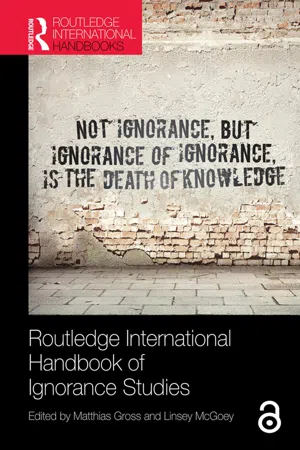
Once treated as the absence of knowledge, ignorance today has become a highly influential topic in its own right, commanding growing attention across the natural and social sciences where a wide range of scholars have begun to explore the social life and political issues involved in the distribution and strategic use of not knowing. The field is growing fast and this handbook reflects this interdisciplinary field of study by drawing contributions from economics, sociology, history, philosophy, cultural studies, anthropology, feminist studies, and related fields in order to serve as a seminal guide to the political, legal and social uses of ignorance in social and political life.
eBook - ePub
Routledge International Handbook of Ignorance Studies
- 408 pages
- English
- ePUB (mobile friendly)
- Available on iOS & Android
eBook - ePub
Routledge International Handbook of Ignorance Studies
About this book
Information
1
Introduction
New knowledge always leads to new horizons of what is unknown. New knowledge unsettles the contours of individual and collective understanding; it perturbs more than it settles, engendering fresh debate over the appropriate way to respond to sudden or incremental awareness of earlier unknowns: how to respond; when to respond; who may respond; who should respond but is incapacitated from doing so. New knowledge is never complete knowledge. Especially in today’s so-called risk, information, or knowledge societies, where sophisticated means of controlling or at least assessing the possibilities of loss or injury are developed via risk assessments, and where the acquisition of knowledge is viewed as an epoch-defining aspect of the current era, the unknown is not diminished by new discoveries. Quite the contrary: the realm of the unknown is magnified. This in turn raises questions about how to cope with growing ignorance, on new possibilities for shielding knowledge from others, and on what really needs to be known. It also illuminates how not knowing can be an important resource for successful action.
Consequently, over the last decade or so, the terrain of ignorance studies has developed into a dynamic field that has forged links across many disciplines. A wide range of scholars have begun to explore the social life and political issues involved in the distribution and strategic uses of not knowing. To note just a few examples, they have explored the potentially misleading role of risk assessments when clear knowledge about probabilities and outcomes are not available (cf. Stirling 2007) and the usefulness of feigned or willful ignorance in efforts to deny knowledge of unsettling information (cf. Cohen 2001; Stocking and Holstein 2009). Similarly, a growing number of economists and political scientists have begun to criticize the rational approach to institutions as insufficient for understanding the complexity of behavior. Sometimes the only rational decision is based on chance, which is the opposite of what Jon Elster (1989) once called hyperrationality, that is, “the failure to recognize the failure of rational choice theory to yield unique prescriptions and predictions” (Elster 1989: 17). A number of economists have started to realize and to study the importance of decision-making under situations of ignorance (cf. Caplan 2001; Faber and Proops 1990; van der Weele 2014). After all, decision-making in such circumstances requires the realization that the limits of rationality need to be acknowledged rationally. In this way, making decisions based on nonknowledge would not be irresponsible but fully justifiable as the only rational solution (cf. Bleicher 2012; Gross 2015; Heidbrink 2013). This Handbook reflects these interdisciplinary approaches by drawing contributions from economics, sociology, the neurosciences, philosophy, anthropology, and feminist studies in order to serve as a seminal guide to the uses of ignorance in social and political life.
The positive aspects of not knowing can, for instance, be illustrated with the notion of experiment in everyday life (cf. Gross 2010; Marres 2012; Overdevest et al. 2010). An experiment can be established with the explicit aim to generate unexpected events (cf. Rheinberger 1997). The surprising effects derived from this set-up can be seen as the driver behind the production of new knowledge, not least because surprises help the experimenter to become aware of her or his so far unperceived ignorance (unknown unknowns or forgotten unknowns).
Indeed, in certain experimental designs, the deliberate use of ignorance is deemed a vital step in ensuring the robustness of results. The double-blind randomized controlled trial (RCT) is the paradigmatic example of the belief that fostering “intentional ignorance” through blinding mechanisms is essential for improving experimental objectivity (Kaptchuk 1998). Given that the acknowledgement and the specification of ignorance in the form of hypothesis-building needs to be seen as a crucial element in processes of experimentation, ignorance cannot be thought of simply as a negative phenomenon.
Over recent decades, scholars have empirically studied the instrumental value of ignorance, examining its relationship with other forms of partial or limited knowledge, such as organizational ambiguity and economic uncertainty (Best 2012; Downer 2011). They have also highlighted the ways that willful ignorance can be a commendable stance in societies that place necessary brakes on their own will to knowledge. Such ignorance is an imperative, for example, within medical ethics, where physicians, patients, philosophers, and jurors argue that remaining ignorant of particular disease aetiologies and possible treatments is more morally acceptable than exploiting an individual’s life or privacy through unethical means.
The moral duty to forego the possibility of obtaining new knowledge when the only way to achieve new information is through compromising human safety and the right to life was enshrined in ethical principles such as the Nuremburg Code, and reiterated since in many national legislative codes. And yet, like most ethical principles, the medical duty not to harm is breached regularly. Occasionally, this leads individuals at ethical review committees such as Institutional Review Boards (IRBs) to develop a sort of defensive ignorance, willing themselves not to see the ways that ethical guideless are politically and commercially malleable in practice (Heimer 2012; Simpson et al. 2014).
A similar tension exists in the courtroom. At least since the fifteenth century, Justitia, the Roman goddess of justice, is regularly depicted wearing a blindfold, underscoring the modern belief that impartiality and fairness are contingent to a large extent on not seeing and not judging. In the courtroom, as Robert Proctor and Londa Schiebinger (2008: 24) point out, knowledge “is interestingly attached to bias, ignorance to balance.” And yet, much like the uneven and often opportunistic use and misuse of medical ethics, the principle of blind justice is something of an elusive, illusory goal. The power of its mythology diverts attention from the gulf between its ideal and its realization. In the United States, for example, as I. Bennett Capers writes, “what does it mean, connotatively and denotatively, for Justitia to be blind in a racialized society where colour is so determinative?” (Capers 2006: 4).
The belief that prejudice and exploitation can be remedied through professional ideals of legal objectivity or medical restraint might be seen as entirely commendable or simply innocuous if such principles were not themselves implicated in preventing their own self-realization. To what extent does the belief that justice is blind thwart recognition of the ways that legal decisions are highly subjective in practice? To what extent does adherence to “ceremonial” forms of medical compliance, such as ensuring signatures on informed consent forms, allow global structural injustices in medical exploitation to persist?
Hans-Georg Gadamer once suggested that “the fundamental prejudice of the Enlightenment is the prejudice against prejudice itself” (2004: 272). His comment points to a longstanding conceit of the Enlightenment period onwards: the idea that knowledge, when systematically produced through adherence to reliable methods of data collection or extraction, will inevitably trump superstition. That conceit dominates the social and physical sciences to this day. The belief that individuals are capable of suspending prejudice when making legal or medical decisions, or the belief that knowledge inevitably increases one’s political power or leverage: these are inheritances of an Enlightenment era marked by the assumption that prejudice can and should be tamed by making knowledge more universally accessible. But what about when people do not wish to know? What about when, through the principle of not seeing, certain groups are rendered more vulnerable, more at risk of exploitation or punishment by legal systems that purport to function free of prejudice? What is the role of ignorance in societies that hail the importance of knowledge even as we court ignorance in a myriad of ways, at once obvious and less apparent, pernicious and commendable in turn? Contributions in this handbook address those questions. Together, they suggest that in order to understand the limits of knowledge, we must increase our awareness of the ineradicable importance of ignorance.
The promise and perils of ignorance
A number of scholars, many working in the tradition of Georg Simmel’s (1906) debate on secrecies and secret societies, have explored the relationship between secrecy and the unknown. Recent empirical studies cover important terrain, such as Brian Balmer (2012) and Rebecca Lemov (2006) on secrecy in medicine and military strategies and operations; Claudia Aradau and Rens van Munster (2011) on military preparedness and the usefulness of contingency; Andrew Barry (2013) on the politics of transparency. Most recently, John Urry’s work on offshoring has illuminated the economic and political sphere of secret movements, relocation and concealment of funds as well as elaborate forms of secrecy via tax havens and the like (Urry 2014). This relates to Robert Proctor’s work (1995) on “agnotology,” or the cultural reproduction of ignorance, where he examines the ways that different industry groups, such as big tobacco, purposefully seek to foster doubt and non-knowledge about the effects of their products.
Although studies such as Proctor’s on cancer, Naomi Oreskes and Erik Conway’s (2010) on the tobacco industry and global warming, Sheldon Ungar’s (2008) on scientific illiteracy, Urry’s (2014) on financial concealments, or Riley Dunlap’s (2013) research on climate skeptics can alert us to the mongering of doubt for commercial gain, they easily tend to amplify a normative stance against commercially or politically generated forms of secrecy and uncertainty. Worse, they tend to ignore alternative ways of viewing the world by implying that an emphasis on uncertainty is somehow “anti-science” or unquestionably driven by commercial or ideological objectives. Or, as Scott Frickel and Michelle Edwards put it most succinctly: “While politically important, these studies tend to utilize a conspiratorial logic that ties the production of ignorance to the specific political, economic, or professional interests of powerful organizations and individuals intent on keeping certain research results private” (2014: 216).
Frickel and Edwards sum up these streams of studies on science as follows: “Apart from being empirically shortsighted, this narrow conceptualization is problematic because it is based on the misguided and nominally functionalist assumption that [ . . . ] the production of ignorance results from deviant science” (2014: 217). However indirectly, such studies also imply that increasing public transparency will inevitably help minimize the development and deployment of “deviant” science, and thereby reduce scientific ignorance. Such a notion fails to appreciate what scholars such as Michael Smithson (1989) and Stuart Firestein (2012) have long stressed: that ignorance is an inevitable and often positive feature of scientific productivity (see also Boudia and Jas 2014; Croissant 2014; Rescher 2009; Vitek and Jackson 2008; Walton 1996; Wehling 2015).
In this handbook, we move one step further and show that ignorance needs to be understood and theorized as a regular feature of decision-making in general, in social interactions and in everyday communication. In many areas of social life, individuals often need to act in spite of (sometimes) well-defined ignorance, or what has more recently been termed nonknowledge – the possibility of becoming knowledgeable about the specifics of one’s own ignorance (Gross 2010). Nor, we suggest, should ignorance be viewed as uniquely useful or profitable for the powerful. Rather, the deployment of ignorance can be an emancipatory act, skirting oppressive or demeaning demands for knowledge disclosure, such as the expectation that one should disclose one’s sexual orientation (McGoey 2014; Sedgwick 1990). Feigned ignorance can also be an indispensable tool of dissimulation for overburdened workers, enabling them to carve out a space for autonomy and creativity in the workplace (Scott 1985).
Our suggestion – to view ignorance as “regular” rather than deviant – is based on the insight that human decision-making is always positioned on the boundary between knowledge and its flipside. In other words, human existence per se is a matter of constantly negotiating, calculating, or playfully experimenting with what is known and what is not known. Thus, following Simmel’s classic thread, in addition to knowledge, it is important to understand the complex interweavings of what is known and what is not known if we wish to grasp the quality, the depth, and the nuances of social life in general.
The regularity of ignorance
Early work by feminist and postcolonial theorists of ignorance comes closest to exemplifying the situational and “regular” character of ignorance that we wish to emphasize. Linda Alcoff offers a useful analysis of this early work in Shannon Sullivan and Nancy Tuana’s Race and Epistemologies of Ignorance (2007), an edited volume that has played an integral role in shaping the field of ignorance studies (cf. Townley 2011). Building on work by Lorraine Code, Sandra Harding and Charles Mills, Alcoff points out that ignorance is an inevitable consequence of the “general fact” of our situatedness as knowers. Given what Alcoff describes as the “nonfungible nature of knowers,” or the bounded nature of our individual perceptual frameworks, our assumptions need to be situated within an understanding of the epistemic geography from which we speak. Alcoff and Code, like Harding, do not believe that acknowledging the situated nature of our knowledge and ignorance inevitably implies that one must possess a relativist ontology of truth. Rather, by taking into account the location of a speaker – by deliberately acknowledging their limitations as knowers – one increases, rather than decreases, the ability of others to evaluate the objectivity of their knowledge claims. In Code’s phrasing, “objectivity requires taking subjectivity into account” (Code, 1995: 44, quoted in Alcoff 2007: 41).
An important stream of this research is centered on the interplay between subjectivity and objectivity that feminist scholars are at the forefront of illuminating. Will acknowledging what w...
Table of contents
- Cover
- Half Title
- Series Page
- Title Page
- Copyright Page
- Contents
- List of illustrations
- Acknowledgements
- Notes on contributors
- 1 Introduction
- PART I Historical treatments of ignorance in philosophy, literature and the human sciences
- PART II Registering the unknown: Ignorance as methodology
- PART III Valuing and managing the unknown in science, technology and medicine
- PART IV Power and ignorance: Oppression, emancipation and shifting subjectivities
- PART V Ignorance in economic theory, risk management and security studies
- Index
Trusted by 375,005 students
Access to over 1.5 million titles for a fair monthly price.
Study more efficiently using our study tools.
Frequently asked questions
Yes, you can cancel anytime from the Subscription tab in your account settings on the Perlego website. Your subscription will stay active until the end of your current billing period. Learn how to cancel your subscription
No, books cannot be downloaded as external files, such as PDFs, for use outside of Perlego. However, you can download books within the Perlego app for offline reading on mobile or tablet. Learn how to download books offline
Perlego offers two plans: Essential and Complete
- Essential is ideal for learners and professionals who enjoy exploring a wide range of subjects. Access the Essential Library with 800,000+ trusted titles and best-sellers across business, personal growth, and the humanities. Includes unlimited reading time and Standard Read Aloud voice.
- Complete: Perfect for advanced learners and researchers needing full, unrestricted access. Unlock 1.5M+ books across hundreds of subjects, including academic and specialized titles. The Complete Plan also includes advanced features like Premium Read Aloud and Research Assistant.
We are an online textbook subscription service, where you can get access to an entire online library for less than the price of a single book per month. With over 1.5 million books across 990+ topics, we’ve got you covered! Learn about our mission
Look out for the read-aloud symbol on your next book to see if you can listen to it. The read-aloud tool reads text aloud for you, highlighting the text as it is being read. You can pause it, speed it up and slow it down. Learn more about Read Aloud
Yes! You can use the Perlego app on both iOS and Android devices to read anytime, anywhere — even offline. Perfect for commutes or when you’re on the go.
Please note we cannot support devices running on iOS 13 and Android 7 or earlier. Learn more about using the app
Please note we cannot support devices running on iOS 13 and Android 7 or earlier. Learn more about using the app
Yes, you can access Routledge International Handbook of Ignorance Studies by Matthias Gross, Linsey McGoey, Matthias Gross,Linsey McGoey in PDF and/or ePUB format, as well as other popular books in Social Sciences & Sociology. We have over 1.5 million books available in our catalogue for you to explore.