![]()
Chapter 1
Principles of rock slope design
1.1Introduction
A variety of engineering activities requires excavation of rock cuts. In civil engineering, projects include transportation systems such as highways and railways, dams for power production and water supply, and industrial and urban development. The design of rock cuts, and their excavation and stability are closely related to site geological conditions that may vary from strong, blocky rock containing well-defined discontinuities, to weak, highly weathered rock in which the remnant discontinuities, if any, have little influence on stability. Between these two extremes, a wide spectrum of conditions exists that must be quantified and incorporated appropriately into the design.
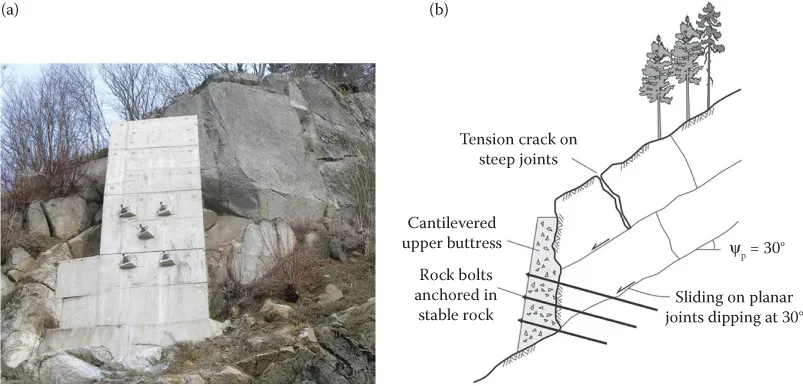
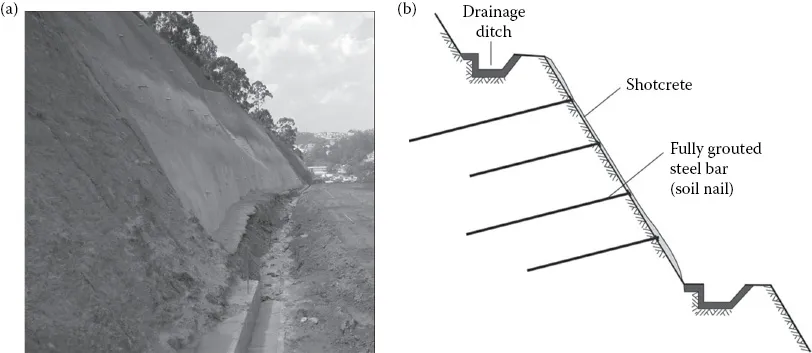
Figures 1.1 and 1.2 show contrasting examples of rock slopes with respect to rock strength and structural geology.
Figure 1.1Rock slope in very strong granite in which upper blocks of rock can slide from right to left on planar joints dipping at about 30° (near Agassiz, British Columbia, Canada). (a) Concrete buttress and tie-back anchors; (b) slope geometry showing dimensions of sliding blocks, bolt lengths and buttress configuration (Gygax Engineering).
Figure 1.2Excavated slope at 56° in highly weathered rock for highway construction: (a) image showing reinforcement of slope with soil nails and shotcrete (Sao Paulo, Brazil); (b) layout of soil nails in slope face.
In Figure 1.1, the rock is a very strong, blocky granite containing a set of high-persistence, planar joints dipping from right to left at about 30°. Movement of blocks of rock on these smooth, planar joints had opened tension cracks on a steeply dipping orthogonal joint set. Previous instability in this area had occurred with no warning because only a few millimetres of movement was required for the shear strength on the smooth joints to be reduced from peak to residual. Stabilization of the slope involved the construction of a reinforced concrete buttress with the lower part secured with tensioned rock anchors to stable rock below the sliding plane, and the upper part acting as a cantilever to support the sliding blocks.
Figure 1.2 shows an excavated face at an angle of 56° in highly weathered schist with a portion of the face reinforced with soil nails (steel dowels fully embedded in cement grout) on a 2-m square pattern and covered with a 100-mm (4 in.)-thick layer of reinforced shotcrete. The bolt lengths alternate between 5 and 6 m (16–20 ft) to avoid creating a potential plane of weakness at the end of the bolts that would occur if they were all the same length.
Other stabilization measures at this site include erosion control of this low-strength rock by installing lined ditches on each bench, and growing grass on the exposed rock faces.
In addition to man-made excavations, the stability of natural rock slopes in mountainous terrain may also be of concern. One of the factors that may influence the stability of natural rock slopes is the regional tectonic setting. For example, factors of safety of natural slopes may be only slightly greater than unity where rapid uplift of the land mass, and corresponding down cutting of the water courses, is occurring. Also, earthquake ground motions may loosen surficial rock and cause slope displacement. Such conditions exist in seismically active areas such as the Pacific Rim, the Himalayas and Central Asia.
The required stability conditions of rock slopes will vary depending on the type of project and the consequence of failure. For example, for cuts above a highway carrying high-traffic volumes, it will be important that both the overall slope be stable, and that few, if any, rock falls reach the traffic lanes. This will often require careful blasting during construction, and the installation of stabilization measures such as rock anchors. Because the useful life of such stabilization measures may be only 10–30 years, depending on the climate and...