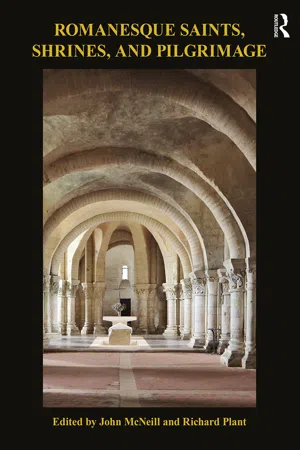
Romanesque Saints, Shrines, and Pilgrimage
- 308 pages
- English
- ePUB (mobile friendly)
- Available on iOS & Android
Romanesque Saints, Shrines, and Pilgrimage
About this book
The 23 chapters in this volume explore the material culture of sanctity in Latin Europe and the Mediterranean between c. 1000 and c. 1220, with a focus on the ways in which saints and relics were enshrined, celebrated, and displayed.
Reliquary cults were particularly important during the Romanesque period, both as a means of affirming or promoting identity and as a conduit for the divine. This book covers the geography of sainthood, the development of spaces for reliquary display, the distribution of saints across cities, the use of reliquaries to draw attention to the attributes, and the virtues or miracle-working character of particular saints. Individual essays range from case studies on Verona, Hildesheim, Trondheim and Limoges, the mausoleum of Lazarus at Autun, and the patronage of Mathilda of Canossa, to reflections on local pilgrimage, the deployment of saints as physical protectors, the use of imagery where possession of a saint was disputed, island sanctuaries, and the role of Templars and Hospitallers in the promotion of relics from the Holy Land.
This book will serve historians and archaeologists studying the Romanesque period, and those interested in material culture and religious practice in Latin Europe and the Mediterranean c.1000âc.1220.
Frequently asked questions
- Essential is ideal for learners and professionals who enjoy exploring a wide range of subjects. Access the Essential Library with 800,000+ trusted titles and best-sellers across business, personal growth, and the humanities. Includes unlimited reading time and Standard Read Aloud voice.
- Complete: Perfect for advanced learners and researchers needing full, unrestricted access. Unlock 1.4M+ books across hundreds of subjects, including academic and specialized titles. The Complete Plan also includes advanced features like Premium Read Aloud and Research Assistant.
Please note we cannot support devices running on iOS 13 and Android 7 or earlier. Learn more about using the app.
Information
Table of contents
- Cover
- Half Title
- Title
- Copyright
- Contents
- Notes on contributors
- Preface
- Colour plates
- The Lazarus mausoleum at Autun revisited
- A re-praesentatio of royal and holy bodies: the monumental tombs of Vienne cathedral in their liturgical settings
- Heribert and Anno II of Cologne: two saintly archbishops, their cult, and their Romanesque shrines
- The canonisation of Bernward and Godehard: Hildesheim as a cultural and artistic centre in the 12th and 13th centuries
- A garland of saints: Romanesque Verona and the evocation of Rome
- The geography of death: tombs of saints and nobles in the lands of the Canossas
- A satirical itinerary of holy bodies? Recommendations from the Pilgrimâs Guide
- The pilgrimage Church of St Martin at Tours: the building project of the treasurer HervĂ© (c. 1001â1022) and its context
- Saint Martial of Limoges and the making of a saint
- Local hero: St Eusice at Selles-sur-Cher
- Extra-mural developments: the eleventh-century reconstruction of St-Eutrope at Saintes
- Stone, image, body. Constructing the memory of saint Dionysius in Regensburg
- Byzantine echoes at the end of the eleventh century in the kingdom of Aragon: Sancho RamĂrez and the relics of saint Demetrius of Thessaloniki, fact or historiographic fiction?
- Inventing a new antiquity: the reliquary-altar depicting the martyrdom of saint Saturninus at Saint-Hilaire dâAude
- With faithful mind: the pilgrimage to Santo Domingo de Silos
- Bradanreolice, Burryholms, and Barry Island: saints, shrines, and pilgrimage centres in the Severn Estuary
- Leo on the margins? Reform, Romanesque, and the island monastery on Inishark Island, Ireland
- Three Hungarian shrines from 1083: canonisation, politics, and reform
- The royal and Christ-like martyr: constructing the cult of saint Olav 1030â1220
- The âForest of Symbolsâ on the Romanesque bronze doors at Gniezno Cathedral Church
- Images in the Bayeux tapestry and Rodes Bible: reliquaries, models, and meaning
- Templars, cults, and relics: the Cleveland reliquary of the True Cross
- Templars, Hospitallers, and Canons of the Holy Sepulchre on the way of Saint James: building at the service of lay spirituality
- Index