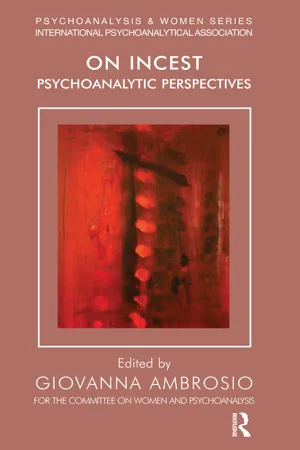
Incest is a universal taboo that is found throughout the history and mythology of the majority of societies. A neglected subject in more recent psychoanalytic work, this book was inspired by the COWAP European Conference of 2003. On Incest explores the theories and reasons behind incest, using themes such as gender identity and perversion. This fourth volume in the Psychoanalysis & Women Series for the Committee on Women and Psychoanalysis of the International Psychoanalytical Association contains papers from leading experts in the field. It includes the papers delivered at the conference, and two additional papers from Mariam Alizade and Brendan MacCarthy, who present their accounts of the discussions as they developed during the conference. The collection deals with a number of issues that surround incest, including Freud's work and how his outlook changed throughout the years; the post-Freudian theories; treatment of both offender and victim through traditional one-on-one and group therapy; the importance of the sex of the analyst; the permutations of the abuser/abused; and the "why" of incest.
- 140 pages
- English
- ePUB (mobile friendly)
- Available on iOS & Android
eBook - ePub
About this book
Information
Chapter One
Incest yesterday and today: from conflict to ambiguity1
Simona Argentieri
To which sphere of competence does incest belong? To the sphere of morality, of biology, of psychology, of legislation, of culture . . .? What is certain is that during the course of time and of history, sexual intercourse between blood relations has been the cause of reflection and debate on the part of censors, poets, scientists, ethnologists, sociologists, anthropologists, and psychoanalysts. The common starting point between so many disciplines is that the taboo on incest is universal, although articulated in many complicated variations regarding the degree of relationship; or perhaps—as Demause says—it is incest that is universal and consequently calls for prohibition. The first problem that we have to face, therefore, is taking into account all these different approaches while keeping a clear distinction between the methodologies.
We must also consider that the concept of incest is closely correlated with the equally multi-disciplinary concept of family. As the Dizionario di Sociologia (De Marchi, Ellena & Cattarinussi, 1987) says:
the nuclear family as a group of men, women and children is more or less universal on account of the great adaptive capacities of human beings. There are no linear evolutionary laws, but alternations, cycles; there is no ideal static model, but many variations.
From the sociological point of view, therefore, the irreducibility and the complexity of the phenomenon of family, together with all its biological, sexual, psychological, economic, religious, and political aspects, ensure that, because it is so apparently obvious, it is always the expression of both nature and culture and belongs contemporaneously to the public as well as to the private sphere. This partly explains its continuity in time, to the extent that in his Dizionario Sociologico, Gallino states that: “The survival, not the end, of the family appears to be necessary to the historic development of democracy”.
Incidentally, I think that the way in which we deal with the concept of family in psychoanalysis requires a certain amount of caution. Psychoanalysis is not—or at least should not be—”normative” about the family model. I believe that we must above all analyse what exists, what persists or changes, how it changes, and what the consequences are. Instead, there is a strong tendency in psychoanalysis, in my opinion, to construct patterns of relationships and models that are absolute; for example, by speaking of mother or father as fixed stereotypes and superim-posing levels of role, functions, and gender identity (Argentieri, 1988).
Regarding the problem of exogamy, in accordance with the view of many sociologists and in contrast with that of certain anthropologists, I think that it is strictly correlated with the problem of incest but cannot be superimposed on it. If the taboo prohibits sex between blood relations, then it is not only an exogamic rule; because exogamy, as well as prohibiting, prescribes the union outside of the family group. We cannot assume that the destructive effect of incest on the family is the reason for the prohibition; however, it is certain that incest disarticulates the symbolic network of family relations. (Even on this assumption there can be discussion, although to us as psychoanalysts it seems obvious. For example, some people wonder whether the contrary is not the case; i.e., it is the fact that the taboo exists that renders incest destructive.)
Theories on the taboo on incest
Let us begin by saying that up until now, no single theory has managed to definitely and exhaustively explain why the taboo on incest, even though in various forms, is universal. The quantity of theories that have been produced (about twenty accredited and many that are bizarre, to say the least) is already a clear indication of this. Even so, I think it would be useful to summarize them briefly.2
Biological theories
At the beginning of the last century Hobhouse, Wheeler, and Ginsberg (1915), Lowie (1920) and others considered the taboo itself to be of an instinctive nature. There would be a “natural” and inborn repulsion against sexual intercourse between relatives, as though in the genotype of our species there were a particular gene that produces a behavioural reaction against incest. This idea is not very convincing because, as Freud himself points out, it would not be necessary to threaten such harsh sanctions if the attraction were not so strong.
The eugenic hypothesis is less ingenuous and more substantial, stating that the taboo on incest is a “spontaneous” protection against the damage that can be caused by reproduction between relatives, both by the appearance of recessive hereditary diseases in the homozygosis, as well as for the loss of the advantages of heterozygosis (greater vitality, fertility, longevity, etc.). The eugenic hypotheses are reinforced by arguments from the worlds of animals (weakening through inbreeding) and of plants (Mendel speaks of the thriving characteristics of hybrids, while self-fecundation of plants is considered to be an involutionary process). Darwin says that nature “abhors continued self-fecundation”. But, in fact, the scientific elements supporting this are very recent; there are only about twenty hereditary genetic illnesses and the risk of the “taint” are relatively modest. On the other hand, the theories against incest date back to antiquity: from Aristotle, who predicted dire consequences for descent amongst blood relations, to the Romans, who were the first to codify its illegitimacy.
In summary, these observations are non-systematic and, above all, do not make any distinction between sex and reproduction. These hypotheses—typical “ad hoc theories”—are an example of the defensive use that we can sometimes make of biological expla-nations in order to support ideologies without having to justify them. This also occurs when “hygienic” justifications are sought for rationalizing rituals such as circumcision or food interdictions of a religious nature. Attempts to find confirmation in the world of the primates are just as deceptive. The theories of Darwin, and after him Freud, on the behaviour of the great African apes were simply wrong. As we are told today by ethologists, the social regulations of the apes, our ancestors, are in reality extremely variable (ranging from solitary animal to family groups, social group, “harem”, etc.) and the mother–child couple (pertaining, indeed, to all mammals) is such only until the maturity of the young. Nor can the so-called proto-taboo, that in other species assigns to particular differential signals (smell, song) the task of stimulating sexual attraction only between individuals of other groups, offer more than a generic suggestion to the world of human beings.
Bio-psychological theories
Westermark (1894) believes that, through natural selection, an instinctive lack of erotic attraction develops towards those with whom one has co-habited. This line of thought is followed also by Havelock Ellis (1906), Max Marcuse (1915), and Marvin Harris (1968), all of whom invoke a “bio-psychological” component of the taboo. On the whole, there are more descriptions—contradicted by the facts—than explanations. Moreover, as we have learned from psychoanalysis, there is a substantial difference between lack of attraction and abhorrence; while the distance is minimal between desire and repulsion. Starcke (1889) invoked the disrupting action of incest on the family, and Malinowski (1927) strongly proclaimed the effect of social chaos and the impossibility of transmitting culture from one generation to another. But these are circular propositions, with cause–effect connections that can be overturned; moreover, other family systems could be hypothesized (and, in fact, examples can always be found) that are “compatible” with incestuous practices. Thus, the problem is simply shifted from sexuality on to the family.
Socio-anthropological theories
We only need to make a passing reference to the strange hypothesis of McLennan (1865) according to which the shortage of women within the human horde would lead to the capture of wives from external hordes, and to the well-known theory of Durkheim (1898) that overturns the terms of the problem and considers the taboo a consequence of exogamy. According to this line of thought, totemism would be an obligatory phase of human evolution. The theories “of alliance and exchange” have their precursor in Saint Augustine, and—after Tylor (1888) and Fortune (1932), who emphasize the value of exogamy in promoting cooperation between different families, thus leaving aside the problem of sexuality—we come to the famous conceptualization of Lévi-Strauss that met with such success during the past decades.
The theory of Claude Lévi-Strauss is too complex and too well known for me to try to summarize it. For the purposes of our discourse, I will limit myself to recalling that he overcomes the functional concept and states that the taboo is an ontological category of the human spirit; in his comparison between “language” and exogamy, the prohibition to sexually use the daughter or sister obliges men to give them as wives to other men and, reciprocally, constitutes their own right to women. (As many feminists vehemently noted at the time, women were thus reduced to “gifts” or merely objects of desire or renunciation.) After the world-wide enthusiasm for the structuralism of the recent past, I do not think that his ideas represent for us today anything more than a brilliant metaphor. (We are also indebted to him for the theory on the weakening of desire on account of cohabitation, and I shall return to this theme later.)
The taboo on incest as myth
None of the theories that we have referred to is sufficient to account for the eternal problem of incest, and every one of them (thanks to the careful exploration of anthropologists such as Margaret Mead or Lucy Mair) can be confirmed or refuted according to the variety of human customs throughout time and space. Even the psychoanalytical hypothesis has an implicit conceptual and methodological weakness; we all admit this, beginning with Freud himself.
I do not intend to go through the various stages of Freudian thought, and his hope of being able to base on empirical data the hypothesis that culture is founded on instinctive renunciation, that the taboo is transmitted with onto-philogenetic linearity from generation to generation, and that it resurfaces in a symbolic form in dreams, in delusions and in the fantasies of any human being whatsoever. We can, however, reach a compromise by considering the history of the primitive parricidal and cannibalistic horde that transmits the taboo on incest, with its burden of anxiety and guilt, morality and religion, from one generation to another as a myth. This is suggested by Green (1992), who describes the myth in his own way as a kind of “collective transitional object”. Moreover, a long time before Green and before psychoanalysis, Sallustio wrote about myths: “These things never happened, but they always exist”.
Although we may renounce the “historic truth” of the murderous phratry, certain definite points of reference remain:
- the taboo on incest is universal, as is the violation of this prohibition;
- the family as a structure is also universal, although extremely variable, and within it incest as a taboo and as a violation assumes meaning.
External reality and internal reality
Statistics in a field as elusive as incest are always unreliable. To us, who are more attentive to the deep levels of meaning than to those of overt behaviour, they are of little use; and in our turn we can offer data that are enlightening but difficult to compare with those gathered through other methodologies. Having said this, we must take note of the fact that, according to those who have tried to translate the problem of incest into numbers, as far as I know in first place there is the incest of father with daughter, then brother with sister, brother with younger brother, father with son, and, last, mother with sons and daughters.
How do these statistical data change through time and in different cultures? It appears that progress in the rules of civil cohabitation has led to a decrease in the number of the coarser and more brutal cases of authoritarian, possessive fathers (in Italian, padre–padrone), but at the same time to an increase in cases of reporting to the authorities and of no longer keeping things hidden within the family (in Italian, omertà—family’s silent complicity). But probably other, more subtle, forms proliferate and continue to escape systematic enquiry.3 (The observations of Estela Welldon (1991) come to mind—to which I shall return later—about the widespread refusal to recognize the problem of incestuous tendencies in mothers.)
From my by now considerable clinical experience, both direct (analyses, psychotherapy, and consultations) and indirect (consultations and supervision of colleagues and students), I have been able to distinguish the following:
- dramatic cases of explicit and consummate incest over a long period of time, undergone by someone who has then come into analysis;
- cases of “soft” incest, masked as ambiguous bodily contacts (the most frequent) reported by those who have committed them and also by those who have been the victims;
- cases of pathological defensive solutions against inhibited incestuous drives and fantasies.
Certainly, from the ethical as well as the legal standpoint, there is a sharp distinction between victim and perpetrator, between sexual violence, plagiary, and abuse, and between someone who has materially carried out the sexual act and someone who has collusively facilitated it. But on the psychological plane, the situation is inevitably much more tormented and elusive. The paradox that differentiates the psychoanalytical approach from that of other disciplines is that, for us, it is very difficult—at least from the genetic viewpoint—to separate the person who is the passive partner from the person who is the active partner in the sexual act; in many cases the person who commits incest has in turn suffered it, and just as frequently the psychopathological distortions that are the cause of incest are spread throughout the whole family group and are the same distortions that the incest then determines in the victim.
For example, there is case of a woman who, in order to avoid the unwanted sexual attentions of her husband, sent him to sleep in their daughter’s room while keeping the younger son with her. Or that of two parents with strongly perverse traits and whose sexuality was characterized by hatred and inhibition, who—especially the mother who needed to enact split-off aspects of herself—encouraged incest between their son and their youngest daughter with the almost explicit message that this was common and “normal” behaviour.
Another dramatic clinical example was that of a consultation that unfortunately did not lead to a course of therapy. An attractive and intelligent girl aged twenty-four, with a degree in literature and who worked temporarily, had to continue living with her family: upper middle class, cultured, well-off, composed of father, mother, and a brother who was three years older, had interrupted his university studies, and was tyrannical and violent. The brother was systematically physically violent to her and beat her, especially at night, for futile and often non-existent motives. The father pretended not to see, and the mother rebuked her for provoking her brother and for risking upsetting her father if she complained to him. The maximum paradox was when their parents took them on holiday to hotels or holiday villages, and put them in the same bedroom. In the morning when the girl appeared covered in scratches and bruises, the mother would silence her with a glance in case it would look bad in front of the other guests. This young girl was apparently unaware of the sexual problem masked by the physical violence, of the confusion between sexual drives and aggressive sado-masochistic drives; and I am afraid that it was her unconscious complicity with the perverse family fabric that interrupted the analytic project.
We know that an essential turning point occurred in Freud’s thought when he understood that being seduced by a parent is a more or less ubiquitous fantasy in the child, and that only in certain single cases is this traumatic seduction experienced in reality.4 His most important intuition, however, was when he understood that both the fantasy and the real event could have the same pathogenic effect.5 Furthermore, we know that the same identical childhood dramas can produce both neurotic inhibitions as well as perverse forms of behaviour.
Another obviously important, but also elusive, fact is that of the age at which the incest is committed. In many cultures there is an initial, fairly long period of life during which children of both sexes can freely enjoy intimacy with their mother’s body (sometimes also with the father’s) without interdiction or conflict; until the time when cultural mores, or the father—if there are fathers—brusquely and peremptorily impose the caesura of separation. (The most impressive example is that of the Japanese tradition in which a little boy can live happily according to his own omnipotent whims or fancies until the age of seven; at that point the child is traumatically torn from intimacy with his mother and from the dimension of amae6 and is entrusted to a harsher discipline.) Perhaps it is this diffused habit of initial “privilege” that has given rise to the fantasy that a historic “pre-human” epoch existed in which incest was possible and pacific. Moreover, Freud observed that kings and queens, demons and gods were exempt from the prohibition of incest, owing to the principle of omnipotence.
The significance of the rule of detachment ...
Table of contents
- Cover
- Half Title
- Title
- Copyright
- Contents
- FOREWORD
- CONTRIBUTORS
- Introduction
- CHAPTER ONE Incest yesterday and today: from conflict to ambiguity
- CHAPTER TWO Incest(s) and the negation of otherness
- CHAPTER THREE Incest: the crushed fantasy
- CHAPTER FOUR Incest: a therapeutic challenge
- CHAPTER FIVE Incest: the damaged psychic flesh
- CHAPTER SIX Counterpoints
- REFERENCES
- BIBLIOGRAPHY
Trusted by 375,005 students
Access to over 1.5 million titles for a fair monthly price.
Study more efficiently using our study tools.
Frequently asked questions
Yes, you can cancel anytime from the Subscription tab in your account settings on the Perlego website. Your subscription will stay active until the end of your current billing period. Learn how to cancel your subscription
No, books cannot be downloaded as external files, such as PDFs, for use outside of Perlego. However, you can download books within the Perlego app for offline reading on mobile or tablet. Learn how to download books offline
Perlego offers two plans: Essential and Complete
- Essential is ideal for learners and professionals who enjoy exploring a wide range of subjects. Access the Essential Library with 800,000+ trusted titles and best-sellers across business, personal growth, and the humanities. Includes unlimited reading time and Standard Read Aloud voice.
- Complete: Perfect for advanced learners and researchers needing full, unrestricted access. Unlock 1.5M+ books across hundreds of subjects, including academic and specialized titles. The Complete Plan also includes advanced features like Premium Read Aloud and Research Assistant.
We are an online textbook subscription service, where you can get access to an entire online library for less than the price of a single book per month. With over 1.5 million books across 990+ topics, we’ve got you covered! Learn about our mission
Look out for the read-aloud symbol on your next book to see if you can listen to it. The read-aloud tool reads text aloud for you, highlighting the text as it is being read. You can pause it, speed it up and slow it down. Learn more about Read Aloud
Yes! You can use the Perlego app on both iOS and Android devices to read anytime, anywhere — even offline. Perfect for commutes or when you’re on the go.
Please note we cannot support devices running on iOS 13 and Android 7 or earlier. Learn more about using the app
Please note we cannot support devices running on iOS 13 and Android 7 or earlier. Learn more about using the app
Yes, you can access On Incest by Giovanna Ambrosio in PDF and/or ePUB format, as well as other popular books in Psychology & History & Theory in Psychology. We have over 1.5 million books available in our catalogue for you to explore.