- 144 pages
- English
- ePUB (mobile friendly)
- Available on iOS & Android
eBook - ePub
About this book
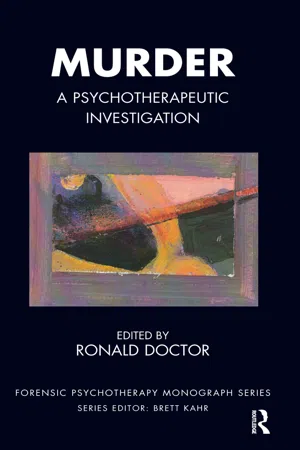
This book, a sequel to the edited book Dangerous Patients: A Psychodynamic Approach to Risk Assessment and Management, places the emphasis on working in psychodynamic psychotherapy with patients who have killed to gain a greater understanding of their internal world and object relationships.
Information
Chapter One
Life after death: a group for people who have killed
Gwen Adshead, Sarita Bose and Julia Cartwright
“No one interrupts when the murderers talk.”
Paul Celan, Wolfsbuhne (1959)
Introduction
A significant proportion of patients in forensic psychiatric hospitals are admitted because they have killed someone. Homicide is a rare event in the UK, with only 600 on average recorded each year in England and Wales. This figure has remained relatively constant over the last 30 years, since the abolition of capital punishment, implying that of the 60 million people who live together in the UK, fewer than 1000 will die each year as a result of murder by another.
Such rare events are inevitably complex and multi-determined. If we accept the psychoanalytic position that all of us (consciously and unconsciously) have murderous impulses that we can sometimes struggle to contain, then the question becomes: why is homicide so rare? Most of us will never kill anyone even though we have these murderous thoughts, so what made these people cross the line from fantasy to reality? There is an urgent need to find an answer to this question: for the therapist, the public, the perpetrator, and the victim’s family.
There is equally an urgent existential problem for the perpetrator: how do I live now that I have done this? How do I think about myself in relation to others? What identity can I let myself have? In this chapter we discuss how members of a psychodynamic group for people who have killed approach these questions. This group has been running for a year in a high security psychiatric hospital, as part of a centralized group work programme offering a range of different psychological group interventions for patients in the hospital.
Beyond words: a review of the literature on groups and homicide
All homicides occur within the context of a group (i.e. more than two people), be it the family, the gang, the community, or society. As such, an understanding of the group dynamics surrounding acts of homicide may help to answer the question of why some people kill. However, review of the offender treatment literature reveals a marked lack of published material on group work with homicide perpetrators. Instead, most of the published literature on group therapy and homicide is concerned with group therapy for those who have been bereaved by homicide.
Cox (1976) describes how the process of group psychotherapy provides an intense arena in which the forensic patient can be observed, as well as one in which psychodynamic change may occur. We might therefore expect group psychotherapy to be an important treatment modality in work with those who have killed, and question why such work is not routinely offered. One reason could be that society, as a large group, views victims as more deserving of help than perpetrators, and finds it easier to empathise with the victims than to be put in touch with its own murderousness. There may also be a belief that forensic populations in general are not amenable to group therapy. People who have killed a parent tend to isolate and alienate themselves within institutions, and this may be seen as a contraindication to group work (Hillbrand & Young, 2004). Stein and Brown (1991) argue that the personality characteristics of forensic patients inhibit group-mediated change, regardless of the patients’ diagnosis. From their observations of group psychotherapy in medium and minimum security settings, they conclude that psychic change was hindered by the inability of patients to form a cohesive group or to develop positive group dynamics such as altruism, trust, or a sense of universality. Finally, there may be an anxiety about what feelings might arise out of a pooling of homicidal experiences (Schlabopersky, 1996).
Another possible reason for the lack of published literature on group work with people who have killed (especially those who have killed someone close to them) is that the story to be written is essentially an incoherent one of contrasting identities. On the one hand, these people are homicide perpetrators, and this may be their own adopted defining identity (Hillbrand & Young, 2004). On the other hand, they are also victims of trauma, who have been suddenly and terribly bereaved. In a group context, they are people who are simultaneously fearsome perpetrators and traumatized victims. One of the tasks of group therapy is to integrate these two often polarized aspects of the group and its members, and to pose the question: how do you survive a disaster when you are the disaster?
Group work for survivors of homicide
Klein and Schermer (2000) define trauma as “an earth-shattering intrusion and disruption that is difficult to assimilate into ordinary consciousness and discourse”. The DSM diagnostic criteria for posttraumatic stress disorder (PTSD) include a defining criterion for traumatic events, namely that they include the experience of witnessing injury or death of another, and the experience of intense fear and helplessness (APA, 1994). Empirical study has shown that some traumatic events are psychologically so stressful that they overwhelm the individual’s capacity to manage his or her own distress, and result in psychiatric illnesses of various sorts, which require and respond to psychiatric treatment, including group therapy.
The capacity to overcome trauma is dependent upon a number of factors, including the experience of previous victimization, particularly in childhood (Adshead & van Velsen, 1996). A high proportion of patients within high secure settings have been the victims of childhood trauma (Coid, 1992) and are therefore potentially more vulnerable to the effects of further trauma. However, there is some debate as to whether doing violence to another person is traumatic in the sense described above. The DSM criteria would require evidence of intense fear and helplessness, which is not commonly described by perpetrators at the time of the offence. On the other hand, there is some limited evidence that killing another person is traumatic, especially if the killing takes place in a grotesque or socially unacceptable way, such as military atrocities (Haley, 1974), or if the victim is psychologically important to the perpetrator (Papanastassiou et al, 2004). Perpetrators of homicide can develop PTSD, pathological grief and clinical depression in relation to their offences, and will require treatment for these conditions.
Most information on the psychological needs of those traumatized and bereaved by homicide comes from the study of secondary victims of homicide, i.e. parents, partners, siblings and children of those who have been killed. Rynearson (2001) describes the reactions of family members to a violent death, and suggests that a particular problem for survivors is that their story is an incoherent one which cannot contain the simultaneous drama of killing and caring. He describes three phases of the distress response in those traumatized by a violent death. The first response is avoidance, where the death is acknowledged but grief and distress are denied. This is then followed by a conflict between trauma distress, which is associated with intrusive re-enactment fantasies and fear, and separation distress, which is associated with longing and searching. Rynearson describes the value of group therapy for those bereaved by homicide, emphasizing the therapeutic effects of universality, altruism, vicarious learning and cohesiveness for people who are both grieving and frightened.
Brunning (1982) comments on the similarity of psychological responses between those who have killed and those who have been bereaved by a killing. In describing a group he ran for male prisoners who had killed someone close to them, he reported that the men went through an initial stage of disbelief, reliving the trial “in the manner of the bereaved who go through repeated circumstantial accounts”. He also described a denial phase, where the victim is thought of as being still alive, and a depressive phase characterized by social withdrawal and an unwillingness to identify with other prisoners. He found, however, that cohesiveness was stronger in this group than in other groups he had conducted, although it was slower to develop. Similarly, Hillbrand and Young (2004) have described how, in a psychodynamic group intervention for psychiatric patients who had killed their parents, members of the group benefited from the therapeutic effects of universality and the instillation of hope, and did experience meaningful group-mediated change, especially a reduction in feelings of alienation.
Garland (2003) has written about the impairment of fantasy and symbol formation in traumatized individuals. Fantasy and symbol formation are crucial steps in the regulation and modulation of negative feelings, because they are part of the unconscious cognitive processes whereby emotions (which are largely unconscious) are transformed into conscious feelings (Damasio, 2000). This transformation takes place at the boundary between the internal reality of the individual and the external reality of the group(s) to which he or she belongs. Thus symbolic capacity is an essential feature of the total capacity both to monitor reality and to manage negative emotions by transforming them from the unspeakable into something that can be communicated in the external world. If, as Garland suggests, trauma impairs symbolic capacity, then this should result in trauma survivors experiencing memory problems and communication problems; this is in fact the case. Trauma survivors do experience real problems in putting their experiences into words, and do struggle with unregulated memories and emotions, especially fear and anger. These are the symptoms which are therefore likely to be present in any traumatized group of people and may make the group process more complicated to manage. In such patients, failure of symbolization and an inability to express their feelings in words leads to the acting out of violent impulses and the enacting “on an external stage what takes place internally in the mind of everyone” (Foulkes, 1990).
Klein and Schermer (2000) have written about the countertransference responses of therapists working with groups of traumatized people. He described such countertransference as being on a continuum between primarily irrational personal conflict in the analyst and a sense of disruption and turmoil that would be normative and expected, particularly as the therapist becomes a “witness” of recollected and re-enacted catastrophic events, and experiences “vicarious traumatization” and vicarious grief. Ideally, the therapist should be able to “work with” rather than “detach from” his or her countertransference feelings and to sustain a sense of being alive through the experience, thus surviving and transcending the inner trauma whilst manifesting the ability to contain his or her own and the group’s emotionality. This requires a “sensitive navigation between internal containment through self-reflection and genuine emotional experience judiciously self-disclosed”. Unsurprisingly, Schermer has highlighted the importance of a co-therapist and/or experienced supervisor when working with traumatized groups.
Homicide and group analysis: "killing in the group, of the group, by the group . . . including the conductor"
This famous quote by Foulkes about group process has been crucial for us in understanding the dynamics of a group for men who have killed. As described above, we can understand the group members as people who have been traumatized and bereaved, and appreciate how this affects the group process. We also have to keep in mind that the group members are also perpetrators of cruelty and destructiveness, and this experience is also likely to be manifested in the group process in recognisable ways.
Killing in the group
Rage, anger and hostility are common factors in all therapy groups, but the conscious expression of such aggressive feelings is often defended against (Ormont, 1984). Group members may cover their hostility towards each other (or the conductor) with silence, intellectualisation, or by indirect manifestations of rage such as withdrawal or distress. In patients whose extreme rage has once been enacted in the form of taking a life, there may be a justifiable fear that to experience rage will result in killing whoever provoked it.
Rage towards other group members, and particularly towards the therapist, may be enacted within the group by ignoring the therapist or by non-attendance. New members generate rage in the form of sibling rivalry with the new “baby” who joins a family. Therapist absences provoke the rage of rejection, abandonment, deprivation and jealousy. The therapist’s role is to help these patients find words for their rage, and guide the group into helping its members elaborate their feelings, uncouple them from actions, and thereby give access to real emotions which, once contained and expressed in the reflective language of feelings, can be understood and resolved (Ormont, 1984).
Killing of the group
Nitsun (1996) formulated the concept of the “anti-group” to describe the destructive aspect of groups which threatens the integrity of the group and its therapeutic development. The anti-group may be located within a particular group member who may, for example, drop out of the group, having been unconsciously selected by the group to enact the group’s rage. Alternatively, the anti-group may be located in the wider institution, and may be expressed as attempts to sabotage the running of the group.
Nitsun saw the anti-group as being constructed of the fantasies and projections of its members. The early group, because it is not yet an integrated unit, is seen as a weak or dangerous container, which provokes anxiety and attack. This attack further weakens and fragments the group, which invites attack, and so a vicious circle begins. The ultimate expression of the anti-group is to destroy the group, but this rarely happens as there is often sufficient good projected onto the group to counteract the destructive forces.
Killing by the group
Outside war, killing by groups occurs most often in the context of the gang. Williams (1998) describes the dynamics of gang structure as authoritarian, strictly stratified into a pecking order, and based on power principles. Gangs are often made up of individuals who feel mistreated by others and have little sense of responsibility or connection to wider society. The gang thus constitutes an “in-group” which views society as the “out-group”, which is both adversarial and persecutory. The humanity of members of the “out-group” is denied, allowing brutality to take place. Gangs regulate negative feelings almost entirely by projecting them into an “other” (“out-groups”, rival gangs or victims), and then destroying them. Any expressed feelings of compassion, conscience or a tendency to compromise with others are regarded as a threat to the security of the gang, and are dealt with harshly and often violently. In a study of gang homicides, Decker and Curry (2002) found that homicides occurred more often within gang factions than between them. By killing “weaker” group members in this way, the group maintains cohesion at the expense of coherence (Adshead, 2002).
Including the conductor
Working with groups for people who have killed necessitates regular supervision and attention to the strong countertransference that can be evoked. The members of the group have at least on one occasion acted out the universal fantasy of fatal destruction, and if serious destructive behaviour has occurred once, there is no theoretical reason why it should not occur again (Cox, 1976). The therapist may not only fear further destructive acting out by the group, he or she may also be put in touch with his or her own murderous feelings. These may then manifest as a wish to kill off the group. Murderousness in the therapist may also manifest itself as a reaction formation, with extreme attachment to group members, denial of their capacity for cruelty, and attacks on anyone who appears to threaten the group (Lanza, 1999).
The therapist has to work with this discomfort, and be prepared to relinquish the defences that usually make working with offenders in prisons or secure hospitals survivable for the majority of staff (McClure, 2004). Such groups are therefore potentially exhausting for the therapist, and exacerbate the vicarious traumatization described above. Understanding both positive and negative feelings towards the patients has been an essential part of the supervision space.
Restorative justice: uniting the victim and the perpetrator
I...
Table of contents
- Cover
- Half Title
- Title
- Copyright
- Contents
- ACKNOWLEDGEMENTS
- SERIES FOREWORD
- EDITOR AND CONTRIBUTORS
- FOREWORD
- Introduction
- CHAPTER ONE Life after death: a group for people who have killed
- CHAPTER TWO Murder: persecuted by jealousy
- CHAPTER THREE Women who kill: when fantasy becomes reality
- CHAPTER FOUR Killing off the shadow: the role of projective identification in murderous acts
- CHAPTER FIVE The history of murder
- CHAPTER SIX The dog that didn't bark: a mild man's murderousness
- REFERENCES
- INDEX
Trusted by 375,005 students
Access to over 1.5 million titles for a fair monthly price.
Study more efficiently using our study tools.
Frequently asked questions
Yes, you can cancel anytime from the Subscription tab in your account settings on the Perlego website. Your subscription will stay active until the end of your current billing period. Learn how to cancel your subscription
No, books cannot be downloaded as external files, such as PDFs, for use outside of Perlego. However, you can download books within the Perlego app for offline reading on mobile or tablet. Learn how to download books offline
Perlego offers two plans: Essential and Complete
- Essential is ideal for learners and professionals who enjoy exploring a wide range of subjects. Access the Essential Library with 800,000+ trusted titles and best-sellers across business, personal growth, and the humanities. Includes unlimited reading time and Standard Read Aloud voice.
- Complete: Perfect for advanced learners and researchers needing full, unrestricted access. Unlock 1.5M+ books across hundreds of subjects, including academic and specialized titles. The Complete Plan also includes advanced features like Premium Read Aloud and Research Assistant.
We are an online textbook subscription service, where you can get access to an entire online library for less than the price of a single book per month. With over 1.5 million books across 990+ topics, we’ve got you covered! Learn about our mission
Look out for the read-aloud symbol on your next book to see if you can listen to it. The read-aloud tool reads text aloud for you, highlighting the text as it is being read. You can pause it, speed it up and slow it down. Learn more about Read Aloud
Yes! You can use the Perlego app on both iOS and Android devices to read anytime, anywhere — even offline. Perfect for commutes or when you’re on the go.
Please note we cannot support devices running on iOS 13 and Android 7 or earlier. Learn more about using the app
Please note we cannot support devices running on iOS 13 and Android 7 or earlier. Learn more about using the app
Yes, you can access Murder by Ronald Doctor in PDF and/or ePUB format, as well as other popular books in Psychology & Forensic Psychology. We have over 1.5 million books available in our catalogue for you to explore.