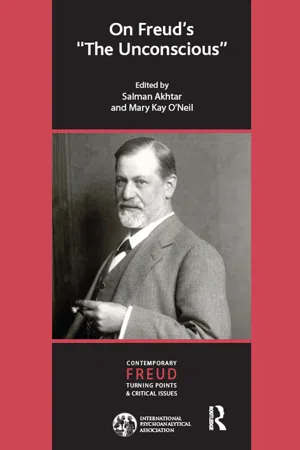
If there ever was one word that could represent the essence of Freud's work, that word would be 'unconscious'. Indeed, Freud himself regarded his 1915 paper 'The Unconscious' as central to clarifying the fundamentals of his metapsychology. The paper delineates the topographic model of the mind and spells out the concepts of primary and secondary process thinking, thing and word presentations, timelessness of the unconscious, condensation and symbolism, unconscious problem solving, and the relationship between the system Ucs and repression. Examining these proposals in the light of contemporary psychoanalytic theory as well as from the perspective of current neurophysiology and ethology, nine distinguished analysts take Freud's ideas further in ways that have implications for both psychoanalytic theory and practice.
- 320 pages
- English
- ePUB (mobile friendly)
- Available on iOS & Android
eBook - ePub
On Freud's The Unconscious
About this book
Information
PART I
“The unconscious” (1915e)
EDITOR’S NOTE
DAS UNBEWUSSTE
(a) GERMAN EDITIONS:
1915 Int. Z. Psychoanol., 3 (4), 189–203 and (5), 257–69.
1918 S.K.S.N., 4, 294–338. (1922, 2nd ed.)
1924 G.S., 5, 480–519.
1924 Technik und Metapsychol., 202–41.
1931 Theoretische Schriften, 98–140.
1946 G.W., 10, 264–303.
(b) ENGLISH TRANSLATION:
‘The Unconscious’
1925 C.P., 4, 98–136. (Tr. C. M. Baines.)
The present translation, though based on that of 1925, has been very largely rewritten.
This paper seems to have taken less than three weeks to write—from April 4 to April 23, 1915. It was published in the Internationale Zeitschrift later in the same year in two instalments, the first containing Sections I–IV, and the second Sections V–VII. In the editions before 1924 the paper was not divided into sections, but what are now the section-headings were printed as side-headings in the margin. The only exception to this is that the words ‘The Topographical Point of View’, which are now part of the heading to Section II, were originally in the margin at the beginning of the second paragraph of the section at the words ‘Proceeding now …’ (p. 172). A few minor changes were also made in the text in the 1924 edition.
If the series of ‘Papers on Metapsychology’ may perhaps be regarded as the most important of all Freud’s theoretical writings, there can be no doubt that the present essay on ‘The Unconscious’ is the culmination of that series.
The concept of there being unconscious mental processes is of course one that is fundamental to psycho-analytic theory. Freud was never tired of insisting upon the arguments in support of it and combating the objections to it. Indeed, the very last unfinished scrap of his theoretical writing, the fragment written by him in 1938 to which he gave the English title ‘Some Elementary Lessons in Psycho-Analysis’ (1940b), is a fresh vindication of that concept.
It should be made clear at once, however, that Freud’s interest in the assumption was never a philosophical one—though, no doubt, philosophical problems inevitably lay just round the corner. His interest was a practical one. He found that without making that assumption he was unable to explain or even to describe a large variety of phenomena which he came across. By making it, on the other hand, he found the way open to an immensely fertile region of fresh knowledge.
In his early days and in his nearest environment there can have been no great resistance to the idea. His immediate teachers—Meynert, for instance1—in so far as they were interested in psychology, were governed chiefly by the views of J. F. Herbart (1776–1841), and it seems that a text-book embodying the Herbartian principles was in use at Freud’s secondary school (Jones, 1953, 409 f.). A recognition of the existence of unconscious mental processes played an essential part in Herbart’s system. In spite of this, however, Freud did not immediately adopt the hypothesis in the earliest stages of his psychopathological researches. He seems from the first, it is true, to have felt the force of the argument on which stress is laid in the opening pages of the present paper—the argument, that is, that to restrict mental events to those that are conscious and to intersperse them with purely physical, neural events ‘disrupts psychical continuities’ and introduces unintelligible gaps into the chain of observed phenomena. But there were two ways in which this difficulty could be met. We might disregard the physical events and adopt the hypothesis that the gaps are filled with unconscious mental ones; but, on the other hand, we might disregard the conscious mental events and construct a purely physical chain, without any breaks in it, which would cover all the facts of observation. To Freud, whose early scientific career had been entirely concerned with physiology, this second possibility was at first irresistibly attractive. The attraction was no doubt strengthened by the views of Hughlings-Jackson, of whose work he showed his admiration in his monograph on aphasia (1891b), a relevant passage from which will be found below in Appendix B (p. 206). The neurological method of describing psychopathological phenomena was accordingly the one which Freud began by adopting, and all his writings of the Breuer period are professedly based on that method. He became intellectually fascinated by the possibility of constructing a ‘psychology’ out of purely neurological ingredients, and devoted many months in the year 1895 to accomplishing the feat. Thus on April 27 of that year (Freud, 1950a, Letter 23) he wrote to Fliess: ‘I am so deep in the “Psychology for Neurologists” that it quite consumes me, till I have to break off really overworked. I have never been so intensely preoccupied by anything. And will anything come of it? I hope so, but the going is hard and slow.’ Something did come of it many months later—the torso which we know as the ‘Project for a Scientific Psychology’, despatched to Fliess in September and October, 1895. This astonishing production purports to describe and explain the whole range of human behaviour, normal and pathological, by means of a complicated manipulation of two material entities—the neurone and ‘quantity in a condition of flow’, an unspecified physical or chemical energy. The need for postulating any unconscious mental processes was in this way entirely avoided: the chain of physical events was unbroken and complete.
There were no doubt many reasons why the ‘Project’ was never finished and why the whole line of thought behind it was before long abandoned. But the principal reason was that Freud the neurologist was being overtaken and displaced by Freud the psychologist: it became more and more obvious that even the elaborate machinery of the neuronic systems was far too cumbersome and coarse to deal with the subtleties which were being brought to light by ‘psychological analysis’ and which could only be accounted for in the language of mental processes. A displacement of Freud’s interest had in fact been very gradually taking place. Already at the time of the publication of the Aphasia his treatment of the case of Frau Emmy von N. lay two or three years behind him, and her case history was written more than a year before the ‘Project’. It is in a footnote to that case history (Standard Ed., 2, 76) that his first published use of the term ‘the unconscious’ is to be found; and though the ostensible theory underlying his share in the Studies on Hysteria (1895d) might be a neurological one, psychology, and with it the necessity for unconscious mental processes, was steadily creeping in. Indeed, the whole basis of the repression theory of hysteria, and of the cathartic method of treatment, cried out for a psychological explanation, and it was only by the most contorted efforts that they had been accounted for neurologically in Part II of the ‘Project’.1 A few years later, in The Interpretation of Dreams (1900a), a strange transformation had occurred: not only had the neurological account of psychology completely disappeared, but much of what Freud had written in the ‘Project’ in terms of the nervous system now turned out to be valid and far more intelligible when translated into mental terms. The unconscious was established once and for all.
But, it must be repeated, what Freud established was no mere metaphysical entity. What he did in Chapter VII of The Interpretation of Dreams was, as it were, to clothe the metaphysical entity in flesh and blood. He showed for the first time what the unconscious was like, how it worked, how it differed from other parts of the mind, and what were its reciprocal relations with them. It was to these discoveries that he returned, amplifying and deepening them, in the paper which follows.
At an earlier stage, however, it had become evident that the term ‘unconscious’ was an ambiguous one. Three years previously, in the paper which he wrote in English for the Society for Psychical Research (1912g), and which is in many ways a preliminary to the present paper, he had carefully investigated these ambiguities, and had differentiated between the ‘descriptive’, ‘dynamic’ and ‘systematic’ uses of the word. He repeats the distinctions in Section II of this paper (p. 172 ff.), though in a slightly different form; and he came back to them again in Chapter I of The Ego and the Id (1923b) and, at even greater length, in Lecture XXXI of the New Introductory Lectures (1933a). The untidy way in which the contrast between ‘conscious’ and ‘unconscious’ fits the differences between the various systems of the mind is already stated clearly below (p. 192); but the whole position was only brought into perspective when in The Ego and the Id Freud introduced a new structural picture of the mind. In spite, however, of the unsatisfactory operation of the criterion ‘conscious or unconscious?’, Freud always insisted (as he does in two places here, pp. 172 and 192, and again both in The Ego and the Id and in the New Introductory Lectures) that that criterion ‘is in the last resort our one beacon-light in the darkness of depth psychology’.1
THE UNCONSCIOUS
WE have learnt from psycho-analysis that the essence of the process of repression lies, not in putting an end to, in annihilating, the idea which represents an instinct, but in preventing it from becoming conscious. When this happens we say of the idea that it is in a state of being ‘unconscious’,1 and we can produce good evidence to show that even when it is unconscious it can produce effects, even including some which finally reach consciousness. Everything that is repressed must remain unconscious; but let us state at the very outset that the repressed does not cover everything that is unconscious. The unconscious has the wider compass: the repressed is a part of the unconscious.
How are we to arrive at a knowledge of the unconscious? It is of course only as something conscious that we know it, after it has undergone transformation or translation into something conscious. Psycho-analytic work shows us every day that translation of this kind is possible. In order that this should come about, the person under analysis must overcome certain resistances—the same resistances as those which, earlier, made the material concerned into something repressed by rejecting it from the conscious.
I. JUSTIFICATION FOR THE CONCEPT OF THE UNCONSCIOUS
Our right to assume the existence of something mental that is unconscious and to employ that assumption for the purposes of scientific work is disputed in many quarters. To this we can reply that our assumption of the unconscious is necessary and legitimate, and that we possess numerous proofs of its existence.
It is necessary because the data of consciousness have a very large number of gaps in them; both in healthy and in sick people psychical acts often occur which can be explained only by presupposing other acts, of which, nevertheless, consciousness affords no evidence. These not only include parapraxes and dreams in healthy people, and everything described as a psychical symptom or an obsession in the sick; our most personal daily experience acquaints us with ideas that come into our head we do not know from where, and with intellectual conclusions arrived at we do not know how. All these conscious acts remain disconnected and unintelligible if we insist upon claiming that every mental act that occurs in us must also necessarily be experienced by us through consciousness; on the other hand, they fall into a demonstrable connection if we interpolate between them the unconscious acts which we have inferred. A gain in meaning is a perfectly justifiable ground for going beyond the limits of direct experience. When, in addition, it turns out that the assumption of there being an unconscious enables us to construct a successful procedure by which we can exert an effective influence upon the course of conscious processes, this success will have given us an incontrovertible proof of the existence of what we have assumed. This being so, we must adopt the position that to require that whatever goes on in the mind must also be known to consciousness is to make an untenable claim.
We can go further and argue, in support of there being an unconscious psychical state, that at any given moment consciousness includes only a small content, so that the greater part of what we call conscious knowledge must in any case be for very considerable periods of time in a state of latency, that is to say, of being psychically unconscious. When all our latent memories are taken into consideration it becomes totally incomprehensible how the existence of the unconscious can be denied. But here we encounter the objection that these latent recollections can no longer be described as psychical, but that they correspond to residues of somatic processes from which what is psychical can once more arise. The obvious answer to this is that a latent memory is, on the contrary, an unquestionable residuum of a psychical process. But it is more important to realize clearly that this objection is based on the equation—not, it is true, explicitly stated but taken as axiomatic—of what is conscious with what is mental. This equation is either a petitio principii which begs the question whether everything that is psychical is also necessarily conscious; or else it is a matter of convention, of nomenclature. In this latter case it is, of course, like any other convention, not open to refutation. The question remains, however, whether the convention is so expedient that we are bound to adopt it. To this we may reply that the conventional equation of the psychical with the conscious is totally inexpedient. It di...
Table of contents
- Cover
- Half Title
- Title Page
- Copyright Page
- Table of Contents
- CONTEMPORARY FREUD
- ACKNOWLEDGEMENTS
- EDITORS AND CONTRIBUTORS
- Introduction
- PART I “The unconscious” (1915e)
- PART II Discussion of “The unconscious”
- EPILOGUE
- REFERENCES
- INDEX
Trusted by 375,005 students
Access to over 1.5 million titles for a fair monthly price.
Study more efficiently using our study tools.
Frequently asked questions
Yes, you can cancel anytime from the Subscription tab in your account settings on the Perlego website. Your subscription will stay active until the end of your current billing period. Learn how to cancel your subscription
No, books cannot be downloaded as external files, such as PDFs, for use outside of Perlego. However, you can download books within the Perlego app for offline reading on mobile or tablet. Learn how to download books offline
Perlego offers two plans: Essential and Complete
- Essential is ideal for learners and professionals who enjoy exploring a wide range of subjects. Access the Essential Library with 800,000+ trusted titles and best-sellers across business, personal growth, and the humanities. Includes unlimited reading time and Standard Read Aloud voice.
- Complete: Perfect for advanced learners and researchers needing full, unrestricted access. Unlock 1.5M+ books across hundreds of subjects, including academic and specialized titles. The Complete Plan also includes advanced features like Premium Read Aloud and Research Assistant.
We are an online textbook subscription service, where you can get access to an entire online library for less than the price of a single book per month. With over 1.5 million books across 990+ topics, we’ve got you covered! Learn about our mission
Look out for the read-aloud symbol on your next book to see if you can listen to it. The read-aloud tool reads text aloud for you, highlighting the text as it is being read. You can pause it, speed it up and slow it down. Learn more about Read Aloud
Yes! You can use the Perlego app on both iOS and Android devices to read anytime, anywhere — even offline. Perfect for commutes or when you’re on the go.
Please note we cannot support devices running on iOS 13 and Android 7 or earlier. Learn more about using the app
Please note we cannot support devices running on iOS 13 and Android 7 or earlier. Learn more about using the app
Yes, you can access On Freud's The Unconscious by Salman Akhtar, Mary Kay O'Neil, Salman Akhtar,Mary Kay O'Neil in PDF and/or ePUB format, as well as other popular books in Psychology & Cognitive Neuroscience & Neuropsychology. We have over 1.5 million books available in our catalogue for you to explore.