- 184 pages
- English
- ePUB (mobile friendly)
- Available on iOS & Android
eBook - ePub
About this book
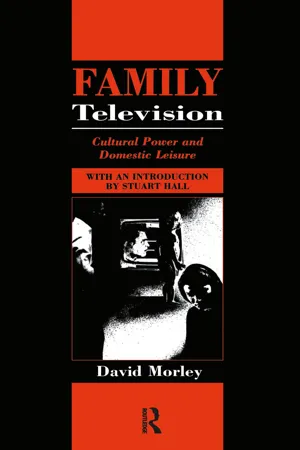
First Published in 2006. In this detailed study of television viewing among families from different cultural backgrounds, Morley develops many of the themes of his earlier work on the nationwide audience. This book extends that work into new territory, examining different ways in which television is actually watched within the context of family life. Here television viewing is situated firmly within the politics of the living room and the structure of power relations within the family.
Information
1
Understanding the uses of television
Centrally, this project was designed to investigate two different types of questions, concerning, on the one hand, how television is used within different families and, on the other hand, how television material is interpreted by its audience.
Questions of interpretation and questions of use have not previously been investigated in relation to each other. In the past they have been the exclusive provinces of different research traditions—the one within the realms of literary/semiological perspectives, the other within the field of sociological “leisure studies”. My project was designed to overcome this unproductive form of segregation, in the belief that only a more holistic research perspective- which takes account of both kinds of issues—could successfully pursue these urgent questions about the television audience.
My central thesis was that the changing patterns of television viewing could only be understood in the overall context of family leisure activity. Previous work in this area has tended to focus too narrowly on one or another side of a pair of interlinked issues which need, in fact, to be considered together: these are the issues of how viewers make sense of the materials they view, and the social (and primarily familial) relations within which viewing is conducted.
One tradition of work (in film cultural studies) has concentrated on the semiology of the text/image and the problem of textual meaning, only latterly registering the problematic status of the “reader” to whom the text/image is addressed, and that largely in isolation from the social context of viewing. On the other side, the sociological/leisure studies perspective has concentrated (as has much of the broadcasting organisations’ own research) on counting patterns of viewing behaviour with scant regard for how meanings (and thus choices) get made in this process.
My premise here was that the respective strengths of these two different perspectives needed to be combined, so as to consider problems of audience decoding/choice in the context of family leisure. Too often, the fact that television is predominantly a domestic medium and that viewing is largely done “in” the family is either ignored, or is “registered” only to be assumed away as a pre-given “backdrop” to the activity, rather than being directly investigated. Television viewing may be a “privatised” form of activity, by comparison with cinema-going for example, but it is still largely conducted within, rather than outside of, social relations—in this case the social relations of the family or household.
My own increasing interest in the analysis of the domestic viewing context can best be understood in relation to my previous involvement in the Nationwide research project at the Centre for Contemporary Cultural studies in Birmingham.1 Originally it had been hoped to follow up the investigation of differential patterns of “decoding” of Nationwide in that project with supplementary interviews with respondents at home. In the end, because of the practical limitations of time, funding, etc., that dimension was never pursued and the Nationwide project stopped short at the analysis of the pattern of differential “decodings” offered by groups of respondents when interviewed in groups (primarily in the context of educational instructions).
While I would, of course, argue that the findings in that project remain of considerable interest, I had subsequently come to feel that it was vital to pursue finally the question of how people watched television in its more “natural” setting, at home with their families. In short, my focus of interest has thus shifted from the analysis of the pattern of differential audience “readings” of particular programme materials, to the analysis of the domestic viewing context itself—as the framework within which “readings” of programmes are (ordinarily) made.
This research project was also designed to investigate the increasingly varied uses to which the television set can now be put. We are now in a situation where people can “do” a number of things with their television set besides watching broadcast television. This question goes beyond the implications of the increasing range of options in broadcast television (Channel Four, breakfast television) and beyond the implications of cable and satellite television in providing yet further choices.
We now confront a situation where the television set, while remaining the “family hearth”, can be used to videotape broadcast television and watch this at a later time; to watch rented and bought videotape material; to call up “electronic pages” of information (Teletext, Prestel, Oracle); and as a space on which either to play interactive video games or to display computerised data and to make calculations.
Audience research needs to explore the implications of this set of changes if we are to understand the changing significance of the “box in the corner”, in the context of the growing impact of new technology, both in diversifying the nature of the home-based leisure opportunities and in re-emphasising the existence of the home as the principal site of leisure.
A further premise of the analytical framework of the research project is that the social dimensions of “watching television”—the social relations within which viewing is performed as an activity—have to be brought more directly into focus if we are properly to understand television audiences’ choices of, and responses to, their viewing.
Here I have attempted to build upon some of the insights of the “uses and gratifications” approach to audience research—asking what people do with the media—but taking the dynamic unit of consumption to be more properly the family/household rather than the individual viewer. This is to raise questions about how the television set is handled in the home, how decisions are made—by which family members, at what times, as to “what to watch”—and how responses to different kinds of material are discussed within the family, etc. In short, this represents an attempt to analyse individual viewing activity within the social (and primarily household/familial) relations in which it commonly operates. Audience research which ignores the social/familial position of the viewer cannot comprehend a number of key determinations relating to both viewing “choices” and responses. These involve questions of differential power, responsibility and control within the family, at different times of the day or evening.
The further premise is that the use of the television set has to be understood in the wider context of the other, competing and complementary, leisure activities (hobbies, interests, pastimes, etc.) in which viewers are engaged. Television clearly is a primary leisure activity, but previous research has tended merely to investigate leisure options as a range of separate and unrelated activities to be listed, rather than to investigate the relations between “watching television” and other leisure activities. This project was designed to investigate the relations in which television viewing can be seen to structure—and be structured—by other leisure activities, in different ways for viewers in different social/familial positions.
“Watching television” cannot be assumed to be a one-dimensional activity which has equivalent meaning or significance at all times for all who perform it. I was concerned to identify and investigate the differences hidden behind the catch-all description “watching television”; both the differences between the choices made by different kinds of viewers in relation to different viewing options, and the differences (of attention and comprehension) between different viewers’ responses to the same viewing materials—differences which are masked by the finding that they all “watched” a given programme.
I was concerned to explore both differences within families, between their different members, and differences between families in different social and cultural contexts. I would argue that it is only in this context —that of the wider fields of social and cultural determinations which frame the practices of viewing—that individual “choices” and “responses” can be understood.
My argument is that the viewing patterns for broadcast television can only be comprehended in the context of this wider set of questions concerning life-style, work situation, and their interrelation with the scheduling limitations of broadcast television. “Availability” is thus a dynamic concept which relates “which groups can (or wish to) watch, when (and with how much attention)?” and “what types of programme are being broadcast and at what times?”—plus the availability of certain types of televisual material from off-air or hired/purchased video recordings.
As Mallory Wober has argued,2 most television “research” is in fact measurement, i.e., quantitative registration of how many people of what kinds are watching particular programmes and to what degree particular samples of people thought certain prograrrtmes interesting and/or enjoyable. The results, as he argues, offer bases for research, but are not research in and of themselves.
Moreover, the ways in which the information is gathered for these surveys ignore the contexts of use of television. By asking individuals to complete diaries (for the audience appreciation measurements) of which programmes they watched, reasons for such choices are not discovered. Moreover, the placing of the television set in a context of differential users (and differential uses) is never raised. Measuring does not address issues like this. Even that minority of audience research which is concerned with evaluation as opposed to measurement, is insufficiently comparative. By “comparative” I am referring to four types of comparisons:
(a) Comparisons as between channels
(b) Comparisons as between different types of programme
(c) Comparisons as between different groups of viewers
(d) Comparisons as between different uses of the television set (in terms of different types of televisual material and different groups of viewers).
This research programme was designed, then, to pursue a number of
related concerns:
(i) the need for a fuller and more flexible understanding of (rather than simply measuring) viewers’ reactions to material trans mitted. One important question here is that of developing differential “appreciation-indexes” in relation to the life-styles and cultural backgrounds of different categories of viewers.
(ii) the need for an understanding of the grounds of such individual choices and reactions, which takes account of the ways in which individual choices and viewer reactions are situated in and affected by particular social and cultural contexts.
I was also concerned to generate a comparative study of specific social groups in relation to channel-choice and programme-type commitment:
Choice: the significance of scheduling in relation to (a) television use, (b) channel switching and channel loyalty, and (c) life-patterns of different social groups, and different members of families within the same social group.
Commitment: the significance of the internal characteristics and structure of different types of programmes within television use in relation to different social groups and different members of families within the same social group.
The objectives were:
(1) to complement existing measurement data;
(2) to deepen our understanding of what patterns of viewing relate to which social groups;
(3) to reconceptualise notions of “appreciation” in relation to types of programme.
In particular, this project was designed to explore in detail, with a deliberately limited universe, the factors which frame “viewing behaviour”. The focus was on the “how” and “why” questions which lie unexplained behind the patterns of viewing behaviour revealed by large-scale survey work (as discussed, for instance, in Goodhart et al.). My objective was to produce a fuller understanding of the questions (for example, the grounds for and differential criteria employed in particular viewing choices) which need to be understood in order to pave the way for more productive large-scale survey work across a larger sample.
In short, by investigating how factors such as programme type, family position and cultural background interrelate to produce the dynamics of family viewing behaviour and responses, I aimed to produce a more developed conceptual model of viewing behaviour in the context of family leisure which would then be available for testing across a wider sample.
2
Television in the family
Despite frequent moral panics about “television and the family” we still know very little about how families as distinct from individuals (who, after all, mostly live in families or households of some kind) interact with and use television in their everyday lives. The perspective employed in this project has been one which attempts to redress this imbalance and to consider television viewing as a social activity, one which is conducted within the context of the family as a set of social relations, rather than as a merely individual activity, or as the activities of a collection of individuals who merely happen to live in the same household. The need for this approach is surely now beyond argument. As the introduction to Communication Research Trends’ issue on “TV and Family Communication” put it:
“As long ago as 1972 the US Surgeon General’s Advisory Committee Report on TV and Social Behaviour requested that TV be studied in the home environment. Ten years later, the update of the Surgeon General’s report Television and Behaviour’ called once again for more studies on family interaction with TV and for a research approach which uses the family or peer group as the unit of analysis.”1
This perspective has a number of implications. First, let us return to the comments above on the disjuncture between my findings in this project and the generally accepted thesis that people are just as likely to view types of programme which they claim not to like as they are to view their claimed programme preference. James Webster and Jacob Wakshlag go some considerable way towards explaining why stated preferences fail to match up with observed viewing behaviour by the simple expedient of taking into account the influence of “others” (other members of the family or household) on programme choice—that is, “the role that group viewing plays in mediating the free exercise of individual preference”.2 As they explain, many theorists have assumed that television programme choice is a direct result of individual programme preference, and that, as a consequence, patterns of stated programme preference should be manifest in viewing behaviour. As they note, Goodhart et al. concluded that in terms of recorded viewing behaviour “there is no special tendency across the population for people who watch one programme of a given type also to watch others of the same type”.3 This conclusion has led many to believe that statements of programme type preference, given that they are poor predictors of viewing behaviour, are of little interest or significance.
In fact, as Webster and Wakshlag show, when respondents view alone, their programme choice is more consistent with reference to programme type (as indeed it is when they view consistently with the same group of other people). A large part of the “gap” between individuals’ stated programme preferences and their actual viewing behaviour is to be accounted for by the effects of others, and the need to accommodate and negotiate with their preferences as to what is to be viewed. In short, a lot of people’s viewing is not of their own choosing. As they put it, contrary to their original hypothesis that an increased incidence of group viewing would result in a reduction of programme type loyalty:
“Group viewing per se did not reduce programme type loyalty. Rather, it appeared that when a composition of the viewing unit varied across time [for example, when a respondent viewed with varying combinations of family members], programme type loy...
Table of contents
- Front Cover
- Title Page
- Copyright
- Acknowledgemetns
- Contents
- Introduction
- Foreword
- 1. Understanding the uses of television
- 2. Television in the family
- 3. Research development: from ‘decoding’ to viewing context
- 4. Objectives, methodology and sample design
- 5. Family interviews
- 6. Television and gender
- Afterword
- Notes
Trusted by 375,005 students
Access to over 1.5 million titles for a fair monthly price.
Study more efficiently using our study tools.
Frequently asked questions
Yes, you can cancel anytime from the Subscription tab in your account settings on the Perlego website. Your subscription will stay active until the end of your current billing period. Learn how to cancel your subscription
No, books cannot be downloaded as external files, such as PDFs, for use outside of Perlego. However, you can download books within the Perlego app for offline reading on mobile or tablet. Learn how to download books offline
We are an online textbook subscription service, where you can get access to an entire online library for less than the price of a single book per month. With over 1.5 million books across 990+ topics, we’ve got you covered! Learn about our mission
Look out for the read-aloud symbol on your next book to see if you can listen to it. The read-aloud tool reads text aloud for you, highlighting the text as it is being read. You can pause it, speed it up and slow it down. Learn more about Read Aloud
Yes! You can use the Perlego app on both iOS and Android devices to read anytime, anywhere — even offline. Perfect for commutes or when you’re on the go.
Please note we cannot support devices running on iOS 13 and Android 7 or earlier. Learn more about using the app
Please note we cannot support devices running on iOS 13 and Android 7 or earlier. Learn more about using the app
Yes, you can access Family Television by David Morley in PDF and/or ePUB format, as well as other popular books in Social Sciences & Marriage & Family Sociology. We have over 1.5 million books available in our catalogue for you to explore.