This book critically assesses the role of agrobiodiversity in school gardens and its contribution to diversifying diets, promoting healthy eating habits and improving nutrition among schoolchildren as well as other benefits relating to climate change adaptation, ecoliteracy and greening school spaces.
Many schoolchildren suffer from various forms of malnutrition and it is important to address their nutritional status given the effects it has on their health, cognition, and subsequently their educational achievement. Schools are recognized as excellent platforms for promoting lifelong healthy eating and improving long-term, sustainable nutrition security required for optimum educational outcomes. This book reveals the multiple benefits of school gardens for improving nutrition and education for children and their families. It examines issues such as school feeding, community food production, school gardening, nutritional education and the promotion of agrobiodiversity, and draws on international case studies, from both developed and developing nations, to provide a comprehensive global assessment.
This book will be essential reading for those interested in promoting agrobiodiversity, sustainable nutrition and healthy eating habits in schools and public institutions more generally. It identifies recurring and emerging issues, establishes best practices, identifies key criteria for success and advises on strategies for scaling up and scaling out elements to improve the uptake of school gardens.
Julian Gonsalves, Danny Hunter, and Nina Lauridsen
Introduction
School garden programmes have been a popular development intervention for many decades. The objectives for school gardens have, however, differed greatly, determined by the purpose, the targeted audiences, and the proponent. In the developing world, these have included teaching improved farming skills, supporting community food production, raising funds, and demonstrating exemplary agricultural practices to the communities surrounding the schools. In the industrialized world (and increasingly in the global South), school gardens have served a broader education function, helping children understand science, nature, and the environment. Increasingly a case is also made for reconnecting rapidly urbanizing school communities with the realities of rural areas, local food culture, local food biodiversity, and farm tourism. There is now a wider recognition of the role of school gardens in environmental and nature education, in local food biodiversity and conservation, food and ecoliteracy, diets, nutrition and health, and agricultural education. The current concerns about environmental degradation and the disconnect of young people with nature and agriculture have resulted in school gardens receiving unprecedented attention.
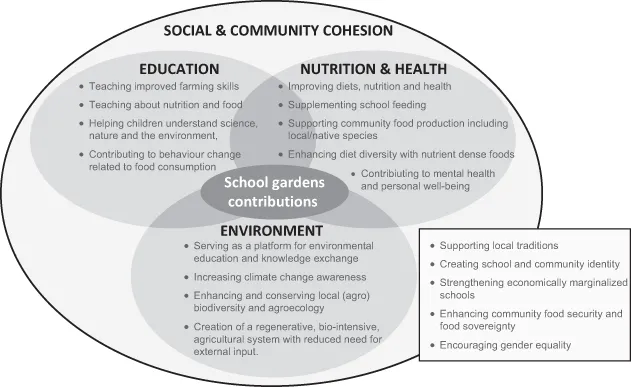
However, with donors and government, the nutrition agenda is also driving the current interest in supporting school garden programmes. This is a major focus of many of the chapters and case studies in this book, highlighting the importance of school gardens as a tool for improving food and nutrition education – especially through the better incorporation of local agrobiodiversity and enhanced awareness of its nutritional value – to improve healthy eating habits and dietary diversity. Governments are embarrassed and challenged by the growing prevalence of malnutrition among school-aged children. Evidence from nutrition surveys has drawn attention to school-aged malnutrition. In the global South, funding for school nutrition activities including gardens and associated feeding programmes is sourced from health and nutrition sectors resulting in mainstreaming and institutionalization efforts and policy support. In an increasing number of countries, frameworks are being developed to support universal school feeding programmes. This wider attention to the nutrition agenda in schools, a parallel effort to find ways to leverage the nutrition contributions of agriculture through what is now referred to as nutrition-sensitive agriculture, with the engagement of a diverse range of sectors and players (not just agriculture), has brought school gardens back to the development agenda. The increasing appreciation of the wider multiple benefits and multi-functionality of school gardens is indeed the driver of this growing interest in school gardens, irrespective of geography (Figure 1.1).
FIGURE 1.1 Themultiple benefits of school gardens.
This chapter provides a brief history of school gardens and an overview of their multiple benefits. These benefits include: a better understanding of the agriculture and nutrition sectors; enhancement of farming and livelihood skills; behavioural and attitudinal changes towards food, including a wider awareness of healthy eating and diets; the conservation of agrobiodiversity; understanding climate change impacts on agriculture and food production; enhancing academic skills and performance; empowerment of girls and women; reconnecting indigenous children with their foods and culture; and using these as a potential space to address mental health and well-being in schoolchildren. The chapter concludes with the identification of some key issues for the future of school gardens and a brief outline of the structure of the book including an overview of the chapters and case studies.
School gardens: a short history1
In the last century, in Europe and the United States, school gardens have featured as a hunger intervention. Some of the earliest gardening efforts (George Putnam School in Massachusetts) remain useful reminders of the importance of school gardens and the role they played in hunger mitigation (e.g. the Victory Gardens in the two World Wars and the introduction of ‘U.S. Garden Armies’ by the Federal Bureau of Education). By the end of 1906, the U.S. Department of Agriculture (USDA) estimated that there were 75,000 school gardens mostly referred to as relief gardening. School gardens were considered a national phenomenon, but they were also considered a part of U.S. culture from the 1890s to 1920s (Wills, 2019). In the 1970s the growing environmental movement helped revive interest in school gardens, resulting in another period of intense growth in the 1990s (Hayden-Smith, 2015). In recent years, the FoodCorps2 movement has grown, supporting school and community garden efforts. Learning about gardening, the environment, nature, and sustainable diets characterizes current school gardening efforts in Europe, Australia, and the United States.
In the developing world, in the mid-sixties and seventies, school gardens have featured primarily as food security interventions which help encourage children to appreciate agriculture and to learn how food is produced. School gardens are largely featured as part of efforts to address hunger and malnutrition among schoolchildren and occasionally to supplement school feeding programmes. Linking school gardens with school feeding and nutrition education is emerging as a new area to converge the efforts of the agriculture, health, and nutrition sectors in school platforms. Linking schools with communities has brought in an added interest in home gardens and their role in supporting household nutrition. The role of school gardens in behavioural modification in relation to healthy food, sustainable diets, and environmental stewardship is also receiving prominent attention. In the global South, education for vocational agricultural training or agricultural education has been an important focus for school gardens. Some have been used for food production, often with the intention that they might help to augment the ingredient requirements of school meal programmes. In some cases such initiatives have been unsustainable because of the lack of resources, motivation, or expertise, though some countries, such as Costa Rica, with suitable policies and enabling environments are the exception (FAO, 2010). In many instances, though, when the donor support has stopped, so too has the school garden programme. In the Philippines, the Department of Education and the Department of Agriculture have allocated funds to schools to support both gardens and feeding programmes: policy and recent legislation have helped improve the sustainability of such programmes.
School garden programmes in the global South have sometimes had a troubled past often due to poor clarity on the objectives and relevance of school garden interventions to the wider educational role of schools and often further complicated by a lack of vision and creativity, resulting in the perception of school gardens as drudgery and efforts to integrate them into schools as ‘ruralisation’ of the curriculum (FAO, 2010). This has often led to negative perceptions of school gardens, such as that school garden work can be used as a form of punishment; that school garden activities do not help to pass exams; that gardening is dirty and tiring work; that our children are being exploited; and that the food from school gardens, especially if promoting indigenous crops, was the food of the poor, only eaten in hard times (FAO, 2010). There is also a need to consider the burden school teachers already have with school-based activities. Well-intentioned ideas about promoting school gardens and linking schools with communities and homes have to factor in the increased commitments of human and financial resources. The good intentions of ‘outsiders’ to link schools with a host of other activities (income generation, community outreach, home gardens of parents, reforestation, and small livestock) must be screened carefully to ensure that teachers and students are not unduly burdened. For community outreach efforts the already burdened teachers should be provided additional human and financial resources, otherwise once again sustainability and quality are sacrificed. More individuals and organizations are realizing the huge potential of school gardens to transform how children learn and understand the world in which they live and act accordingly. There is an increased appreciation that school gardens can be suitable learning spaces to address the complexity of challenges we face by promoting interdisciplinary and holistic approaches. That school gardens not only serve the pupils but also the wider community and society itself by realizing the multiple benefits they can deliver (Figure 1.1).
The multiple benefits of school gardens
Development of agricultural and livelihood skills including knowledge of sustainable food systems
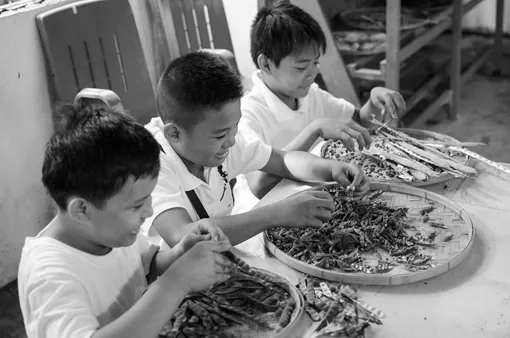
Traditionally school gardens have played an important role, and continue to do so, in teaching agricultural and horticultural skills and associated learning and capacity building. This often covers the full spectrum of the growing cycle from the design of the garden, selection of planting material and agricultural biodiversity, growing and management through harvesting, and preparation for consumption as well as processing for longer-term storage (Figure 1.2). Such activities allow children to learn how to grow and maintain a variety of foods, not just crops and plants but sometimes to raise small livestock and even fish (FAO, 2010). Such learning often also includes enhancing knowledge and skills for the sustainable management of natural resources especially soils (Box 1.1) and water, including recycling or circular economy approaches such as minimizing waste and composting and its addition to soil to enhance soil health, fertility, and water retention. Environment-friendly approaches to managing pests and diseases, and the importance of beneficial insects, including pollinators, are also often taught, including the enhancement of biodiversity in school gardens combined with cultural approaches, such as cover crops, mulching, companion planting, and hand collection of damaging pests. All of this raises awareness and capacity of students in regenerative agriculture including its contribution to a more sustainable food system.
FIGURE 1.2 Sustainability is enhanced with seed saving practices, which are now a special feature of the Philippine government’s school garden programme.
Source: IIRR.
BOX 1.1: SOILS FOR LIFE
Soils for Life, an Australian non-profit organization, dedicates its mission to promoting regenerative management practices in farming, also known as regenerative agriculture. Maintaining healthy soils is fundamental to the work of Soils for Life, who believe that regenerative management practices are key to restoring soil quality. Regenerative agriculture not only promotes agrobiodiversity and output productivity but also the overall resilience and sustainability of the system. Through identifying successful regenerative management practices and innovations and disseminating this knowledge through peer-to-peer exchange programmes, through which experienced land managers are partnered with farmer mentors in a 12-month-long dynamic process, Soils for Life works to encourage and support the adoption of regenerative agriculture. Besides promoting regenerative management practices with farmers and land managers, Soils for Life also aims to share its knowledge with other members in the community. One avenue through which Soils for Life works to achieve this is through their school garden programme, which partners with primary schools to establish an educational garden where children can learn about the crucial role soil plays in a healthy ecosystem. The organization believes that children should have an understanding about not only how their food is grown but also the importance of healthy soil to their food. Soils for Life has been advocating and promoting a national school garden policy for Australia, as an engaging medium whereby students can learn biological concepts, such as photosynthesis, as well as environmental issues, such as carbon sequestration.
Linked to this is the role of school gardens and associated activities in fostering livelihood and ...
Table of contents
Cover
Half Title
Series Page
Title Page
Copyright Page
Table of Contents
List of figures
List of tables
List of boxes
Acknowledgements
List of contributors
List of abbreviations
1 School gardens: multiple functions and multiple outcomes
2 Schools as a system to improve nutrition
3 Strategies for integrating food and nutrition in the primary school curriculum
4 Linking school gardens, school feeding, and nutrition education in the Philippines
5 School gardens in Nepal: design, piloting, and scaling
6 Trees nurture nutrition: an insight on how to integrate locally available food tree and crop species in school gardens
7 The role of school gardens as conservation networks for tree genetic resources
8 The impact of school gardens on nutrition outcomes in low-income countries
9 Parent engagement in sustaining the nutritional gains from School-Plus-Home Gardens Project and school-based feeding programmes in the Philippines: the case of the Province of Laguna
10 Scaling up the integrated school nutrition model in the Philippines: experiences and lessons learned
C1 The Stephanie Alexander Kitchen Garden Foundation Program
C2 Reviving local food systems in Hawai‘i
C3 Food Plant Solutions: School gardens in Vietnam
C4 Preserving local cultural heritage through capacity building for girls in the Moroccan High Atlas
C5 Learning gardens cultivating health and well-being – stories from Australia
C6 African leafy vegetables go back to school: farm to school networks embrace biodiversity for food and nutrition in Kenya
C7 Grow to learn – learning gardens for Syrian children and youth in Lebanon
C8 School gardens (māra): today’s learning spaces for Māori
C9 Intergenerational transfer of knowledge and mindset change through school gardens among indigenous children in Meghalaya, North East India
C10 Laboratorios para la Vida: action research for agroecological scaling through food- and garden-based education
C11 Agrobiodiversity education: the inclusion of agrobiodiversity in primary school curricula in Xiengkhouang Province, the Lao People’s Democratic Republic
C12 Katakin kōṃṃan jikin kallib ilo jikuul – Republic of the Marshall Islands School Learning Garden Program
C13 Where the wild things are
C14 Slow Food 10,000 gardens – cultivating the future of Africa
C15 The integration of food biodiversity in school curricula through school gardens and gastronomy in Brazil
Index
Trusted by 375,005 students
Access to over 1.5 million titles for a fair monthly price.
Study more efficiently using our study tools.
Frequently asked questions
Yes, you can cancel anytime from the Subscription tab in your account settings on the Perlego website. Your subscription will stay active until the end of your current billing period. Learn how to cancel your subscription
No, books cannot be downloaded as external files, such as PDFs, for use outside of Perlego. However, you can download books within the Perlego app for offline reading on mobile or tablet. Learn how to download books offline
Perlego offers two plans: Essential and Complete
Essential is ideal for learners and professionals who enjoy exploring a wide range of subjects. Access the Essential Library with 800,000+ trusted titles and best-sellers across business, personal growth, and the humanities. Includes unlimited reading time and Standard Read Aloud voice.
Complete: Perfect for advanced learners and researchers needing full, unrestricted access. Unlock 1.5M+ books across hundreds of subjects, including academic and specialized titles. The Complete Plan also includes advanced features like Premium Read Aloud and Research Assistant.
Both plans are available with monthly, semester, or annual billing cycles.
We are an online textbook subscription service, where you can get access to an entire online library for less than the price of a single book per month. With over 1.5 million books across 990+ topics, we’ve got you covered! Learn about our mission
Look out for the read-aloud symbol on your next book to see if you can listen to it. The read-aloud tool reads text aloud for you, highlighting the text as it is being read. You can pause it, speed it up and slow it down. Learn more about Read Aloud
Yes! You can use the Perlego app on both iOS and Android devices to read anytime, anywhere — even offline. Perfect for commutes or when you’re on the go. Please note we cannot support devices running on iOS 13 and Android 7 or earlier. Learn more about using the app
Yes, you can access Agrobiodiversity, School Gardens and Healthy Diets by Danny Hunter, Emilita Monville-Oro, Bessie Burgos, Carmen Nyhria Roel, Blesilda M. Calub, Julian Gonsalves, Nina Lauridsen, Danny Hunter,Emilita Monville-Oro,Bessie Burgos,Carmen Nyhria Roel,Blesilda M. Calub,Julian Gonsalves,Nina Lauridsen in PDF and/or ePUB format, as well as other popular books in Education & Education General. We have over 1.5 million books available in our catalogue for you to explore.