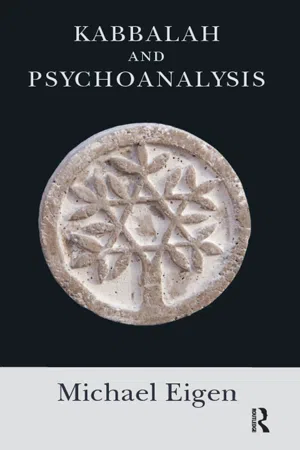
Wilfred Bion once said, "I use the Kabbalah as a framework for psychoanalysis." Both are preoccupied with catastrophe and faith, infinity and intensity of experience, shatter and growth of being that supports dimensions which sensitivity opens. Both are preoccupied with ontological implications of the Unknown and the importance of emotional life. This work is a psychospiritual adventure touching the places Kabbalah and psychoanalysis give something to each other. Michael Eigen uses aspects of Bion, Winnicott, Akivah, Luria and Nachman (and many more) as colours on a palette to open realities for growth of experience. Bion called faith "the psychoanalytic attitude" and Eigen here explores creative, paradoxical, multidimensional aspects of faith. Eigen previously wrote of psychoanalysis as a form of prayer in The Psychoanalytic Mystic. In Kabbalah and Psychoanalysis he writes of creative faith. Sessions as crucibles in which diverse currents of personality mix in new ways, alchemy or soul chemistry perhaps, or simply homage to our embryonic nature which responds to the breath of feeling moment to moment.
- 160 pages
- English
- ePUB (mobile friendly)
- Available on iOS & Android
eBook - ePub
Kabbalah and Psychoanalysis
About this book
Information
CHAPTER ONE
[Testing microphone, chanting]: Shema. shhhmaaaa. Shhhh…
The heart of the Kabbalah, the very heart of Kabbalah is the line: “V’ahav’ta eit Adonai Elohekha b’khol l’vav’kha uv’khol naf’sh’kha uv’khol m’odekha”. Everyone who knows this line please say it with me. (Group: V’ahav’ta eit Adonai Elohekha b’khol l’vav’kha uv’khol naf’sh’kha uv’khol m’odekha.) (Deuteronomy 6:5.)
When I was a child, we were taught that this meant, “You will love the Lord your God with all your heart, with all your soul, with all your might.” It was presented as a commandment, although, even as a child, I felt there was more to it. More resonance, another vibration I could not quite link up with: more than a commandment, other than a commandment. It was a clue about who I was and what was in me.
When I was a little older, I took it as an invitation: you are invited to love God with all your heart and soul and might. A sort of invitation to God’s playground, God’s holy ground. You are invited to come and play with God with all your heart and soul and might. Then, when I was still older, I started thinking, V’ahav’ta—and you will love. And you will love, you will love. When I am in despair and wretched and totally unloving and hateful and miserable and have no guidance or hope, something sometimes comes up in me and says, “I love you.” And it is the hope that I will love. You will love, you will love God with all your heart and soul and might.
When I became older still, I began to sense this sentence as a statement of fact. It was just the way it was, it is the way we are imprinted. It is something in us, something in our foundation, a blueprint for our very being. It keeps changing, opening. One never stops growing into it. We relate to it differently at different times, and it relates to us differently. It is a statement of fact. I love you. I love God with all my heart and soul and might. So let’s say that together: “I love God with all my heart and soul and might.” (Group: I love God with all my heart and soul and might. I love God with all my heart and soul and might.) I love you. I love you. I love you with all my heart and soul and might: a commandment, an invitation, a challenge, a fact. The heart of both Kabbalah and Torah. Everything grows out of this love.
The you in the words “and you will” is an inclusive you, meaning all of us. V’ahav’ta eit Adonai (“and you will love the Lord”). Adonai, as many of you know, is a substitute word. Adonai means “lord”, and it substitutes for the tetragrammaton, Yud-Hay-Vav-Hay. Throughout the Torah, Yud-Hay-Vav-Hay (YHVH) is the word that is used. But then, superimposed on it is Adonai.
You are not supposed to say the tetragrammaton, YHVH. We do not even know how it is said, We do not know the vowel sounds, although early Christian texts tell us you say it, “Yahweh”. Sometimes, in wry, humorous moments, I think maybe it was pronounced Oy-vey, or something that led to this all purpose expression. A few days ago, I stopped some very religious looking Jews in the park and asked them about words for God that were singular and plural. In their answer, they used the word Jaweh—avoiding pronunciation of Y and V. With Jaweh, you almost say the name without saying the name. Jaweh: close but not quite. Who knows?
Here is a semi-Kabbalistic story. When I was a child in Passaic, New Jersey, a man from New York would come and visit us once or twice a year seeking a charitable donation for the poor of his Chassidic group. His name was Rabbi Kellner and he always had a nice word for me, a little boy. When I saw him, something different happened from the usual person I would meet in Passaic. His face had a glow and I did not know what the glow was. It did something special inside. When I grew up, I came to know the glow was a sense of the holy. When Rabbi Kellner came, my father stopped whatever he was doing. I do not remember much of what was said, but the feeling never left. (Aner Govrin questioned me about my childhood in Passaic, New Jersey, and you can find out about it in Conversations With Michael Eigen, 2007.)
When my father died in 1986 I went to a shul (synagogue, temple, house of prayer and study) near my house in Brooklyn to say kaddish. I picked this shul because, weeks before, the rabbi from this shul was walking down the street with a lulav and esrog and invited my five-year-old son and I to say a prayer and shake them. (The lulav is a bundle of palm, myrtle and willow; the esrog a citrus similar to a lemon. You shake them all around you, God all around you, celebrating Sukkot, holiday of huts and fall harvest, remembering the trek through the wilderness, underscoring impermanence and deep dependence on God.) My son and I enjoyed shaking them. It felt so good that when I went to say kaddish, I picked this rabbi’s shul. Not long before my father died, he told me the kaddish is not what many think, a mourning prayer, a sad prayer—it is a song of praise, it sings God’s praises. He meant me to say kaddish in this fashion.
About the same time I started going to my neighbourhood shul, a rabbi who spoke at my father’s funeral in Passaic put me in contact with Rabbi Kastel in Crown Heights, Brooklyn. I spent some time with Rabbi Kastel and when he heard my story about Rabbi Kellner, he fixed me up with Rabbi Kellner’s two sons, then old men living in Crown Heights. So there I was, a man in my fifties, studying with Rabbi Kellner’s sons in Brooklyn. There is much to tell you about these weekly visits, but that will have to wait for another day. I was lucky to have the time with them that I did, for, not long after we stopped, they left this earth. If that’s not Kabbalistic, I don’t know … The rabbi whose shul I picked in my neighbourhood also had roots in Crown Heights—again, stories for another day.
Time does strange things. It opens doors you do not expect to be opened. Doors close, doors open.
Here is a little something the Kellners taught me. I asked them, in the sh’ma, why are there two names of God, Yahweh and Elohenu (Sh’ma Yisroel, Adonai Elohenu, Adonai echad: Hear, O Israel, the Lord is our God, the Lord is one. Adonai, lord, is orally substituted for the written YHVH, the unsayable infinite mystery). They told me one is singular and one is plural. YHVH—adonai, lord—singular. Elohenu plural, gods. In my mind—and they did not correct me—I took it that all the gods, all the gods the Bible alludes to, or that anyone might allude to, all are subsumed by the One, profiles of the One, so to speak. The One and Only remaining beyond thought, image, word. All gods are One God, with the mystery of the One taking precedence. Plural and singular are one. A unity of plurality and the One.
The one runs through religions, doesn’t it? There is a one in Taoism. In Buddhism, there is one-finger Zen, our original face, and much more. At rock concerts, everyone waves their hand above their head with their index finger pointing upward. At Matisyahu (a Chassidic rocker-rapper) concerts, the same thing happens, all the people in the room waving one finger upward in time with the music. So this one is very special, very popular. All one. When I think on it now, I get a sense that I am honoured to be here. It is an honour to be with you. And it is an honour for us to be here at all. The Dalai Lama talks about the precious human form, and my prayer is that we honour the day and that the day honours us, that we are worthy of life this day and that life gives us inspiration to go forward, to open a little more.
It is one of the themes in Kabbalah, and one of the themes in aspects of psychoanalysis, that we are broken. And, at the same time, there is an odd paradox—a kind of paradoxical monism rather than dualism—that we are whole and broken at the same time. Psalms tell us that the soul is pure and kabbalah adds that there is a soul point in contact with God at all times. We might or might not be aware of this point of contact. A term like “point” is just an image for ineffable sense of contact with the Deepest of All. Yet, the psalms also tell us of times when we feel no contact, bereft of contact, abandoned, abysmal, and long for contact again. I said before that we are touching something more than duality, but, paradoxically, we are deep in dualities. I am and am not in contact with God. We are and are not in contact. Something in me might be pure, I am not pure. I can be a devil. I am mischievous, weird, playful, nasty, selfish, and worse, yet I have to bear witness to something pure, whole, utterly uplifting and amazing: a miracle that a life form such as you and me should be. Crippled and whole, corrupt and pure, and everything between and mixed. I would like to touch the theme of brokenness more.
Kabbalah is vast. Kabbalah is not a unified thing, an official set of books like the Torah. It is an archipelago, fragments over time. That one wrote this, this one wrote that. It accumulates over many years, possibly to this day. Many tracts, books, visions, meditations, records of talks, probably spanning more than 2,000 years, reaching back to imaginative elaborations of what Torah is made of, hidden, deeper meanings. Kabbalah reaches us through broken forms touching a needy core. It is about a deep intimacy we sense and express, lose, re-find, re-create in longing, suffering, and rejoicing.
One thread on brokenness that has become a popular Kabbalah theme is in Lurianic Kabbalah. Rabbi Isaac Luria taught in Safed in the sixteenth century. He did not write much, but a follower, Chaim Vital, wrote and reshaped his talks and teachings. I will share a little portion of his vision, which many of you know. We all have our idiosyncratic ways of telling a story. God felt inspired to create something. It is odd to say this about God, since creativity, we imagine, is intrinsic to his “nature”. The God of Genesis is, if anything, a creative God. In the beginning, God created or, to change it to something a little more like an ideogram: In the beginning God creating. Or leave out “in” and “the”: Beginning God Creating.
Perhaps God felt a need to share creative being, although, again, the word “need” sounds suspect when it comes to certain views of God. In Kabbalah, God is often talked about as having needs, although one realises one is speaking about the unspeakable. To speak of need is to speak of love; to share creativity out of love, or simply out of creativeness as such.
Some Gnostic teachings tell us that creation is a kind of step down for God, a lower form of God’s being. There are Kabbalah teachings that echo this, but there are others that give a special weight to this “lower” creation, a place of radical consequence, filled with spiritual possibility, a place where compassion can be realised, as compassion and cruelty vie and intertwine. Life as home to anguish and joy.
A problem God faced: how to go about creating something if you are everything? There is no room for creation if God fills everything. God’s problem is how to make room for anything but God. Rabbi Luria (1534–1572) in Safed and Jacob Boehme, a German mystic born two years after Rabbi Luria died, had similar solutions. God contracts to make room for the world. I wonder if this is a kind of mystical underpinning for Martha Graham’s emphasis on contraction. I say this somewhat tongue in cheek because contraction has many possibilities, as in contracting with pain and anguish, or, more Taoist, part of the in-out rhythm of breath, or Melanie Klein’s unconscious phantasy processes involving introjection–projection. We even speak of expanding–contracting universes. Then there is the wordplay, the double meaning of contract, to pull in, to make a contract with, a covenant.
God pulls back, contracts. I see it as a bow: bowing, making room for the other. Making space, a covenant, a kind of mutual bowing. Now, everything we say about God, we are saying about ourselves. We say God is omniscient, omnipotent, but these are capacities we wish for ourselves. More, we act as if we are omniscient and omnipotent in important ways. That is, we act as if we know everything, or more than we do, and that we have power to do whatever we want, or are deluded to think so. Omniscience and omnipotence as powerful fantasies that permeate our behaviour, often with disastrous results, sometimes with astonishing creative results. As analysts, we might say we project omniscience–omnipotence on to God, reflecting our own preoccupation with knowledge and power. Look at all the trouble we get into thinking we know more than we do and acting as if we are more powerful or should be, and the contraction we undergo thinking that God is as we imagine. We impoverish God by contracting God to adumbrations of selected mental categories, mental contractions.
Here is an example of omniscience. We knew—at least some of us knew, or thought they knew, or simply made believe they knew—that Saddam Hussein had weapons of mass destruction and we had better get him before he gets us. Omniscience has many variations. We should know better. At times, we attribute omniscience to God and blame him for the mess we are in. We shift the blame, the cause, the responsibility. But we do not know better, and blaming does not help. It is best to acknowledge this dangerous, at times perverse quality we have, that we think we know more than we do.
Luria and Boehme tell us God contracts to make room for us. God models something for us. We need to contract, to make room. If we are only expanding, there is no room for others. It is good to be expansive and enjoy your expansive self. But if someone is telling you something deeply meaningful, something real and true and delicate for them, and you can only expand, how will you hear them, how will you let them in?
God contracted and made room for us. Not a hell of a lot of room, perhaps, but here we are, such as we manage to be. I would like to share a vision, a paradoxical impossibility, which inner vision proposes as deep reality. God is wholly everywhere. Yet we are, we exist. Can we say we exist inside God, outside God, both, elsewhere? Is there any space that is not godspace? If God is everywhere, how can we feel without Him? Yet we do. We have no access to God who is always accessible; accessible yet withdraws and, in coming and going, quickens us with pain and joy: partly a cruel vision, partly embracing. A primordial “now you see him, now you don’t”, connecting with the coming and going of our own aliveness and self-feeling, our emotional fluctuations. At the same time, Chassidus (Schneerson, 1998) tells us, there is a soul point ever in contact with God that, in our experience, waxes and wanes, or perhaps is like a constant hum in the background.
In Rabbi Luria’s story, even though God tried to make room for us, something went wrong. Vessels that were meant to hold and transmit and transmute godly energy shattered. Vessels emanating creation broke at lower levels of formation. They could not take the intensity of the energy they were mediating. Some of the higher channels remained intact, but those most involved in what turned out to be our world (and us) shattered. I was touched in a recent Anselm Kiefer exhibit by a sculptural representation of the Shekinah in tatters, torn, smudged, burn marks on her rag-like, princess-like garment, perhaps a wedding gown (the Sabbath bride). Shekinah, whatever else, is God’s Presence in us, on earth, in the tenth Sephirot, Malkut, one of the shattered spheres, dimensions, vessels, channels. (Appendix 1: Ein Sof and the Sephirot Tree of Life.) It is said our challenge, our job, is to repair the rupture. Wherever we are, embedded in the shatter, in the shards, the brokenness, there are divine sparks awaiting redemption with our help. And we are helped by the Divine Presence, the Shekinah, which, in Kiefer’s vision, partakes in the dust and ashes of our scarred beings. One cannot help turning letters around, wondering about scarred—scared—sacred.
That creation and the creative process could not bear its own intensity teaches us, as psychotherapists, to go slow, dose it out. Wilfred Bion (1970; Eigen, 1998) sees catastrophic processes at the beginning of psychic life and writes of a sense of catastrophe as a link that cements personality together. He cites Rabbi Luria as resonant with his concerns and adds a new turn. Bion feels we cannot take the intensity of our own experience. We are, in some sense, embryonic with regard to ability to work with our experiential capacity. We are able to process or digest very little of what has impacts on us. Bion presents this as a kind of developmental and evolutionary challenge: how to grow psychic capacity to work with the psyche. Or, to put it slightly differently, how to grow ability to work with emotional problems, the disturbances human personality presents. I hope time will allow us to develop this theme further.
Bion is parallel to Luria: our system cannot take very much of itself. Experiencing cannot take too much experiencing. We do not know what to do with ourselves and our experiential capacity. The latter produces experiences that are too much for us, that we cannot “handle”. If one meets this situation, begins taking it in, a broader attitude develops. If the patient seems not to be changing and you are getting impatient and irritated, contract, make room for apparent unchanging. Armed with Luria–Bion, you are aware that our system cannot take too much. Changes of energy, shifts of being and ways of being might be too much for this patient now. The patient’s “unchanging” might be too much for you now. Contract, make room, for the patient and yourself, your frustration and the patient’s slow pace. There are always other ways to view a situation. Much that happens imperceptibly may surface in surprising ways when one least expects it.
Remember Luria’s story: God contracted all at once to create our world and life, and the vessels transmitting being could not take the process. This is akin to saying the psyche cannot take the forces of psychotherapeutic change. In psychotherapy, slow is important, dosing is important. It is not just repetition. It is giving time for someone to get ready, build capacity for a little more. Therapeutic change is difficult and it takes time to build ability to make use of it, let it happen, digest it. We have to build resources that make therapeutic change possible. Building up resources is crucial.
Some of you heard me tell this story before (at the end of Psychic Deadness, 1996). Susan Deri used to talk about it at meetings. It was a case of a “chronic schizophrenic” man. Over the course of fifteen or twenty years of work together, he improved. He now had an apartment; he now took care of himself. He had a more independent existence. He was alone, but he was surviving, living the life he could. Then this man gets the idea—it came to him—that he wants to fall in love. And, lo and behold, it happens....
Table of contents
- Cover
- Half Title
- Title Page
- Copyright Page
- Dedication
- Table of Contents
- ABOUT THE AUTHOR
- PREFACE AND INTRODUCTION
- CHAPTER ONE
- CHAPTER TWO
- Appendix 1: Ein Sof and the Sephirot (Tree of Life)
- Appendix 2: Four worlds
- Appendix 3: Circle and rays
- Appendix 4: O-grams
- Appendix 5: Bion’s Grid
- Appendix 6: Bion quotes
- Appendix 7: Rabbi Nachman’s paths
- Appendix 8: Selected readings
- REFERENCES
- INDEX
Trusted by 375,005 students
Access to over 1.5 million titles for a fair monthly price.
Study more efficiently using our study tools.
Frequently asked questions
Yes, you can cancel anytime from the Subscription tab in your account settings on the Perlego website. Your subscription will stay active until the end of your current billing period. Learn how to cancel your subscription
No, books cannot be downloaded as external files, such as PDFs, for use outside of Perlego. However, you can download books within the Perlego app for offline reading on mobile or tablet. Learn how to download books offline
Perlego offers two plans: Essential and Complete
- Essential is ideal for learners and professionals who enjoy exploring a wide range of subjects. Access the Essential Library with 800,000+ trusted titles and best-sellers across business, personal growth, and the humanities. Includes unlimited reading time and Standard Read Aloud voice.
- Complete: Perfect for advanced learners and researchers needing full, unrestricted access. Unlock 1.5M+ books across hundreds of subjects, including academic and specialized titles. The Complete Plan also includes advanced features like Premium Read Aloud and Research Assistant.
We are an online textbook subscription service, where you can get access to an entire online library for less than the price of a single book per month. With over 1.5 million books across 990+ topics, we’ve got you covered! Learn about our mission
Look out for the read-aloud symbol on your next book to see if you can listen to it. The read-aloud tool reads text aloud for you, highlighting the text as it is being read. You can pause it, speed it up and slow it down. Learn more about Read Aloud
Yes! You can use the Perlego app on both iOS and Android devices to read anytime, anywhere — even offline. Perfect for commutes or when you’re on the go.
Please note we cannot support devices running on iOS 13 and Android 7 or earlier. Learn more about using the app
Please note we cannot support devices running on iOS 13 and Android 7 or earlier. Learn more about using the app
Yes, you can access Kabbalah and Psychoanalysis by Michael Eigen in PDF and/or ePUB format, as well as other popular books in Psychology & Mental Health in Psychology. We have over 1.5 million books available in our catalogue for you to explore.