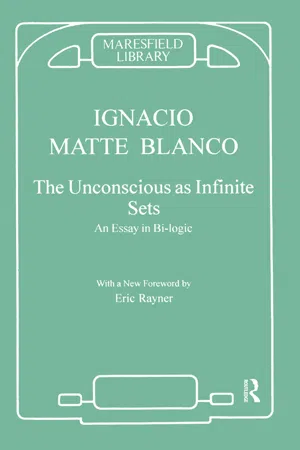
- 502 pages
- English
- ePUB (mobile friendly)
- Available on iOS & Android
eBook - ePub
About this book
A systematic effort to rethink Freud's theory of the unconscious, aiming to separate out the different forms of unconsciousness. The logico-mathematical treatment of the subject is made easy because every concept used is simple and simply explained from first principles. Each renewed explanation of the facts brings the emergence of new knowledge from old material of truly great importance to the clinician and the theorist alike. A highly original book that ought to be read by everyone interested in psychiatry or in Freudian psychology.
Information
Part One
Introduction
… the other view, which held that the psychical is unconscious in itself, enabled psychology to take its place as a natural science like any other. The processes with which it is concerned are in themselves just as unknowable as those dealt with by other sciences, by chemistry or physics, for example; but it is possible to establish the laws which they obey and to follow their mutual relations and interdependences unbroken over long stretches – in short, to arrive at what is described as an ‘understanding’ of the field of natural phenomena in question.
This cannot be effected without framing fresh hypotheses and creating fresh concepts; but these are not to be despised as evidence of embarrassment on our part but deserve on the contrary to be appreciated as an enrichment of science. They can lay claim to the same value as approximations that belong to the corresponding intellectual scaffolding found in other natural sciences, and we look forward to their being modified, corrected and more precisely determined as further experience is accumulated and sifted. So too it will be entirely in accordance with our expectations if the basic concepts and principles of the new science (instinct, nervous energy, etc….) remain for a considerable time no less indeterminate than those of the older sciences (force, mass, attraction, etc…). (Freud, An Outline of Psycho-analysis, 1940, pp. 158–9, my italics)
1.
Scope, Outline and Meaning of this Book
1. The difficulties of present-day psycho-analytic theory
In the course of its development psycho-analysis has outgrown to a considerable extent its own theory and finds itself in a situation comparable to that of an adolescent who has outgrown his clothes and feels restricted, hampered in his movements and uncomfortable. The finding of significant new facts – and I do not mean by this just simple elaborations of already well-established discoveries – has become increasingly difficult on account of the lack of an appropriate frame of reference against which new facts can be seen. The result is that much of the inexhaustible wealth offered daily by clinical reality is simply not seen because it does not fit in with the theories in use. If this situation continues indefinitely psychoanalysis, as a science and as a technique for helping patients, runs the risk of falling into a circular and sterile pursuit of an ever-escaping psychical reality; it will become like an animal attempting to catch its own tail. As a result of this, the image of the dogmatic, self-satisfied analyst who is closed to and afraid of new developments is becoming increasingly frequent, and one is reminded of the futile subtleties of some medieval theologians or of some Talmudic interpreters. But one is also reminded, and this is distressing, of the evolution of some animal species which in the course of time exaggerated the development of certain characteristics to the detriment of their survival; this, for instance, was the case with some wild boars whose tusks became so twisted that they finally made eating an impossibility.
There is no doubt that psycho-analytic theory needs reformulating and we are witnessing at present various attempts at doing so.
It seems that it is necessary first to try to understand where psycho-analytic theory is insufficient. In order to do this satisfactorily one must have some clear ideas on a fundamental question: the relation between theory on the one hand, and facts and fact-finding on the other.
I believe it is accurate to say that at the present moment a large proportion of analysts tend to avoid theorising in order to concentrate, so one frequently hears, on clinical facts. Such an attitude seems ingenuous and those who adopt it seem to be unaware that in fact they are living on borrowed income: somebody else’s income. For they do not seem to realise that the facts they discover are precisely, and no more than, those which the theories to which they subscribe enable and allow them to find. The examples in favour of this assertion could be multiplied at will, and I shall only mention one or two. When the so-called castration complex was found, a great deal of the clinical material was interpreted in terms of it, and nothing was seen in terms of, say, introjection or envy of the breast. It would be unwarranted to assume that the patients seen in that period did not show any signs corresponding to these later concepts: only that such signs were not noticed, for the simple reason that the corresponding concepts were not yet available. In a similar way, the type of interpretation we nowadays give may be an accurate reflection of the clinical material at hand but not necessarily a complete reflection of it. We do not know how many things pass unnoticed by us in the data offered by our patients, simply because we do not have the frames of reference which would enable us to see such things.
When (for example) we hear people giving interpretations in terms of relations with the internal object, or of the role of container played by the analyst, or of the envy of the breast, as also represented by the analyst, one frequently gets the impression that such interpretations are correct and conform with the clinical evidence. At the same time, when observing such commendable therapeutic activity sometimes one cannot avoid feeling that the therapist is convinced that his interpretations cover the totality of what is happening to the patient and that he is implicitly conveying his own certainty that there is no more to be known about it. It is in cases of this type that one can see the intimate link existing between the frame of reference employed and fact-finding. Interpretations of the type just mentioned are based, as can easily be seen, on a three-dimensional analogy; if instead of this analogy we were to use, say, a five- or six-dimensional analogy, the whole material presented by the patient would be seen in a quite different light. Various interrelations so far invisible would become evident and one would have a new understanding of the patient. The ‘internal object’ itself would then become something corresponding more intimately to actual psychical reality, for it would then be possible to realise that something which at a lower dimension is experienced as a separate object, becomes, at a higher dimension, a constituent of the whole. One would, in this case, be more able to approach the proper formulation of a question which has become urgent in recent times: what are the respective roles of the unity of the individual and of internal objects? On the one hand, we cannot avoid feeling that each individual is one and is something that confronts other individuals; on the other, we cannot reject the evidence in favour of the internal object. It must be recognised that present-day psycho-analysis has no satisfactory answer to this question.
To return to the internal object and the container, we may now consider an alternative way of understanding the data given by our patients. The notion of multidimensional space (which is the concept referred to in the alternative mentioned above) is not studied exhaustively in this book and only some initial approach to it is made. Instead, the relation between space-time and spacelessness-time-lessness, is the object of a more detailed study. Now, if the material offered by patients is systematically studied in this light, many as yet unnoticed facts become apparent and we are then able to understand and help our patients better. We may, for instance, find that the same material shows signs of several levels (in the sense studied in Part IV) in action simultaneously. At a more superficial level we may find the relationship between separate persons, whereas at an intermediate level, instead, the persons are ‘lived’ as objects which may be inside, or inside which one may be. This is the level of envy, of projective identification and containers. At a still deeper level the distinction between persons or between objects begins to lose sense in the same proportion as spatio-temporal notions begin to fade away. Correspondingly, the concept of aggression, after having passed through levels of infinite magnitude, begins to recede into the background. The fundamental unity of subject and object makes itself increasingly felt, until a moment comes when speaking of projective identification no longer has any sense; we are at the level of the basic matrix of projection and introjection. The notion of envy is, at this level, no longer pertinent.
The above is only a summary and a schematic description of an alternative way of looking at given material which had first been interpreted in terms of current analytical views. It would be possible to give many more clinical examples which would show in detail how, starting from the associations of the patient, one may reach different types and different degrees of understanding, and hence of therapeutic help, according to the type of approach. The type of approach, in turn, depends on the frame of reference used in the study of reality; or, as is usually said, it depends on the theory in the light of which reality is seen.
For this reason it becomes imperative to reach a clear stand on the question of the relationship between facts and theory.
Clinical facts, frame of reference and theory. At this point we must ask: what actually is a fact, whether clinical or otherwise? The position which assumes that facts are things in themselves, independent from the way they are observed, is frequently found among clinicians and is the origin of much superficial theorising, of which people are not aware. Let us consider a very simple fact: the time at which an aeroplane arrives at a given airport. It may be, for instance, 6.30, and this appears to be quite precise. But if the country where the plane arrives has adopted summer time it will be 7.30. It will, then, be equally true to say that the plane arrives at 6.30 or 7.30. Now if the country from which it started is very far off, the time of arrival expressed in terms of hours may vary from 6.30 to 19.30, according to which country’s time is chosen to express the arrival in question.
We may also adopt another convention and correlate the time of arrival with the rising of the sun at the place where it arrives. In this case the plane will arrive before sunrise, at sunrise or after sunrise, according to the time of the year. If, instead, we prefer to change the place in relation to whose sunrise we measure the arrival, we may then arrange things in such a way that every day of the year the plane will arrive exactly at sunrise, only the sunrise of each day will be that of a different place from the sunrise of all other days of the year.
If instead of adopting a 24-hour day, we adopted a different convention, we might easily arrange things so that the plane arrives at a given day or the next, according to the convention preferred.
If we now consider the word ‘aeroplane’ we soon realise that it means a complex system of relations, say between wings, fuselage, methods of propulsion, etc. A bird has wings but it is not aplane. Cars have engines, like planes, but they are not planes. Wing, fuselage, engines, etc. are, themselves, sets of relations.
And so we finally arrive at the conclusion that all our knowledge of the world is ultimately a knowledge of relations to which that which we call world conforms (in a greater or lesser degree, according to how appropriate the relations chosen are). The true reality, the noumeno, of the world is unknown to us. A fact is, therefore … a relation between two events; and an event is itself another relation, so that in the end the only things we may discover are relations, relations between relations, relations between relations between relations, and so on. We could define these as events. And I imagine that it is because of this that some contemporary philosophers and mathematicians have come to define the world as composed only of events, which do not happen to matter, nor to anything else, but simply happen…
A fact is something that is always defined against a frame of reference, and this frame itself is a system of relations. The same underlying ‘reality’ may be described against various frames or systems or relations, some of which may be more appropriate to it and belong to a more general order, which will permit us to make more accurate predictions and a greater number of them. (Matte Blanco, 1954, p. xxxi)
The position just outlined is that generally adopted by philosophers of science, and unfortunately frequently ignored by researchers, who sometimes do not seem to be aware that they are never describing facts in themselves, because such things do not exist. Perhaps it is useful to give two significant quotations to clarify the meaning of the concept underlying the word ‘theory’. Von Mises (quoted by Szasz, 1959) writes:
Since the time of Ernst Mach, natural scientists have known that the explanation or the theory of a group of phenomena is only a description of the facts at a higher level.
On the other hand, Braithwaite (1953, pp. 367–8) says:
Nature does not provide separately both facts and laws; our statements of laws are a way of describing observed facts and of predicting facts at present unobserved. The form of a statement of a scientific hypothesis, and its use to express a general proposition, is a human device; what is due to Nature are the observable facts which refute or fail to refute the scientific hypothesis.
… The function of mathematics in science has been shown to be, not that of admitting only hypotheses of a pre-ordained form, but that of providing a variety of methods for arranging hypotheses in a system; knowledge of new branches of mathematics opens up new possibilities for the construction of such systems.
As can be seen, this author speaks of hypothesis, system and law. In psycho-analysis it is common to speak of theory. Personally, I prefer to employ the term ‘frame of reference’, rather than ‘theory’, because the latter is historically loaded with a collection of meanings which are better avoided. I am referring to the fact that the word theory frequently evokes the concept of guesses, which may be more or less warranted, more or less happy, or be accurate; or elaborations which may be rather distant from our initial observations and which may or may not turn out to be true. In contrast the expression ‘frame of reference’ has a more restricted meaning: that of a system of relations into which our observation of reality directly fits. In other words, it is more immediate, and aims at being more directly in contact with the reality under study. It is more directly at the service of this reality, ready to be changed as soon as new observations make us aware that the frame is not capable of describing them satisfactorily. But such a distinction between theory and frame of reference is ultimately a matter of convention and we may agree to employ both terms as synonymous. What seems to be important to keep in mind is that sound scientific research aims at creating frames of reference which are, so to speak, directly suggested by our intellectual contact with reality and which are modified as fresh contacts suggest changes in the frame which is being used.
Psycho-analytic theories or basic concepts have become manifestly insufficient. Psycho-analysis has been developed within the frame of three closely interconnected concepts: instinct, energy and space. The first refers to the biplogical nature of man, whereas the latter two establish some contact between the concepts of mind and matter, since both of them are also fundamental in the study of inanimate nature. As Freud himself has remarked, this ‘intellectual scaffolding’ may be ‘modified, corrected and more precisely determined as further experience is accumulated and sifted’. It seems that this is precisely the present case of all three. The concept of instinct has been the object of intensive studies among biologists, ethologists and psychologists, and though its essential features do not seem to have changed since the times of William James, an enormous amount of information has been gathered in the course of time which is of great relevance to psycho-analysis as a conception and a technique. Much work needs to be done in order to introduce this relevant information into psycho-analytical thinking and this task has already been started by various researchers, foremost among whom is Bowlby.
The concept of energy is the basis of the dynamic and economic points of view in psycho-analysis as generally accepted. The concept of space is the background to the topographical and structural points of view and to the notion of object. As this assertion may be questioned it deserves some comment. Freud preferred to employ the term ‘topographic’, but he explicitly treated ‘structural’ as synonymous to it, as we shall see in Part III. ‘Topographic’ clearly refers to space, as do expressions such as ‘depth psychology’, “deep unconscious’, ‘surface of the mental apparatus’, ‘barrier’, ‘keeping away from consciousness’, ‘return of the repressed’, ‘projection’, ‘introjection’, ‘internal object’, ‘internalisation’, ‘extemalisation’, ‘external object’, ‘container’, ‘blowing up’, ‘tearing into bits’, ‘reparation’, ‘deviation of energy’ (sublimation), ‘displacement’, ‘turning against the self’, and various others. Some, instead, question the accuracy of the view that the so-called structural conception is a topographical one. The fact is, however, that it employs the same spatial metaphor as all the expressions just mentioned. This can easily be seen if one considers that Freud spoke of ‘regions or provinces’ of the mind, and that this is a topographical comparison. Freud also made a diagram in which at least some of the relations between the three psychical instances are studied in terms of the comparison with space.
All the same, the problem is that all the spatial comparisons so far usually employed in psycho-analysis are appropriate to describe physical phenomena and are insufficient to describe mental phenomena. In fact all such comparisons are based on the three-dimensional analogy and it is extremely improbable that psychical phenomena can be described in terms of only three dimensions. Yet, the psycho-analytic literature is most strangely silent about this fundamental prem...
Table of contents
- Cover
- Half Title
- Title
- Copyright
- Dedication
- Contents
- Foreword
- Preface
- Acknowledgments
- PART I: INTRODUCTION
- PART II: INDISPENSABLE NOTIONS
- PART III: FROM THE UNREPRESSED UNCONSCIOUS TO THE SYMMETRICAL MODE OF BEING
- PART IV: SYMMETRICAL BEING (UNREPRESSED UNCONSCIOUS) AS INFINITE SETS
- PART V: THE INFINITE SETS AND THE QUESTION OF MEASUREMENT OF UNCONSCIOUS PROCESSES
- PART VI: ON THE NATURE OF EMOTION
- PART VII: THE GENERAL LAWS OF THE BIPOLARITY SYMMETRICAL-ASYMMETRICAL OR UNCONSCIOUS-CONSCIOUS
- PART VIII: A RETROSPECTIVE LOOK AND A GENERAL PERSPECTIVE
- PART IX: SPACE AND MIND
- Appendix: Emotion, Magic, the ‘Numinosum’ and the Infinite. A Comment on Sartre
- Bibliography
- Index
Trusted by 375,005 students
Access to over 1.5 million titles for a fair monthly price.
Study more efficiently using our study tools.
Frequently asked questions
Yes, you can cancel anytime from the Subscription tab in your account settings on the Perlego website. Your subscription will stay active until the end of your current billing period. Learn how to cancel your subscription
No, books cannot be downloaded as external files, such as PDFs, for use outside of Perlego. However, you can download books within the Perlego app for offline reading on mobile or tablet. Learn how to download books offline
Perlego offers two plans: Essential and Complete
- Essential is ideal for learners and professionals who enjoy exploring a wide range of subjects. Access the Essential Library with 800,000+ trusted titles and best-sellers across business, personal growth, and the humanities. Includes unlimited reading time and Standard Read Aloud voice.
- Complete: Perfect for advanced learners and researchers needing full, unrestricted access. Unlock 1.5M+ books across hundreds of subjects, including academic and specialized titles. The Complete Plan also includes advanced features like Premium Read Aloud and Research Assistant.
We are an online textbook subscription service, where you can get access to an entire online library for less than the price of a single book per month. With over 1.5 million books across 990+ topics, we’ve got you covered! Learn about our mission
Look out for the read-aloud symbol on your next book to see if you can listen to it. The read-aloud tool reads text aloud for you, highlighting the text as it is being read. You can pause it, speed it up and slow it down. Learn more about Read Aloud
Yes! You can use the Perlego app on both iOS and Android devices to read anytime, anywhere — even offline. Perfect for commutes or when you’re on the go.
Please note we cannot support devices running on iOS 13 and Android 7 or earlier. Learn more about using the app
Please note we cannot support devices running on iOS 13 and Android 7 or earlier. Learn more about using the app
Yes, you can access The Unconscious as Infinite Sets by Ignacio Matte Blanco in PDF and/or ePUB format, as well as other popular books in Psychology & Emotions in Psychology. We have over 1.5 million books available in our catalogue for you to explore.