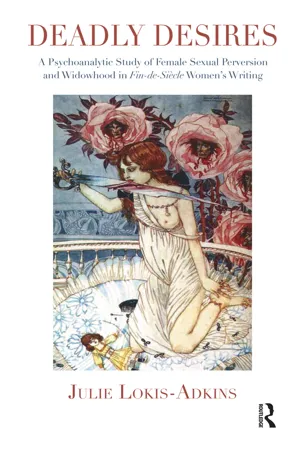
eBook - ePub
Deadly Desires
A Psychoanalytic Study of Female Sexual Perversion and Widowhood in Fin-de-Siecle Women's Writing
- 208 pages
- English
- ePUB (mobile friendly)
- Available on iOS & Android
eBook - ePub
Deadly Desires
A Psychoanalytic Study of Female Sexual Perversion and Widowhood in Fin-de-Siecle Women's Writing
About this book
During the fin-de-siecle, stories about hysterical women filled the air of Paris and the novels emerging during this era conveyed this hysteria and openly portrayed the symptoms of the women being treated at the Salpetiere. This book examines the emergence of hysterical discourse and its influence on women's writing, specifically focusing on the presentation of female sexuality in three different narratives.
Information
PART I
HISTORICAL BACKGROUND
CHAPTER ONE
Widowhood and nineteenth-century culture
Although the field of women’s history has flourished in recent decades, the subject of widowhood is one area where the research is still relatively sparse. When exploring the current studies pertaining to single women in nineteenth-century France, it becomes apparent that researchers have largely examined these women only through their reproductive capacities and their sexuality; therefore, the widowed woman is often neglected. During the nineteenth century, French society held strong to the idea that a woman’s social identity was defined in terms of her reproductive behaviour and marital status; this was especially true during the Ancien Régime and, in spite of the maelstrom of 1789, reinforced by the Code Civil of 1804. Waelti-Walters (1990) shows that in the latter part of the nineteenth century, politicians in France became increasingly concerned about the low birth rate and worked very hard to valorise maternity to such an extent that the terms “wife” and “mother” were inseparable in the public mind. This created a problematic situation for the fin-de-siècle widow, since these women were marginalised by a society that socialised women primarily to be wives and mothers. In considering these societal stipulations placed on a woman’s social importance, it is necessary to determine where the widow fitted into this societal norm. Accordingly, the importance of establishing the extent of social, economic, and legal freedom, or lack thereof, as the case may be, that the widow possessed also becomes vital to understanding her social placement during the fin-de-siècle.
Stearns (1980) has suggested that nineteenth-century society was more sympathetic to the widow in comparison to her unmarried counterparts and that this was directly linked to the widow having accepted and fulfilled her marital and reproductive duties as a woman. Generally speaking, the widow had done the right thing: she had married and usually borne children. Still, the social situation at the fin-de-siècle reflected the belief that men and women should inhabit different spheres: men belonged to the public realm and women to the private. This obviously created a problematic situation for the widow, since she was no longer part of a couple and was, therefore, living outside this public vs. private arrangement. At the fin-de-siècle, women were expected to stay at home and raise children while men were given free rein in the outside world. As a result, men had significantly more sexual freedom than women and, recalling the diagnosis of hysteria, women who showed an overt sexuality, especially outside of marriage, were deemed mentally ill. This being the case, given the focus of this study, it prompts us to ask how these misogynistic ideas influenced women’s writing about their female heroines. Second, it raises the question of how the widow fits into this nineteenth-century and, in many ways, twentieth-century ideal which values the woman solely as wife and mother.
When examining the subject of widowhood in a study such as this one, it is necessary to look at the particular events that specifically contributed to the onset of widowhood. Logically speaking, there are two main “entrances” into widowhood that were specific to the fin-de-siècle period on which this project focuses: death caused by war and the shorter life expectancy among men compared with women. As the nineteenth century was a time of great political and social disturbance in France, the number of men killed during its many wars was immense. At the dawn of the nineteenth century, the Napoleonic Wars contributed to the death of over two million soldiers, not to mention the hundreds of thousands of civilians who also lost their lives during this time. Turning to the fin-de-siècle, on which this book focuses, this period reveals a further instance that points to a particularly remarkable era in the history of widowhood. The Franco-Prussian War, lasting less than one year from 1870–1871, resulted in a large number of young widows living in France. It is estimated that in addition to the numerous men killed on the battlefield, there were an additional 590,000 civilian deaths throughout France that were attributed to the smallpox epidemic that spread among the French population. This book emerges from this unusual socio-historical situation. Old women, where one might at first glance expect to find widows categorised, were replaced by young, reproductively capable women restricted to single life because of their widowed status. Within the socio-historical situation of women at the fin-de-siècle, the widow was not always old, but could very well be young, sexually charged, and actively desiring. This study will demonstrate that widows were an important demographic at the end of the nineteenth century, not only in society but also in the fin-de-siècle novel.
When examining the governmental regulations established for women during the fin-de-siècle, it becomes clear that the Code Civil did not allow them much freedom: social, economic, or legal. During this era of French history, women were effectively treated as minors. They were denied citizenship, the right to vote, control of the family property or issues pertaining to finance or children and the right to divorce (prohibited in 1816, but reinstated in 1884); married women could even be imprisoned for committing adultery. In contrast, the Code Civil did grant special rights that were exclusive to widows, designed to protect them and allow them a greater freedom in comparison to other types of women. Although it is true that widows were often viewed as an economic handicap by society, when examining the socio-economic and legal situation for widows at the fin-de-siècle it becomes clear that the government allowed the widow certain rights which were unavailable to other women. For example, the widow was allowed to keep all of her own earnings and, more often than not, control of her own property. If she were simply divorced or separated from her spouse, the common law at the fin-de-siècle stipulated that the woman would lose all of her personal property and would be obliged to surrender all rights to any land the couple had owned throughout their marriage; in other words, the widow had rights which other single women were not allowed. Considering this, a fin-de-siècle woman could see widowhood as a release from a less than ideal husband. However, as will be explored in this book, widowhood was not always a situation that resulted in social autonomy, even if it did normally offer greater economic and legal freedom. In many cases, widows were expected to follow stipulations set for them by their late husband, and, although they enjoyed certain liberties which other single women did not have access to, widows often had to deal with the constraint of male domination even after the death of their husband or risk being thrown into the Salpêtrière.
Despite enjoying certain economic and legal freedoms that were unavailable to other single women, the fin-de-siècle widow did face certain social limitations. As Blom (1991) confirms, “In France, even younger widows were urged to retire piously from the world” (p. 201) and this was primarily attributed to the male (and, in some cases, female) belief that the sexually experienced and sexually independent woman was dangerous. Examining both the historical situation and the literature written about widows at the fin-de-siècle suggests that these women were placed under exceptional scrutiny by society, especially with regard to how they handled themselves during the months immediately following their husband’s death. The common belief held at the fin-de-siècle was that a sexually knowledgeable, mature woman, whose passion had not subsided after widowhood, was to be feared. This is evident in various theories relating to female hysteria and the single woman that emerged at the turn of the century. There was a widespread belief that when a widow was no longer able to release her sexual energy through marriage, she became a threat to society and social familial morality; this makes the widow a powerful symbol of sexual disorder and destruction. Gittens attempts to explain this phenomenon by relating this fear to a more contemporary belief held among women today. She states,
Living outside a male-headed household also meant that such women were often perceived as sexual threats to other women’s husbands and lovers, much as separated and divorced women are today. At this time women were believed to have much greater sexual needs than men, so that unattached women were seen as particularly dangerous. (Gittens, 1985, p. 41)
Because of the widow’s supposed unfettered sexual longing, she was often seen as a source of cultural and societal anxiety and this was especially the case for younger widows, as this book explores. With this in mind, although the widow might have enjoyed greater economic and legal freedom when compared to other single women, she was socially vulnerable as she inhabited an ambiguous sexual state; she was no longer seen as the marriageable, and marketable, virgin, but as a sexually experienced woman.
CHAPTER TWO
Rachilde, widowhood, and the fin-de-siècle
When examining texts written during the nineteenth century, it becomes clear that the widow figure is rarely cast as a main protagonist; instead, she most often plays the part of a suspicious aunt or dubious neighbour and almost never assumes the role of the leading female protagonist. This being said, however, widows are present in some of the most prominent literary works emerging from this era. In fact, some of France’s greatest novelists—Balzac, Flaubert, Maupassant, and Zola—all chose to include widows in their literature. When examining these different texts emerging from the nineteenth century, it becomes evident that the representation of the widow figure underwent some transformations that almost certainly shaped the way in which people viewed (and read) this type of woman. What one often finds in literature written during the fin-de-siècle is that the language used to describe the widow is dependent on how the woman comes to be widowed; this is directly related to the level of narrative sympathy shown in the text towards the widow. For instance, in some cases the widow is shown as a victim of circumstance, whereby widowhood is depicted as an unfortunate state of being. In other cases, the widow is shown as a conniving, manipulative female figure, often insinuating that widowhood is in some way her fault. The literature I examine in this book is different, not only because of the way that widowhood is used in the narrative, but because the female protagonists purposely cast aside their traditional “feminine” sexual identity in order to achieve an enormous, and for the nineteenth-century reader, worrying amount of power over their male lovers.
I have chosen to look at one particular female author in this study, Marguerite Eymery (1860–1953), who wrote under the androgynous pseudonym Rachilde. In recent years, Rachilde has been the subject of much scholarly research, specifically in terms of psychoanalytical analysis of her texts. After George Sand, Rachilde is arguably the nineteenth-century French woman writer in whom critics have shown the most interest. Her novels have been portrayed as a prominent example of Decadent writing and have been examined alongside the works of Jean Lorrain, Paul Verlaine, Remy de Gourmont, and Joris-Karl Huysmans as extending a fin-de-siècle aesthetic of perversity and deathliness. Ernest Gaubert dubbed Rachilde the “Reine des Décadents”, and although some critics have been derogatory towards her writings, describing her works as misogynistic and using such terms as “ludicrous” when referring to her often perverse or outlandish plots, she has still managed to hold the fascination of both readers and literary analysts alike.
Much of the focus on Rachilde has been limited to the realm of her personal life as a female French writer in the nineteenth century, as well as to the women’s social issues which her writing addresses. With the influx of studies focusing on women’s writing and feminist texts over the past few years, the works of Rachilde have gained a great deal of notoriety and have become the topic of much critical interest. There are many reasons that contribute to her rise in popularity over recent years. She led an unusual life, claiming not to be a feminist and allegedly engaging in lesbian affairs despite being married. In addition, although it is difficult to situate Rachilde’s writings into a specific literary genre, elements of both Realism and Naturalism can be found in her work. For example, her stories are full of deviant and often “monstrous” heroines and, although other fin-de-siècle novels, such as Nana, depict monstrous women, Rachilde’s heroines are more shocking than those of writers such as Zola. The avant-garde aspects of Rachilde’s literature set her apart from her literary contemporaries; in fact, I would argue that it was specifically Rachilde’s progressive way of writing about women that helped to launch her on to the French literary scene at the fin-de-siècle. In this respect, Rachilde’s literature could also be defined as anti-idealist, and I would argue that this anti-idealism manifests itself primarily as irony in her texts. The difficulty of deciding where to position Rachilde in relation to fin-de-siècle literary genres is perhaps one reason why she has been re-established as a literary figure worth examining.
The present study aims to counter the primarily biographical interest a first wave of feminist critics had in Rachilde’s work by analysing, in depth, the connections between widowhood and female desire through exploring what factors lead Rachilde’s female protagonists to either realise or to deny their own sexual freedom. Each of the heroines I examine wish to remain sexually autonomous and, as a result, female desire becomes the driving force of the plots. This desire is often facilitated (and sometimes hindered) by widowhood. In the three novels examined, female sexuality is divorced from reproduction and detached from the expected sexual duties of the wife; instead, these women take control of their sexuality, and sometimes that of their male partners and, as a result, they challenge the familiar assumption that the male is active and the female passive.
Although widowhood is virtually absent from the narratives until the end, except in the case of La Jongleuse, Rachilde makes it clear to her readers that women who ignore their “natural” female destiny in order to pursue their independence ultimately fail to realise their potential and end up either alone or dead. Although Rachilde proclaimed that she was not a feminist and dubbed herself an Homme de Lettres, I think Rachilde was indeed a feminist and that this is reflected in her writings. Driven by women’s extreme subordination, as seen in the nineteenth century, Rachilde initially portrays widowhood in her texts as a possible path towards freedom. However, as dictated by the historical situation for widows at the fin-de-siècle, Rachilde uses the theme of widowhood to exemplify the fact that female autonomy is ultimately unattainable; in other words, even in instances where the husband is dead, although often enjoying greater economic and legal freedom, widows are nevertheless subject to male control.
On the one hand, the widow was viewed with compassion and empathy; on the other hand, she was often the object of society’s mockery and apprehension. It is evident that the widow is a figure who is very difficult to define, since she was always characterised by contrasting extremes, both socially and literarily; she is either portrayed as lavishly rich or utterly poor, a merry widow enjoying a life of sexual freedom, or the pious woman living a lifetime of mourning. There is often no “in-between” when describing the nineteenth-century widow. Amid these contrasting extremes, however, it is evident that the widow presented a problematic figure within nineteenth-century French society. Both the literary analysis undertaken in this book, and this brief explanation of the socio-historical situation for the fin-de-siècle widow, demonstrate that the sexual needs and desires of these young women lived beyond the death of their husband. Yet, as Rachilde points out in her literature, society’s need to restrict these female desires and render these women sexually untouchable has a destructive effect on the lives of these young widows. The historical situation for the widow at the fin-de-siècle and the destructive ending of each of the novels examined suggests that Rachilde believes that marriage and motherhood remain the best choices for women. Contrary to her heroines’ beliefs on marriage, Rachilde agrees with her readers that widowhood cannot, in fact, offer an escape from patriarchal control.
As has been established, the widow is unique when compared to other women at the fin-de-siècle for the reason that she is at once socially empowered because of her widowed status, but also socially condemned for the very same reason. Rachilde suggests that there is no escape from patriarchal control; in other words, the man will always have the control whether he is alive or dead. Through the analysis of Rachilde’s three novels, I argue that it is as if Rachilde places her heroines in the exact place she does not want them to be; that is, subject to a man’s authority that is inescapable even in widowhood. Rachilde shows how society’s influence dictates her heroines’ perverse acts and inevitable decline. As a result, the avant-garde aspects of Rachilde’s writings become evident, especially when taking into consideration the historical situation for women at the time her novels were published. Through her writings, Rachilde successfully demonstrates how destructive nineteenth-century patriarchal structures can be to a woman’s intelligence and freedom to desire.
Although Rachilde wrote over sixty works, including novels, plays, and personal essays, I have chosen to focus on three specific novels: Monsieur Vénus (1884 [English translation 1992]), La Marquise de Sade (1887 [English translation 1994]) and La Jongleuse (1900 [English translation 1990]). Although I have primarily consulted with th...
Table of contents
- Cover
- Half Title
- Title Page
- Copyright Page
- Table of Contents
- Acknowledgements
- About the Author
- Dedication
- Preface
- Introduction
- Part I: Historical Background
- Part II: Monsieur Vénus
- Part III: La Marquise de Sade
- Part IV: La Jongleuse
- Conclusion
- Bibliography
- References
- Index
Trusted by 375,005 students
Access to over 1.5 million titles for a fair monthly price.
Study more efficiently using our study tools.
Frequently asked questions
Yes, you can cancel anytime from the Subscription tab in your account settings on the Perlego website. Your subscription will stay active until the end of your current billing period. Learn how to cancel your subscription
No, books cannot be downloaded as external files, such as PDFs, for use outside of Perlego. However, you can download books within the Perlego app for offline reading on mobile or tablet. Learn how to download books offline
Perlego offers two plans: Essential and Complete
- Essential is ideal for learners and professionals who enjoy exploring a wide range of subjects. Access the Essential Library with 800,000+ trusted titles and best-sellers across business, personal growth, and the humanities. Includes unlimited reading time and Standard Read Aloud voice.
- Complete: Perfect for advanced learners and researchers needing full, unrestricted access. Unlock 1.5M+ books across hundreds of subjects, including academic and specialized titles. The Complete Plan also includes advanced features like Premium Read Aloud and Research Assistant.
We are an online textbook subscription service, where you can get access to an entire online library for less than the price of a single book per month. With over 1.5 million books across 990+ topics, we’ve got you covered! Learn about our mission
Look out for the read-aloud symbol on your next book to see if you can listen to it. The read-aloud tool reads text aloud for you, highlighting the text as it is being read. You can pause it, speed it up and slow it down. Learn more about Read Aloud
Yes! You can use the Perlego app on both iOS and Android devices to read anytime, anywhere — even offline. Perfect for commutes or when you’re on the go.
Please note we cannot support devices running on iOS 13 and Android 7 or earlier. Learn more about using the app
Please note we cannot support devices running on iOS 13 and Android 7 or earlier. Learn more about using the app
Yes, you can access Deadly Desires by Julie Lokis-Adkins in PDF and/or ePUB format, as well as other popular books in Literature & Feminist Literary Criticism. We have over 1.5 million books available in our catalogue for you to explore.