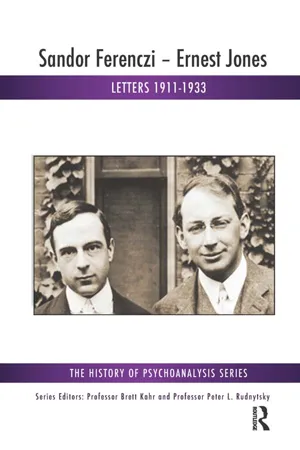
eBook - ePub
Sandor Ferenczi - Ernest Jones
Letters 1911-1933
- 246 pages
- English
- ePUB (mobile friendly)
- Available on iOS & Android
eBook - ePub
Sandor Ferenczi - Ernest Jones
Letters 1911-1933
About this book
The Ferenczi-Jones correspondence presented here is an important document of the early history of psychoanalysis. It spans more than two decades, and addresses many of the relevant issues of the psychoanalytic movement between 1911-1933, such as Freud's relation to Stekel, Adler and Jung; the First World Wa;, the debates of the 1920s regarding the theoretical and technical ideas of Rank and Ferenczi; problems of leadership, structure, and finding a centre for the psychoanalytical movement; as well as issues related to telepathy and lay analysis. It includes thirty-seven letters and six postcards, as well as original documents waiting to be found for eight decades; these belong to the 'private', personal history of psychoanalysis and help to decode diverse aspects of the experience preserved in these documentary memories of former generations.Perhaps the most interesting aspect of this correspondence is how it allows us to build up a far more nuanced picture of the development of an extraordinary relationship between Ferenczi and Jones. It could hardly be termed harmonious, and was not devoid of rivalry and jealousy, sometimes even of hidden passion and outright hostility. Nevertheless, friendship, sympathy, collegiality and readiness for cooperation were just as important for Ferenczi and Jones as rivalry, mistrust and suspicion. This volume celebrates the 100th anniversary of the foundation in 1913 of both the British and the Hungarian Psychoanalytical Societies.
Information
LETTERS
1F
DR. FERENCZI SÁNDOR BUDAPEST, VII, ERZSÉBET-KÖRÚT 54.
Budapest, 8 April 1911
Dear Friend1
I too must content myself with the English salutation and have to write the letter itself in a language I am more familiar with. My thanks for having remembered me, for sending proof of your diligent and productive psychoanalytic activity, and for your detailed and appreciative review of my work on suggestion.2 With professor Freud, we often talked about our friends in America and took pleasure from this small but steadfast group of supporters across the ocean.
Psychoanalysis—once unleashed—is like energy, it cannot be destroyed. It will not leave people in peace until they come to terms with it. It is no use to struggle or resist; its biggest enemies are those who suffer most from its revelations; Ziehen,3 Kräpelin4 and Oppenheim5 must have to dream psychoanalysis, given their rejection of it by day.
I myself am well. Unfortunately, I have too many analytic hours and therefore write too little—my all too abundant experience has hardly been put to use on paper this year. It makes me admire your capacity for work all the more.
Next Thursday, I will travel to Tyrol with Professor Freud. He is looking for a summer house there for his family. I very much look forward to our spending this time together.6
In Vienna, Adler7 (seconded by Stekel8) is beginning to take up a particular scientific position: he overemphasises the organic, the self-preservative drive—and scotomises sexuality in a rather tendentious fashion.
One must fear that those who do not altogether have a firm grasp of things themselves, might keep them company in this “reactionary” departure.
I hope your letter betokens the beginning of a regular correspondence and that you will come over for the congress (due to be held in Weimar9).
Kindest regards,
Ferenczi
Notes to letter 1F
1.In English in the original.
2.“Introjektion und Übertragung. Eine psychoanalytische Studie: 1. Die Introjektion in der Neurose. 2. Die Rolle der Übertragung bei der Hypnose und bei der Suggestion” (Ferenczi, 1909[67]) appeared in the Jahrbuch (1[1909]: 422–457), and was translated by Jones in Contributions to Psycho-Analysis with the title: “Introjection and transference. 1. Introjection in the neuroses. 2. The part played by transference in hypnotism and suggestion” (Ferenczi, 1916[186], pp. 35–93). Ferenczi might be thanking Jones for sending him his “The action of suggestion in psychotherapy” (Jones, 1911), which had been published in January in the Journal of Abnormal Psychology. If so, he would change his mind about Jones’ paper, coming to see it as plagiarising his own work (see Ferenczi’s letter to Freud, 26 December, 1915 in Freud–Ferenczi, 2, p. 99, on the accusation of plagiarism see also 25F, note 3).
3.Theodor Ziehen (1862–1950), was a German psychiatrist and experimental psychologist with a special interest in child psychology. For an account of his antipathy towards psychoanalysis, see, for example, the letter from Karl Abraham to Sigmund Freud, 10 November 1908 in Freud– Abraham, p. 64.
4.Emil Kraepelin (1856–1926), a German psychiatrist, was Professor of Psychiatry at Munich University from 1903 to 1922. The system of classification for psychiatric disorders he devised was enormously influential, most notably his subdivision of the psychoses into dementia praecox (schizophrenia) on the one hand, and manic–depressive insanity on the other. His principal work, Psychiatrie. Ein Lehrbuch für Studierende und Ärtze (Psychiatry. A Text book for Students and Physicians), remained authoritative for a long time and went through many editions. For a brief sketch of his opposition to psychoanalysis at this time, see Falzeder and Burnham (2007, pp. 1226, 1234).
5.Hermann Oppenheim (1858–1919), a German neurologist, was head of the “Berliner Privatpolyklinik für Nervenkranke”, a private clinic for the mentally ill, which became a centre for training and further education for physicians from all over the world. In 1907, he founded the Society for German Neurologists with Wilhelm Erb. For a brief sketch of his opposition to psychoanalysis at this time, see Falzeder and Burnham (2007, p. 1227).
6.Ferenczi and Freud spent two days (16th and 17th April) in Bozen, Southern Tyrol (now Bolzano, Italy). (See Freud’s letter to Jung dated 11 April 1911 in Freud–Jung, p. 415. See also Freud’s letter on 10 April and Ferenczi’s letter on 11 and 24 April 1911, in Freud–Ferenczi, 1, pp. 268–270).
7.Alfred Adler (1870–1937), a physician, was a member of the circle around Freud from 1902 and the first significant follower of Freud to break away, in 1911, and found his own school of “Individual Psychology”. After 1926, he frequently worked in the USA, moving there permanently in 1935. He died in Aberdeen, during a lecture tour in May 1937. According to Jones, Freud had stepped down as leader of the Viennese to make Adler the President of the Vienna Psychoanalytic Association and had given Adler and Stekel control over the Zentralblatt, newly founded in the autumn of 1910. Freud had done so in an attempt to appease the Viennese, who were disgruntled both by his preference for Jung and by Ferenczi’s speech at the Nuremberg Congress proposing Jung as first President of the International Psychoanalytical Association (see Jones, 2, pp. 75–76).
8.Wilhelm Stekel (1868–1940), a neurologist, was one of the first members of the “Wednesday Society”, following his analysis with Freud. He became known in the psychoanalytic movement chiefly for his work on the interpretation of dreams and symbols. Freud made him Adler’s deputy as Vice-President of the Vienna Society in the wake of the Nuremberg Congress. He split from Freud and his circle in 1912 but remained editor (at first jointly with Alfred Adler) of the Zentralblatt until 1914. In 1923, he founded the “Organisation of Independent Medical Analysts”, came out against lay analysis, and developed “Active Analysis”. He spent his last years in London, where he committed suicide. On Stekel’s life and his conflict with Freud, see Bos and Groenendijk, 2007; Gutheil, 1950; Nitzschke, 1992.
9.The third International Congress of Psychoanalysis took place in Weimar on 21 and 22 September 1911. Jones attended it. Originally, Jung wanted to hold it first in Lugano, then in Nürnberg.
2F
DR. FERENCZI SÁNDOR BUDAPEST, VII, ERZSÉBET-KÖRÚT 54.
Budapest, 14 November 1911
Dear Friend,
We are each required to take account of our level of linguistic proficiency,—everything stays as it is: you will write to me in English and I shall write to you in German.—You surprised me again with a whole host of concepts, for which I thank you very much; they caused me to be amazed at the stamina with which you do not cease to produce such quantities1 of work, and work of such qualitative value.
The other things you wrote about are pleasing too. Freud is likely to be right with his assumption that a personal complex has played a role for me. In any case, you must make this attempt—and do not hesitate for too long. I hope your success will justify Freud.
My lymphangoitis made the journey home rather arduous, since I did not manage to secure a sleeper. Though four days of bed rest put everything right again.
—Now to your questions,2 which I shall hardly be able to answer...
Table of contents
- Cover Page
- Half Title
- The History of Psychoanalysis Series
- Title Page
- Copyright Page
- Contents
- ACKNOWLEDGEMENTS
- ABOUT THE EDITORS
- SERIES EDITOR’S FOREWORD
- ABBREVIATIONS
- INTRODUCTION
- CHALLENGES OF HONESTY — Gábor Szőnyi
- AROUND THIS CORRESPONDENCE — André Haynal
- Letters
- Appendix: The Ferenczi-Jones correspondence (list)
- REFERENCES
- INDEX
Trusted by 375,005 students
Access to over 1.5 million titles for a fair monthly price.
Study more efficiently using our study tools.
Frequently asked questions
Yes, you can cancel anytime from the Subscription tab in your account settings on the Perlego website. Your subscription will stay active until the end of your current billing period. Learn how to cancel your subscription
No, books cannot be downloaded as external files, such as PDFs, for use outside of Perlego. However, you can download books within the Perlego app for offline reading on mobile or tablet. Learn how to download books offline
Perlego offers two plans: Essential and Complete
- Essential is ideal for learners and professionals who enjoy exploring a wide range of subjects. Access the Essential Library with 800,000+ trusted titles and best-sellers across business, personal growth, and the humanities. Includes unlimited reading time and Standard Read Aloud voice.
- Complete: Perfect for advanced learners and researchers needing full, unrestricted access. Unlock 1.5M+ books across hundreds of subjects, including academic and specialized titles. The Complete Plan also includes advanced features like Premium Read Aloud and Research Assistant.
We are an online textbook subscription service, where you can get access to an entire online library for less than the price of a single book per month. With over 1.5 million books across 990+ topics, we’ve got you covered! Learn about our mission
Look out for the read-aloud symbol on your next book to see if you can listen to it. The read-aloud tool reads text aloud for you, highlighting the text as it is being read. You can pause it, speed it up and slow it down. Learn more about Read Aloud
Yes! You can use the Perlego app on both iOS and Android devices to read anytime, anywhere — even offline. Perfect for commutes or when you’re on the go.
Please note we cannot support devices running on iOS 13 and Android 7 or earlier. Learn more about using the app
Please note we cannot support devices running on iOS 13 and Android 7 or earlier. Learn more about using the app
Yes, you can access Sandor Ferenczi - Ernest Jones by Sandor Ferenczi,Ernest Jones, Ferenc Eros,Ken Robinson,Judit Szekacs-Weisz, Ferenc Eros, Ken Robinson, Judit Szekacs-Weisz in PDF and/or ePUB format, as well as other popular books in Psychology & History & Theory in Psychology. We have over 1.5 million books available in our catalogue for you to explore.