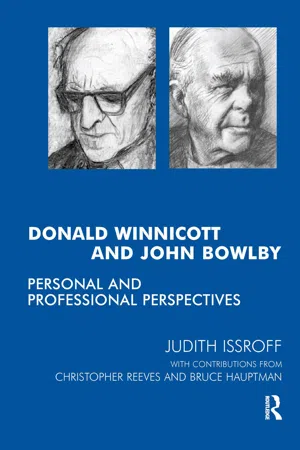
eBook - ePub
Donald Winnicott and John Bowlby
Personal and Professional Perspectives
- 302 pages
- English
- ePUB (mobile friendly)
- Available on iOS & Android
eBook - ePub
Donald Winnicott and John Bowlby
Personal and Professional Perspectives
About this book
A fascinating book that sets Bowlby and Winnicott in context and relation to one another to provide a new perspective on both, as well as providing a welcome testimony to their enduring legacy.
Information
CHAPTER ONE
Winnicott and Bowlby: personal reminiscences
Judith Issroff
Intention of this personal communication
Here, after more than three decades of silence, I pay tribute in personal fashion: by reminiscing, I hope to share a glimpse of the men, their personalities, experience, wisdom, and ways of being in this world. Through my unabashedly subjective views I hope to awaken enthusiasm to pursue their respective écriture in those who may not be familiar with their works. As both were wont to do, I ask myself questions and allow myself to associate freely while trying to answer them. In no way is my attempt to be considered didactic. Because I choose this approach—a patchwork “meandering design”, as Rycroft dubbed such essays (1992, p. 87)—there is no particular argument or linear structure, merely a series of topics and anecdotes comparing and contrasting them. Of course, I comment on areas of their work and their respective contributions. I have tried to separate personal memories from other comparative evaluations, although my chapter topics overlap.
How well did I know Bowlby and Winnicott? How well does one know anyone? To reminisce, I cannot but share some personal history. I am “expert” on neither Bowlby nor Winnicott, but a student, supervisee, and personal acquaintance, in particular between 1965 and 1970. Their contributions, personalities, and styles accompany me in my daily work and life; their wise adages reverberate along with the sayings of others from whom I was lucky to learn. The question “What were Bowlby and Winnicott like?” is answered as I recall my time with them. In their presence, as in their work, the two men were profoundly different.
Acquaintance with Bowlby
I studied at the Tavistock Clinic and School for Family Psychiatry and Community Mental Health (Dicks, 1969; Trist & Murray, 1999) from 1965, before its move to its present Hampstead location, and I worked there from 1966 to 1977. I was John Bowlby’s registrar in the Department for Children and Parents between 1966 and 1968. We became acquainted when he was 61 years old, and soon I became the first senior registrar in the newly formed Adolescent Unit under Derek Miller (1969, 1973, 1983), working there at consultant level after Derek departed for the United States. During my time as trainee, Bowlby spent a sabbatical year in Stanford, so my formal weekly supervision with him lasted for only a year and a bit. I remember John Bowlby, with his fierce, quizzical eyebrows, in his red braces and sometimes a bow-tie, generally formal, polite, face crinkling into an absolutely sincere and genial smile. He was always most proper, somewhat diffident, and very careful in what he said or did not say. He took a lively, kindly interest in and directed and guided all my programmed activities. He invited me to observe during his weekly group with parents and children. I took part in a research group where, despite my own biochemical, laboratory-based scientific research background experience, I felt that my comments and suggestions were not welcomed. (I learned later from Dorothy Heard and Colin Parkes, who worked with him, that they often felt the same.) I attended all the seminars he gave, where, again, questions were not always warmly welcomed.
Bowlby was an enthusiastic teacher, and he steered me to a great deal of useful literature as well as a wide variety of learning-through-experience work and apprenticeship placements and situations with allied professionals. He made me aware of the importance of many areas and clearly had high hopes for the future of all his students and disciples. I was fond of him, liked and respected him, and felt that this was mutual. Although answers were not always forthcoming, nonetheless he always listened well. Years later we did share an intimate moment: while we both knew he had had strategically to maintain his focus of reading and writing for very good reasons, I nonetheless talked with him about my bewilderment that he had ignored the most articulate body of literature about loss, grief, and mourning—that of the Shoah, the Jewish Holocaust, a painful literature that he knew I had been studying steadily since 1967. I asked him why. It enabled me to explain to him that my reading had been stimulated by the very large number of cases of children of survivors that had come my way, both at the Tavistock Clinic and in the private practice I had inherited when Derek Miller left for the United States, together with the Tavistock Adolescent Unit consultant position from which I had voluntarily resigned most of my sessions, because I considered myself too young at the time. I explained to him how I had realized my good fortune in not having been in the position of those I had encountered and about whom I had read, and how I felt about the responsibility of having enjoyed the privilege of further education that my courageous and able refugee grandparents’ and parents’ efforts had permitted me while they denied themselves. These motives had led to my emigration, along with what I had absorbed from Winnicott (1950) about the critical x:y ratio between the x number of relatively traumatized, handicapped, and dependent people a society could contain if it is to be able to operate democratically, for needy people depend on a sufficient y number of those enjoying a measure of health. He listened most attentively, and it was my impression that he was happy to learn why I had left the security of the Tavistock for the difficulties of life in Israel. I told him what a challenge that had been, and how enriching. I write about this to reveal and illustrate how easy it was to talk of personally significant matters with John Bowlby.
One felt that things Bowlby said were completely straightforward. Nonetheless, he was quite capable of side-stepping difficult issues in what were to him distracting, too challenging, or unimportant matters, or he might act in a transparently disingenuous way. For instance, he might agree to be one’s referee when he was going to be on the appointments committee that already had decided to appoint a Maudsley candidate without discussing it, excusing himself, or warning one. Incidents like this ultimately led me to trust Winnicott more.
Despite my warm regard for Bowlby, I felt only superficially acquainted with him. In contrast, I have the illusion that I knew Winnicott quite well. In a way this may be less a matter of time spent together than of their respective ways of relating. Winnicott was capable of a kind of easy intimacy that played no part for John Bowlby. His son, Sir Richard Bowlby, has given me permission to quote him saying that his father displayed “an avoidant attachment style”.1 Bowlby kept his distance, although he was approachable. Winnicott invited and opened himself to intimacy—which may have been an illusory intimacy, in which he was personally distant. Never could Bowlby have triggered personal insights for me to the depth and extent to which Winnicott did so (Issroff, 1995a). Nonetheless, when Bowlby raised his dramatic eyebrows on meeting me at a party (I think it might have been in 1996, held to celebrate the completion of the publication of the Freud Standard Edition), elegantly shod in stiletto heels and wearing a recklessly low-cut, mini-skirted, black lace dress, I realized that while my self-presentation would be perfectly appropriate and unremarkable in Johannesburg in those days, or even in certain London circles, I was over-dressed for this collegial London gathering in the Adams rooms of Mansfield House.2
Bowlby was an avid ornithologist and ethologist, Winnicott a watcher of humans (Morris, 1967, 1970, 1978). While we drank our ritual tea, during which we were often silent—part of the deliberate “quieting” of me so I should experience his and my own profound “being-ness”?—Winnicott might begin one of my supervisions with something like: “I was walking down the Strand today, and there they were—all those nymphets. I thought, ‘What do they want of a father?’ And then it came to me they want to be eaten: loving is eating . . .” This seemingly irrelevant comment, delivered with his sage, offbeat charm, was, of course, pertinent to the case I was analysing with his supervision: that of a two-and-a-half-year-old girl who had never known a father and who, at that point, was functioning predominantly at some early oral stage developmentally—really pre-verbal, for all her apparent precocious ability to speak. Or, at another level, perceptively, he might have been relating to my personal need for fathering, and in this manner he might let me know that he was aware of this.
Richard Bowlby told me that John Bowlby’s father was largely absent: away for four years fighting the War and otherwise a workaholic and an absent father. John identified with his grandfather. So Richard is not surprised that John neglected to explore the other— colour—figure of the primary attachment spectrum: namely, the highly significant bond to the father. A 22-year-long study of fathers carried out in Germany (Grossman & Grossman, in press; Kretchmar & Jacobvitz, 2002) has clearly shown that if there is a secure comfort base in attachment to mother, the bond and role of the father in enabling the characteristically human exploratory, adventuring drive is of immense significance to an adult ability to excel in the sphere of social relationships. John Bowlby used to talk about the imaginary elastic band that tethered a securely bonded and attached toddler to the mother sitting in a park. However, what he overlooked was the need for and role of the father in generating excitement in exploration and adventures and in enabling greater doses of excitement to come to be tolerated by a developing youngster.
John Bowlby was profoundly interested in and bonded “almost worshipfully” with Darwin. Richard thinks he wrote his last book about Darwin essentially for himself, to discover more about his hero. Dyslexia runs in the Bowlby family, and Richard thinks that his father, John, who read little outside his professional passions and interests, was—like Churchill and Darwin—somewhat dyslexic, as is Richard himself, as well as an uncle. But today brain imaging techniques show how widely the brain of a dyslexic lights up in response to a stimulus, how much richer a range of attention is involved in the processing of observable experience than in the narrower, more localized areas employed by those considered non-“handicapped” literate. He describes his father as passionately interested in everything.
John Bowlby involved me intellectually: Winnicott engaged and stimulated me in personal as well as professional ways. I had several unexpected—indeed, pivotal—personal encounters with him.
Encountering Winnicott
Personal contacts
In 1965, when I telephoned Winnicott about the possibility of having personal analysis with him, he graciously rejected me with “Thank you for asking me. I consider it a compliment. But, my dear, I am much too old to take on new candidates.” Shortly thereafter I witnessed him blithely, uninhibitedly skipping down the corridors of the Rijksmuseum, hand-in-hand with Clare, while other sedate participants at the Amsterdam International Psycho-Analytic Congress seriously studied the paintings.
In 1967 Winnicott and I shared a journey from London’s Cromwell Road bus station to Copenhagen airport that was of immense significance for me. During these hours he bewitched, bothered, and bewildered me and mischievously disabused me of any illusions about psychoanalysts and their world. I was entertained—indeed, enthralled and somewhat shocked. The many hours that followed did nothing to alter my level of delight, discovery, and inner series of opening awarenesses and growth.
Because we would have little opportunity to learn from Winnicott unless we approached him ourselves, I initiated and organized the series of seminars held every two weeks at his home from which grew his 1971 book of case studies, Therapeutic Consultations in Child Psychiatry (1971d). He supervised my first child analytic case—that of the precocious fatherless toddler mentioned earlier. I consulted him on important life decisions. When it was crucial to me that he did so, he told me he “had the capacity to dream about me” and had “watched me grow quieter” over the years I went to him for supervision. When, for reasons known only to the Training Committee, I had to leave Charles Rycroft and change analysts, I went to Winnicott to discuss the problem. He scrunched himself into a foetal position in his chair, head buried in his hands, and confided that he felt guilty about having referred a number of well-known professors of psychiatry to analysts with “headpieces” that did not match, so that their analyses had failed. He regretted that he had done “such damage both to psychiatry and to psychoanalysis” (in the United Kingdom) and indiscreetly rattled off a list of eminent names. Concerned that I should be in analysis with someone with a “matching headpiece”, as he called it, and despite my reservations, he directed me to Masud Khan to complete my formal analytic training requirements and, with my permission, he supervised Khan (Cooper, 1993; Groarke, 2003; Hopkins, 2000, in press; Sandler, 2004; Willoughby, 2004). He helped Masud to enable me to experience “being”—and to minimize his “boundary violations” (Godley, 2001a, 2001b, 2004; see also Appendix A)—during the period I was in analysis with him while Winnicott was alive. Masud said that Winnicott had told him that I had learned more from him in five years than others had in twenty-five—but that may not be altogether true (Hopkins, in press; Issroff, 2002b). I wish I had been able to make my own all that Winnicott so generously offered me.
After Winnicott’s death, his widow Clare (Kanter, 2004a) and I were friendly. I became her confidante for a while, and naturally she spoke about him freely. We enjoyed concerts, dined together, spoke frequently on the telephone, discussed what she needed to do as executor of his estate, and so on (Issroff, in preparation-a).
Vicarious encounters with Winnicott are presented in his writing and are unavoidable in all his case presentations. Many people describe personally memorable meetings with him (e.g. Clancier & Kalmanovitch, 1984; Hopkins, 2002; Milner, 2001; Pena, 2001a, 2001b; Roazen, 2002). Marion Milner discussed her own tangled relationship with Winnicott with me, providing me with unexpected glimpses of him in a different personal context. Through Marion Milner (1969, 1978, 2001) I met and have interviewed two women who lived for some years in the home of Donald and his first wife, Alice (Issroff, in press). Donald and Alice are described as having been “made for each other”, but Alice appears never to have been as interested in or involved with his working life. My impression is that while they were affectionately most compatible in many ways, she was not as successful as Clare in sparking off with him playfully and intellectually in relation to his professional life and ideas. Joel Kanter (2004b) depicts Clare and Donald’s professional and personal compatibility in his biographical introduction to Clare Winnicott’s published works, and this is clear in memoirs such as her engaging interview with Michael Neve, which Rudnytsky discovered and transcribed (1991), and her spontaneous reminiscences in 1982, in which she recalls the impact of his “reality”, integrity, and humour, along with much else. He was tough, caring, musical, and notorious for “hair-raisingly” dangerous driving. His sense of timing and capacity to listen were great. He kept a list of friends who had been killed in the War and for whom, he felt, he had to live every moment and make something of his life.
Clare and Donald’s wartime work greatly impacted on the development of his ideas and on the ethos of various residential schools and therapeutic communities. Clare calculated that he had been involved with “60,000 cases” during his long life as a paediatrician, and he left copious, meticulously detailed records. Clare thought he identified with his mother’s liveliness and that the whole family had a remarkable ability to communicate with children: he was confident of being loved, yet he needed to feel appreciated, liked, and loved (C. Winnicott, 1982, and her much re-printed “D.W.W.: A Reflection”, 1978).
Winnicott’s ability to trigger personal insights— “turning points”
From Winnicott I received a series of astonishing—not always comfortable, yet always insight-deepening and growth-promoting—self-revelations that changed me in relation to myself and others. Although I was never in analysis with him, I was, on several such occasions, profoundly affected and altered by the impact of one of his remarks or gestures: in retrospect, I am sure that he was totally cognizant of their effect.
One example of this is our encounter, early in 1967, during the one and only lecture that Winnicott was invited to give at the Tavistock School of Family Psychiatry and Community Mental Health during the five years preceding his death. What happened during that lecture had an impact on me that I can only liken to the kind of unexpected personal awakening described in Zen Buddhist literature. What I experienced was, while not exactly satori, akin to an awakening or opening of “gateless inner gates”. It was not a pleasant experience, but one that exposed me to myself in a kind of private insight striptease that probably saved me months of analysis. This incident was so significant that I will elaborate below. The mutative quality of this personal experience is mentioned to illustrate a rare and special gift of Winnicott’s—one that I attribute to a measure of genius.
What happened inside me has driven out the overt stated subject of that lecture. I remember feeling somewhat stunned with the revelation of paradox, with remarks like: “You see, if you ask a direct question, then you are liable to create a liar” (cf. conventional psychiatric history taking). In my language he was implying that a direct attempt to teach anyone something might well function like an antigen provoking an antibody response, creating a locked, closed, even potentially explosive and personally destructive situation rather than one in which the words might act as a lubricant to facilitate further movement and genuine personal growth.
Of course, some of these notions are familiar ones in terms of increasing resistance when interpretation is premature or rouses too much pain or traumatic memory re-experiences. The main thrust of the lecture was to emphasize that Winnicott was opposed to preaching and to teaching, and to too many impinging interpretations. His technique was in fact a total antithesis to that of the Kleinians, to whose influence and beliefs we trainees at the Tavistock at that time were exposed and subjected daily.
People integrate experience into liveable knowledge only when they discover what they are capable of ...
Table of contents
- Cover
- Half Title
- Title Page
- Copyright Page
- Dedication
- Contents
- Acknowledgements
- About the Author and Contributors
- Introduction
- Chapter One Winnicott and Bowlby: personal reminiscences
- Chapter Two Singing the same tune? Bowlby and Winnicott on deprivation and delinquency
- Chapter Three Reflections on Donald Winnicott and John Bowlby
- Chapter Four Bowlby and Winnicott: differences, ideas, influences
- Chapter Five A duty to care: reflections on the influence of Bowlby and Winnicott on the 1948 Children Act
- Chapter Six Postscript: from past impact to present influence
- Appendix A
- Appendix B
- Appendix C
- Appendix D
- Appendix E
- References and Bibliography
- Index
Trusted by 375,005 students
Access to over 1.5 million titles for a fair monthly price.
Study more efficiently using our study tools.
Frequently asked questions
Yes, you can cancel anytime from the Subscription tab in your account settings on the Perlego website. Your subscription will stay active until the end of your current billing period. Learn how to cancel your subscription
No, books cannot be downloaded as external files, such as PDFs, for use outside of Perlego. However, you can download books within the Perlego app for offline reading on mobile or tablet. Learn how to download books offline
Perlego offers two plans: Essential and Complete
- Essential is ideal for learners and professionals who enjoy exploring a wide range of subjects. Access the Essential Library with 800,000+ trusted titles and best-sellers across business, personal growth, and the humanities. Includes unlimited reading time and Standard Read Aloud voice.
- Complete: Perfect for advanced learners and researchers needing full, unrestricted access. Unlock 1.5M+ books across hundreds of subjects, including academic and specialized titles. The Complete Plan also includes advanced features like Premium Read Aloud and Research Assistant.
We are an online textbook subscription service, where you can get access to an entire online library for less than the price of a single book per month. With over 1.5 million books across 990+ topics, we’ve got you covered! Learn about our mission
Look out for the read-aloud symbol on your next book to see if you can listen to it. The read-aloud tool reads text aloud for you, highlighting the text as it is being read. You can pause it, speed it up and slow it down. Learn more about Read Aloud
Yes! You can use the Perlego app on both iOS and Android devices to read anytime, anywhere — even offline. Perfect for commutes or when you’re on the go.
Please note we cannot support devices running on iOS 13 and Android 7 or earlier. Learn more about using the app
Please note we cannot support devices running on iOS 13 and Android 7 or earlier. Learn more about using the app
Yes, you can access Donald Winnicott and John Bowlby by Bruce Hauptmann,Christopher Reeves, Judith Issroff in PDF and/or ePUB format, as well as other popular books in Psychology & Social Science Biographies. We have over 1.5 million books available in our catalogue for you to explore.