- 188 pages
- English
- ePUB (mobile friendly)
- Available on iOS & Android
eBook - ePub
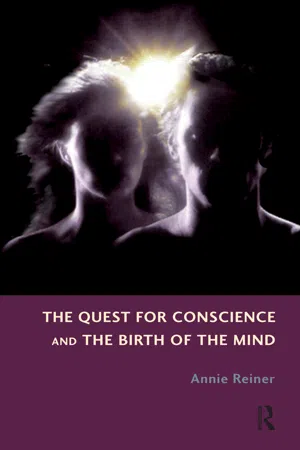
The Quest for Conscience and the Birth of the Mind
About this book
This book offers a new perspective on conscience as an as yet unrealized human potential, but a potential toward which human beings are naturally driven. A distinction is made between a "mature" or "healthy" conscience - a "conscience capable of maturation" - and the classical notion of the superego; it also postulates that the two may represent two separate lines of development. Conscience is seen to be inseparable from consciousness; the development of a mature conscience is seen to have its foundation in the development of a true or authentic self, while the classical notion of the superego is viewed as an often pathological manifestation of this natural mental potential. Theological ideas are relevant to any discussion of morality, conscience and guilt. Freud's and Bion's perspectives on religion are closely examined, revealing fundamental differences in their views of the mind. The author incorporates the metaphysical perspective central to Bion's concept of "O" as fundamental to an understanding of the development of a healthy conscience.
Information
Part I
Conscience and Morality: Theoretical Explorations
CHAPTER ONE
Philosophical and psychoanalytic background
“I will put my law in their minds, and write it on their hearts”
(Jeremiah, 31: 33)
The unconscious conscience
Conscience is a function of an individuated mind. However, primitive fears of abandonment and psychic disintegration in the absence of the mother present impediments to the awareness of separateness, which may lead to encapsulated, entombed, or “en-wombed” states of mind. This kind of retreat into a phantasy of a safe haven, though on the one hand self-protective in its intention, also represents an unconscious attack on the self and on the object. This gives rise to unconscious guilt and confusion, which become impediments to the development of conscience.
From the perspective of the prevailing societal view, conscience is commonly seen as a conscious ability to distinguish right from wrong, good from evil: intentioned moral judgements based on learnt behaviour. This differs greatly from Freud’s idea of an unconscious conscience, which includes the idea of inner life, unconscious mental states which, though unknown, none the less affect the individual’s moral actions and thoughts. In addition, popular notions of conscience focus on social behaviour toward others and rarely include an awareness of damage to the self. However, these apparent acts against the self also reflect problems of conscience, for, with these unconscious forces at work, and from the point of view of object relations, acts against the self may reflect unconscious attacks on internalized objects, mental representations of others toward whom one may consciously believe oneself to be lovingly disposed. The failure to develop a mature conscience derives from this fundamental confusion of affects. It is a state of mind which confounds love and hate, described by Rosenfeld (1987) in his discussion of confusional states, and which Fairbairn (1952) clearly outlines in his concept of the “moral defence”, examined in detail below.
In the grip of the “unconscious conscience”, or “unconscious sense of guilt”, an individual may regard himself as guilty “even when a person has not actually done the bad thing but has only recognized in himself an intention to do it” (Freud, 1930a, p. 124). This recognition may also remain unconscious, however, so that one feels he has done wrong despite the absence of any physical evidence.
The following brief vignette illustrates the idea of unconscious guilt. The patient, Mr A, exhibits severe schizoid qualities and is at times almost completely withdrawn from society. His emotional detachment from his parents began at an early age, in part in reaction to a narcissistic mother, but complicated by the birth of a brother when he was sixteen months old, before he himself had been weaned. This left him with a feeling of abandonment and distrust from which he never recovered. After three months in analysis, he reported this dream.
A man had killed a woman. I was trying to help him cover it up; I kept washing the patio even though there wasn’t any blood.
The patient explained repeatedly that he did not know the man and could not understand why he would risk himself to help him.
I was reminded of Lady Macbeth: “Out, out damned spot!”, a hallucinatory manifestation of unconscious guilt which, in this case, seemed to me to reflect the patient’s murderous rage at his mother. There was no blood, of course, for he had killed “only” his love for her, and his emotional connection to her in his mind. The “unknown man” seemed to represent the patient himself, a destructive, split-off aspect of his personality with which he was unfamiliar. In Mr A’s short time in analysis, feelings of connection toward me had already been awakened, all unconscious, for these also had to be killed, along with me and the analysis itself. These emotional “crimes”, implemented through severe splitting, were often manifested in the session by arrogant verbal posturing meant to keep me at a distance. He experienced no conscious sense of wanting or needing to see me, although he continued to come, always on time, behaviour he was at a loss to explain. His question in the dream and other association as to why he would want to help someone he did not know were relevant to this and to his treatment in general, for, although he experienced terrible guilt and feelings of self-hatred for which he was constantly being punished internally, both his transgressions and his guilt were unconscious. All that remained as evidence was his disturbingly insular life, a kind of self-imposed exile or imprisonment. His real feelings and real self were hermetically sealed off behind the bravado of a false persona, and so he could not consciously understand why he was having these sessions with me to try to help someone he did not experience or recognize as himself.
Freud noted that “bad intentions are equated with bad actions” (1930a, p. 128). Long before Freud’s concept of the superego, however, this correspondence of thought and deed were expressed in the New Testament.
You have heard how it was said to our ancestors: You must not kill; and if anyone does kill he must answer for it before the court. But I say this to you: whosoever is angry with his brother without cause will have to answer for it before the court. [Matthew, 5: 21–22]
If we view the court as one’s own unconscious conscience, it is oneself to whom one must answer. This idea of responsibility for one’s thoughts as well as one’s actions was seen as a new and higher standard, meant to fulfil the spirit of the existing religious law (Matthew, 5: 17–20).
Nietzsche (1886) describes a similar course of moral development in Beyond Good and Evil. He refers first to a “pre-moral period of mankind [in which] the imperative ‘know thyself’ was as yet unknown” (p. 44). He goes on to say that only in the last ten thousand years have there been signs of “a period that one may call moral”. This, he says, constitutes a reversal of man’s entire perspective, in which the value of an action is judged not only by its consequences but also by its intentions. However, Nietzsche indicates the need for a further shift.
We stand at the threshold of a period which should be designated . .. as extra-moral. After all, today at least we immoralists have the suspicion that the decisive value of an action lies precisely in that which is unintentional in it . .. In short, we believe that the intention is merely a sign and symptom that still requires interpretation. [ibid.]
Nietzsche’s ironic reference to himself as an “immoralist” implies someone at odds with a prevailing moral system that, in his opinion, is not really moral. The true higher morality lies in the search for the underlying and unknown intention. He views the traditional sense of morality, the morality of known (or conscious) intentions, as a kind of provisional morality, but one by which society continues to be guided.
The overcoming of [traditional] morality . .. let this be the name for that long secret work which has been saved up for the finest and most honest, also the most malicious, consciences of today, as living touchstones of the soul. [ibid., p. 45]
This “immoralist” is one whose assessment of vice or virtue is not based on conventional notions of good or evil, but on a reality more difficult to apprehend, as it requires an understanding of unconscious motives. These judgements made by the “finest and most honest . .. consciences” and based on long and difficult work, require contact with an authentic self beyond the dictates of social convention. This is one characteristic of the “living touchstones of the soul” to which he refers, a capacity related to Bion’s (1970) ideas about the mystic, the gifted or extraordinary person with direct access to knowledge of the “soul” or mind denied to “ordinary” people. Nietzsche’s conjunction between the “most honest” and the “most malicious consciences” also warrants comparison to Bion’s description of the mystic as someone dangerous to the society or group of which he is a member, whose role as a harbinger of truth and an instrument of change may prove destructive to group ideals.
The need to interpret underlying, unknown intentions presages Freud’s theory of the unconscious, and Freud’s recognition and admiration of Nietzsche’s thinking is clear. “In my youth,” Freud writes, “[Nietzsche] signified an ability which I could not attain” (Jones, 1957, p. 460). The development of psychoanalysis and the psychoanalytic method, however, can be seen as a form of “that long and secret work” which addresses this level of unconscious intentions, and calls attention to an idea of conscience that depends on the development of a capacity to think in a new way. It is occupied with the task of uncovering the provisional morality of presumed good intentions to make known the hidden intentions beneath the surface, and, in this way, is, in Nietzsche’s terms, “extra-moral”. The assessments of good and evil, of vice and virtue, become blurred, for accepted ideas of goodness may, from the perspective of conventional thought, represent the denial of deeper truths.
To give a common clinical example, if the patient’s anger is kept buried by a harsh superego designed to split off or anaesthetize emotion, any awareness or expression of that anger, while conventionally felt to be bad, from a psychoanalytic perspective is good, for it reflects the patient’s co-operation in the analysis in the service of emotional growth. This conflict becomes central to the development of a true self if the reality of the family group is destructive to the child’s inner reality. So-called “bad” aggressive impulses which arise from such a situation are then actually attempts to protect the true self, leading to a profound confusion between good and bad, or loving and aggressive, impulses.
Nietzsche’s most scathing indictment of small-minded, traditional morality is aimed at the stultifying false piety of Christianity, and yet his idea of responsibility for one’s unknown thoughts echoes Christ’s dictum quoted above. This seeming contradiction reflects Nietzsche’s distinction between essential religious knowledge and the use to which this knowledge has been put through concretized and institutionalized thinking. It is analogous to Symington’s (1994) distinction between the true and false god, but it also reflects Bion’s (1970) reference to “the Establishment” as a force against the threat of the new—or messianic—idea.
The awareness that one’s intentions are unknown to oneself brings the additional awareness that one’s judgements, perhaps all of one’s thinking, may be based on false premises. This places the individual in a terrifying position, for the very foundation of his beliefs must be reassessed and each experience considered according to his own, perhaps new, ideas. This requires one to know his ideas, which, in turn, requires the difficult work of thinking and the awareness of inner life. The individual is deprived of the false security of a known, dependable, and externally prescribed code of moral behaviour that is antithetical to thinking. The fear generated by having to know one’s mind, to have a mind and to think, ushers in the terrifying fears associated with a mental birth.
Along these lines, Bion points out that any thought already contained within the container of a mind is false, for it is not an evolution of O or absolute truth. He says, “. .. all thought as it is ordinarily known, that is, as an attribute of the human being, is false, the problem being the degree and nature of the falsity” (Bion, 1970, p. 117). It is an idea also suggested in this vivid image by the poet, T. E. Hulme, “Prose is a museum in which all the old weapons of poetry are kept” (Hughes, 1960, p. 21). It suggests the kind of struggle involved in thinking a new thought as distinct from musty old ideas to which Bion (1970) referred as the elements of a mind saturated with old ideas and associations.
Bion’s idea of “the thought without a thinker” relates to his discussion of the messianic idea, for both “. .. represent O at the point at which its evolution and the evolution of the thinker intersect” (ibid., p. 117). One is called upon to traverse feelings of uncertainty and doubt, which arouse primitive paranoid–schizoid anxieties. If one can bear it, Bion says, one is rewarded with the momentary security of an experience of truth. He symbolizes this journey from patience to security as Ps↔D, a later, more evolved version of the infant’s primitive states of mind.
In Nietzsche’s terms:
To recognize untruth as a condition of life: that, to be sure, means to resist customary value sentiments in a dangerous fashion; and a philosophy which ventures to do so places itself, by that act alone, beyond good and evil. [Nietzsche, 1886, p. 12]
Nietzsche’s reference to “untruth” refers not only to the lies told to shield ourselves from the difficult challenge of facing the natural laws of reality, but to the idea of our always flawed human attempts to reach an ultimately unreachable absolute truth. Given this, one needs to recognize the continuous need to assess good and evil anew. They are not static, learnt moral laws, but change according to an understanding of the dual nature of that realm, the indivisible wholeness of life. He asks, “Did you ever say yes to one joy? O my friend, then you have said yes to all woe as well” (Nietzsche, 1888, p. 12). The capacity to think toward this inclusive unified view of a realm of higher truth also underlies Bion’s theories about thinking and contact with the transcendent infinite reality, O, ultimate reality, absolute truth, or the godhead. The capacity to think, and the capacity for morality that is a function of thinking, depends upon this deeper knowledge.
The clinical material in Chapter Five indicates that the primary obstacle to moral development is a fundamental and unconscious confusion which makes it impossible to distinguish between behaviour that is good for oneself or others and behaviour that is harmful. All behaviours which are unhealthy for oneself or others, addictions to drugs, alcohol, food, sex, etc., reflect a problem of conscience, a fundamental inability to distinguish, with sufficient conviction, “this is good for me” from “this is bad for me.” This confusion requires within the self a fundamental understanding of the concepts of good and evil and the relationship between them, without which both the development of conscience and higher consciousness are obstructed. Without the ability consciously to distinguish good from bad, one cannot wage war effectively against one’s unconscious identifications with forces of ignorance, cruelty, or confusion in oneself or in others.
On a societal level, there seems to be an increasing reluctance to make clear distinctions such as between “good” and “evil”, distinctions which may become confused with moralistic values felt to be politically incorrect, reactionary, or unenlightened. However, this reflects confusion between a primitive superego and a more mature conscience, a problem in thinking which confuses being judgemental and being capable of making judgements. The former—based on prejudice and preconceptions—is antithetical to thinking while the latter—based on observation and knowledge—is a necessary factor in the capacity to think.
Centuries before psychoanalysis, Rumi described the unconscious conscience from a perspective we can now recognize as informed by object relations.
A thief carrying off someone’s property
feels a twinge of conscience.
“What’s this?” he asks. Tell him,
“It’s the hurt of the one you’ve hurt,
hurting you” [Rumi, 1991, p. 43]
feels a twinge of conscience.
“What’s this?” he asks. Tell him,
“It’s the hurt of the one you’ve hurt,
hurting you” [Rumi, 1991, p. 43]
These unrecognizable “twinges of conscience” exist within the labyrinth of a mind in the complex identifications, introjections, and reintrojections that make up the world of internal objects. The unconscious inner wars to which they often give rise will be elaborated in Chapter Three, with reference to Fairbairn’s ideas about conscience.
CHAPTER TWO
The true self and psychological birth
The true self and the false self
It is important to look more deeply into the development of the true self, upon which the development of conscience depends. “At an early age,” Bion writes, “we have already learnt . .. not to be ourselves . .. But the facts continue to exist” (F. Bion, 1980, p. 12). This true self, in other words, continues to exist despite the forces working against it or the phantasies of the self one believes oneself to be. Furthermore, this real self is an internal “fact”, a reality of psychical existence, though its existence may remain unknown to the individual and those who know him. In speaking of his own childhood, Bion refers to himself and his sister as “an accomplished pair of liars, smooth and quick to see what our betters expected of us and to provide accordingly” (F. Bion, 1982, p. 28). These lies, if unconscious, go to make up a false self.
Winnicott’s idea of the false self describes a premature defensive organization established at the very earliest object relations, and which represents the death of the self. He writes, “When the mother’s adaptation is not good enough at the start the infant might be expected to die physically, because cathexis of an external object is not initiated . .. But in practice the infant lives, but lives falsely” (1960a, p. 146). “The False Self,” he goes on to say, “has one positive and very important function: to hide the True Self, which it does by compliance with environmental demands” (ibid., pp. 146-147). He makes it clear that “only the True Self can be creative and . .. feel real” (ibid., p. 148).
Bion (1962a) describes the psychodynamics of a severely pathological kind of mental escape from the self dominated by psychotic processes and a primitive conscience. The infant develops a system of morality based on an archaic superego, a moralistic "superior [internal] object which asserts its superiority by finding fault with everything" (ibid., p. 98). It does not aim at understanding of behaviour but is, rather, an "envious assertion of moral superiority without any morals" (ibid., p. 97). Its aim is the destruction of contact with the object, with reality and with truth. Such patients exist in what Bion calls minus K (-K), a state of mind (or mindlessness) in which no mental...
Table of contents
- Cover
- Half Title
- Title
- Copyright
- Contents
- ACKNOWLEDGEMENTS
- ABOUT THE AUTHOR
- Dedication
- FOREWORD by James S. Grotstein
- INTRODUCTION
- PART I: CONSCIENCE AND MORALITY: THEORETICAL EXPLORATIONS
- PART II: CLINICAL APPLICATIONS: THE DEVELOPMENT OF CONSCIENCE
- REFERENCES
Trusted by 375,005 students
Access to over 1.5 million titles for a fair monthly price.
Study more efficiently using our study tools.
Frequently asked questions
Yes, you can cancel anytime from the Subscription tab in your account settings on the Perlego website. Your subscription will stay active until the end of your current billing period. Learn how to cancel your subscription
No, books cannot be downloaded as external files, such as PDFs, for use outside of Perlego. However, you can download books within the Perlego app for offline reading on mobile or tablet. Learn how to download books offline
Perlego offers two plans: Essential and Complete
- Essential is ideal for learners and professionals who enjoy exploring a wide range of subjects. Access the Essential Library with 800,000+ trusted titles and best-sellers across business, personal growth, and the humanities. Includes unlimited reading time and Standard Read Aloud voice.
- Complete: Perfect for advanced learners and researchers needing full, unrestricted access. Unlock 1.5M+ books across hundreds of subjects, including academic and specialized titles. The Complete Plan also includes advanced features like Premium Read Aloud and Research Assistant.
We are an online textbook subscription service, where you can get access to an entire online library for less than the price of a single book per month. With over 1.5 million books across 990+ topics, we’ve got you covered! Learn about our mission
Look out for the read-aloud symbol on your next book to see if you can listen to it. The read-aloud tool reads text aloud for you, highlighting the text as it is being read. You can pause it, speed it up and slow it down. Learn more about Read Aloud
Yes! You can use the Perlego app on both iOS and Android devices to read anytime, anywhere — even offline. Perfect for commutes or when you’re on the go.
Please note we cannot support devices running on iOS 13 and Android 7 or earlier. Learn more about using the app
Please note we cannot support devices running on iOS 13 and Android 7 or earlier. Learn more about using the app
Yes, you can access The Quest for Conscience and the Birth of the Mind by Annie Reiner in PDF and/or ePUB format, as well as other popular books in Psychology & History & Theory in Psychology. We have over 1.5 million books available in our catalogue for you to explore.