A Practical Psychoanalytic Guide to Reflexive Research offers an accessible guide to enriched qualitative research. In this novel approach, the researcher's feelings and empathy in relation to participants take centre stage, leading to fresh, exciting and usable research findings. The psychoanalytic concept of reverie refers to those startling and unexpected images, feelings and daydreams which can come to mind as we interact with other people in the world. Qualitative research involves interacting with human subjects, and the book shows how uncanny or troubling reverie experiences can be turned to good use by being linked back to deeper research questions and hypotheses.
Joshua Holmes critically explores the role of self-reflection (reflexivity) in psychoanalysis and qualitative research. Practical guidance is offered while planning research; conducting research interviews; analysing interview data; teaching methods which foster the capacity for reverie; and in relation to research groups. Examples are given throughout, including the author's own missteps along the way, in which he shares the importance of learning from experience. The book breathes life into research processes offering much-needed clinical relevance. The method moves away from one-size-fits all, formulaic research procedures and brings tenor, colour and texture into the research process, to create vivid, real-life meaningful findings.
A Practical Psychoanalytic Guide to Reflexive Research will be essential reading for undergraduate and postgraduate qualitative researchers wishing to enhance their reflexive practice, while psychotherapists and psychoanalysts will find a genuinely psychoanalytic research method, where their clinical skills become vital capacities rather than an awkward hindrance.
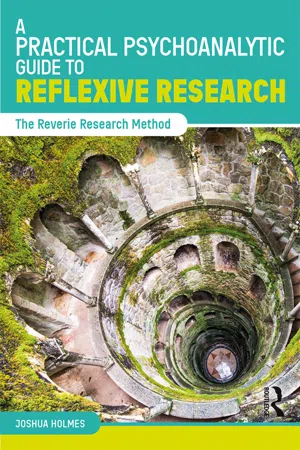
eBook - ePub
A Practical Psychoanalytic Guide to Reflexive Research
The Reverie Research Method
- 164 pages
- English
- ePUB (mobile friendly)
- Available on iOS & Android
eBook - ePub
About this book
Information
1
Introduction and overview
‘Not sure …’ Karl seems to drift into some sort of reverie. He sits upright with his sportsman’s shoulders. Only traces of boyhood remain – a young, beardless face – but with intense weary eyes. He’s glancing up to the left – searching inside, I think. And I wait, watching, sure enough that something will come out of the silence. He speaks quietly, bleakly, deeply.
I sense my own keenness – willing more from Karl, tuning into the words. He speaks in a rather detached way about the difference between his depression and sadness. Sadness ‘was’ (using the past tense) ‘the opposite of happy but depression’… he pauses. ‘I dunno’ – another pause … ‘just sort of …’ the tone conveys movement – he will know soon – (I picture an empty glass about to be moved towards and filled from running water). And now stumbling towards a close-enough fit: ‘it’s like it goes over all your feeling as a whole thing’. With my own inward glance, I now imagine a field which snow has blanketed – ‘gone over’ it. I see stillness, and hear silence. ‘And it sort of governs your thoughts as well.’ Now I find myself wondering if an authoritarian figure has made Karl’s bed (put the blanket in place). A few seconds of quiet, beholding the snowscape, before we are aware of it. ‘I’m imagining a blanket covering everything,’ I say. With the word ‘blanket’ Karl has said ‘yeah’, then he rests, and dismisses further exploration for the moment: ‘that’s some incre-good example’.
I wrote this from my recollections of sitting in a room, for about an hour, with a 17-year-old young man.1 We were involved in a ‘research interview’. The recollection draws on intersubjective psychoanalytic theory which suggests that a two-person interaction entails a ‘mutual meaning-making process’ (Aron, 1992, p. 475), and that ‘the analyst’s associations to the patient’s dreams are no less important than the patient’s associations’ (Ogden, 2001, p. 12). My own impressions, observations and reveries interact with Karl’s responses to generate mutual and confirmatory understanding: ‘that’s some incre-good example’.
What is a reverie approach to interviews?
Why do I start with this example? I want to show how in response to research interviews, the researcher’s emotions, imagination and meaning-making capacities are activated, and how these processes can be put to good research use, rather than discarded as interference. The essence of this book and of the Reverie Research Method (RRM) is to show how, in response to qualitative research processes, researchers may foster a state of receptivity to emotional experience in which he or she may experience imagistic responses (‘reveries’), which may then be linked to research data in order to better understanding the participant.
Understanding the ‘inter view’ (Kvale & Brinkmann, 2008) from a reverie perspective means studying the meeting of two minds – a collision of unconsciousness and consciousnesses – in such a way that the unconscious component can be thought about. Reverie-inspired mutual meaning-making involves a radical revision of what it means to be ‘participant-centred’ (Riach, 2009, p. 356). From this perspective, researcher neutrality becomes undesirable – and impossible in any case. A reverie approach to research interviews means the researcher learns to work with reference to his or her own subjective responses. This book aims to show how this can be done sensitively and systematically.
Reverie researching: who cares?
My focus is reverie-informed research and its consequences, potentialities and pitfalls. The book is aimed at two main constituencies: qualitative researchers interested in what psychoanalysis has to offer to their work, and psychoanalytic clinicians wanting to undertake psychoanalytically relevant research. The RRM may generate discussion and cross-fertilisation between them and point the way to new methodologies.
For qualitative researchers, a key question may be: ‘Why, given its technical complexity and methodological problematics, is it so important to look inwardly (“practice reflexively”), and what can psychoanalysis add to this endeavour?’ Some qualitative researchers have already made inroads towards interweaving psychoanalytic approaches into research methodologies (Devereux, 1967; Hunt, 1989; Hollway & Jefferson, 2013). Building on, although to some extent critical of this, the psychoanalytically inspired RRM offers a novel approach to reflexivity, reverie and intersubjectivity, showing how these can enhance the everyday qualitative methods of the research interview.
For psychoanalytic clinicians, a key question is: ‘Is a research method possible that stays true to clinical realities?’ (Holmes, 2017). Psychoanalysts, under external pressure to form an ‘evidence base’, but struggling with positivist notions of research, which are generally wholly remote from consulting room realities, may find themselves daunted, turned off and possibly irritated by demands which seem to fundamentally misunderstand the discipline (Chiesa, 2010). My hope is that this book may inspire clinicians to research and that clinicians may, via reverie-inspired methodology, find here a way of framing and conducting valid research, which at the same time prioritises unconscious processes and offers an ethical and close-up view of the human subject.
Comparing clinical psychoanalysis and research interviews
The significance of reverie, a complex and somewhat mythical concept, will emerge in the course of this book. But let’s start with definitions. The Oxford English Dictionary defines reverie as ‘being lost in thought’, elegantly capturing the non-ego aspect and inwardness of reverie. Bion’s technical elaboration of this, to be expounded later, led to his emphasis on ‘mother’s capacity for reverie’ as descriptive of the state of mind which facilitates ‘alpha function’ (Bion 1962a, p. 307) – the way in which she receives, processes and returns, in manageable form, her infant’s chaotic psychic experience.
As we shall see, the role of reverie in psychoanalysis was already present in Freud’s early thinking, although more fully developed and theorised by Bion. Currently, the psychoanalyst Thomas Ogden, along with Antonio Ferro, are probably the foremost clinical proponents of the importance of reverie, especially when seen relationally. Ogden emphasises how reverie is a part of what it means to be alive as a ‘human being’ (e.g. Ogden 1994, p. 16; 1995, p. 696; 1997a, p. 6; 2001, p. 9). In doing so he reminds us that reverie is not limited to the clinic but underpins creativity. Reverie is an unforced, ‘natural phenomenon’; and it is no less available and applicable in one-off encounters (which research interviews usually are) than in long-term ones. As Ogden (1992, p. 226) puts it: ‘there is no difference in the analytic process in the first meeting and the analytic process in any other meeting’. Nevertheless, even if not limited to that location, the consulting room is certainly a good place to explore it. Aspects of psychoanalytic technique – attending to dreams and daydreams, free association, reflection, respecting silence, introspection – all are integral to reverie.
I shall show how these clinical principles can be reconsidered, reconfigured and applied in research methodology. Given that the research interview is a two-person dialogue, it is a good potential arena for mutually created meaning-making, and thus also a promising location for the exploration and application of reverie.
Three core concepts
Before exploring the practicalities of the RRM, three wider and interlinked themes will need to be considered: the nature of daydreaming (reverie); the search for understanding (research); and what it means to converse (interviewing).
Daydreaming
Reverie cannot be understood without reference to dreaming; etymologically the words are linked: ‘rêve’ is French for ‘dream’. In ‘knowing about’ (Bion, 1965 p. 149) reverie, I have attempted – where possible – ‘to be’ in reverie and – from and through reverie – to research and write. My starting point is the view that reverie is not an intrinsically isolated and isolating phenomenon – although at times it can be – but to see it as relational. I justify this on two counts. First, as in my opening example, reverie is stimulated by the juxtaposition of two or more people’s inner worlds. Second, even though one dreams alone, dreaming dissolves the ego, and therefore draws in an ‘other’ with which or whom the ego is in dialogue. A dream is a story about something distinct from one’s conscious self; one that can be told to an ‘other’ – even if that other happens to be oneself! Reverie, and with it creativity, comes from a dawning awareness, from the ‘edge of consciousness’ (Waddell, 1984, p. 82).
Psychoanalytic discussions of reverie start from Bion (1962a, 1962b). Although before Bion the term reverie occasionally appears in the psychoanalytic literature, it refers in a non-technical sense to self-absorbed daydreaming. For example, Freud, in The Interpretation of Dreams (1900, p. 401) describes a mother in whom:
… thinking of the boy going into the water induced a reverie [‘eine traumerei’] in which she saw herself taking him out of the water.
Just as Freud took the everyday term ‘unconscious’ and developed it into one of psychoanalysis’s foundation stones, so Bion moved from the vernacular to develop a specialised psychoanalytic concept of reverie, although he deliberately avoids too much precision:
I discuss the background of emotional experience from which it [the theory of reverie] has been abstracted. I shall do this in general terms without attempting scientific rigour.
Bion (1962a, p. 306; emphasis added)
For Bion, the prototype of reverie is the feeding infant-and-mother. He sees reverie in terms of the mother’s transformation of the baby’s inchoate feelings into thoughts and meanings: ‘the mother’s capacity for reverie is the receptor organ for the infant’s harvest of self-sensation gained by its conscious’ (Bion, 1962a, p. 308). He links this with his ‘theory of thinking’ in which ‘beta elements’ (i.e. sensations) are transformed through this reverie process, via ‘alpha function’, into ‘alpha elements’ (i.e. thoughts).
Bion was influenced by Melanie Klein, although Klein herself appears not to have used the term ‘reverie’ (‘Psychoanalytic Electronic Publishing-web’ search). Bion links ‘failures of alpha function’, and therefore the incapacity for thinking which psychoanalysis aims to reverse, with the Kleinian notion of ‘excessive projective identification’. This is a one-way process in which the infant expels overwhelming feelings such as rage and envy into the attendant object, i.e. the mother’s breast. Bion’s contribution, later developed and modified by Ogden, was the notion of ‘realistic projective identification’ (1962a, p. 309), a to-and-fro movement of the minds’ contents from baby to mother and back again. In Bion’s hands, Klein’s unidirectional projective identification becomes relational.
Bion’s theory of reverie implies a number of other theoretical ingredients. First is container/contained. The mother’s mind, figuratively, in Kleinian terms ‘the breast’, is the container into which the infant’s sensations are projected. Second, if they can be contained, and not ignored or expelled by a mother in a state of intolerance of ‘frustration’, they become available for thinking, and, third, therefore, for ‘communication’. I shall try to show how all three are relevant to researchers, for whom ‘communication’ encompasses not just verbal conversation but also publication.
In contrast to Bion’s relational model, reverie in isolation is by definition incommunicable. Like maternal reverie, reverie-enriched researching involves balancing ‘the free play of association’ with ‘logical scrutiny’ (Ferenczi, 1950 [1919], p. 189). Devoid of reverie, research may verge into cold science, the ‘mechanical brain’ (Heimann, 1950, p. 82). But at the other extreme, reverie experience untempered by logical scrutiny, lies incomprehensibility.
Reverie can open alternative avenues into research data, and my aim here is to show how to apply reverie in research. Reverie-influenced researching becomes a capacity which may potentially be developed through practice and supervision. Reverie may be useful in overcoming blocks in research interviews, freeing moments of inarticulacy, or conversely enhancing emotional awareness when words block feelings. A second use of reverie lies in analysing interview transcripts. This has a more clearly defined methodology and, as I shall show, can be thought about systematically and in a group context.
When studying research interview transcripts, the ‘free play of association’ versus ‘logical scrutiny’, a toing-and-froing analogous to mother–baby interplay, involves sculpting understanding in relation to an experience of reverie, as it is worked and reworked. The writer has time for contemplation, and recruiting colleagues’ perspectives, before committing finger to keyboard. In-the-moment ‘live’ reverie sharing, as in the case of Karl, involves greater risk. In that instance, I felt confident enough that what I said would contribute to the atmosphere of exploration. But – as we shall see – deciding how and whether to give voice to reverie is far from straightforward. There is always a tension between risk and security which reverie-influenced qualitative research entails.
What allows for the ‘free play of association’/‘logical scrutiny’ process in the first place? When ‘dreaming’ cannot be separated from ‘perceiving’ (Ogden, 2003, p. 17) reverie cannot be distinguished from reality – that way lies delusion. Most people are fairly at home with benign daydreams of happiness, pleasure or success. But interviewing people who are suffering can induce disturbing fantasies or escape dreams in the interviewer. The excitement of ‘awayness’ (Sperling, 1953, p. 464) in reverie evokes and interacts with the counter-impulse towards safety and the fear of psychic freedom (cf. Fromm, 2001).
Researcher subjectivity and the interpersonal approach
Especially in psychological research, ‘re-search is me-search’: ‘behind the theory, method, analysis, ontology, epistemology, and methodology of qualitative research stands the personal biography of the researcher’ (Denzin & Lincoln, 2000, p. 18). The same is true for the consenting participant. There is a balance to be struck between the wish to know and the reality that self-knowledge is elusive and potentially disruptive. ‘At the centre of each person is an incommunicado element … and this is sacred and most worthy of preservation’ (Winnicott, 1965a, p. 187).
A brief discussion is needed here about three overlapping but distinct terms which I shall be using throughout: the interpersonal, intersubjective and relational. The term ‘interpersonal’ is typically associated with the American psychoanalyst and psychiatrist Harry Stack Sullivan (1954), founder of the William Alanson White clinic in Maryland. Sullivan was influenced by Sandor Ferenczi, and wanted to develop a psychiatry which valued connectedness and relationship as the key to psychic health and happiness; he criticised the aloof neutrality of the quasi-surgical analyst figure. Sullivan’s collaborators included Harold Searles and Freida Fromm-Reichman, both pioneers of psychoanalytic work with psychotic patients, and also Erich Fromm. Fromm (2001), a refugee from Nazi Germany, developed his own existential-eth...
Table of contents
- Cover
- Half Title
- Endorsement
- Title Page
- Copyright Page
- Dedication
- Contents
- Acknowledgements
- 1 Introduction and overview
- 2 Freud and the role of subjectivity in psychoanalysis
- 3 Bion and beyond
- 4 Reverie, reflexivity and research interviews
- 5 Reflexivity and data analysis
- 6 Towards ethical research interviewing
- 7 The RRM – the emergence of a new approach in qualitative research
- 8 Thomas Ogden and the RRM
- 9 The RRM in live research interviewing
- 10 RRM and interview transcript analysis
- 11 RRM teaching groups 1: General
- 12 RRM teaching groups 2: Data analysis
- 13 Discussion and reprise
- References
- Index
Trusted by 375,005 students
Access to over 1.5 million titles for a fair monthly price.
Study more efficiently using our study tools.
Frequently asked questions
Yes, you can cancel anytime from the Subscription tab in your account settings on the Perlego website. Your subscription will stay active until the end of your current billing period. Learn how to cancel your subscription
No, books cannot be downloaded as external files, such as PDFs, for use outside of Perlego. However, you can download books within the Perlego app for offline reading on mobile or tablet. Learn how to download books offline
Perlego offers two plans: Essential and Complete
- Essential is ideal for learners and professionals who enjoy exploring a wide range of subjects. Access the Essential Library with 800,000+ trusted titles and best-sellers across business, personal growth, and the humanities. Includes unlimited reading time and Standard Read Aloud voice.
- Complete: Perfect for advanced learners and researchers needing full, unrestricted access. Unlock 1.5M+ books across hundreds of subjects, including academic and specialized titles. The Complete Plan also includes advanced features like Premium Read Aloud and Research Assistant.
We are an online textbook subscription service, where you can get access to an entire online library for less than the price of a single book per month. With over 1.5 million books across 990+ topics, we’ve got you covered! Learn about our mission
Look out for the read-aloud symbol on your next book to see if you can listen to it. The read-aloud tool reads text aloud for you, highlighting the text as it is being read. You can pause it, speed it up and slow it down. Learn more about Read Aloud
Yes! You can use the Perlego app on both iOS and Android devices to read anytime, anywhere — even offline. Perfect for commutes or when you’re on the go.
Please note we cannot support devices running on iOS 13 and Android 7 or earlier. Learn more about using the app
Please note we cannot support devices running on iOS 13 and Android 7 or earlier. Learn more about using the app
Yes, you can access A Practical Psychoanalytic Guide to Reflexive Research by Joshua Holmes in PDF and/or ePUB format, as well as other popular books in Psychology & Mental Health in Psychology. We have over 1.5 million books available in our catalogue for you to explore.