- 140 pages
- English
- ePUB (mobile friendly)
- Available on iOS & Android
eBook - ePub
About this book
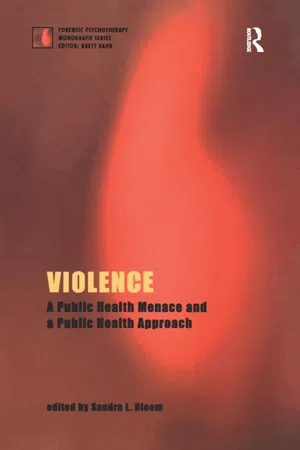
This book provides practical information to design specific intervention strategies aimed at preventing the escalation of violence in any community. It provides both practical advice and theoretical stimulation for introductory students and for senior practitioners of forensic psychotherapy.
Information
CHAPTER ONE
A kind of necessity? Violence as a public health problem
Violence takes many forms and has appeared in many guises, especially in the twentieth century (Hobsbawm, 1994). The Oxford English Dictionary devotes three pages to definitions of violence and related words. Four separate meanings seem to emerge, which will be examined in this chapter:
1. violence as compulsion and coercion;
2. violence as extremes of feelings;
3. violence as violation;
4. violence as perversion of meaning.
Violence as compulsion and coercion: the exercise of force over others
For they eat the bread of wickedness, and drink the wine of violence.
Proverbs, 4:17
Statistics and numbers
Because so much violence goes unreported, measuring violence quantitatively is problematic. The fact that so much is hidden is a reminder that violence is often associated with secrecy and shame. Quantitatively, figures for recorded crime show a dramatic increase over the last century: for example, from 0.1 million in 1876 to nearly 6 million in 1992 in England and Wales. The same appears to be true for other European countries and the United States.
The commonest recorded crime is property theft. Violent crime (i.e. interpersonal violence) accounts for only a tiny proportion—5% to 6%—of crime. This figure is stable over time; it is a higher figure in the United States, but not dramatically so. Even if there were 100% under-reporting of all interpersonal violence, it would still represent the minority of rule-breaking behaviour in most societies.
A breakdown of the main types of violent crime committed by adults is listed in Table 1 (Barclay, Tavares, & Prout, 1995). These data suggest that even within violent crime, severe interpersonal violence is less common. Of course, the size of a problem is not an indicator of its seriousness. Furthermore, these data reflect only recorded violence, and one cannot assume that because the wounding is described as “minor”, the event did not represent a major trauma for either the victim and/or the perpetrator. Nevertheless, the comparative rarity of some types of severe interpersonal violence suggests that such violence represents a significant breakdown of functioning for the perpetrator and therefore needs to be taken extremely seriously.
TABLE 1. Most common types of violent crime
serious wounding | 6% |
sexual offences | 10% |
robbery | 19% |
minor wounding | 64% |
The unusualness of interpersonal violence in terms of human behaviour should remind us of two things: first, that the majority of human beings do live together without violence and have the capacity to create constructive communities together. Second, that if interpersonal violence is an indicator of a derailed human interpersonal process, either at an individual or at large group level, then it has meaning for people (consciously or unconsciously) and cannot be explained as blindly instinctual.
Although interpersonal violence is unusual, it takes common forms worldwide. Some form of family violence was found in 90 societies studied by Levinson (1989). But different societies show different levels of violence. For example, Levinson indicates that while 74% of societies studied used physical punishment, only 13.3% used it regularly, and 26% used it rarely or never. Similarly Sanday (1981) found that, while 40% of societies that she studied were what she called “rape-prone”, an equal proportion were not. There appears to be a significant relationship between different types of family violence—that is, if one is occurring, others are likely to be. Family violence is also affected by external factors: deprivation, unemployment, social density, and laws regulating interpersonal violence (Buchanan, 1996).
Family violence is not the only sort of interpersonal violence. It also occurs in the form of violence between strangers, either within national borders (street violence, gang wars, and civil wars) or outside (international wars). Most recorded criminal violence takes place between those who know each other, and I shall say more about this later; here I will point out only that violence between strangers tends to be a group phenomenon and involve disputes over territory and resources. In this sense, human violence resembles animal violence (Wrangham & Peterson, 1996).
Theories of violence
The literature on the origins of human violence is vast, and I shall not attempt to review it here. Theories have been generated by different disciplines such as sociology, psychology, and criminology. At different times, different theories have been more or less popular. Of late, there have been more attempts to integrate some of the theories, since it is clear that there is no one single explanation for human violence, any more than there is one for any human behaviour. The post-modern emphasis on context has forced researchers to rethink empirical strategies for studying human phenomena, and violence is an example of a phenomenon that needs multiple theoretical approaches.
Gunn (1991) lists some previous explanatory theories for violence, which he defines as “destructive aggression” (Table 2). Other reviews offer similar lists and comment that although there may be a biological substrate to aggression, its expression is profoundly affected by environmental and cultural factors.
Aggression and violence
Is aggression the same as violence? Although often presented as identical, I would like to suggest that there is an important distinction between them, as shown in Table 3.
Aggression is on a continuum with arousal, which undoubtedly is biologically mediated through complex perceptual systems in the brain and the sympathetic nervous system. There is evidence that individuals have different genetic susceptibilities to arousal, temperament, and reactivity (Kagan, 1994, 1997; Suomi, 1997). Responses to stimuli that might provoke arousal and aggression are affected by the organism’s experience of anxiety which, in turn, depends on threat perception and memory (Amini et al., 1996). Threat perception is affected by previous experience of threat and its conclusion, and it is mediated by perceptual systems especially for indicators of similarity and difference. Subtle differences in the environment can signal danger; if there has been previous threat, the organism’s sensitivity to those subtle differences may be increased.
TABLE 2. Some explanatory theories of violence
violence as a human instinct | either an innate evil or a biological given |
violence as a result of social frustration hypothesis | aggression as a result of frustration |
social learning theory | violent behaviour is modelled, reinforced, and rewarded |
social dominance theory | violence in the pursuit of power |
Arousal and aggression make it possible to respond to threats to the organism’s security. The recognition of similarity and difference and responses to threat are a crucial part of ordinary social survival. Presumably because of its destructive potential, aggression and arousal are organized and managed within most primate groups according to recognized and recognizable cues. In non-human primates, aggression regulates and is regulated by social hierarchies and relationships (Wrangham & Peterson, 1996). There are quite complex rules for who can bite whom and in what circumstances. Displays of aggression usually relate to competition for food, partners, or social position.
Human aggression is regulated in a much more complex and elaborate way. A degree of aggression is necessary for motivated functioning and is highly regulated within certain rules, regulations, and boundaries. Although there may be social and cultural differences about the rules between different societies, aggression is still regulated, and its creative possibilities are maintained. The most obvious example is in relation to sport, where competition is a highly regulated way of expressing aggression, both by individuals and by groups.
TABLE 3. Distinctions between concepts
arousal | threat perception, sympathetic arousal |
aggression | includes competition; a “fight” type of arousal |
violence | aggression that exceeds a containing boundary |
Violence occurs when the internal and external boundaries for aggression are broken. A sporting example makes the point. Mr Tyson and Mr Holyfield are professional boxers. By boxing rules, Mr Tyson is allowed to assault Mr Holyfield physically within certain boundaries, even to the extent of knocking him unconscious and causing him brain damage. He is even allowed to kill him by hitting him. He is not, however, allowed to bite his ear off.
Boundaries, rules, and thresholds
The absurdity of the Holyfield/Tyson fight reveals a very human preoccupation with rules of behaviour. The best example of this is war and the “rules of engagement”. Hobsbawm (1997) argues that traditional wars, in this sense, were aggressive but not violent; that professional fighting does not involve feelings of interpersonal hatred but utilizes aggression within certain aims to achieve a certain (usually territorial) purpose. He suggests that contemporary wars are based on hatred and the demonization of the opponent, which then justifies attacks on civilians and non-combatants. He is thus making a distinction between organized conflict that is aggressive and barbaric conflict that is violent.
The literature seems to suggest that there can be aggression without violence, but not violence without aggression—that is, violence occurs when there is a breaching of the internal and external boundaries that control aggression and arousal. The question, then, is how and where the boundaries are set. Using Belsky’s (1980) ecological model, we may postulate that boundary-setting for aggression takes place at four levels (see Table 4). Individual risks for violence at Level 1 (genetic susceptibility to arousal and fragile temperament) may interact with stressors in the family and social system (Level 2). The family is influenced by stressors mediated by Level 3 structures. Both Level 2 and Level 3 are influenced by Level 4 factors—for example, cultural attitudes to violence towards children. The extent to which Level 4 and Level 1 might continuously influence one another in a type of feedback loop is unknown.
TABLE 4. Boundaries
Level 1 | the inner world of the individual: including biological make-up and the capacity for self-reflection |
Level 2 | the microsystem of the individual in social and family context: including the person’s attachment and relationship history |
Level 3 | the exosystem of the community: legal and economic strategies that influence the environment |
Level 4 | the macrosystem: including the cultural matrix of the society, international relations, and the management of difference |
For each society, we can explore where the threshold for violence lies and how it changes over time. The key message is that we are not helpless pawns of internal drives but, rather, that the boundaries are set where we want them to be. This means that all individuals and groups may be involved in complex ethical decision-making processes. For example, Gunn (1991) argues that some types of violence (like wars) are of benefit to society, although such a benefit would have to be set against any social costs. Groups and individuals might also have to consider the social importance of never treating others “merely” as a means—Kant’s categorical imperative.
Victims of violence
The experience and needs of victims are described in depth by my colleagues in this volume, and I shall make only two points here. First, criminal victimization is a relatively common experience: recent surveys of Western populations show that one person in four has been a victim of one or more crime (Barclay, Tavares, & Prout, 1995). The highest rates for victimization seem to be in the most “civilized” places: Australia, New Zealand, and the United States, where the Department of Justice reports that 83% of the population has experienced victimization. Victims of crime tend to be the disenfranchised and vulnerable—uneducated young men, ethnic minorities, children, the elderly.
The second point relates to the experience of victimization as a risk factor for later violence (see de Zulueta, this volume). Physical abuse in childhood increases the chance of arrest for a violent offence in adulthood in men (Widom & Ames, 1994; Weiler & Widom, 1996); it also increases the risk of developing anti-social personality disorder (APD), which is, by definition, associated with criminal and violent behaviour (Luntz & Widom, 1994). Although the cycle of violence is not a perfect circle (Widom, 1989), addressing the needs of the victimized may be an important part of any strategy for violence reduction.
Violence as extremes of feeling
Why, I can smile, and murder while I smile
Shakespeare, Richard III
Different types of violence
One of the central assumptions of this chapter is that all human action has meaning. However, understanding the meaning of violence is complex, because violence is heterogeneous and contextual. Various types of violence are listed in Table 5.
Violence that is in the c...
Table of contents
- Cover
- Half Title
- Title Page
- Copyright Page
- Table of Contents
- SERIES FOREWORD
- EDITOR AND CONTRIBUTORS
- INTRODUCTION
- 1 A kind of necessity? Violence as a public health problem
- 2 Violent attachments and attachment to violence
- 3 Creating a non-violent environment: keeping sanctuary safe
- 4 Conclusion: a public health approach to violence
- REFERENCES
- INDEX
Trusted by 375,005 students
Access to over 1.5 million titles for a fair monthly price.
Study more efficiently using our study tools.
Frequently asked questions
Yes, you can cancel anytime from the Subscription tab in your account settings on the Perlego website. Your subscription will stay active until the end of your current billing period. Learn how to cancel your subscription
No, books cannot be downloaded as external files, such as PDFs, for use outside of Perlego. However, you can download books within the Perlego app for offline reading on mobile or tablet. Learn how to download books offline
Perlego offers two plans: Essential and Complete
- Essential is ideal for learners and professionals who enjoy exploring a wide range of subjects. Access the Essential Library with 800,000+ trusted titles and best-sellers across business, personal growth, and the humanities. Includes unlimited reading time and Standard Read Aloud voice.
- Complete: Perfect for advanced learners and researchers needing full, unrestricted access. Unlock 1.5M+ books across hundreds of subjects, including academic and specialized titles. The Complete Plan also includes advanced features like Premium Read Aloud and Research Assistant.
We are an online textbook subscription service, where you can get access to an entire online library for less than the price of a single book per month. With over 1.5 million books across 990+ topics, we’ve got you covered! Learn about our mission
Look out for the read-aloud symbol on your next book to see if you can listen to it. The read-aloud tool reads text aloud for you, highlighting the text as it is being read. You can pause it, speed it up and slow it down. Learn more about Read Aloud
Yes! You can use the Perlego app on both iOS and Android devices to read anytime, anywhere — even offline. Perfect for commutes or when you’re on the go.
Please note we cannot support devices running on iOS 13 and Android 7 or earlier. Learn more about using the app
Please note we cannot support devices running on iOS 13 and Android 7 or earlier. Learn more about using the app
Yes, you can access Violence by Sandra L. Bloom in PDF and/or ePUB format, as well as other popular books in Psychology & Forensic Psychology. We have over 1.5 million books available in our catalogue for you to explore.