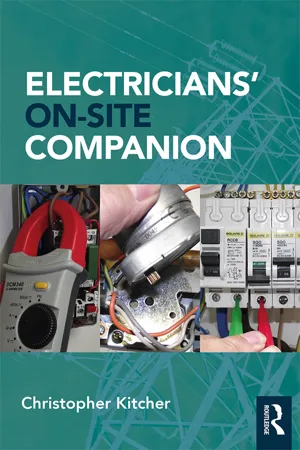
This book contains everything electricians need to know about working on site, covering not only the health and safety aspects of site work, but also the techniques and testing knowledge required from the modern-day electrician. Regulations issues are included alongside step-by-step instructions for each task, after which testing information, checklists and example forms are given so that site workers can ensure they have done everything required of them.
- 166 pages
- English
- ePUB (mobile friendly)
- Available on iOS & Android
eBook - ePub
Electricians' On-Site Companion
About this book
Information
Chapter 1
Design considerations
It is vital for a satisfactory outcome to any electrical installation that it is designed correctly. It doesn’t matter whether the installation is a single circuit or a full installation, the same rules apply.
The statutory document that applies to all electrical installations is the Electricity at Work Regulations 1989 (EWAR 1989). These regulations are made under the Health and Safety at Work Act 1974 (HASWA 1974) and quite clearly state that although BS 761 wiring regulations are non-statutory, compliance with them will be likely to achieve compliance with the relevant parts of the EAWR.
The HASWA places a duty of care on employers, the self-employed and on employees. EAWR also places responsibilities on everyone at a place of work – this, of course, means employers, self-employed persons and employees.
An employer is any person or body that employs one or more persons under a contract of employment or apprenticeship, and it is the employer’s duty to comply with the EAWR. It is the employee’s duty to co-operate with their employer to enable the duty placed on the employer by the EWAR to be complied with.
Under normal circumstances, the person who has the electrical installation under their control is classed as the duty holder; this may apply to the whole installation or just the part of the electrical installation which is being worked on. Of course, if there is no work being carried out the duty holder would be the managing director or owner as it is his duty to ensure that the EAWR are complied with in any place of work.
The important thing to remember is that the EWAR applies to everyone wherever work is being carried out, and that the duties in some of the regulations are subject to the term ‘reasonably practicable’. Where the term ‘reasonably practicable’ is not used, then the regulation is said to be absolute and must be adhered to.
When a person has to do something so far as reasonably practicable, they must assess the magnitude of the risk for the work activity against the cost in terms of physical difficulty, trouble, time and the expense that would be involved in eliminating or reducing the risk. The term ‘reasonably practicable’ would be acceptable where the risks to health and safety for a particular job are low, and the cost or technical difficulties to reduce the risk are high.
Where the risk is high and may result in death, then the level of duty would always be absolute and cost would not form part of the equation.
When designing any electrical installation, all regulations that have or may have an effect on it must be taken into account. None of these regulations is more important than the others, although of course some may be more relevant.
As an example, the Health and Safety at Work Act will always form part of any electrical design but Part P of the building regulations will not apply to buildings other than dwellings.
All of the relevant statutory regulations are in place to ensure that electrical installations are installed safely and remain safe; one of the major requirements is that materials and equipment are manufactured and installed to a high standard. During the design stage it is important that we ensure that all materials that are intended to be used in the installation are to a British or harmonised standard.
BS 7671: 2008 has been adopted as the British Standard for electrical installations; it is not a statutory document but compliance with this standard will ensure compliance with the other statutory regulations. Chapter 51 of BS 7671 requires that all equipment complies with a British or harmonised standard.
This regulation is not intended to prevent the use of non-BS equipment, but it makes it quite clear that any equipment that does not have a British or harmonised standard must be compared with the standards and that any differences must be verified by the designer or installer. Any differences must not result in a lesser degree of safety, and the use of the equipment must be recorded on the inspection and test documentation that is completed for the work.
An example would be where a wrought-iron light fitting has been made by the local blacksmith. This would not have a BS, however it could be installed providing the person installing it was happy that it was safe, and that the correct documentation was completed.
If it was just the installation of a light fitting then it would be recorded on a minor works certificate (Figure 1.1) in Part 1, Item 4, which is headed as ‘Details of departures’, provided, of course, that the fitting was being connected to an existing circuit. New inventions that have not yet been given a British Standard would also need to be entered as a departure.
BS 7671 consists of 7 parts and 16 appendices; each part is broken up into chapters.
Each regulation has a number, and in the system used the first digit is the part number, the second digit is the chapter and the third digit is the section; the remaining digits are the actual regulation number.

Figure 1.1
Example: regulation 421.1.1
This will tell us that the regulation is Part 4, Chapter 2, section 1. This covers the General Requirements of this chapter. Then we have the 1.1, which shows us that it is the first regulation in that section and is the first part of that regulation.
Any regulation ending with a number in the 200 range is specific to the UK.
Example: regulation 422.4.203
This tells us that the regulation is Part 4, Chapter 2, section 2. It is regulation 4, which covers combustible construction materials and is section 203 of the actual regulation. This is specific to UK installations only.
For all electrical installations the basic requirements are the same:
- It must be designed to provide protection of persons, livestock and property.
- It must ensure the proper functioning of the electrical installation.
Before any design can begin, the following basic information about the installation will be required; it will also need to be entered onto the installation documentation on completion of the work.
Characteristics of the supply that is available
- Is it AC or DC?
- Purpose and number of conductors:
- ○ Is the installation single phase or three phase and neutral?
- ○ Is there a supplier’s earth connection?
- ○ Is there a PEN conductor (TN-C-S)?
- Values and tolerances:
- ○ Nominal voltage available, voltage tolerances. For a supply from the DNO the voltage tolerance is +10% and −6%
- ○ Maximum current that is available
- ○ Prospective short circuit current (Isc)
- ○ External earth fault loop impedance (Ze)
- Has the DNO any particular requirements?
Nature of demand
Once it has been decided that the supply is suitable for the requirements of the installation the next step is to decide on the types of circuits required.
This will need to include anything within the proposed installation that will require an electrical supply.
Items that need to be considered are:
- The location of points that will re...
Table of contents
- Cover
- Title
- Copyright
- Contents
- 1 Design considerations
- 2 Types of supply system and earthing arrangements
- 3 Earth electrodes
- 4 Protective bonding
- 5 Diversity
- 6 Cable calculation
- 7 Socket outlet circuits
- 8 Safe isolation
- 9 Isolation and switching
- 10 Periodic inspection volt drop
- 11 Installing an electric shower
- 12 Two-way and intermediate switching
- 13 Fault finding in central heating
- 14 Electrical installation fault finding
- 15 Changing an immersion heater
- 16 RCD tripping faults
- 17 Electric motors
- 18 Use of RCDs
- 19 Calculating the maximum Zs
- 20 Fire protection
- Index
Trusted by 375,005 students
Access to over 1.5 million titles for a fair monthly price.
Study more efficiently using our study tools.
Frequently asked questions
Yes, you can cancel anytime from the Subscription tab in your account settings on the Perlego website. Your subscription will stay active until the end of your current billing period. Learn how to cancel your subscription
No, books cannot be downloaded as external files, such as PDFs, for use outside of Perlego. However, you can download books within the Perlego app for offline reading on mobile or tablet. Learn how to download books offline
Perlego offers two plans: Essential and Complete
- Essential is ideal for learners and professionals who enjoy exploring a wide range of subjects. Access the Essential Library with 800,000+ trusted titles and best-sellers across business, personal growth, and the humanities. Includes unlimited reading time and Standard Read Aloud voice.
- Complete: Perfect for advanced learners and researchers needing full, unrestricted access. Unlock 1.5M+ books across hundreds of subjects, including academic and specialized titles. The Complete Plan also includes advanced features like Premium Read Aloud and Research Assistant.
We are an online textbook subscription service, where you can get access to an entire online library for less than the price of a single book per month. With over 1.5 million books across 990+ topics, we’ve got you covered! Learn about our mission
Look out for the read-aloud symbol on your next book to see if you can listen to it. The read-aloud tool reads text aloud for you, highlighting the text as it is being read. You can pause it, speed it up and slow it down. Learn more about Read Aloud
Yes! You can use the Perlego app on both iOS and Android devices to read anytime, anywhere — even offline. Perfect for commutes or when you’re on the go.
Please note we cannot support devices running on iOS 13 and Android 7 or earlier. Learn more about using the app
Please note we cannot support devices running on iOS 13 and Android 7 or earlier. Learn more about using the app
Yes, you can access Electricians' On-Site Companion by Christopher Kitcher in PDF and/or ePUB format, as well as other popular books in Technology & Engineering & Civil Engineering. We have over 1.5 million books available in our catalogue for you to explore.