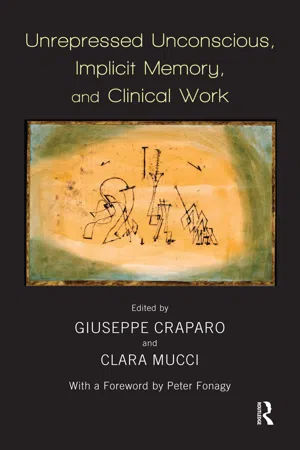
Unrepressed Unconscious, Implicit Memory, and Clinical Work analyses the psychological and neurobiological characteristics of what nowadays goes under the name of "unrepressed unconscious", as opposed to Freud's earlier version of a kind of "repressed unconscious" encountered and described initially in his work with hysterical patients. Pioneering Italian psychoanalyst and neuroscientist Mauro Mancia has distinguished this seminal Freudian concept from an earlier version of the unconscious (preverbal and pre-symbolic) that he terms "unrepressed", and which he describes as "having its foundations in the sensory experiences the infant has with his mother (including hearing her voice, which recalls prosodic experiences in the womb). In connection with this description of two different kinds of unconscious, a 'double' system of memory has been identified: if a traumatic event or series of events takes place when the nervous system is not ready to encode them linguistically and register them within the declarative memory system, they leave a trace within the implicit memory and particularly within the right brain, which both Mancia and Schore see as the seat of implicit memory.
eBook - ePub
Unrepressed Unconscious, Implicit Memory, and Clinical Work
- 208 pages
- English
- ePUB (mobile friendly)
- Available on iOS & Android
eBook - ePub
Unrepressed Unconscious, Implicit Memory, and Clinical Work
About this book
Information
Chapter One
“The unconscious” in psychoanalysis and neuroscience: an integrated approach to the cognitive unconscious*
Using Freud’s (1915e) essay on “The unconscious” as my point of departure, I endeavour in this chapter to update Freud’s classical metapsychology in the light of recent developments in cognitive and affective neuroscience. In doing so, my effort is to integrate Freud’s concept of repression with contemporary notions of the cognitive—unrepressed—unconscious. My arguments are set out in eight sections.
Most mental processes are unconscious
Freud wrote, “Our right to assume the existence of something mental that is unconscious and to employ that assumption for the purposes of our scientific work is disputed in many quarters” (p. 166). (Unless otherwise indicated, all Freud citations in this chapter are from “The unconscious”, 1915e.)
This statement no longer holds true. In cognitive science today, Freud’s insistence that mental processes are not necessarily conscious is widely accepted.
However, the consensus was not won by the arguments that Freud set out in his writings; it derived from a different research tradition. Where Freud cited clinical psychopathological evidence (and the psychopathology of everyday life), modern scientists independently postulated unconscious mental processes on the basis of neuropatho-logical and experimental evidence. Foremost were observations of “split-brain” cases in which complex psychological responses (e.g., giggling) were elicited in patients by stimuli (e.g., pornographic images) that were exposed only to the isolated right hemisphere, of which the speaking left hemisphere was unaware (Galin, 1974). Also influential were reports of ‘implicit memory’; that is, significant learning effects in amnesic cases, who, following bilateral mesial temporal lobectomy, had lost the ability to encode new conscious memories (Milner et al., 1968). Most striking were reports of “blindsight”: cases of cortical blindness where the patients could localise visual stimuli of which they had no visual consciousness (Weiskrantz, 1990). These examples provided evidence of unconscious brain processes that could only be described as mental: unconscious embarrassment, unconscious remembering, and unconscious seeing. Such examples could easily be multiplied.
Experimental neurophysiological studies, the most celebrated of which was Libet’s (1985) demonstration that voluntary motor acts are initiated at the level of supplementary motor area before a subject becomes aware of the decision to move (i.e., unconscious volition), have only strengthened the conviction.
The general view today is just as Freud put it:
that at any given moment consciousness includes only a small content, so that the greater part of what we call conscious knowledge must in any case be for very considerable periods of time in a state of latency, that is to say, of being psychically unconscious. (p. 167)
Bargh and Chartrand (1999), for example, estimate that consciousness plays a causal role in less than 5% of cognition. It is likewise now generally agreed that some mental processes are not merely “in a state of latency”; they are not “capable of becoming conscious” (Freud, p. 173). In other words, on the face of it, we all seem to agree that mental activity can be divided into three grades: what Freud called Cs., Pcs., and Ucs. (the conscious, not currently conscious, never conscious).
At this point, however, modern notions of the unconscious begin to diverge from Freud’s.
Unconscious processes are automatised cognition
It is true that Freud himself gradually came to recognise the inadequacy of his taxonomy, especially when he realised that many secondary processes, which obey the reality principle, are never conscious (Freud, 1923b). But the existence of unconscious ego processes is not disputed. What is controversial is the very idea of dynamically unconscious processes, that is, of all the things that Freud theorised under the headings of “repression” (and “resistance” and “censorship”). For Freud, tendentious mechanisms for the avoidance of unpleasure were pivotal to his conception of the unconscious, giving rise as they do to the active exclusion of certain mental contents from awareness. With relatively rare exceptions (e.g., Anderson et al., 2004; Ramachandran, 1994), the unconscious of contemporary cognitive scientists is theorised without any reference to psychodynamic processes; that is, the unconscious outside of psychoanalysis has no special relationship to affect. It is a purely cognitive entity. In contemporary science, the unconscious is a repository of automatic and automatised information processing and behavioural capacities (see Kihlstrom, 1996 for review). In cognitive neuroscience today there is, in short, no conception of the “id”.
Consequently, it makes no sense for modern cognitive scientists to speak of the “special characteristics of the system Unconscious” as Freud did (1915e, p. 186). Although some neuropsychoanalysts draw attention to clinical neurological evidence and experimental psychological findings that confirm Freud’s conception (e.g., Kaplan-Solms & Solms, 2000; Shevrin et al., 1996), cognitive scientists generally char-acterise unconscious mental systems in very different terms (e.g., Schacter & Tulving, 1994).
Typically, they do not even speak of “conscious” vs. “unconscious” systems; they refer instead to “explicit” vs. “implicit” and “declarative” vs. “non-declarative” systems. This difference, as we shall see, is not entirely accidental.
Consciousness is endogenous
It is important to draw attention to the fact, perhaps not widely recognised among psychoanalysts, that the behavioural neurosciences are just as riven by competing “schools” as psychoanalysis is. Most pertinent for our purposes is the division between cognitive and affective neuroscientists. Affective neuroscientists (e.g., Panksepp, 1998) bemoan the anthropocentrism of their cognitive colleagues, and their excessive focus on cortical processes. They argue that the cognitive approach overlooks the fundamental part played in mental life by phylogenetically ancient subcortical structures, and by the instinctual and affective processes associated with them. The affective neuro-science tradition, which relies more on animal than human research, can be traced back to Darwin’s The Expression of Emotions in Man and Animals (1872) via Paul Maclean (1990) to the work of Jaak Panksepp (1998)—who actually coined the term “affective neuroscience”.
What I said about cognitive neuroscientists still having no conception of the id does not apply to affective neuroscientists. What Freud called the “id” is the principle object of study in affective neuroscience (Solms & Panksepp, 2012). Panksepp identifies his research focus as the “primary processes” of the mammalian brain, the raw instinctual affects. He argues that these are evolutionarily conserved in humans, where they play a fundamental but largely unrecognised role in behaviour. His findings in this respect are, therefore, of the utmost relevance to psychoanalysts (see Panksepp & Biven, 2012).
Unlike his cognitive colleagues, Panksepp would have little difficulty agreeing with this statement of Freud’s:
The content of the Ucs. may be compared with an aboriginal population in the mind. If inherited mental formations exist in the human being – something analogous to instinct in animals – these constitute the nucleus of the Ucs. Later there is added to them what is discarded during childhood development as unserviceable; and this need not differ in nature from what is inherited. (p. 195)
But there is one crucial respect in which Panksepp and colleagues would disagree with this statement, and this pulls the carpet right out from under we psychoanalysts. He would not agree that the core content of what Freud first called the system Ucs. and subsequently called the id—that is, the deepest stratum of the mind—is unconscious. Panksepp, with Damasio (2010) and an increasing number of other scientists (e.g., Merker, 2009), would argue that the primitive brain structures that process what Freud called instincts1—“the stimuli originating from within the organism and reaching the mind, as a measure of the demand made upon the mind for work in consequence of its connection with the body” (1915c, p. 122)—are the very fount of consciousness (see Solms, 2013; Solms & Panksepp, 2012). According to these scientists, consciousness derives from the activating core of the upper brainstem, a very ancient arousal mechanism.
We have known this for many years. A mere decade after Freud’s death, Moruzzi and Magoun (1949) first demonstrated that the state of being conscious, in the sense measured by EEG activation, is generated in a part of the brainstem thereafter called the “reticular activating system”. Total destruction of exogenous sensory inputs had no impact on the endogenous consciousness-generating properties of the brainstem (e.g., sleep/waking). Moruzzi and Magoun’s conclusions were confirmed by Penfield and Jasper (1954), whose studies led them to the view that absence seizures (paroxysmal obliterations of consciousness) could only be reliably triggered at an upper brainstem site. They were also impressed by the fact that removal of large parts of the human cortex under local anaesthetic, even total hemispherectomy, had limited effects on consciousness. Cortical removal did not interrupt the presence of the sentient self, being conscious, it merely deprived the patient of “certain forms of information” (Merker, 2009, p. 65). Lesions in the upper brainstem, by contrast, rapidly destroyed all consciousness, just as the induced seizures did. These observations demonstrated a point of fundamental importance: consciousness always depends upon the integrity of upper brainstem structures. This contradicted an assumption of nineteenth-century behavioural neurology, which was that consciousness was derived from perception and attached to higher cortical functions. According to the affective neuroscientists cited above, there appears to be no such thing as intrinsic cortical consciousness; the upper brainstem supplies it all.
Freud never questioned what is now called the “corticocentric fallacy”. Despite occasional disclaimers to the effect that “our psychical topography has for the present nothing to do with anatomy” (p. 175), Freud repeatedly asserted that his system Pcpt.-Cs. was anatomically localisable and that it was a cortical system. For example:
What consciousness yields consists essentially of perceptions of excitations coming from the external world and of feelings of pleasure and unpleasure which can only arise from within the mental apparatus; it is therefore possible to assign to the system Pcpt.-Cs. a position in space. It must lie on the borderline between inside and outside; it must be turned towards the external world and must envelop the other psychical systems. It will be seen that there is nothing daringly new in these assumptions; we have merely adopted the views on localization held by cerebral anatomy, which locates the “seat” of consciousness in the cerebral cortex – the outermost, enveloping layer of the central organ. Cerebral anatomy has no need to consider why, speaking anatomically, consciousness should be lodged on the surface of the brain instead of being safely housed somewhere in its inmost interior. (Freud, 1923b, p. 24, my emphasis)
Ironically, as it turns out, consciousness is housed in the inmost interior of the brain. The observations of Moruzzi and Magoun (1949) and Penfield and Jasper (1954) have stood the test of time, but greater anatomical precision has been added (see Merker, 2009, for review). Significantly, the peri-aquaductal grey, an intensely affective structure, appears to be a nodal point in the brain’s “activating” system. This is the smallest region of brain tissue in which damage leads to complete obliteration of consciousness. This fact underscores a major change in recent conceptions of the brain’s ascending activating system: the deep structures that generate consciousness are not only responsible for the level (quantity) but also for the core content (quality) of con sciousness. The conscious states generated in the upper brainstem are inherently affective. This realisation is now revolutionising consciousness studies.
The classical conception is turned on its head. Consciousness is not generated in the cortex; it is generated in the brainstem. Moreover, consciousness is not inherently perceptual; it is inherently affective.
Basic (brainstem) consciousness consists in states rather than images (cf., Mesulam, 2000). The upper brainstem structures that generate consciousness do not map our external senses; they map the internal state of the (visceral, autonomic) body. This mapping of the internal milieu generates not perceptual objects but rather the subject of perception. It generates the...
Table of contents
- Cover
- Half Title
- Title
- Copyright
- CONTENTS
- ABOUT THE EDITORS AND CONTRIBUTORS
- FOREWORD
- INTRODUCTION
- CHAPTER ONE “The unconscious” in psychoanalysis and neuroscience: an integrated approach to the cognitive unconscious
- CHAPTER TWO Implicit memory and early unrepressed unconscious: their role in the therapeutic process
- CHAPTER THREE Attachment, implicit memory, and the unrepressed unconscious
- CHAPTER FOUR The right brain implicit self: a central mechanism of the psychotherapy change process
- CHAPTER FIVE Implicit memory, unrepressed unconscious, and trauma theory: the turn of the screw between contemporary psychoanalysis and neuroscience
- CHAPTER SIX The role of unrepressed and repressed unconsciousness in clinical work
- AFTERWORD The psychoanalytic clinical unconscious: a guide for the perplexed?
- INDEX
Trusted by 375,005 students
Access to over 1.5 million titles for a fair monthly price.
Study more efficiently using our study tools.
Frequently asked questions
Yes, you can cancel anytime from the Subscription tab in your account settings on the Perlego website. Your subscription will stay active until the end of your current billing period. Learn how to cancel your subscription
No, books cannot be downloaded as external files, such as PDFs, for use outside of Perlego. However, you can download books within the Perlego app for offline reading on mobile or tablet. Learn how to download books offline
Perlego offers two plans: Essential and Complete
- Essential is ideal for learners and professionals who enjoy exploring a wide range of subjects. Access the Essential Library with 800,000+ trusted titles and best-sellers across business, personal growth, and the humanities. Includes unlimited reading time and Standard Read Aloud voice.
- Complete: Perfect for advanced learners and researchers needing full, unrestricted access. Unlock 1.5M+ books across hundreds of subjects, including academic and specialized titles. The Complete Plan also includes advanced features like Premium Read Aloud and Research Assistant.
We are an online textbook subscription service, where you can get access to an entire online library for less than the price of a single book per month. With over 1.5 million books across 990+ topics, we’ve got you covered! Learn about our mission
Look out for the read-aloud symbol on your next book to see if you can listen to it. The read-aloud tool reads text aloud for you, highlighting the text as it is being read. You can pause it, speed it up and slow it down. Learn more about Read Aloud
Yes! You can use the Perlego app on both iOS and Android devices to read anytime, anywhere — even offline. Perfect for commutes or when you’re on the go.
Please note we cannot support devices running on iOS 13 and Android 7 or earlier. Learn more about using the app
Please note we cannot support devices running on iOS 13 and Android 7 or earlier. Learn more about using the app
Yes, you can access Unrepressed Unconscious, Implicit Memory, and Clinical Work by Giuseppe Craparo, Clara Mucci, Giuseppe Craparo,Clara Mucci in PDF and/or ePUB format, as well as other popular books in Psychology & Cognitive Neuroscience & Neuropsychology. We have over 1.5 million books available in our catalogue for you to explore.