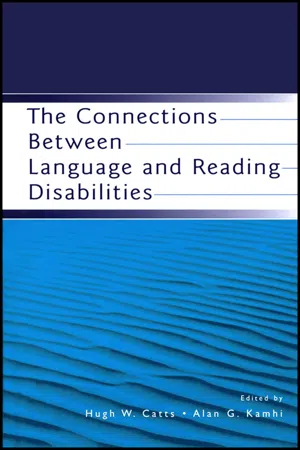
This is an edited book based on papers presented at a 2003 invitee-only conference under the sponsorship of the Merrill Advanced Studies Center of the University of Kansas. The participants were prominent scholars in the areas of language and reading, and have research programs funded by NIH and other sources. The purpose of the gathering was to discuss theoretical issues and research findings concerning the relationship between developmental language and reading disabilities, specifically looking at neurological, behavioral, and genetic factors. In addition, it discussed other factors contributing to reading difficulties in the middle elementary school years through adolescence and literacy outcomes for children with early language impairments, and how these problems relate to children with dyslexia. The Foreword is written by Reid Lyon, Branch Chief, Child Development and Behavior Branch, NICHD-National Institutes of Health.
This book appeals to scholars in the areas of language disorders and reading disabilities, as well as to practicing speech-language pathologists, special educators, and reading specialists. It may also be used in graduate courses designed as seminars in either language disorders or reading disabilities in schools of communication disorders, as well as schools of education--especially special education departments.
eBook - ePub
The Connections Between Language and Reading Disabilities
- 248 pages
- English
- ePUB (mobile friendly)
- Available on iOS & Android
eBook - ePub
The Connections Between Language and Reading Disabilities
About this book
Information
II
GENETIC AND NEUROLOGICAL BASES OF LANGUAGE AND READING DISABILITIES
6
The Neurobiological Basis of Reading: A Special Case of Skill Acquisition
Peter E.Turkeltaub
Jill Weisberg
D.Lynn Flowers
Debi Basu
Guinevere F.Eden
Georgetown University Medical Center
Beginning with the seminal work of Wiesel and Hubel demonstrating that monocular deprivation leads to a reorganization of ocular dominance columns in visual cortex (e.g., Wiesel & Hubel, 1963), a large body of literature has accumulated documenting the dynamic nature of the nervous system. The adaptability and plasticity of the brain is nowhere more apparent than in the fact that throughout our lives we continue to learn. Functional brain imaging techniques enable us to observe changes in brain systems as people learn new skills and information. Recent studies employing crosssectional and longitudinal approaches offer new insights into how cortical networks change as learning occurs throughout development.
Among the most important skills learned during childhood is reading. Written language is a recent invention relative to the course of human evolution. In that brief time, writing schemes have grown from collections of simple shapes representing objects encountered in daily life to sophisticated systems of symbols representing spoken sounds. Alphabetic systems have been passed on to various societies that have altered them to suit the phonetic structures of their oral languages, leading to the widespread use of written languages. Reading, and with it writing, is a fundamental skill for information exchange in today’s society; the importance of good reading skills is enormous. Not being part of the human evolutionary heritage, it requires extensive effort and training to learn. Over several years of reading instruction and practice, the consolidation of orthographic and phonological skills, combined with automaticity and vocabulary gains, leads to the acquisition of a skill that is uniquely human and particularly important in today’s literate society. From a neuroscientific perspective, this protracted time course of learning to read provides a unique opportunity to examine the mechanisms of neural plasticity associated with skill learning. From an educational perspective, considering reading in the context of biological plasticity, learning, and acquisition of expertise opens the potential for optimizing instructional approaches.
This chapter examines the functional specialization of reading in the developing brain as an example of skill learning and neural plasticity. We first present a brief discussion of neural plasticity associated with skill learning in humans. Recently, several neuroimaging studies have examined changes in brain anatomy and function that occur with acquisition of motor or perceptual skills. These studies elucidate general mechanisms of skill learning in tightly controlled experimental settings. Their findings may suggest potential biological adaptations associated with learning to read. Of particular interest is a discussion of musical training, which shares some attributes with reading: It too is a distinctly human skill, requires integration and sequencing in multiple sensory modalities, and is learned through years of effortful training, usually initiated during childhood. Furthermore, musical training is somewhat easier to study than reading acquisition because musicality is less linked to confounding sociocultural factors than is literacy. Next we review the implications of social and academic experiences on the neural wiring of the brain. Evidence suggesting experiential learning in two cortical areas is discussed: (a) the right hemisphere “fusiform face area,” which seems specialized for processing faces; and (b) the homologous left hemisphere “visual word form area,” which in literate adults seems specialized for processing text. Finally, we discuss the neural plasticity associated with learning to read. We first discuss behavioral models of learning to read, which consistently describe phases in the development of reading skill. Then we examine evidence from neuroimaging studies suggesting neural mechanisms associated with these behavioral changes. In particular we focus on two recent studies from our laboratory. The first addresses changes in the functional neuroanatomy of reading in a cross-section of good readers ranging from kindergarten through the end of college. The second examines the neural mechanisms of reading in a 9-year-old hyperlexic boy who acquired extremely advanced reading skills at a young age despite severe expressive and receptive language delay.
THE EFFECT OF ENVIRONMENTAL EXPERIENCES ON THE BRAIN
Functional neuroplasticity following sensory deprivation has been extensively documented in studies of both animals and humans. Often deprivation in one modality affects the development of the intact modalities both behaviorally and neurally (see Kujala, Alho, & Naatanen, 2000; Rauschecker, 2002, for reviews). The loci for these effects include multimodal, early sensory, and even primary sensory cortices, and theorized mechanisms include changes in local connectivity, stabilization of normally transient connections, and modification of cortical feedback loops (see Bavelier & Neville, 2002; Rauschecker, 1997, for reviews). Although neural adaptation secondary to sensory deprivation is a classic example of brain plasticity, the learning of novel information or new skills also engenders plastic changes in brain structure and function.
One type of learning in which we continually engage is commonly referred to as procedural or skill learning. Procedural learning occurs implicitly and can be contrasted with declarative learning, which requires conscious awareness of that which is being learned. Functional neuroimaging studies of procedural learning, including motor and perceptual skill acquisition, have shown that learning-dependent changes in the brain may manifest as increases or decreases in extent or magnitude of activity, and as shifts in the locus or temporal relationships of neural responses (see Gilbert, Sigman, & Crist, 2001, for review).
In a typical perceptual or motor learning study, subjects are trained to perform a task (e.g., motor tapping sequence) until performance asymptotes, and then some parameter of the task is manipulated such that performance returns to a pre-skill-acquisition baseline level. To study the cortical changes consequent to long-term practice on a motor task, Karni and colleagues (1995) trained subjects to perform two different finger-thumb opposition sequences, which they were instructed to execute as quickly and accurately as possible without looking at their hand. Subjects were scanned after measuring baseline performance on both sequences, then weekly as they practiced one of the sequences for 10 to 20 minutes each day for 3 weeks. Behaviorally, there were no differences between performance of the two sequences during baseline testing. After practice, however, subjects more than doubled their speed and accuracy of the practiced sequence, as compared with the untrained sequence. Interestingly, in addition to a lack of transfer to the untrained sequence, improvements were limited to the trained hand, with little transfer of learning to the untrained hand. The specificity of practice effects to stimulus and task conditions is a common finding in procedural learning paradigms (see Gilbert et al., 2001, for further discussion, but see Green & Bavelier, 2003, for alternative findings). Functional magnetic resonance imaging (fMRI) data revealed that the experience-dependent changes in motor performance were reflected by an increase in the extent of motor cortex devoted to performing the trained sequence compared with the untrained sequence. Thus, the authors concluded that the effect of practice was the recruitment of additional neurons in motor cortex, resulting in an altered cortical topography, perhaps through new or stronger synaptic connections, effectively expanding the network of neurons dedicated to performing the trained sequence.
In addition to motor learning, practice can also bring about perceptual learning, reflected by an improved ability to detect differences in sensory stimuli. Although cortical changes accompanying perceptual learning have been documented within each sensory domain (visual, auditory, tactile, and olfactory), perhaps the visual modality has received the most attention. fMRI data have shown that after just a few minutes of practice on a coherent motion detection task, the extent of activation in area MT/V5, which mediates motion perception and is located at the occipito-temporal junction, was five times greater than when subjects initially performed the task (Vaina, Belliveau, des Roziers, & Zeffiro, 1998). This increased activity was highly correlated with behavioral performance, which was near chance for the first set of trials and near perfect after several minutes. Furthermore, as subjects’ performance improved and the extent of activity in area MT/V5 grew, activity was reduced in other extrastriate regions, creating a more focused representation and suggesting that perceptual processing had become more efficient. Additional learning-related changes were found in the cerebellum, where activity was inversely correlated with learning, decreasing by more than 90% as learning proceeded. When the visual stimulus was changed such that subjects had to detect motion in the opposite direction, performance returned to chance levels and cerebellar activity showed a marked increase. The specific region of the cerebellum modulated in this study has been implicated in visual attention (Allen, Buxton, Wong, & Courchesne, 1997), suggesting that fewer attentional resources are required as we become more proficient at visual perception tasks.
Studies of professional musicians’ brains offer further insight into the neuroanatomical substrates of skill learning. Like reading, performing music is a complex skill that, for most accomplished musicians, is learned from an early age, and life-long practice leads to automatic processing with respect to the component skills (visual, auditory and tactile sensory skills, motor skills, and multimodal sensorimotor skills; for review, see Munte, Altenmuller, & Jancke, 2002). In one study, musicians were found to have an extended hand area in right primary motor cortex compared with nonmusicians, with reduced asymmetry (nonmusicians show a pronounced asymmetry favoring the dominant hand; Amunts et al., 1997). Similarly, in a study of string instrument players, Elbert et al. (1995) reported increased somatosensory cortex representation for the fingers of the left, but not the right hand, compared with control subjects. String players use the left hand for intricate finger movements on the strings, entailing finely skilled motor movements and intense somatosensory stimu-lation. In contrast, the right hand manipulates the bow, requiring considerably less skill and sensory stimulation. Moreover, in each of these studies, the size of the hand area was negatively correlated with the age at which musical training began and in Amunts et al. (1997) with behavioral measurements of left (and therefore right-hemisphere) index finger-tapping ...
Table of contents
- Cover Page
- Title Page
- Copyright Page
- Contributors
- Foreword
- Preface
- I: Behavioral Connections Between Language and Reading Disabilities
- II: Genetic and Neurological Bases of Language and Reading Disabilities
Trusted by 375,005 students
Access to over 1.5 million titles for a fair monthly price.
Study more efficiently using our study tools.
Frequently asked questions
Yes, you can cancel anytime from the Subscription tab in your account settings on the Perlego website. Your subscription will stay active until the end of your current billing period. Learn how to cancel your subscription
No, books cannot be downloaded as external files, such as PDFs, for use outside of Perlego. However, you can download books within the Perlego app for offline reading on mobile or tablet. Learn how to download books offline
Perlego offers two plans: Essential and Complete
- Essential is ideal for learners and professionals who enjoy exploring a wide range of subjects. Access the Essential Library with 800,000+ trusted titles and best-sellers across business, personal growth, and the humanities. Includes unlimited reading time and Standard Read Aloud voice.
- Complete: Perfect for advanced learners and researchers needing full, unrestricted access. Unlock 1.5M+ books across hundreds of subjects, including academic and specialized titles. The Complete Plan also includes advanced features like Premium Read Aloud and Research Assistant.
We are an online textbook subscription service, where you can get access to an entire online library for less than the price of a single book per month. With over 1.5 million books across 990+ topics, we’ve got you covered! Learn about our mission
Look out for the read-aloud symbol on your next book to see if you can listen to it. The read-aloud tool reads text aloud for you, highlighting the text as it is being read. You can pause it, speed it up and slow it down. Learn more about Read Aloud
Yes! You can use the Perlego app on both iOS and Android devices to read anytime, anywhere — even offline. Perfect for commutes or when you’re on the go.
Please note we cannot support devices running on iOS 13 and Android 7 or earlier. Learn more about using the app
Please note we cannot support devices running on iOS 13 and Android 7 or earlier. Learn more about using the app
Yes, you can access The Connections Between Language and Reading Disabilities by Hugh W. Catts, Alan G. Kamhi, Hugh W. Catts,Alan G. Kamhi in PDF and/or ePUB format, as well as other popular books in Education & Inclusive Education. We have over 1.5 million books available in our catalogue for you to explore.