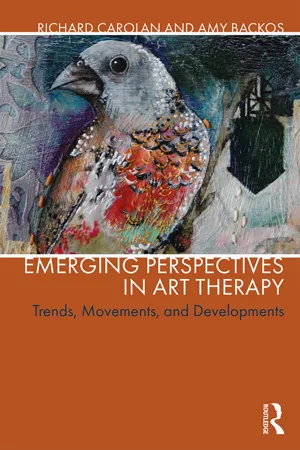
Emerging Perspectives in Art Therapy aims to document newly emerging trends in the field of art therapy and to offer a vision of the future practices. This exciting new volume contains a diverse selection of chapters written to examine the current transitional phase of the profession where new paradigms of thinking and research methods are emerging due to the continued examination of old assumptions and development of new knowledge. Specific attention is paid to emergent knowledge in the areas of neuropsychological applications, philosophical foundations, research, multicultural and international practices, and art as therapy in allied professions.
eBook - ePub
Emerging Perspectives in Art Therapy
Trends, Movements, and Developments
- 182 pages
- English
- ePUB (mobile friendly)
- Available on iOS & Android
eBook - ePub
Emerging Perspectives in Art Therapy
Trends, Movements, and Developments
About this book
Information
Part I
Theory
1 Philosophical Foundations of Art Therapy
Foundational Pillars of Art Therapy
In order to forge ahead into emerging trends and new ways of thinking about art therapy, we are required to review some of the most relevant foundations of our work. To both remain true to the origins of art therapy, while simultaneously developing new paths, it is necessary to review the philosophical foundations on which art therapy rests. Talwar (2016) noted that the art therapy profession must continually and critically examine “the socially constructed definition of art therapy” (p. 117); doing so calls for continual self-reflection of our work with respect to the people we serve as art therapists. The philosophical foundations of art therapy intermingle to create the basis of its assumptions, practices, and research. This chapter describes three of the foundations that are critical to understanding the profession of art therapy and the role art therapists assume in communities, institutions, and agencies.
The primary foundational pillar is the role of healer. The role of modern-day healer rests on the assumption that individuals and communities can be healed and made better. This is coupled with the belief that we, as art therapists, have much to offer in healing individuals and improving the state of the world. The second foundational pillar is our role and identity as artists. We stand in the tradition of creators, makers, and provocateurs by constructing beauty and function, guiding and mentoring others, and challenging the status quo by nature of what we attend to in our art. We rely on art itself—the philosophy of art and its honored role across cultures—for its ability to document, soothe, provide catharsis as well as calm during times of chaos, and engage and challenge the viewer. The third philosophical foundation of art therapy is that of psychotherapist. Art therapy has deep roots in the field of psychology, including treating neuroses and promoting self-actualization, as well as researching and classifying human behavior. Therefore, the field of psychology heavily influences the research and practices of art therapists. This chapter will explore these three philosophical foundations of art therapy as a way to deepen our connection to the collective cultural experience of being an art therapist.
Healer
As art therapists, we embody the role of healer. Healers play important roles in all religions and cultures—priest, shaman, doctor, chief, witch, elder, and psychotherapist (Jung, 1964; McNiff, 1979). They serve others through helping to reduce sickness, increase health, expel demons, and perhaps most importantly, to heal broken spirits. This is a sacred role that spans history, and art therapy is part of this long tradition of the honored healing arts; these include the laying on of hands, administering herbal or chemical medicines, talking, chanting, dancing, vision-questing, smudging, sweating, fasting, praying, making art and talismans, and pilgrimaging to sacred places. These healing arts rest on the optimistic belief that a person can be soothed, healed, emboldened, or even cured with the help of a guide, intention, treatment, and ritual. For those who have ailments, the I Ching teaches, “It furthers one to appoint helpers” (Kopp, 1972, p. 7), and indeed, the role of healer is critical for furthering individuals and communities. Three types of healers will be explored here: shaman, pilgrim, and activist.
What brings each of us to the profession of healer varies, but we can draw on this collective, archetypical identity as healer to lend inspiration, purpose, and personal satisfaction to our work. McNiff (1979) called attention to one aspect of this role of the art therapist: a shaman. Regardless of one’s religion, culture, or personal beliefs, this is an early archetypical foundation on which much past and current work rests. The identity of art therapist is more than a healer who administers a single treatment—like a shaman, art therapists also participate in the process and serve as a guide. Unlike cult leaders and gurus who may seek to cultivate dependence from those with whom they work, the psychotherapist, shaman, and art therapist pursue treatment so refined and curative that they ideally, and eventually, render themselves obsolete and unnecessary in the lives of their clients (Kopp, 1972).
Healers accompany others on their own journey towards self-actualization and wellness to help them foster rewarding relationships and meaningful work through art making. Therefore, a second metaphor for our work as healer is that of the co-pilgrim. Ultimately, as art therapists, we are captains of our own voyages, and our meaningful relationships with clients become a vital part of our travels. This allegory of pilgrim and guide captures the stance I take in providing art therapy; I too am on a journey; thus, making art is necessary for me in tending to the aching souls of others; it is necessary for revitalizing myself when the work of therapy becomes painful. Clients seek relief from whatever ails them, and under the guidance of an art therapist they also become the proverbial pilgrim. As Kopp noted, “The contemporary pilgrim wants to be a disciple of the psychotherapist” (Kopp, 1972, p. 7). Using the metaphor of psychotherapy as a journey, modern healers empower clients with agency as they embody the role of teacher, mentor, therapist, or guide. Conversely, a guru teaches others using stories and metaphors, but the therapy client as pilgrim learns only by telling her or his own story (Kopp, 1972). In this way, art and art therapy help clients to tell their stories by creating coherent trauma narratives (Gantt & Tinnin, 2009) and re-authoring problem-saturated stories (Corey, 2013).
Witnessing the art process and final product can foster a healing and growth-promoting climate. In reflecting on her three-dimensional art, Erin Partridge, Ph.D., ATR-BC, considers the role an art therapist plays as a healer (Plate 1):
The quick movements and fragile nature of finches obscure their potent symbolism. One thread at a time, a finch weaves and creates a sense of place, a sense of home and a sense of purpose. Finches are collaborative problem-solvers without attachment to a final product; they will continue to do and undo in search of comfort and security. The healer does not provide a premade nest and does not fill in or bandage holes. The healer joins in the weaving, simply holding the end of the thread as the draft is untangled.
(E. Partridge, personal communication, April 2, 2017)
Art therapists are not only concerned with helping disenfranchised individuals, but we also engage in actions to impart long-lasting change on the social structures that support and maintain disenfranchisement. Therefore, artists, as community healers and activists, participate in social justice movements and work to help empower and heal disenfranchised communities. Artists have historically played a critical role in calling attention to injustices and oppression, and they assume the role of activist when they engage in social action art therapy (Kaplan, 2007, 2016). Art therapy researchers engaged in social justice include the marginalized and oppressed groups as co-researchers; thus, the voices of their co-researchers are central to the development of the research questions (Partridge, 2016; Potash & Kalmanowitz, 2016). Art therapists around the globe provide communities with opportunities to engage in collective art making for the purposes of fostering social engagement and action (Kaplan, 2007; 2016), crisis management (Anderson, 1995; Gantt & Tinnin, 2009; Howie, 2016), as well as growth and healing (Isis, 2016).
Long a part of the profession of art therapy, social action (Moon, 2016) in art therapy takes on renewed purpose as the world faces pressing attacks against social justice and freedom. Due to the rise of social media, the unparalleled access to information and people (Belkofer & McNutt, 2011), and the evolution in digital art (Orr, 2016), we now have unprecedented opportunities to collaborate with other artists, educators, and art therapists to effect attitude changes in our own communities and throughout the world. We can now easily touch the lives of our friends, families, and online acquaintances with our art and our vision for a better world. We need only look to Lynn Kapitan (2007, 2016), Don Jones, Robert Ault, Catherine and Bruce Moon (2016), and many others for inspiration about activism in art therapy (Potash & Kalmanowitz, 2016). A new generation of young, globally conscious art therapists picks up this call for social action through response art, community engagement, collaboration, and dialogue about the significance and necessity of art’s contribution to social discourse.
Artist
The second foundational pillar in art therapy is occupied by the art therapist’s role as an artist. Formal training and apprenticed positions in art provide art therapists with the pragmatic tools of our profession. Our individual creative forces are honed with education in the fine arts and application of the tools to our own artistic ends. We foster our artistic selves for professional development and self-awareness, as well as to remain vitally integrated in the therapeutic process on a shared artistic journey with our clients.
Art has served a critical role throughout humankind, and aesthetics plays a crucial part in the development of civilization (Dissanayake, 1992). With the role that the arts play in discourse, advancement in cultural norms, beliefs, and relationships are possible. Dissanayake (1992) asserted that the role of art is biological and the use of art has evolutionary advantages for individuals and communities. Extrapolating from Diassanayke, understanding art and aesthetics, as well as making, exhibiting, and teaching art, are critical functions to the evolutionary survival of the art therapy profession. Without practicing the language of art, art therapists lose the ability to understand and communicate with others. Art making remains critical to the evolution of individual and collective art therapy work. Specifically, the open studio approach identifies clients as artists and promotes intrapsychic experiences combined with interpersonal interactions and community experiences (Moon, 2002; 2016). Art making allows discovery of personal myth to promote discovery of spiritual creation (Allen, 1995).
To understand the historical role of art and the artist, as well as art’s influence on culture and thinking, one must consider the role art making plays in communicating one’s inner experience and in reflecting the outer world. For example, art communicates political history through political-action art, the role of religion and spiritual attunement in religious art, and the branding of a company or an idea through media and corporate art. Aesthetics, with its origin in the Greek word, aisthanomai, refers to perceptions of the senses (Budd, n.d.). Aesthetics can be described in two ways: the philosophy of art and the philosophy of the aesthetic experience in response to nature.
Art stems from spirit, and the content of art is spiritual (James, 2008). From this standpoint, artistic beauty surpasses even natural beauty. The idea of art springing from the spirit derives from 18th century philosopher Georg Hegel (David, 2009). His observations are contextualized in terms of art’s relationship to religion and spiritual tenets. Cultural and universal symbols are necessary to both communicate and understand the spirit in art. Art therapists utilize these symbols as we create art with our clients; through doing so, we simultaneously value the dignity and sacredness of each of our clients, while also relying on the accepted best practices of our profession. However, Hegel postulated that art must also be conceptualized according to historical and cultural circumstances—an idea that fits well within our postmodern belief system. We attend to and celebrate diversity in culture as well as conceptualize culture within the global profession of art therapy.
We can further understand our modern ideas about aesthetics by reflecting on the judgment of beauty. Kant, a contemporary of Hegel, noted that the experience of beauty is based on three types of aesthetic judgments (Burnham, n.d.). First, disinterested judgment is necessary, whereby something is found to be pleasurable because it is beautiful (not the other way around). We enjoy and find pleasure in what is beautiful. Next, universal judgment must be made; others will come to the same conclusions and agree with the application of the term beautiful, but again, an object does not possess beauty in and of itself. Here, beauty in art can be generally, but not universally, agreed on by others. Finally, art is purposive in its creation, but it does not need to have a particular purpose. In other words, this final judgment implies that art exists for art’s sake—we perceive art as if it had a purpose, but no other purpose is necessary, according to Kant, except for the perception of beauty.
In an attempt to capture the definition of art, we must explore the intention of the maker and consider the procedural and functional definitions of art (Davies, 2011). We might procedurally call an object art if it has been created properly or vetted by the institutions of art. We can functionally call something art when it provides an aesthetic experience. The former definition suggests art is reserved for museums and trained artists. Using the procedural definition, Art (with a capital A) can be a source of inspiration for art therapy, but it might also leave clients and therapists believing that their art (with a lowercase a) is lacking, insufficient, primitive, or generally not good enough. Conversely, using the functional definition of art suggests that what our clients create is indeed art and should be called such. Functional art can be made by anyone, including children, adults, elders, clients, the differently abled, the disenfranchised communities, and self-taught outsider artists. Art brut (raw art) or outsider art, is a term that refers to the work of artists who create independently of the high art market or cultural art scene, as well as those who lack formal training (“What is Outsider Art?” 2017). Art brut, a term coined in the 1940s and later expanded on in the 1970s, describes the art of those who display raw creativity, typically practice in isolation, lack outside influence in their art, and may or may not have a mental illness.
Art therapy bridges procedural, high Art (with a capital A) and functional, common art (with a lowercase a), which brings a formal quality to the teaching of art to our clients, while advocating that anyone can create art. However, Budd (n. d.) reminds us that not all creations are necessarily art. Examples of functional art include process-oriented art therapy interventions, or a craft, with craft often being seen as less complex, sophisticated, or meaningful as art. Craft is skill-based and often relies on learning a technique and recreating an object from a template or pattern. It may be seen as subsidiary to art because it may lack spontaneous creative expression. Moreover, it typically serves a functional purpose in addition to aesthetics and is often associated with women’s work. However, craft is used in art therapy, and at times, no doubt inspires what Kant calls the experience of beauty based on aesthetic judgments. Three examples of women’s textile work illustrate this point: the work of the quilters of Gee’s Bend, Alabama; the crochet work of Toshiko Horiuchi MacAdam; and the textile work of textile artist Mandy Greer.
Textile crafts in art therapy have been documented as a means to reduce unwanted symptoms and promote positive mood states (Collier, 2011), as well as a way to call up tactile experiences related to childhood attachment (Findlay, Latham & Hass-Cohen, 2008). Textile and fiber materials in art therapy has focused on women’s preference for textiles as intrinsic to the use of the materials (Hinz, 2...
Table of contents
- Cover
- Title
- Copyright
- Dedication
- Contents
- Contributing Authors
- List of Figures
- List of Plates
- Introduction
- Part I Theory
- Part II Practice
- Index
Trusted by 375,005 students
Access to over 1.5 million titles for a fair monthly price.
Study more efficiently using our study tools.
Frequently asked questions
Yes, you can cancel anytime from the Subscription tab in your account settings on the Perlego website. Your subscription will stay active until the end of your current billing period. Learn how to cancel your subscription
No, books cannot be downloaded as external files, such as PDFs, for use outside of Perlego. However, you can download books within the Perlego app for offline reading on mobile or tablet. Learn how to download books offline
Perlego offers two plans: Essential and Complete
- Essential is ideal for learners and professionals who enjoy exploring a wide range of subjects. Access the Essential Library with 800,000+ trusted titles and best-sellers across business, personal growth, and the humanities. Includes unlimited reading time and Standard Read Aloud voice.
- Complete: Perfect for advanced learners and researchers needing full, unrestricted access. Unlock 1.5M+ books across hundreds of subjects, including academic and specialized titles. The Complete Plan also includes advanced features like Premium Read Aloud and Research Assistant.
We are an online textbook subscription service, where you can get access to an entire online library for less than the price of a single book per month. With over 1.5 million books across 990+ topics, we’ve got you covered! Learn about our mission
Look out for the read-aloud symbol on your next book to see if you can listen to it. The read-aloud tool reads text aloud for you, highlighting the text as it is being read. You can pause it, speed it up and slow it down. Learn more about Read Aloud
Yes! You can use the Perlego app on both iOS and Android devices to read anytime, anywhere — even offline. Perfect for commutes or when you’re on the go.
Please note we cannot support devices running on iOS 13 and Android 7 or earlier. Learn more about using the app
Please note we cannot support devices running on iOS 13 and Android 7 or earlier. Learn more about using the app
Yes, you can access Emerging Perspectives in Art Therapy by Richard Carolan, Amy Backos, Richard Carolan,Amy Backos in PDF and/or ePUB format, as well as other popular books in Psychology & Mental Health in Psychology. We have over 1.5 million books available in our catalogue for you to explore.