eBook - ePub
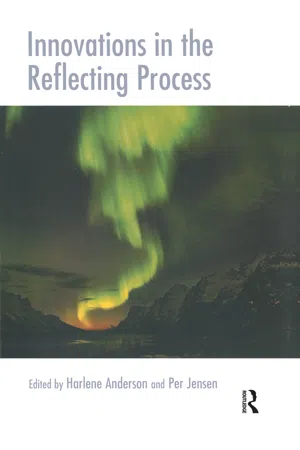
Innovations in the Reflecting Process
- 256 pages
- English
- ePUB (mobile friendly)
- Available on iOS & Android
eBook - ePub
Innovations in the Reflecting Process
About this book
'The passion to continually be on the move to seek new understanding is a characteristic of the field of family therapy and systemic thinking over the last forty years. Many professionals have moved around, more or less freely, in and out of this field. Some have made footprints that will last for a long time. One of these is Tom Andersen. From a position as professor in social psychiatry at the University of Tromso in northern Norway he has moved around the world participating with other professionals in their efforts to develop their work and seek wider horizons.' - Harlene Anderson and Per Jensen, from the Preface
Information
Innovations
Chapter 1
Practising “withness”: a human art
The first rays
Ihad been to the North of Norway on numerous occasions, mostly at the Summer Solstice, but Tom Andersen kept telling me that I must come in the “Darktime”. So he invited me for the first day of spring, just as the sun was going to appear. Tom took me to his top-floor office at the University of Tromsø the morning of the conference, and out the window I saw the first rays. They appeared in the cleft of two snow-covered mountains, then faded away, followed by colours of pink, mauve, and gold that lit up the edges of landscape and sky.
From time to time as I have passed through the history of this field, I have been given the chance to see such first rays. And I have in some way known or guessed which newcomer approaches would establish themselves and persist. One is taking shape now, like a ship hull-up on the horizon and coming closer. Roger Lowe (2005), in a recent article, has referred to it as the “Conversational” or “Dialogical therapies”. More interesting, perhaps, Lowe distinguishes between “Structured-Question” approaches, like Narrative (White, 1995) and Solution-Focused (de Shazer, 1994) work, and what he calls, following John Shotter (Shorter & Katz, 1998), a “Striking Moments” approach. By this description, we seem to have discovered a territory that relies on a relational version of static electricity for its effects rather than a technology that is imposed from outside. Using this new measure, the Collaborative perspective of Harry Goolishian and Harlene Anderson, and the Reflecting Process of Tom Andersen, are being joined by a new band of travelling players who have related, but different, songs to sing.
As part of this thinking, we have been introduced to a cornucopia of philosophical treasures based on the writings of Ludwig Wittgenstein and Mikhail Bakhtin. We have a new “in-house philosopher” in social thinker John Shotter (1993), who has described how these writers can help us understand what Bakhtin (1981) calls “dialogicality”. We are beginning to have new terms for what we do, like Tom Andersen’s idea of “Withness Practices”. Finally, we have some unusual examples of these ideas embedded in the work of innovators such as Jaakko Seikkula and his colleagues in Finland (Seikkula & Olson, 2003; Seikkula et al., 1995), who have been developing an approach called “Open Dialogue”. Finally, let me mention Chris Kinman (2001) in Vancouver, who has been experimenting with a Language of Gifts that is producing an entire system change. But being one of the historians of this field, I am interested in establishing a train of forebears for these new additions. So let me go back in time and start with the early genius who (for me) began it all: Gregory Bateson.
Batesonand “syllogisms in metaphor”
Bateson’s daughter Catherine tells us that, at the end of his life, when he and she were working on Angels Fear together (Bateson & Bateson, 1987), her father was excitedly focusing on what he was calling “syllogisms in metaphor”. This focus, she explained, tied together his lifelong interest in the forms of sublingual communication that are common to religion, humour, playfulness, some forms of madness, animal communication, and art. Catherine saw his goal as putting together “the beginning of a Creatural grammar”. Her father had used Jung’s term, the “Creatura”, to describe the world of the living, as opposed to the “Pleroma”, meaning Newton’s world of force and mass. The Pleroma has no mental process, no names, no classes. The Creatura, on the other hand, is founded on pattern and communicates through “as-if” language, using similitude and metaphor in a variety of embedded and embodied ways.
So what might that mean? In contrasting the truths of logic with the truths of metaphor, Bateson explains that classical logic describes causal word structures called syllogisms that are built on classification and follow the form, “if this is true, then that is true”:—if Socrates is a man, and if all men die, then Socrates will die. But there is another word structure that Bateson describes that is built on likeness, the example for which is: “Grass dies, Men die, [therefore] Men are grass.” Logicians disapprove of this kind of syllogism because it does not make sense (they call it “affirming the consequent”), but Bateson believed that this formula indicated the way the natural world communicated. He fires off this ringing salvo:
The whole of animal behaviour, the whole of repetitive anatomy, and the whole of biological evolution—each of these vast realms is within itself linked together by syllogisms in grass—whether the logicians like it or not. … And it became evident that metaphor was not just pretty poetry, it was not either good or bad logic, but was in fact the logic on which the biological world had been built, the main characteristic and organizing glue of this world of mental process that I have been trying to sketch for you. … [Bateson & Bateson, pp. 26–30]
This statement thrilled me. It felt accurate, and it justified the enormous importance my community of relational therapists placed on sensory pathways and emotional gestures in the work we did. The preverbal, analogical vision of Bateson seemed especially pertinent to the project of psychotherapy, because it indicated that advice and expertise were not enough—you had to reach for connection at levels that lay beyond the scope of words. I felt that Bateson was saying that there is a hidden language that had to do with what Pascal called “reasons of the heart”. Current researchers in neurology (Damasio, 1994) have pointed to a specific area of the brain—the amygdala, also called the “emotional brain”—saying that this is the brain’s “smoke alarm”, because this is where the intense memories are stored that warn us away from bad things and towards good ones. It makes sense to believe that messages directed towards this area have to use this ancient grammar of Nature or they will not be recognized. Of course, when Bateson talked about syllogisms in metaphor, he did not mean that we should literally use figures of speech, but, rather, that sensory and feeling-level channels do best in carrying messages of life importance, as the channels of reason and logic are untrustworthy.
We have also discovered that such messages can break through private walls. Current brain research tells us of the existence of “mirror neurons”, little cells that fire off in us when we see another creature involved in an important action. In rhesus monkeys, reaching for food is a trigger; in experiments with humans, a range of signs, from deep emotion to graphic violence, can do it. The mirror cells in us fire off when we feel touched by someone else’s feelings, and the process goes the other way. This is why an emphasis on the wider web is so important for a therapist. Not only are we required to understand the threads that link people together, but we also have to become one of the threads. My first supervisor, Harry Aponte, always maintained that there was within him a sort of gyroscope that he always had to be in touch with if he were to be true to the process. If you stay with modernist psychology, you will forever be trying to see your job as a matter of building roads, putting up bridges, and various other engineering projects. If you move to a postmodern psychology, you have to jump, like Alice, into the pool of tears with the other creatures. This position is a great equalizer and carries some dangers, but it is the only source of information with the power to transform.
My Three Pillars of Wisdom
But let me move to what I call my Three Pillars of Wisdom, the three major anchors of the kind of work I and my community do. These are the practices that have signalled the shift from a modernist view that sees emotional problems as within-person phenomena like medical complaints, and the postmodern relational view that sees them as dialogic webs spun from the heart of the interchange itself.
The first pillar is the idea of “not knowing”, brought into the field by Harry Goolishian and Harlene Anderson. I once asked Harlene if they took it from the writings of the French philosopher Gaston Bachelard (1964), who speaks of “non-knowing”. He said this was not a form of ignorance, “but a difficult transcendence of knowledge”. Harlene had not read Bachelard and gave me a much simpler reason. She and Harry began to use the phrase when their students would ask them questions about the family, such as what they thought the family’s problem “really” was. They would always say they “didn’t know”, saying that students should ask the family members themselves, as their hypotheses and understandings were more important and relevant than those of the therapists. In this rather off-the-cuff way, the principle of “not knowing” evolved—unforunately, to the scorn and derision of much of the field. But this simple shift in terms made a difference in basic stance that was powerful, and liberated many therapists like myself from the awful position of “knowing it all”.
My second pillar is the practice called the “reflecting team”, contributed by Tom Andersen (1987) and his colleagues in Tromsø, Norway. This format challenged many of the methods sacred to early family therapists. It undermined the one-way screen and other devices that walled the family off from the professionals dealing with them. Asking a family to comment on the opinions of the professionals was even more unheard of. Before he died, Goolishian suggested to Andersen that he broaden “reflecting team” to “reflecting process”, feeling that to link this idea to a specific format was to limit it.
My third pillar is “witnessing”, a practice that leapt out at me when I first became involved in the reflecting team. There is some internal history of the field to report here. Soon after Tom Andersen went public with his reflecting format, Michael White adopted it too. In line with his preference for anthropological rather than psychological language, White (1995) took up anthropologist Barbara Meyerhoff’s term “definitional ceremony” to describe it. He saw that adding an audience to his kind of inspirational interview strongly reinforced people’s experience of a more valuable identity. Experimenting with this idea led him to create what he called an Outsider Witness Registry, where persons he had already worked with could be invited back to help others in similar situations. And he saw witnessing as one method of linking up individual transformation with community action. However, I had a Harry Goolishian moment here. As with the reflecting team, I felt we needed a term that didn’t belong to any one person or school. “Witnessing process” was a suitably large tent under which most of us could fit, regardless of our therapeutic allegiances. That said, let me go on to some of the novel ideas and language games that are once again enlivening our field.
John Shotter and embodied knowing
A primary source of these first rays that I am talking about comes from John Shotter (1993), an innovative social thinker whose writings on the nature of dialogical communication have become increasingly relevant to the relational therapies as I am describing them. Shotter has been creating a little intellectual whirlpool around the ideas of two philosophers in particular—Mikhail Bakhtin and Ludwig Wittgenstein—and, with colleague Arlene Katz, applying them to clinical practice. In addition, he and Tom Andersen have been sharing ideas and giving workshops together, and this has been a happy development.
For my part, I felt that Shotter was our in-house philosopher. He was leading us away from the belief that we could change social reality by mainly linguistic means. In its place was a picture of communication as a more bustling, jostling enterprise. Shotter (2005) speaks of “embodied knowing” versus “language-based knowing” and describes it as “the sense that addresses itself to feelings of ‘standing’, of ‘insidemess or outsidemess’ in any social group”. He says it is not a skill or a theoretical knowing, but has to do with the anticipations we bring to a conversation, and the influence these impressions have on us and others.
This realization seems to have led Shotter (2005) to move away from social constructionism, which was the theory the postmodern thinkers among us had given most space to. Shotter formerly very strong on this theory began to feel that it was lacking in any description of the constraints inherent in social exchange. In his view, communication is like a social weather. It fills our sails, becalms, or sometimes wrecks us. Sensing what is called for in a particular context, responding correctly to gestures like an extended hand, feeling a black cloud settling over a discussion, are all responses to a weather system that can impact on us in concrete and material ways. The truth is that the famous “linguistic turn” of postmodernism implies greater flexibility in what is or is not possible than old-fashioned modernism allows. This is the reason many people have accused it of being relativistic, if not morally delinquent. But there are particular reasons why therapists can feel liberated by giving it up. The move to a sublingual vocabulary, like pills that melt under the tongue, often brings us to the heart of the matters that therapy tries to address.
Shotter points out that people with emotional problems do a lot of gesture talk, and often the problem itself is gesture talk. For this reason, he is very keen on Wittgenstein’s appreciation of this more hidden realm. He quotes Wittgenstein as saying: “The origin and primitive form of the language game is a reaction; only from this can more complicated forms develop.” Wittgenstein explains that by primitive, he means that “this sort of behavior is prelinguistic: that a language game is based on it, that it is the prototype of a way of thinking and not the result of thought”. In this respect, Wittgenstein’s intimations were very similar to those of Bateson.
Shotter also feels that the move towards embodied knowing also takes us away from the rationalism of the Western tradition. Where the Enlightenment valued the objective eye of the observer, dialogical reality is based on the shared subjectivity of the participants. Instead of a “representational” understanding, Shotter offers a “relational” one. Instead of seeking to be a master and possessor of nature, as Descartes favoured, Shotter wants us to respect its “shaped and vectored” qualities. He further observes that in matters that concern the world of the living, many important things occur in meetings. All the more reason that we should scrutinize the kind of talking that goes on in them. And since not all meetings make the special kind of difference psychotherapists are looking for, it behoves us to examine what is the special nature of those that do.
One of Shotter’s biggest contributions from this point of view has been to translate the lofty abstractions that Bakhtin and his colleagues have given us into more ordinary terms. I like particularly his turning the concepts of “Dialogical” vs. “Monological” thinking into “Withness” vs. “Aboutness” thinking. Shotter (2004) says: “‘Withness Thinking’ is a dynamic form of reflective interaction that involves coming into contact with another’s living being, with their utterances, with their bodily expressions, with their words, their works.” In describing Monological or “Aboutness Thinking”, he goes along with Bakhtin who says that “monologue is finalized and deaf to the other’s response, does not expect it, and does not acknowledge it in any decisive force”.
The beauty of the notion of “dialogicality” or “withness” is that it addresses the criss-cross of merging and overlapping voices, and their silences, too, in normal, ordinary exchange. Instead of the “expert” individual being assigned the most influence in this activity, as usually happens in psychotherapy, a “withness” conversation allows voices to emerge that have often been stifled or withheld. Attempts to manage meaning may be the norm in our societies, and many psychotherapy models have been built on such attempts, but in these circumstances “withness” does not automatically occur. In fact, there are some who say it is more apt not to occur. In thinking back on an interview, the best outcome is that people would feel the conversation itself was the author of what was said.
Tom Andersen and “withness” practices
These ideas fed into my own belief that our theory had to take the mysterious world of the senses more into account. I had been using the idea of “underground rivers” to depict the channels that flow between people when they seem to be connecting. I also looked back at my own journey, from an emphasis on sight in “Constructing Realities: An Art of Lenses” (1990), to an emphasis on hearing in Exchanging Voices (1993), to the current move towards touch and feeling. Andersen, of course, had always been persuaded of this emphasis and has always placed the body at the centre of his work. As a result, he is attentive to breathing; to posture; to tone of voice; as well as to his own inner and outer voices and what is going on within himself. He says:
The listener (the therapist) who follows the talker (the client) not only hearing the words but also seeing how the words are uttered...
Table of contents
- Cover
- Half Title
- Title
- Copyright
- Dedication
- CONTENTS
- SERIES EDITORS’ FOREWORD
- ABOUT THE EDITORS AND CONTRIBUTORS
- PREFACE
- Innovations
- Greetings
- REFERENCES AND BIBLIOGRAPHY
- INDEX
Trusted by 375,005 students
Access to over 1.5 million titles for a fair monthly price.
Study more efficiently using our study tools.
Frequently asked questions
Yes, you can cancel anytime from the Subscription tab in your account settings on the Perlego website. Your subscription will stay active until the end of your current billing period. Learn how to cancel your subscription
No, books cannot be downloaded as external files, such as PDFs, for use outside of Perlego. However, you can download books within the Perlego app for offline reading on mobile or tablet. Learn how to download books offline
Perlego offers two plans: Essential and Complete
- Essential is ideal for learners and professionals who enjoy exploring a wide range of subjects. Access the Essential Library with 800,000+ trusted titles and best-sellers across business, personal growth, and the humanities. Includes unlimited reading time and Standard Read Aloud voice.
- Complete: Perfect for advanced learners and researchers needing full, unrestricted access. Unlock 1.5M+ books across hundreds of subjects, including academic and specialized titles. The Complete Plan also includes advanced features like Premium Read Aloud and Research Assistant.
We are an online textbook subscription service, where you can get access to an entire online library for less than the price of a single book per month. With over 1.5 million books across 990+ topics, we’ve got you covered! Learn about our mission
Look out for the read-aloud symbol on your next book to see if you can listen to it. The read-aloud tool reads text aloud for you, highlighting the text as it is being read. You can pause it, speed it up and slow it down. Learn more about Read Aloud
Yes! You can use the Perlego app on both iOS and Android devices to read anytime, anywhere — even offline. Perfect for commutes or when you’re on the go.
Please note we cannot support devices running on iOS 13 and Android 7 or earlier. Learn more about using the app
Please note we cannot support devices running on iOS 13 and Android 7 or earlier. Learn more about using the app
Yes, you can access Innovations in the Reflecting Process by Harlene Anderson, Per Jensen, Harlene Anderson,Per Jensen in PDF and/or ePUB format, as well as other popular books in Psychology & History & Theory in Psychology. We have over 1.5 million books available in our catalogue for you to explore.