![]()
1
Value Creation in Knowledge-Intensive Firms
How knowledge-intensive firms differ
Knowledge-intensive firms are unique in their delivery, in that the service or product being provided has usually been tailored to the client’s unique needs, following an intimate interaction with the professional who has been assigned to the project. It is during this highly individual exchange that the client’s exact requirements will be assessed, and the professional’s knowledge adapted and applied to the particular project.
This contrasts significantly with the relationship between a manufacturing company and its customers. Here, the output is a tangible product that has been produced anonymously in a factory, usually without any direct contact with the customer.
Although the general service industry has more parallels with knowledge-intensive firms in terms of the nature of the ‘product’ being delivered, this field is typically associated with commodity services. As a result, the majority of employees will require limited knowledge, skills, or experience – for example, waiting on tables in a restaurant or providing cleaning services. If staff leave, there is an inconvenience factor, but replacements will be found and customer service levels will suffer minimal interruption. (Not to say that personal motivation and service standards do not matter.)
Knowledge-intensive firms, by contrast, deliver specialist services provided by highly educated employees such as lawyers, accountants, communications advisors, management consultants, IT consultants, engineers, architects, HR specialists, researchers, trainers, doctors, and so on. Output is likely to require specialist skills, extensive experience, and qualifications, and a professional approach to work and clients. The professionals fulfilling these roles are much harder to find, command high salaries, and are difficult to hold on to without the right incentives, challenges, and job satisfaction. They can also be harder to manage.
The origins of value
In the case of a knowledge-intensive firm, the real and perceived value of what is being delivered will depend on how easy it is for the client to find comparable services (by specialist skill, quality, and experience) in the marketplace, and the impact of these services on the client’s business.
To create and maintain this value requires clear vision and planning on the part of the knowledge-intensive firm and its leaders.
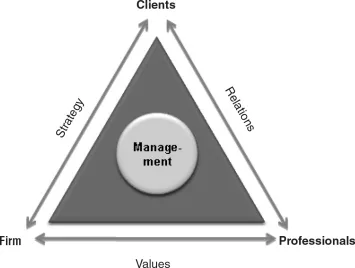
Typically, value creation in knowledge-intensive firms is delivered through a delicate interplay of factors relating to the client, the professional employees, and the company itself. The essential elements of value creation are illustrated in Figure 1.1.
Clients have a need and request a service.
Professionals deliver this service through their engagement with the client. (Because the output is highly dependent on the client’s individual needs and the professional’s interpretation of and response to those requirements, two apparently similar professionals or teams might produce different results.)
Figure 1.1 Framework illustrating the management of knowledge-intensive firms
The firm is responsible for choosing the work it does, targeting clients, and recruiting and managing effective professionals to deliver the services.
Successful management strategies in knowledge-intensive firms involve balancing and integrating these three cornerstones of value creation so that they ensure the strongest impact, creating optimum value. To expand on how this optimal interplay can be best achieved, our model incorporates three additional elements – strategy, client relations, and values.
The six variants, and their relative influence, are described in further detail below.
Clients
Clients have a significant influence on value creation because they define the assignment, receive the service or solution, and will be the ones to decide whether this has delivered as promised.
The solution, then, must be adapted to the client’s needs and their ability to apply the solution in their organization. The level of customization involved will be determined by the knowledge-intensive firm’s approach to market: standardized services based upon concepts and procedures, or customized services to be tailored to the individual client.
Matching the client’s expectations will have a crucial role in determining the perceived value as experienced by the client.
The firm
The vision, strategy, and approach of the knowledge-intensive firm will have a significant bearing on the direction it takes in the market (and how rigidly it follows this), and the nature of the services provided.
Organizational factors will provide the framework for how professionals co-operate internally and with the client organization. Systems supporting service delivery (IT, knowledge-sharing, etc.); procedures for service delivery (concepts, co-operation, quality ensuring, etc.); and incentives and sanctions programs are examples of approaches and tools that can be applied to ensure quality, effectiveness, and efficiency in delivery. The company culture, driven by the firm’s management, will have an important influence too.
Professionals
Individual professionals are inherent to value creation and strategy implementation, being responsible for the actual service delivery to clients. As a result, recruitment and retention of the right professionals are significant to the organization’s ability to compete and position itself in the market. Crucial management considerations here can be focussed by the question: ‘Who do we want to be, by virtue of the competences of our professionals?’
Professionals’ demands for professional and personal development, certain types of assignments, and client relations are challenges to managers, but can be managed through career planning, skills development, allocation of assignments, evaluation of employees, knowledge sharing, and incentive schemes.
Strategy
The strategy of the knowledge-intensive firm defines the markets and the types of client it prefers to deal with. Relations between clients and the company will be dictated by the execution of this strategy by management and professionals. To ensure focus, the organization should define the type of clients it wants to go after, the services it wants to provide, and how these will be delivered (for example, by quality level or price level).
Client relations
The professionals’ interaction with a client will determine the value delivered during an engagement, given that in a knowledge-intensive firm it will be the professionals themselves, and the knowledge and experience they possess, that make up the primary resource being offered. The client’s experience of the engagement, based on 1) the services and products provided, and 2) the professionalism and decisions taken in sales and client meetings, and during project management, and other project activities, will affect this perception directly. Any disparity between the initial sales presentation and the actual services delivered will be noted by clients, who will ascribe more value to the actual delivery than to the expectations created at the outset.
Culture and values
The relationship between the firm and its employees is to a great extent based on the culture and values of the knowledge-intensive firm. The firm should instill these in its professionals in order to create a strong basis for their behavior and decisions in their relationships and interactions, both internally and externally. Defining and implementing this culture, and ensuring that professionals buy into the associated values, are a critical management task in knowledge-intensive firms.
Achieving balance
Effective leadership in the context of a knowledge-intensive firm involves balancing these six approaches in a way that is harmonious. The ideal is to achieve an integrated business model where all components support each other.
This book has been structured to map on to this model. In Chapters 2–7, the three primary components and their interdependencies are discussed in more detail. In Chapter 8, we step back and examine what a truly integrated approach to management requires, so that knowledge-intensive firms are assured of the best possible impact on their compe...