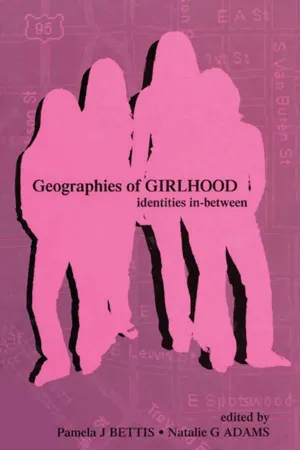
Geographies of Girlhood: Identities In-Between explores how adolescent girls come to understand themselves as female in this culture, particularly during a time when they are learning what it means to be a woman and their identities are in-between that of child and adult, girl and woman. It illuminates the everyday realities of adolescent girls and the real issues that concern them, rather than what adult researchers think is important to adolescent girls. The contributing authors take seriously what girls have to say about themselves and the places and discursive spaces that they inhabit daily. Rather than focusing on girls in the classroom, the book explores adolescent female identity in a myriad of kid-defined spaces both in-between the formal design of schooling, as well as outside its purview--from bedrooms to school hallways to the Internet to discourses of cheerleading, race, sexuality, and ablebodiness. These are the geographies of girlhood, the important sites of identity construction for girls and young women.
This book is situated within the fledgling field of Girls Studies. All chapters are based on field research with adolescent girls and young women; hence, the voices of girls themselves are primary in every chapter. All of the authors in the text use the notion of liminality to theorize the in-between spaces and places of schools that are central to how adolescent girls construct a sense of self. The focus of the book on the fluidity of femininity highlights the importance of race, class, sexual orientation, and other salient features of personal identity in discussions of how girls construct gendered identities in different ways.
Geographies of Girlhood: Identities In-Between challenges scholars, professionals, and students concerned with gender issues to take seriously the everyday concerns of adolescent girls. It is recommended as a text for education, sociology, and women's studies courses that address these issues.
- 624 pages
- English
- ePUB (mobile friendly)
- Available on iOS & Android
eBook - ePub
About this book
Information
Chapter 1
Landscapes of Girlhood
Washington State University
University of Alabama
WHAT WAS MISSING AT LUNCH, IN THE LITERATURE, AND IN THE FEMINIST SHOE CLOSET
This book began as a conversation we had several years ago over lunch about our disappointment with the lack of books that focus on the material realities of adolescent girls in schools. Both of us had been adolescent girls at one point in our lives, obviously. Both us had been middle and high school teachers as well. Furthermore, the two of us had conducted research on and with girls for many years, and we had just completed a year-long ethnography in a Midwestern middle school exploring girls and leadership. What the girls in this middle school made clear to us, which was supported by all of our personal and professional experiences, was their disregard for the formal curriculum of the school in terms of defining themselves. Instead, we observed and listened to the importance associated with peer group dynamics in the cafeteria, cheerleading tryouts, Saturday night mingling at a local dance club, life on the Internet, and fights in the school bathroom. We have taken these girls’ comments seriously, and their words provided the initial impetus for this book.
In the early 1990s, research, such as the Association of American University Women’s (AAUW) initial report How Schools Shortchange Girls (1992) and Sadker and Sadker’s (1994) Failing at Fairness, documented how girls’ academic and social needs were neglected in schools, which led to renewed interest in making schools girl friendly. At about the same time, a plethora of popular-press books, such as Orenstein’s Schoolgirls (1994) and Pipher’s Reviving Ophelia (1995), decried the status of girls as victims of a “girl-poisoning culture.” Since that time, Girl Power, as the girl empowerment movement was named, has been used by girls and corporate interests to reframe girls as sassy, independent, and assertive (Inness, 1998), and girls around the globe have turned to radical cheer-leading, girls’ zines, and girl bands to express this newly emerging girl sensibility. Not surprisingly, in the late 1990s and early 21st century, another wave of popular-press books on girls hit the best-seller list and dovetailed with this new girl sensibility, which was definitely not framed as “nice.” Instead of positioning girls as victims, this time girls were depicted as mean, backbiting victimizers in Simmons’ (2002) Odd Girl Out, and Wiseman’s (2002) Queen Bees and Wannabes. Furthermore, girls’ sexuality, a taboo and neglected topic for many years, was explored in both the popular-press literature such as Fast Girls (White, 2002) and Promiscuities (Wolfe, 1997), as well as the more academic literature, such as The Secret Lives of Girls (Lamb, 2001), Flirting With Danger (Phillips, 2000), and Dilemmas of Desire (Tolman, 2002). All of these books sent parents scurrying to bookstores for help in navigating the tumultuous adolescent years of their daughters. When we mentally surveyed this last decade of girl literature, we again came to the conclusion that there was something missing. As helpful as all of these books were, they did not address the kinds of daily concerns that the girls we taught and the girls we observed and interviewed lived on a daily basis.
Furthermore, we were frustrated with the feminist researchers who took what were “women’s issues” and transplanted them onto the lives of girls. For some feminist researchers, all identity discussions must be located in the global economy of shifting gender regimes and must be grounded in concerns for racial, ethnic, and social-class inequities. No doubt, these are important concerns for us as well and they are certainly part of the macro landscape that all girls and women inhabit (Walkerdine, Lucey, & Melody, 2001). But if you listen closely, these global concerns are not found in the everyday talk of teenage girls when they walk through the hallways, chat in the bathrooms, and play sports. Although most adult feminist researchers spend little time contemplating how they can negotiate a tampon change in the 4 minutes allowed for middle and high school classroom changes, this concern, among the many others raised in this book, is much more salient to the daily lives of adolescent girls than any concern about the impact of a postindustrial economic shift. Along the same lines, most adult feminists have dismissed the activity of cheerleading, yet whether or not one will make the squad is still a pressing question for thousands of adolescent girls (Adams & Bettis, 2003a).
We use the last two examples, tampon changing and cheerleading, both topics discussed in this book, to frame the tensions that, some have argued, exist between feminists in Women’s Studies and those feminists studying girls and girl culture. Nash (2001) speculated that Women’s Studies scholars see their mission as one of addressing the “serious political and economic barriers to women’s equity” whereas Girls’ Studies scholars, who often draw from mass and popular culture in their research, are perceived as engaging in less-weighty feminist scholarship. And we all know what being a lightweight implies for women. Nash has also speculated that these tensions may emanate from the differences between Second and Third Wave Feminists, the former constructed as “sensible shoes” scholars and the latter as ones wearing “dancing slippers.”
Although we do not support the dualisms and hierarchies inherent in these tensions, we are enamored with the shoe metaphor. We see the authors of this book wearing both kinds of shoes, if one can imagine … a sort of fashionable yet sturdy (i.e., chunky) platform. In this book, the contributors had to wear dancing slippers in order to keep up with girls and young women as they traversed the landscape of femininity on the Internet, in fashion, with friends, and in watching movies. By themselves, sensible shoes would not have been able to keep the pace. Thus, we situate this book in the emerging field of Girls’ Studies with the sensible-shoe mission of helping teachers and administrators construct more healthy and vibrant ways of life for adolescent girls/women. But to be able to do that, adult feminist scholars must know what the day-to-day habits of life are for adolescent girls. And if these daily habits include talk of who is nice, who is not, and how to change a tampon, then that talk and focus must be taken seriously, explored, played with, explained, and theorized. That is what this book attempts to do.
The contributing authors of this book describe girls/women and their understandings of their lives in a variety of discursive and physical landscapes. In this book, girls consider what to wear in the Beauty Walk, what to do when they are labeled slut, how to decorate bedrooms, and how to control the backseat of the bus. These are the kinds of daily material concerns that frame the analysis and theorizing found in this book. From these daily material concerns, the authors attempt to provoke new possibilities for understanding girls and their transition to womanhood, how they are produced and how they produce themselves (Davies, 1989, 1993, 2000; Jones, 1993; Walkerdine, 1990, 1993). Although the authors note the “disadvantages” with which girls are faced, particularly those whose social class, race, ethnicity, mental ability, and sexual orientation diverge from the dominant culture, they do not simplify these lives and present them as oppressed, nor do they valorize them. The girls’ understandings of where they are, who they are, and who they can become, are all central in this text, and those understandings are joyful, disturbing, edgy, and typically complex, just like the lives we all lead as adults.
WHO AM I? WHERE AM I? AND THE IMPORTANCE OF THE LOCAL
In much of the research literature, identity has been conceptualized as answering the question, “Who am I?” Typically, a critical lens has focused identity issues on race, ethnicity, social class, gender, and sexual orientation. Although these layers of identity are salient in this book, we would like to encompass an undeveloped question, “Where am I?” (Cuba & Hammond, 1993; Hall, Coffey, & Williamson, 1999; J. B. Jackson, 1994). Although scholarship on globalization and its ramifications on the economic, social, and political lives of people around the world continues to grow, “for many people in the world, everyday life continues to take place in a restricted locale” (McDowell, 1999, p. 3). In this book, we explore how a variety of local contexts and discursive practices, both in between the formal design of schooling as well as outside its purview, influence how girls construct their identities (Bettis, 2001). “Emergent identities require space of their own in which to assert themselves, and are also grounded in (if not tied to) the specificities of particular locations” (Hall et al., 1999, p. 505). The “emergent identities” of the girls with whom we talked asserted themselves in a variety of spaces, particularly those that they controlled. Who they were also shifted according to the spaces they inhabited and how they used these spaces. We see the concept of place as illuminating various facets of the identity work of the girls that we highlight in the following chapters.
The concept of place has been conceptualized differently in recent years (McDowell, 1999) and provides those of us who are interested in identity a new and useful conceptual tool. In the past, geographers defined place as a set of coordinates on a map that fixed and defined a person’s spatial location. “Geographers now argue that places are contested, fluid and uncertain. It is socio-spatial practices that define places and these practices result in overlapping and intersecting places with multiple and changing boundaries, constituted and maintained by social relations of power and exclusion” (McDowell, 1999, p. 4). The chapters that follow mirror this claim in a myriad of ways. For example, riding the bus to and from school is certainly a fixed place and practice in the minds of most parents of school-age children. However, for many children and adolescents, the bus is a nebulous place where the social hierarchy that defines children’s status during the school day dissipates, and new identities are mapped in the transitional time and space between home and school that the bus provides.
Focusing on specific places and the discursive practices associated with these places mandates that we note that often a particular place can be read as one of exclusion(s) and inclusion(s) (Sibley, 1995). “Places are made through power relations which construct the rules which define the boundaries. These boundaries are both social and spatial—they define who belongs to a place and who may be excluded, as well as the location or site of the experience” (McDowell, 1999, p. 4). We believe that the landscape of schooling exemplifies this claim. For example, we observed two cheerleading preparation classes held in a gymnasium for a semester and learned early on that the identity work of becoming a cheerleader was not limited to the cheer exercises performed in class every day in that particular gymnasium. Trying out for cheerleading was, more fundamentally, a celebrated route for trying out for womanhood in that the discourse of cheerleading illuminated characteristics of the ideal female in this society. That discourse had powerful implications for girls, particularly for those who were not White and middle class, in their ability to envision themselves in the space of cheerleading. Thus, although the physical place of the gym during fifth and sixth periods identified girls as aspiring to be cheerleaders, the dominant discourse of cheerleading that constructed a specific type of girl as cheerleader, and that we found circulating in the girls’ talk and understandings of cheerleading, created another space, one of power, privilege, and inclusion, for who could be a cheerleader.
Another facet of place is that it operates at the intersection of both global and local processes, and these processes include social, economic, political, and technological shifts and understandings (Massey, 1994). In one of the following chapters, adolescent lesbians use the virtual space of the Internet to connect with other lesbians and explore a space in which they are safe from the homophobia often found in their schools.
We are using the preceding discussion and examples to illustrate how we are framing our understanding of place and its relationship to identity. We agree with Weis and Fine (2000) that “a sustained look at the ways in which youth develop political and social identities, investments, and relations, both within and outside school contexts, is noticeably absent from the literatures on education and on adolescence” (p. xi). Furthermore, they note Maxine Greene’s focus on the “vibrancy of the ‘in-between’” of adolescent lives. It is the in-between spaces and places found within and outside the formal domain of schools that we believe to be central to how girls make sense of themselves. We want to nest our discussion of girl’s identity at the juncture of place and this “in-between” vibrancy. These theoretical interests deposited us at the conceptual door of liminality.
LIMINALITY AND GIRLHOOD
Liminality, a term coined by the anthropologist Victor Turner (1967) to describe the “betwixt and between” place that adolescents in traditional societies inhabited when undergoing rites of passage, is a construct that we have found helpful. Although aware of its history and conceptual shortcomings (Crapanzano, 1992; Weber, 1995), we still believe that the construct can be of use in making sense of the complexities, simplicities, and contradictions of girls’ lives. We believe that liminality, as an umbrella construct, opens up different ways to think about these in-between spaces and places of female adolescent identity, the focus of this book.
Turner was referring to the time when pubescents were neither adults nor children, but in some in-between and nebulous social place whose rules were unclear and status uncertain. The liminal period was an “inter-structural stage” in which individuals or groups gave up one social state but had yet to enter the new prescribed social state and adopt its accompanying responsibilities and perspectives. As Turner (1967) noted, “This coincidence of opposite processes and notions in a single representation characterizes the peculiar unity of the liminal: that which is neither this nor that, but both” (p. 99). This contradictory space and understanding made sense to us as we surveyed our own work and that of colleagues and students who were exploring how girls made sense of growing up. It also spoke to the contradictory social landscape that girls inhabit. Protected by statutory rape laws, rendered childlike and/or hypersexualized in media, and expected to be strong, assertive, and yet nice, the lives of girls today exemplify the concept of liminality.
We found that Turner (1977) revisited his initial understanding of liminality. Along with another anthropologist, Colin Turnbull (1990), Turner berated himself for not initially understanding the transformative possibilities of the liminal period, one in which the social conventions and hierarchies are shed. During these rites of passage, then, persons can try on new ways of being and identity, even if only temporarily. Both Turner and Turnbull also highlighted how a playfulness was engendered during the liminal time. Thus, we see the liminal spaces of being an adolescent and of being female as offering possibilities, uncertainties, play, and performance. That is what drives the hope embedded in this book, that new spaces for girls can be created in which they more fully explore all of who they can become. We see the following chapters as contributing to an ongoing effort by thoughtful teachers and researchers everywh...
Table of contents
- Cover Page
- Half Title page
- Series
- Title Page
- Copyright Page
- Contents
- Preface
- Chapter 1 Landscapes of Girlhood
- Part I Before School
- Chapter 2 Barbies, Bases, and Beer: The Role of Home in Junior High School Girls' Identity Work
- Chapter 3 Power Beads, Body Glitter, and Backseat Bad-Asses: Girls, Power, and Position on the School Bus
- Part II At School
- Chapter 4 Girl Talk: Adolescent Girls'1 Perceptions of Leadership
- Chapter 5 Girls in Groups: The Preps and the Sex Mob Try Out for Womanhood
- Chapter 6 “The Beauty Walk” as a Social Space for Messages About the Female Body: Toward Transformative Collaboration
- Chapter 7 Fighters and Cheerleaders: Disrupting the Discourse of “Girl Power” in the New Millennium
- Chapter 8 “Only 4-Minute Passing Periods!” Private and Public Menstrual Identities in School
- Chapter 9 In the World But Not of It: Gendered Religious Socialization at a Christian School
- Chapter 10 “We Ain't No Dogs”: Teenage Mothers (Re)Defìne Themselves
- Part III After School
- Chapter 11 Black Girls/White Spaces: Managing Identity Through Memories of Schooling
- Chapter 12 Unstraightening the Ideal Girl: Lesbians, High School, and Spaces to Be
- Chapter 13 Disputation of a Bad Reputation: Adverse Sexual Labels and the Lives of 12 Southern Women
- Chapter 14 Border Crossing—Border Patrolling: Race, Gender, and the Politics of Sisterhood
- Chapter 15 “I Am a Woman Now!”: Rewriting Cartographies of Girlhood From the Critical Standpoint of Disability
- Afterword: Girlhood, Place, and Pedagogy
- Author Biographies
- Subject Index
Trusted by 375,005 students
Access to over 1.5 million titles for a fair monthly price.
Study more efficiently using our study tools.
Frequently asked questions
Yes, you can cancel anytime from the Subscription tab in your account settings on the Perlego website. Your subscription will stay active until the end of your current billing period. Learn how to cancel your subscription
No, books cannot be downloaded as external files, such as PDFs, for use outside of Perlego. However, you can download books within the Perlego app for offline reading on mobile or tablet. Learn how to download books offline
Perlego offers two plans: Essential and Complete
- Essential is ideal for learners and professionals who enjoy exploring a wide range of subjects. Access the Essential Library with 800,000+ trusted titles and best-sellers across business, personal growth, and the humanities. Includes unlimited reading time and Standard Read Aloud voice.
- Complete: Perfect for advanced learners and researchers needing full, unrestricted access. Unlock 1.5M+ books across hundreds of subjects, including academic and specialized titles. The Complete Plan also includes advanced features like Premium Read Aloud and Research Assistant.
We are an online textbook subscription service, where you can get access to an entire online library for less than the price of a single book per month. With over 1.5 million books across 990+ topics, we’ve got you covered! Learn about our mission
Look out for the read-aloud symbol on your next book to see if you can listen to it. The read-aloud tool reads text aloud for you, highlighting the text as it is being read. You can pause it, speed it up and slow it down. Learn more about Read Aloud
Yes! You can use the Perlego app on both iOS and Android devices to read anytime, anywhere — even offline. Perfect for commutes or when you’re on the go.
Please note we cannot support devices running on iOS 13 and Android 7 or earlier. Learn more about using the app
Please note we cannot support devices running on iOS 13 and Android 7 or earlier. Learn more about using the app
Yes, you can access Geographies of Girlhood by Pamela J. Bettis,Natalie G. Adams in PDF and/or ePUB format, as well as other popular books in Education & Education General. We have over 1.5 million books available in our catalogue for you to explore.