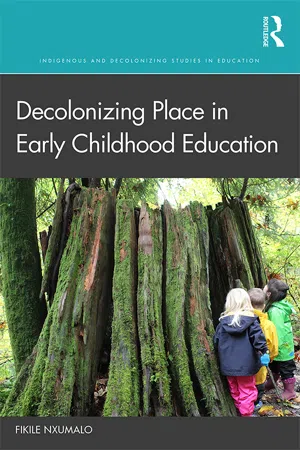
This book draws attention to the urgent need for early childhood education to critically encounter and pedagogically respond to the entanglements of environmentally damaged places, anti-blackness, and settler colonial legacies. Drawing from the author's multi-year participatory action research with educators and children in suburban settings, the book highlights Indigenous presences and land relations within ongoing settler colonialism as necessary, yet often ignored, aspects of environmental education. Chapters discuss topics such as: geotheorizing in a capitalist society, absences of Black place relations, and unsettling unquestioned Western assumptions about nature education. Rather than offer prescriptive solutions, this book works to broaden possibilities and bolster the conversation among teachers and scholars concerned with early years environmental education.
- 160 pages
- English
- ePUB (mobile friendly)
- Available on iOS & Android
eBook - ePub
Decolonizing Place in Early Childhood Education
About this book
Information
1
SITUATING ORIENTATIONS
Working from the context of what is currently Canada, the book is intended as an interruption to the erasures and omissions of environmental education with young children. In particular, the premise of this book is that there is an urgent need for early childhood education to critically encounter and pedagogically respond to the entanglements of environmentally damaged places, anti-blackness, and settler colonial legacies. From my perspective, an important part of this decolonizing response is to disrupt romanticized and decontextualized connections between children and nature as part of outdoor pedagogies. As I detail further in Chapter 4, dominant approaches to environmental education for young children in North American contexts recapitulate colonialist and modernist binaries between humans and nature. This is done, for instance, through positioning nature as something that (certain) innocent children need to be returned to, primarily for developmental benefits (see also Taylor, 2013 and Nelson, Pacini-Ketchabaw, & Nxumalo, 2018). I am also interested in the decolonial potentials of disrupting the normalization of the exclusions that occur when predominantly white middle- and upper-class children participate in North American nature or forest schools and become positioned as future earth saviors and stewards. I consider how such disruptions might happen when children and educators learn to relate to settler colonial and anthropogenically damaged lifeworlds in ways that challenge human exceptionalism while attending to their differential situatedness therein. Put another way, I am interested in bringing forward curricular and pedagogical conversations that unsettle undifferentiated and colonizing views of the world in environmental early childhood education. A central aim of the book, then, is to inquire into generative ethical possibilities of politicized, contingent, and place-attuned responses to settler colonial, anti-Black, and anthropogenic inheritances in early childhood education.
In the remainder of this chapter, I introduce the research project from which the book is drawn. I also discuss some key epistemological and ontological orientations of my work. I begin by situating my role as a researcher, pedagogista, and early childhood educator. I include an introduction to pedagogical narrations as key pedagogical and research artifacts in the project. I follow this positioning by laying out the ways in which I understand, use, and frame certain theoretical concepts and ontologies in this book, including my reasons for bringing certain perspectives together and the tensions therein. I discuss how “meeting” certain ontological and theoretical perspectives, alongside my immersion in the assemblage of data, its materialities, and the unsettling effects of certain encounters, led me toward a methodology of refiguring presences. I explain my rationale for the data gathering, analytic, and place (re)storying approaches that I followed as I put this methodology to work. Given that place is central to the pedagogical encounters that are centered in this book, I also discuss some of the ways in which I have come to understand place through my own childhood and youth experiences. Next, I situate the project from which the book emerged, as a response to current dominant discourses and practices in environmental early childhood education for young children in the North American context. Finally, I provide an overview of the book.
Researcher–Educator–Pedagogista
The particular places that have come to shape the work described in this book are the places in and around a group of early learning and child care centers located in a suburban city in what is now called British Columbia, Canada, on the unceded territories of the Musqueam, Squamish, Stó:lō, and Tsleil-Waututh peoples. I came to be in these places as part of an action research project, the Investigating Quality (IQ) Project, for which ethics approval was obtained from the Human Research Ethics Board at the University of Victoria. Over the course of my four-year involvement in the project, I worked with 23 educators and close to 200 children. This project was intended to disrupt taken-for-granted notions of quality and instead take inspiration from contextualized, dynamic, and politicized conceptions of quality. In Chapter 2, I further discuss this work in relation to the necessity of disruptions of normative conceptions of quality in North American early childhood education.
As a researcher, I spent several hours a week at each of the child care settings making written, video, and photographic observations of everyday moments inside and outside the center. I also participated in practice as an educator. This meant that while I was at the centers, I did more than simply observe and record what was happening. I was also actively involved, alongside educators, in working with children—engaging in planned and unplanned pedagogical provocations and encounters.
My role as a pedagogista was to engage early childhood educators in critically reflective discussions and practices. The role of a pedagogista takes inspiration from the preschools of Reggio Emilia, Italy, where the presence of a pedagogical mentor to support, challenge, and deepen educators’ practices and thinking is an embedded part of early childhood education policy and practice (Rinaldi, 2006). My work as a pedagogista involved bringing forward multiple perspectives to educators to facilitate critical approaches and contestations to several areas of pedagogy within each setting (Nxumalo, Delgado, & Nelson, 2018). To do this, I engaged in ongoing written and verbal dialogue with educators, both during and after my prearranged visits to the child care centers. These dialogues included documenting pedagogical encounters in the form of pedagogical narrations and raising critical questions on these encounters to educators.
Pedagogical narrations, also referred to as pedagogical documentation in some provinces, have been adopted as policy in early learning contexts across Canada. For example, early learning frameworks from the British Columbia Ministry of Children and Family Development (BC MCFD, 2008) and the Ontario Ministry of Education (2014) both center on narrations or documentation as key parts of early childhood education. Pedagogical narrations are visual and textual documentation of educational encounters which are intended to make children’s learning processes visible and to provoke further thought and dialogue on this learning (BC MCFD, 2008; Pacini-Ketchabaw, 2010; Rinaldi, 2006). As Iris Berger (2010) notes, “these narrations provoke us to think anew and to resist normalized habitual conceptions of childhood, education, learning, and assessment” (p. 58). They can include written observations of children, children’s work, or photographs that illustrate a process in children’s learning. These observations can also be documented as audio and video recordings of children and educators engaged in learning inquiries. However, pedagogical narrations are much more than simply a record of what happened. A critical aspect of pedagogical narrations comprises educators’ critical reflections on the moments captured, including, but not limited to, educators’ subjective interpretations of these moments and educators’ critical reflections on their pedagogical practices. Inspired by the practice of pedagogical documentation, as enacted in Reggio Emilia preschools, pedagogical narrations help to support an inquiry-based curriculum, also referred to as project-based learning (Rinaldi, 2006). Therefore, in addition to educators’ interpretations of the learning that occurred, they often include ideas for extending and building on this learning.
Another important part of pedagogical narration is openness to multiple perspectives. Therefore, educators also may invite their colleagues, the children, and the children’s families to contribute their ideas, questions, and suggestions for further curriculum making (Pacini-Ketchabaw, Nxumalo, Kocher, Elliot, & Sanchez, 2014). In summary, pedagogical narration is intended to be an ongoing process that includes: observation and documentation of pedagogical encounters; collective and individual critically reflective interpretation, making the narrations public to gain multiple perspectives; adding connections to educators’ practices and to early learning areas as described in the BC Early Learning Framework; and, beginning the process of documentation again (BC MCFD, 2008). In my work with pedagogical narrations, the process and structure prescribed in the BC Early Learning Framework (BC MCFD, 2008), while a useful guide, was not a template to strictly follow. Rather, I worked with educators to hold processes of narration, as provisional and propositional. For example, many of the pedagogical inquiries that are the subject of this book were not adequately captured by the areas of early learning described in the BC Learning Framework. In other words, our pedagogical narrations varied considerably and intentionally disrupted prevalent classroom materializations of pedagogical narrations as ‘perfect, aesthetically beautiful’ displayed products of early learning that are free of politics, pedagogical tensions, and uncertainty. For further insight into the variation in pedagogical narrations, the book Journeys: Reconceptualizing early childhood practices through pedagogical narration (Pacini-Ketchabaw, Nxumalo, Kocher, Elliot, & Sanchez, 2014) contains several examples of pedagogical narrations produced by the Investigating Quality project within the context of British Columbia. These include pedagogical narrations which address topics that are beyond the scope of this book but are critical aspects of pedagogy and curriculum with young children, including gender, disability, and materiality in children’s art encounters and provocations.
In this project, we worked extensively with educators’ pedagogical narrations to spur discussions on practice, including possibilities for complicating our practices with young children. This book builds on my previous collaborative work on the ways in which pedagogical narrations can be utilized for curriculum development as well as to push and extend educators’ practices, particularly in relation to engaging the ethics and politics of everyday practice (Pacini-Ketchabaw & Nxumalo, 2010, 2012, 2013; Pacini-Ketchabaw, Nxumalo, Kocher, Elliot, & Sanchez, 2014). Pedagogical narrations were a key part of the support I provided as a pedagogista, both in sharing narrations that I had prepared from our encounters and in supporting educators in developing their own processes of pedagogical narration and accompanying practices. Many of our pedagogical narrations were also shared with families in several ways, including through email and in documentation panels displayed in the child care centers.
My work with pedagogical narrations in this project also builds on several studies in the early childhood field that have put pedagogical narrations to work as an assessment tool (MacDonald, 2007); to support educators in enacting critically reflective practice (Thompson, 2010); as a research method in inquiry-based early childhood classrooms (Hultman, 2009; Hodgins, 2012; McLellan, 2010); and to support teacher education (Murris, Reynolds, & Peers, 2018). One particular way in which pedagogical narrations emerged in this project was that after a pedagogical encounter, such as a forest walk, which I documented using one or more of photography, video, and field notes, I would prepare a pedagogical narration, including my questions and critical reflections about the encounter. I would then share this pedagogical narration with educators to obtain their perspectives (see Chapter 2 for an example of the email exchanges that often occurred between myself and educators). Some of these collaborative narrations and the accompanying dialogues would then form the basis of our extended inquiries.
Educators in the child care centers also created and shared with me pedagogical narrations, including those from experiences that I may not have been a part of in the center. Part of my feedback, which was both written and verbal, included critical questions that emerged for me, suggestions for extending and deepening their inquiries in practice, and providing educators with related readings and accompanying questions in an effort to invite multiple perspectives. These readings were selected from pertinent work both within and beyond the early childhood field to bring practice into conversation with perspectives such as Indigenous feminist, postcolonial, anti-racist feminist, poststructural feminist, and posthumanist theories, and the environmental humanities. The readings that I provided to educators raised political, pedagogical, and theoretical issues that I wanted to bring to educators’ attention, or that we were already thinking about together.1
All of the educators from the different participant child care centers also came together for monthly three-hour learning circles that I facilitated. As with the child care setting visits and discussions, the intent in these large group discussions was to deepen, complexify, and critically engage with our pedagogical inquiries. My role in these discussions was to encourage contestations, questions, and multiple critical theoretical and pedagogical perspectives on the pedagogical encounters under discussion. These pedagogical encounters included the inquiries that are included in this book as well as several other areas of practice that are beyond the scope of this book, such as shifting fixed daily routines and schedules and rethinking normative early childhood art practices.
Typically, during the learning circles, we engaged in a detailed collaborative critical reflection of selected pedagogical narrations from one of the child care centers alongside readings that I had selected for the group to read beforehand. As with the readings provided to educators as part of the process of developing pedagogical narrations, I intentionally selected readings for the learning circle discussions that brought forward contextualized perspectives to trouble developmental “readings” of early childhood pedagogies. Euro-Western developmental psychology theories remain foundational to early childhood education practice, and an important aspect of my work was to seek ways to critically encounter, in collaboration with educators, the depoliticized and decontextualized understandings of practice that a predominantly developmental discourse brings (Pacini-Ketchabaw & Nxumalo, 2010, 2013; Pacini-Ketchabaw, Nxumalo, Kocher, Elliot, & Sanchez, 2014). I use the term Euro-Western intentionally here and throughout the book to underline the Eurocentric inheritances that continue to influence early childhood education. Euro-Western denotes epistemologies, ontologies, and practices that have originated from what is also referred to as the ‘West,’ including those from Western Europe, and from white settlers in places such as the United States and Canada (Watts, 2013).
The approaches I worked with toward interrupting practice-as-usual, and the effects thereof, were multiple, emergent, and contingent. That is to say, my role as a pedagogista in supporting and provoking educators to contest, politicize, and disrupt taken-for-granted understandings of childhood and early childhood practices was filled with “tensions, resonances, transformations, resistances, and complicities” (Haraway, 1988, p. 588). One consequence of the inherent tensions in my complex relationship with educators has been that the ways in which I have taken up moments in practice have not necessarily mirrored the interruptive ways that I have taken them up in writing-with the “data” afterwards. For example, in Chapter 4, I write about pedagogical encounters with a forest that I regularly visited with children and educators. In this chapter, the data that I worked with were pedagogical narrations written by educators as well as my field notes and photographic images from these visits to the forest. I also worked with my own research on the settler colonial material and discursive histories of this particular forest and Indigenous relationalities with the Western red cedar trees in it. However, the many discussions with educators that were generated from and helped to generate this data are not fully detailed in this chapter. In relation to unsettling forest pedagogies, these complexities-in-practice have taken a multitude of formations, with varying effects and unresolved tensions (see, for example, Chapter 6; Nxumalo, Delgado, & Nelson, 2018).
My role did not preclude questioning and critically encountering my own practices and situatedness within the pedagogical encounters, particularly in connection with the settler colonial relations that are the predominant focus of this book. Further, while I refer to myself, educators, and children in separate categories, there are no innocent outsider relations implied here. My references to children and educators as separate categories, while perhaps facilitating the clarity of my descriptions of this work, also risk stabilizing some of the very colonizing relations and binaries that this work seeks to unsettle—centering the all-knowing human adult as separate from and above children. It is very important to me that I avoid reenacting colonizing practices with educators and children that “teach that knowers are manipulators who have no reciprocal responsibilities to the things they manipulate” (Battiste & Henderson, 2000, p. 88). Rather than transcending the messiness of that which I aim to unsettle, I am inextricably entangled and implicated in these settler colonial relations.
Foregrounding my implicated situatedness within the encounters also necessitates a telling of the particularities of my positioning within colonialism as an Indigenous African and within settler colonialism as a Black, cis-gendered female immigrant to Canada. As I discuss further in Chapter 3, categories such as this one belie the complexities of the connections between settler colonialism, gender, and anti-blackness, as well as how they come to matter in my everyday place encounters. Within these complexities are structural and everyday violences, complicities, resistances, fluidities, estrangements, and relationalities. Drawing from Chickasaw scholar Jodi Byrd (2011), Eve Tuck (Unangax) and her colleagues Guess and Sultan point to some of the complexities of such categorizations, highlighting how the word arrivants, used to refer to people who have come to the Americas through pastpresent histories of slavery and global imperialism:
is a recognition of the ways in which arrivants both resist and participate as settlers in the historical project of settler colonialism. The word “arrivants” helps to highlight the complicity of all arrivants (including Black people) in Indigenous erasure and dispossession… But “arrivants” may also conceal the unique positioning of Blackness in settler colonialism and the complicity of white people and nonwhite people (including Native people) in antiblackness.(Tuck, Guess, & Sultan, 2014, p. 4)
My focus in this book is on grappling with possibilities for unsettling encounters with “nature” in settler colonial places and spaces, including possibilities that attend to the entanglements of settler colonialism and anti-blackness.
Situating Ontological and Epistemological Terrains
Throughout this book I put to work a methodology of refiguring presences (see Chapter 3) and practices of witnessing (see Chapter 2) to attend to settler colonial formations in everyday place encounters in early childhood education. I discuss multiple material and discursive constituents that come together to enact, sediment, or interrupt colonial relations, including, but not limited to, place histories and stories, pedagogical practices, human and more-than-human bodies, things, and affects, and my own situated subjectivities and location within the encounters. In this section, I want to lay out the ways I have taken up and connected specific theoretical, ontological, and epistemological threads in relation to my focus on troubling place encounters with nature in early childhood stu...
Table of contents
- Cover
- Half Title
- Series Page
- Title Page
- Copyright Page
- Table of Contents
- List of Figures
- Series Editors’ Introduction
- Acknowledgments
- Credits
- 1. Situating Orientations
- 2. Storying Practices of Witnessing: Refiguring Quality in Everyday Encounters
- 3. Refiguring Presences
- 4. Unsettling Forest Encounters
- 5. Restorying Garden Relations
- 6. Geotheorizing Place Relations
- 7. Living with Bee Death
- 8. Inhabiting a Black Anthropocene
- Moving Forward: Toward Decolonial Place Encounters in Early Childhood Education
- Appendix
- References
- Index
Trusted by 375,005 students
Access to over 1.5 million titles for a fair monthly price.
Study more efficiently using our study tools.
Frequently asked questions
Yes, you can cancel anytime from the Subscription tab in your account settings on the Perlego website. Your subscription will stay active until the end of your current billing period. Learn how to cancel your subscription
No, books cannot be downloaded as external files, such as PDFs, for use outside of Perlego. However, you can download books within the Perlego app for offline reading on mobile or tablet. Learn how to download books offline
Perlego offers two plans: Essential and Complete
- Essential is ideal for learners and professionals who enjoy exploring a wide range of subjects. Access the Essential Library with 800,000+ trusted titles and best-sellers across business, personal growth, and the humanities. Includes unlimited reading time and Standard Read Aloud voice.
- Complete: Perfect for advanced learners and researchers needing full, unrestricted access. Unlock 1.5M+ books across hundreds of subjects, including academic and specialized titles. The Complete Plan also includes advanced features like Premium Read Aloud and Research Assistant.
We are an online textbook subscription service, where you can get access to an entire online library for less than the price of a single book per month. With over 1.5 million books across 990+ topics, we’ve got you covered! Learn about our mission
Look out for the read-aloud symbol on your next book to see if you can listen to it. The read-aloud tool reads text aloud for you, highlighting the text as it is being read. You can pause it, speed it up and slow it down. Learn more about Read Aloud
Yes! You can use the Perlego app on both iOS and Android devices to read anytime, anywhere — even offline. Perfect for commutes or when you’re on the go.
Please note we cannot support devices running on iOS 13 and Android 7 or earlier. Learn more about using the app
Please note we cannot support devices running on iOS 13 and Android 7 or earlier. Learn more about using the app
Yes, you can access Decolonizing Place in Early Childhood Education by Fikile Nxumalo in PDF and/or ePUB format, as well as other popular books in Education & Education General. We have over 1.5 million books available in our catalogue for you to explore.