![]()
1
Teaching and Learning in Context
The preschool music campers are musically hard at work, playing, singing, dancing, listening, and learning about the musical world around them. Their teacher, Mr. Jonathan, beckons them over to the felt board and displays bright color photos of three Japanese instruments: the taiko drum, the stringed koto , and a traditional Japanese flute, the shakuhachi . Musical instruments always seem to inspire curiosity in 4- and 5-year-olds—kids are enraptured by new sounds and shapes and compelled by just how these instruments work. The three traditional instruments on the felt board in today’s class are no different.
Mr. Jonathan plays excerpts of music by each of the instruments, asking the children to try to figure out which sound goes with which picture. They accomplish this with ease, tapping into their seemingly innate knowledge of the physics of drums, strings, and flutes, principles of sound they have gleaned throughout their short lifespans and applied to these new sounds. Except the sounds are not new to everyone! Sitting off to the side, seemingly uninterested up until this point, Theo gleefully exclaims “ taiko! ” alluding to his familiarity with this particular instrument due to his own Japanese heritage and family engagement with this music. Young children are keenly attuned to the world around them, the many and varied sounds of their cultural environments. They are awash in the tones and timbres of the world and rejoice in the familiar and seek to explore the unfamiliar.
Music is an essential element of human existence that permeates the lives of young children. All music, from every corner of the world, has the potential to intrigue, excite, educate, and invite little ones to listen and respond in myriad ways. The first chapter of children’s lives, especially the period of their infancy, toddlerhood, and preschool years, is an opportune time for developing their joy and wonder of the world and offering them experiences that open their eyes, ears, and minds to the beautiful diversity of cultural, artistic, and musical practices they can know. The soothing sound of a caregiver’s lullaby, the tunes and tones of favorite cartoon programs, the creative rhythmic and melodic utterances that accompany imaginary play, all of these contribute to the musical threads woven throughout a young child’s life. At this time of peak receptiveness to music, it behooves those who care for and teach young children to consider these early years as an excellent window for bringing the world’s musical cultures into children’s lives, capitalizing on their existing interest to broaden their aural, social, and cultural awareness. In their early years, young children can grow with eyes and ears wide open into a discovery of the world of music, in music, and through music.
Music is a human art form, an inexorable part of the human experience everywhere in the world. Music is social, and indelibly woven into the tapestry of life, and young children are very much a part of this multifaceted fabric. The musical experiences they have provide opportunities for them know language, behaviors, customs, traditions, beliefs, values, stories, and other cultural nuances. As they become musically skilled through experiences in song and instrumental music, young children can also grow cultural knowledge and sensitivity. Music is a vital aspect of culture, shaping and transmitting the aforementioned aspects that characterize groups of people. Exposing young children to the world’s musical cultures brings them into the cultural conversation, allowing them to learn about self and others in an artistically meaningful and engaging way. Prior to the development of social biases and cultural preferences that all too easily devolve into prejudices, the opportunity to know people through song, dance, and instrument play is a gift to all who work for the well-balanced development of young children into the responsible citizens they will one day become.
The Necessity of World Music Pedagogy in Early Childhood
Young children are natural observers—watchers and listeners—who are constantly absorbing the sights and sounds that swirl around them. They observe language, behaviors, faces, vocal inflections, and gestures that help them shape their own identities and viewpoints. At this stage in their development, they are uniquely suited to diving into the world’s musical cultures, receiving new sounds and ideas, and engaging in curious pursuit of instruments and musicians who play, sing, and dance. As young children learn through observation and immersion, they are primed for the holistic way in which many of the world’s musicians transmit their own traditions and cultural values. Music serves as an enticing entry point for them to know people “near and far” from their own families, and a full sampling of sounds invites their curiosity and involvement in knowing people through the music they make. Observations of young children at play show them in the midst of a multifaceted entity of sounds and movement, of imagination and creativity, a close approximation of the various ways in which culture-sharing groups across the globe manifest their musicking. The musical experiences that young children can have set the stage for their cultural understandings, the development of their musical sensitivities, and their pathways to becoming citizens (and musical citizens) of the world.
Regardless of where they live, young children’s lives are wrapped up with musically expressive practices. They are enculturated into music of their cultural surrounds, and they develop musical sensitivities as a result of the music to which they are exposed by parents and extended family members, by their community, and by teachers who offer them journeys beyond their first experiences and into the greater musical world. Research by those in music, education, and the social sciences indicates that young children’s interests are expansive and that the rate of their absorption of knowledge is impressive from an early age. Their acceptance of new knowledge knows no bounds, as they are open and receptive to experiences that please them. Thus can young children enjoy and learn from the many musical experiences that enter into their lives.
Despite this common thread of music shared amongst all humans, interpersonal and intercultural biases still manage to emerge. Young children in the early years of their lives are by no means too young to observe and absorb the various prejudices that may be modeled for them in word and deed by their families and caregivers. This reality sheds light on the imperative nature of bringing up young children in a multicultural musical landscape, modeling the possibilities for developing respect and understanding amongst all (musical) beings. World Music Pedagogy aims to head off the development of these biases and prejudices at an early age by giving children equitable exposure to music from around the globe (Campbell, 2004). While young children are developing their musical skills of singing, dancing, and playing, they must also be invited to cultivate the skills of thinking, sharing, empathizing, and developing a wide palette of musical possibilities and creative expressions. Music can be the lynch pin around which these interpersonal skills can unfold. Beyond dealings with pitches, rhythms, and timbres lies the knowledge that all people are rooted in valid and beautiful musical cultures, opening minds to the world’s people through music. Young children need the opportunity to learn that all people are unified in their human artistic and aesthetic engagement and that all people are worthy of respect and understanding for what they bring to the table.
An incorrect assumption would be that World Music Pedagogy seeks to exclude the Western European Art Music traditions that are so pervasive across cultures. The intent of World Music Pedagogy is to bring all cultures into the musical consciousness of children, with all traditions considered valid and essential for study and performance. The all-inclusive nature of this pedagogy is, all at once, freeing and overwhelming—with the entire world available for study, where does one begin? It might make the most sense for teachers to begin where they are most comfortable and branch out from there, examining personal and family musical traditions and cultural backgrounds. Friends and colleagues might present new voices and viewpoints of music from their own cultural traditions. The children themselves can even inspire teachers to more deeply explore the musical cultures of the little ones whom they serve. Live performances of the world’s musical cultures by teachers and culture-bearers are ideal, but teachers need not worry if these are not possible—effective use of recorded music as presented in this volume, accompanied by singing, dancing, and playing, can draw children into new worlds of sound and appreciation of those who create these sounds.
Early Childhood Music: Its Forms and Functions
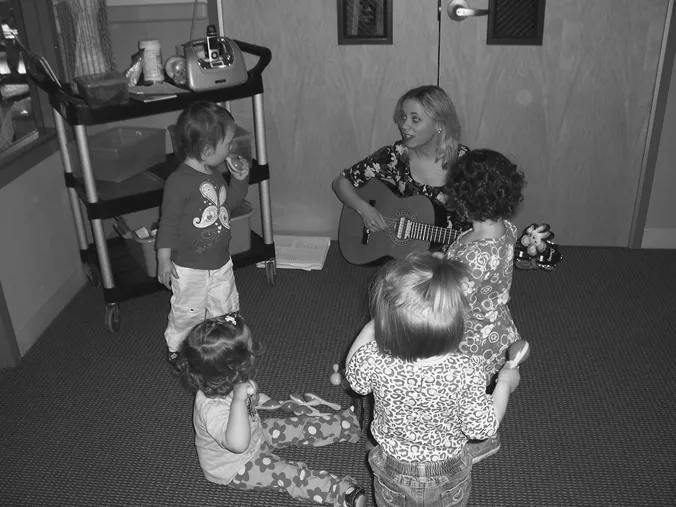
One of the most compelling, creativity-inducing aspects of early childhood musical engagement is that it can take on many different manifestations. From the mother singing a lullaby to soothe her baby to sleep, to a toddler music class accompanied by parents or caregivers, to the natural rhythms and tunes that emerge during playtime, young children are doing music in many ways. Teachers might engage young children with music during circle time in the childcare setting (as pictured in Figure 1.1) or use music as a tool for smooth transitions in the Kindergarten classroom, or young children may even attend a music class designed especially for them by a trained music teacher. Early childhood music is often free to operate outside the confines of the traditional public school context, moving into a realm of customization of musical encounters and acknowledgement of the children’s contributions.
Young children learn informally—language, behaviors, facial expressions, movement; it makes sense, then, that their music learning encounters are delivered informally as well. In the case of a dedicated music time, the teacher may apply this principle of informal instruction through the facilitation of a musical environment, modeling musical behaviors for children, but not necessarily expecting full participation in return. Children of this age and stage may need or want time to observe and absorb—many times a child will quietly observe a music session only to return home and re-teach the entire lesson to her parents or caregivers!
Teachers of early childhood music must plan and prepare effectively, stepping in front of children with a wealth of engaging activities to capture their attention and imaginations. However, an early childhood music class is also a place to expect the unexpected, where flexibility and improvisation are key skills for the teacher to exercise, depending upon the needs and expressions of the children. A typical class may begin with a greeting or welcome song or activity and may proceed with exploration of the voice, songs, games, movement, engagement with child-friendly instruments, and props such as parachutes, ribbons, or balls, puppets, and other manipulatives. Young children are not pressured to respond or perform, but, rather, are given the model of a way to participate. They may invent their own ways to vocalize or play or move, and the adept teacher will capitalize on those moments, reinforcing and extending the child’s musical autonomy.
Early childhood music classes might occur on an ad hoc basis so that students of music and education can grow an awareness of the specialized ways in which music can brighten and enlighten the lives of young children. University-level coursework for pre-service teachers might feature practicum experiences in the early childhood setting, an environment where novice teachers can easily acquire some experience with planning and implementing music instruction (with a very forgiving clientele). In-service teachers, too, who are suddenly charged with teaching music to younger children than had been the focus of their university training, may be drawn to studies in early childhood music education. This may occur through further coursework, professional development conferences, early childhood print resources (like this volume), or even jumping in and trying it out!
Several early childhood music organizations exist and serve children and their families in various capacities. Gymboree offers musical play classes for children ages 6 months through 5 years, tailored to developmental stages. These classes incorporate singing, movement, dance, and instruments while cultivating children’s social and physical development. Props like parachutes, scarves, and other child-friendly gym equipment round out the experience. Kindermusik is a popular organization offering music instruction to children and families. Based in research, Kindermusik employs the methodological work of Orff, Kodály, and Suzuki in its sequential lessons. This approach focuses on the whole child, that is, the varying learning domains that a child must cultivate, including language, math, social-emotional intelligence, and creativity. This approach also exposes children to many different musical styles and cultures. Music Together focuses on the development of musical aptitude that all children possess. Largely based in the work of Edwin Gordon and Music Learning Theory, Music Together specializes in music instruction for infants through preschool-age children and beyond. Classes for school-age children are available, as are multi-generational classes to engage the family and community. Musikgarten, additionally, provides early childhood music instruction for young children and their families. With an emphasis on developing the whole child in a holistic manner, Musikgarten focuses on high-quality materials and repertoire, age-appropriate and sequential curriculum, and empowerment of families to bring the content into the home. Many other local or smaller-scale companies are bringing music into children’s lives in similar ways, such as the Seattle-based Musically Minded, Inc. (see Teacher Feature in Chapter 5).
Figure 1.1 A music class for toddlers
More broadly, music most certainly plays a starring role in the day-to-day operation of an early childhood classroom or childcare setting. Songs are sung to encourage swift clean-up of toys, rhythmic chants accompany storytelling and circle time activities, and recorded music soothes young children to sleep during their post-lunch resting time. Several well-known approaches to facilitating early childhood learning are committed to the inclusion of music as a vehicle to cultivate creativity and self-expression. The approach to early childhood education developed by Maria Montessori in Italy around the turn of the 20th century is one intended to empower children to take responsibility for learning and exploration in developmentally appropriate ways. Children engage with compelling and interesting hands-on materials, fostering curiosity and critical thinking (Burns, 2017). Music and culture studies are overtly built into these learning encounters. Children may investigate the wide world through boxes of manipulative and artifacts representing various peoples, places, and cultures—certainly food for thought for teachers of early childhood music, with many possibilities for the inclusion of music-related artifacts such as instruments, notated music, costuming worn while performing, photographs of musicians and dancers, and more! The Reggio Emilia philosophy of early childhood learning bears some similarities to the Montessori approach by focusing on the individuality of each child and providing experiences and scaffolds for discovery. Developed by Loris Malaguzzi in Italy, Reggio Emilia encourages young children to express themselves in many different ways (or “languages”), including the arts. Clearly, there are existing music-friendly early childhood education frameworks in place across the globe, providing compelling opportunities to incorporate the world’s musical cultures.
Early Childhood Learners: The Basics
In order to educate young children in music and through music so that they might develop cultural respect and understanding, it’s necessary to know the children, how they learn, what they know, and what they are capable of learning. Skilled teachers understand the nature of early childhood learners and their developmental characteristics and accept that it is their responsibility to apply age-appropriate instructional techniques that are distinguished from those in use with school-age children in school settings. Young children have different needs and require different kinds of scaffolding than older elementary school children—but it is in these differences that one can find the joy and richness of working within the scope and settings of early childhood learners.
Cognitive Development
Children acquire knowledge rapidly in their early years, such that what they do, and see, and listen to contributes to their impressive cognitive growth prior to the rigors of academic learning in the elementary school. As young children develop cognitively, building knowledge about the world around them from infancy, through toddlerhood, and into the preschool age, the theories of psychologist Jean Piaget are at work and clearly visible (Mooney, 2013). Piaget posited stages of cognitive development that help teachers and caregivers better understand this population. From birth through around 2 years of age, children are in the sensorimotor stage, that is, they learn and develop knowledge through their five senses, seeing, feeling, hearing, smelling, and tasting to make sense of their surroundings. (Many times children in this age span put toys or other objects in their mouths, much to their caregiver’s dismay—this, however, is simply part of the learning process.) From 2 years of age through the beginnings of formal schooling, children may be associated with the preoperational stage wherein children see the world as it relates to themselves. Their own experiences are key in the generalization and extrapolation of information. For example, a child may have a dog at home, a familiar four-legged furry friend. When that same child sees a goat at a petting zoo, he may cry out, “dog!” as he is generalizing from his own experience of four-legged creatures. Children in this stage are apt to focus on their own experiences. It is during this phase that many teachers might be mystified...