eBook - ePub
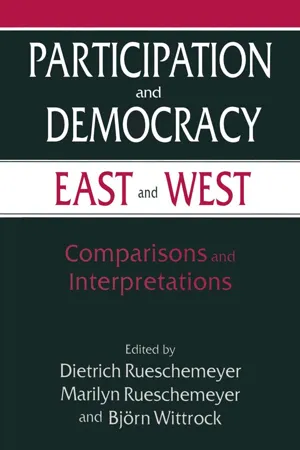
Participation and Democracy East and West
Comparisons and Interpretations
- 304 pages
- English
- ePUB (mobile friendly)
- Available on iOS & Android
eBook - ePub
About this book
Since Alexis de Tocqueville first made the linkage in his writings on America, a healthy democracy has been associated with the flourishing of civil society, as measured by popular participation in voluntary and civic activities and the vitality of organizations that mediate between the individual and the state. This volume takes a fresh look at this classic theme in the context of post-communist Eastern Europe, the West European welfare states and the United States, asking: what patterns of participation characterize the new democracies of Eastern Europe?; what levels of civic activism are characteristic of contemporary Western democracies?; what factors account for differences among countries and changing patterns over time?; and what do findings suggest about the prospects for democracy in the 21st century?
Information
1 |
DIETRICH RUESCHEMEYER, MARILYN RUESCHEMEYER, AND BJÖRN WITTROCK
Introduction
This volume approaches the classic problem of intermediary social organizations and democracy in a fresh way. It brings together theoretical and empirical investigations dealing with several countries in Eastern Europe, selected Western European countries with strong policies of social provision, and the United States—one of the oldest democracies that did not, however, develop as comprehensive welfare policies as the countries of northwestern Europe.
Understanding the relationship between a dense web of social and political organizations and the prospects of democracy has acquired a new urgency since the attempts at democratization in postcommunist Eastern Europe. Under communist rule, autonomous associations were discouraged or entirely outlawed. To what extent the collapse or radical decline of communist-controlled mass organizations has been replaced by a strong, purposeful, and politically relevant self-organization of diverse interests in society is a critical question for the prospects of democracy. These issues have had a central place in reflections on the foundations of democracy since Alexis de Tocqueville, and recently acquired a new prominence in varied claims about the role of “civil society”—the self-organization of society in a great diversity of associations and organizations that mediate between individuals and the state.
Our inquiry might have focused directly and exclusively on the problems of democratization in Eastern Europe. Yet we decided that it would be more fruitful to tackle comparable problems in the West as well and to examine them in an integrated theoretical framework. Such a comparative treatment promises better insights into the conditions favoring or inhibiting the growth of an organizationally dense civil society as well as its role as a foundation of effective democratic rule. In addition, it takes account of the fact that Western societies today often serve as reference points for analysts as well as politicians in Eastern Europe. Because of this, it seemed important to highlight the diversity of conditions that exist in the West as well as to inquire into potential problems of social and political participation faced by Western countries. For both of these reasons—East-West “reference taking” and systematic theoretical considerations—we also chose to look at the organizational underpinnings of democracy in the United States and in some of the welfare states of Western Europe—in Sweden, Norway, and the Federal Republic of Germany.
Since Alexis de Tocqueville’s Democracy in America, the United States has typically been viewed as the classic case of a democracy resting on strong intermediary organizations. Yet, since the 1970s, many observers have expressed concern about a decline of political participation and growing mistrust in political and other institutions. These concerns have been fueled by such other developments as the decline of unionization among workers and employees and the long-standing but aggravated weakening of political parties. The dramatic findings of Robert Putnam’s “Bowling Alone,” which was delivered at the conference out of which this volume developed, brought these problems to wide attention in the American public, when it was published separately in abbreviated form.
Western European countries have also been said to suffer from mistrust in political institutions and comparable problems in the organizational underpinnings of democracy. Thus, it has been argued that in western Germany major organizations in civil society have changed their character fundamentally: they are now service centers attending to the varied needs of disparate sets of individual customers rather than associations that command lasting allegiance and create social/political identities of citizens. Studies that asked people to assess the degree to which they see their interests reasonably represented in the public sphere by various organizations do not exactly address the same issues but raise questions about this diagnosis.1
Western Germany is furthermore a society in which many apparently autonomous organizations are in fact funded by the state. Although such public funding may not have the impact on autonomy that most American analysts are inclined to take for granted, the very different interrelations between state and social associations and institutions in the United States and in continental Western European countries make this an important issue for investigation.
The particular character of state-society relations also makes the Scandinavian countries especially important for a comparative analysis of the participatory and organizational underpinnings of democracy. The interpenetration of state and society has here gone further than in any other Western country. A widespread opinion holds that such comprehensive and pervasive activities by the state choke off the impulses for the self-organization of social and economic interests. More generally, conservative commentators see state action and citizens’ public engagement in a zero-sum relationship: the more of one, the less of the other. Analyzing the special conditions of social and political participation and their change in the Scandinavian welfare states should therefore offer particular insights into the issues of participation and democracy.
Comparison among the countries, however, adds a dimension that goes beyond the fact that here are eight interesting country cases. Comparing social and political patterns across national boundaries critically enhances interpretation and explanation. It is not only that divergent patterns and social transformations in countries that are comparable in many respects illuminate in interesting ways the developments in each; systematically extending interpretations and explanations across national boundaries also has a powerfully disciplining effect on explanatory accounts that seem plausible given the evidence from one country only.
Democracy requires a good deal more than broad and lively participation in a complex set of organizations that make up civil and political society.2 As Dietrich Rueschemeyer argues in his chapter, which seeks to specify the relationship between “the self-organization of society and democratic rule,” it is not sufficient to have a dense civil society strong enough to counterbalance the power of the state. The relations between organized interests and the balance of power within civil society must allow subordinate classes to express their interests in a strong and more or less autonomous way. Otherwise, oligarchic interests may gain hegemonic influence in civil society, come to dominate politics, and even use their influence to oppose democratization or roll back democracy where it exists, no matter how densely organized civil society is.
Beyond that, other conditions may acquire equal weight. International relations—both political and economic—can substantially interfere with or improve the chances of democracy. A system of law that empowers individuals and groups, effectively secures freedom of expression and association, institutionalizes a number of further restraints on sheer majority rule, and ensures the responsibility of administrative organizations to elected representatives is indispensable as an institutional grounding of democracy. Finally, there are features of the state apparatus itself that have critical importance for the prospects of democracy. Among them are a certain level of organizational integrity and efficiency, a minimum of independence from dominant class interests, secure civilian control of the means of coercion, and considerable autonomy of the administration of justice within the state.
Yet social and political participation occupies a special place among the conditions and correlates of democracy. This is not only because forceful, broad-based, and pluralistic participation infuses many of the other conditions—such as legal provisions—with life or because it moderates the effect of otherwise adverse conditions. For certain conceptions of democracy—among them those of John Stuart Mill and, in our own time, of C.B. Macpherson—participation is more than a favorable condition of democracy, though that is acknowledged. Instead, it is among democracy’s most essential results, an end in itself.
If combining for this comparative exploration studies of a wide-ranging set of countries in East and West made eminent sense, it clearly transcended the competence of one or a few scholars. The idea for this volume grew out of earlier research by Marilyn Rueschemeyer on changing conditions in East Germany and in East-Central Europe after 1989.3 Our ideas crystallized in workshops conducted in 1992 at the Swedish Collegium for Advanced Study in the Social Sciences at Uppsala. And the Collegium subsequently allowed us to bring together specialists from East-Central Europe, Scandinavia, western Germany, and the United States to discuss each other’s research on social and political participation and to prepare this volume.
As a result, this volume combines papers on participation and democratization in several Eastern European countries, in Poland, the Czech Republic, Hungary, and eastern Germany, with a set of studies that examine similar questions in an array of Western countries differentiated primarily by the varying degree of the interpenetration of state and civil society—the United States, western Germany, Norway, and Sweden. The book contains chapters of diverse character—vivid qualitative descriptions joined with reflection, theoretically oriented institutional analyses, assessments of complex survey results—framed by theoretical contributions that offer an analytic integration of the country’s essays.
Andrzej Rychard opens the set of country studies. In his discussion of postcommunist Poland he stresses the problems created by the communist heritage but also by its major opponents, the Catholic church and Solidarity. New forms of participation are developing, but are often still in an inchoate state. Michal Illner reports on research in the Czech Republic after 1989. He studied the development of local participation and local government. Local participation is of special interest as one would expect participation to emerge here first. Miszlivetz and Jenson focus in their chapter on the decline of reform movements in Hungary that showed lively promise in the late 1980s. Marilyn Rueschemeyer examines the difficulties encountered by the Social Democratic Party in eastern Germany. All four chapters on Eastern European countries reveal profound difficulties of participation that are partly grounded in the past and partly in the current economic transformations.
Bo Rothstein takes a historical tack in his examination of the development of democracy and cross-class participation in Sweden and explores the role of the emerging and the mature welfare state in instigating and possibly suffocating participation. Per Selle examines the historical development of women’s participation in the civil and political society of Norway; he, too, explores the impact of the mature welfare state on participation. In the chapter on the former West Germany, Bernhard Wessels reviews the development of participation as well as of the sense of being represented.
While the three chapters on Northwest European welfare states put into question the claim that comprehensive policies of social provision and the concomitant interpenetration of government agencies and private organizations of the “third sector” suffocate participation, Robert Putnam shows in his chapter on the United States that the past twenty-five years have seen a steady decline—albeit from a generally high level—in social participation.
In the concluding chapter, the editors comment on and integrate the different contributions. They focus in particular on what can be learned about the conditions favoring, shaping, and hindering social participation, and they examine the impact of different historical patterns of participation on the prospects and the quality of democracy.
Notes
1. See Wolfgang Streeck, “Vielfalt und Interdependenz: Überlegungen zur Rolle von intermediären Organisationen in sich ändernden Umwelten,” Kölner Zeitschrift för Soziologie und Sozialpsychologie 39 (1987): 471–95; and Bernhard Wessels, “Vielfalt oder strukturierte Komplexität? Zur Institutionalisierung politischer Spannungslinien im Verbände- und Parteiensystem der Bunderepublik.” Kölner Zeitschrift für Soziologie und Sozialpsychologie 43 (1991): 454–75.
2. For a more extended theoretical and comparative historical analysis of the conditions of democracy, on which the current study builds, see Dietrich Rueschemeyer, Evelyne H. Stephens, and John D. Stephens, Capitalist Development and Democracy. Cambridge: Polity Press, and Chicago: University of Chicago Press, 1992.
3. See Marilyn Rueschemeyer, “Frauen Osteuropas in der Politik. Der derzeitige Transformationsprozess,” Berliner Journal für Soziologie 2 (1995): 223–30. Idem, “Participation and Democracy: Observations of Residential Communities of the Former GDR in Transition.” In The Federal Republic at 45: Union without Unity, ed. Peter Merkl. London: Macmillan and New York: NYU Press, 1995. Idem, “East Germany’s New Towns in Transition: A Grassroots View of the Impact of Unification,” Urban Studies 30, no. 3 (April 1993): 495–506. And idem, ed., Women in the Politics of Postcommunist Eastern Europe. Armonk, N.Y.: M.E. Sharpe, 1994; rev. ed. 1998.
2 |
DIETRICH RUESCHEMEYER
The Self-Organization of Society and Democratic Rule
Specifying the Relationship
One of the oldest claims about the conditions for democratic rule holds that dense intermediary organizations and lively participation in them are of critical importance both for the establishment of democracy and for the quality of democratic governance.1 In this chapter, I first develop several propositions sustaining this claim, but then explore a number of important qualifications that will specify the relationship more precisely, as well as identify a number of unresolved issues.
I. Seven Basic Propositions
In what ways does dense social participation in intermediary groups, associations, and organizations create conditions favorable for democracy? Several interlocking effects of associational activity have been singled out.
A first proposition goes to the very heart of the idea of democracy, conceived as a constitutional form seeking to approximate equality in political decision making: collective action and organization empower the many. Organization is the most important power resource of those who lack disproportionate influence and power based on coercion, economic resources, cultural hegemony, and/or individual or collective prestige.
This is the most fundamental claim about participation and democracy. Democracy is, after all, a matter of power, even if it remains largely formal, even if, that is, the equality it offers does not—as in many cases of “rea...
Table of contents
- Cover
- Half Title
- Title Page
- Copyright Page
- Dedication
- Table of Contents
- About the Editors and Contributors
- Acknowledgments
- 1. Introduction
- 2. The Self-Organization of Society and Democratic Rule: Specifying the Relationship
- 3. Institutions and Actors in a New Democracy: The Vanishing Legacy of Communist and Solidarity Types of Participation in Poland
- 4. Local Democratization in the Czech Republic After 1989
- 5. An Emerging Paradox: Civil Society from Above?
- 6. The Social Democratic Party in Eastern Germany: Political Participation in the Former GDR After Unification
- 7. The State, Associations, and the Transition to Democracy: Early Corporatism in Sweden
- 8. The Norwegian Voluntary Sector and Civil Society in Transition: Women as Catalysts for Deep-Seated Change
- 9. Social Alliances and Coalitions: The Organizational Underpinnings of Democracy in Western Germany
- 10. Democracy in America at the End of the Twentieth Century
- 11. Conclusion: Contrasting Patterns of Participation and Democracy
- Index
Trusted by 375,005 students
Access to over 1.5 million titles for a fair monthly price.
Study more efficiently using our study tools.
Frequently asked questions
Yes, you can cancel anytime from the Subscription tab in your account settings on the Perlego website. Your subscription will stay active until the end of your current billing period. Learn how to cancel your subscription
No, books cannot be downloaded as external files, such as PDFs, for use outside of Perlego. However, you can download books within the Perlego app for offline reading on mobile or tablet. Learn how to download books offline
Perlego offers two plans: Essential and Complete
- Essential is ideal for learners and professionals who enjoy exploring a wide range of subjects. Access the Essential Library with 800,000+ trusted titles and best-sellers across business, personal growth, and the humanities. Includes unlimited reading time and Standard Read Aloud voice.
- Complete: Perfect for advanced learners and researchers needing full, unrestricted access. Unlock 1.5M+ books across hundreds of subjects, including academic and specialized titles. The Complete Plan also includes advanced features like Premium Read Aloud and Research Assistant.
We are an online textbook subscription service, where you can get access to an entire online library for less than the price of a single book per month. With over 1.5 million books across 990+ topics, we’ve got you covered! Learn about our mission
Look out for the read-aloud symbol on your next book to see if you can listen to it. The read-aloud tool reads text aloud for you, highlighting the text as it is being read. You can pause it, speed it up and slow it down. Learn more about Read Aloud
Yes! You can use the Perlego app on both iOS and Android devices to read anytime, anywhere — even offline. Perfect for commutes or when you’re on the go.
Please note we cannot support devices running on iOS 13 and Android 7 or earlier. Learn more about using the app
Please note we cannot support devices running on iOS 13 and Android 7 or earlier. Learn more about using the app
Yes, you can access Participation and Democracy East and West by Dietrich Rueschemeyer in PDF and/or ePUB format, as well as other popular books in Politics & International Relations & Civics & Citizenship. We have over 1.5 million books available in our catalogue for you to explore.