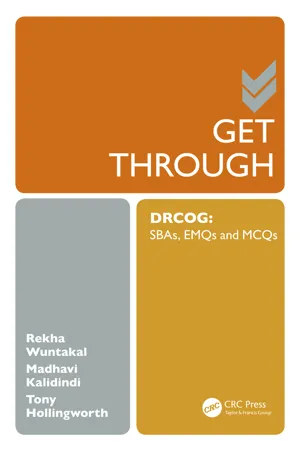
eBook - ePub
Get Through DRCOG
SBAs, EMQs and McQs
- 287 pages
- English
- ePUB (mobile friendly)
- Available on iOS & Android
eBook - ePub
Get Through DRCOG
SBAs, EMQs and McQs
About this book
The book provides advice on how to prepare for the examination and how questions should be approached to obtain the highest marks. With more than 350 questions, preparation tips and extensive answer explanations, it is the definitive resource for those attempting the DRCOG. The book is comprehensive and authoritative: written by an experienced auth
Information
1 | BASIC CLINICAL SKILLS – QUESTIONS |
SBAs
Question 1
A 22-year-old Asian woman is admitted to the hospital with an incomplete miscarriage at 11 weeks’ gestation. An ultrasound shows a ‘snow storm’ appearance. She passes grape-like vesicles through the vagina. She subsequently has a surgical evacuation of the uterus. The histology reveals a large mass with hydropic changes in all the placental villi and no fetal tissue. She is followed up with serum beta human chorionic gonadotrophin (βhCG) levels. There was an initial fall but it started to rise gradually (10,000 units/mL) at 3 months’ follow up. Her CT scan chest, abdomen and pelvis are normal except localized thickened vascular area in the posterior wall of uterus. What is the likely diagnosis?
A. Gestational choriocarcinoma
B. Persistent trophoblastic disease
C. Non-invasive mole
D. Non-gestational choriocarcinoma
E. Placental site trophoblastic disease
Question 2
A 30-year-old woman presents to the early pregnancy unit with mild vaginal bleeding. An ultrasound is performed, which reports a complete molar pregnancy. What would be the parental origin and genetic complement of the complete molar pregnancy?
A. 2 paternal sets: diploid
B. 2 paternal sets: haploid
C. 1 paternal set: haploid
D. 2 paternal and 2 maternal sets: tetraploid
E. 1 maternal and 1 paternal set: diploid
Question 3
A 22-year-old Asian woman is admitted to the hospital with an incomplete miscarriage at 11 weeks’ gestation. She subsequently has surgical evacuation of the uterus. The histology reveals a large mass with hydropic changes in all the placental villi with no fetal tissue. Which of the following is the most likely karyotype and parental chromosomal origin?
A. 46 XX, maternal
B. 46 XX, paternal
C. 46 XY, paternal
D. 69 XXY, paternal
E. 69 XXY, paternal and maternal
Question 4
A 22-year-old Asian woman is admitted to the hospital with an incomplete miscarriage at 11 weeks’ gestation. She subsequently has surgical evacuation of the uterus. The histology reveals focal hydropic placental villi interspersed with normal villi and presence of fetal tissue. Which of the following is the most likely karyotype and parental chromosomal origin?
A. 46 XX, maternal
B. 46 XX, paternal
C. 46 XY, paternal
D. 69 XXY, paternal
E. 69 XXY, paternal and maternal
Question 5
Which one of the following statements is not true with respect to bacterial vaginosis (BV)?
A. Isolation of Gardnerella vaginalis on high vaginal swab culture is diagnostic of BV.
B. Vaginal pH is increased and is typically more than 4.5.
C. Presence of ‘clue cells’ on microscopy is diagnostic of bacterial vaginosis.
D. It is associated with preterm labour or miscarriage.
E. It is the commonest cause of abnormal vaginal discharge in women of reproductive age.
Question 6
In relation to the treatment of BV, which one of the following statements is true?
A. Routine treatment of male partners is recommended.
B. Vaginal douching is beneficial for symptomatic improvement.
C. Metronidazole is not safe during the first trimester of pregnancy.
D. Clindamycin 2% intravaginal cream is not effective.
E. Recurrent BV is difficult to manage as it can recur in up to 70% of females within 3 months of treatment.
Question 7
Which one of the following statements is false with respect to the risks of advanced maternal age?
A. Increased risk of pre-eclampsia
B. No increase or decrease in the stillbirth rate
C. Increased rate of instrumental delivery
D. Increased risk of gestational diabetes
E. Increased rate of caesarean section
Question 8
A 28-year-old para 1 woman with a dichorionic diamniotic (DCDA) twin pregnancy attends her antenatal appointment at 20 weeks’ gestation. She is at risk of developing the following complications with the exception of which of the following?
A. Twin-to-twin transfusion syndrome
B. Pre-eclampsia
C. Postpartum haemorrhage
D. Fetal growth restriction
E. Preterm labour
Question 9
A 30-year-old para 2 woman with a BMI of 45 attends the antenatal clinic at 10 weeks’ gestation. One of the following is incorrect with respect to the a...
Table of contents
- Cover
- Half Title
- Title Page
- Copyright Page
- Table of Contents
- Introduction
- 1 Basic clinical skills – Questions
- 2 Basic clinical skills – Answers
- 3 Basic surgical skills – Questions
- 4 Basic surgical skills – Answers
- 5 Antenatal care – Questions
- 6 Antenatal care – Answers
- 7 Management of labour and delivery – Questions
- 8 Management of labour and delivery – Answers
- 9 Postpartum problems (the Puerperium), including neonatal problems – Questions
- 10 Postpartum problems (the Puerperium), including neonatal problems – Answers
- 11 Gynaecological problems – Questions
- 12 Gynaecological problems – Answers
- 13 Fertility control (Contraception and termination of pregnancy) – Questions
- 14 Fertility control (Contraception and termination of pregnancy) – Answers
Trusted by 375,005 students
Access to over 1.5 million titles for a fair monthly price.
Study more efficiently using our study tools.
Frequently asked questions
Yes, you can cancel anytime from the Subscription tab in your account settings on the Perlego website. Your subscription will stay active until the end of your current billing period. Learn how to cancel your subscription
No, books cannot be downloaded as external files, such as PDFs, for use outside of Perlego. However, you can download books within the Perlego app for offline reading on mobile or tablet. Learn how to download books offline
Perlego offers two plans: Essential and Complete
- Essential is ideal for learners and professionals who enjoy exploring a wide range of subjects. Access the Essential Library with 800,000+ trusted titles and best-sellers across business, personal growth, and the humanities. Includes unlimited reading time and Standard Read Aloud voice.
- Complete: Perfect for advanced learners and researchers needing full, unrestricted access. Unlock 1.5M+ books across hundreds of subjects, including academic and specialized titles. The Complete Plan also includes advanced features like Premium Read Aloud and Research Assistant.
We are an online textbook subscription service, where you can get access to an entire online library for less than the price of a single book per month. With over 1.5 million books across 990+ topics, we’ve got you covered! Learn about our mission
Look out for the read-aloud symbol on your next book to see if you can listen to it. The read-aloud tool reads text aloud for you, highlighting the text as it is being read. You can pause it, speed it up and slow it down. Learn more about Read Aloud
Yes! You can use the Perlego app on both iOS and Android devices to read anytime, anywhere — even offline. Perfect for commutes or when you’re on the go.
Please note we cannot support devices running on iOS 13 and Android 7 or earlier. Learn more about using the app
Please note we cannot support devices running on iOS 13 and Android 7 or earlier. Learn more about using the app
Yes, you can access Get Through DRCOG by Rekha Wuntakal,Madhavi Kalidindi,Anthony Hollingworth, Antony Hollingworth in PDF and/or ePUB format, as well as other popular books in Medicine & Family Medicine & General Practice. We have over 1.5 million books available in our catalogue for you to explore.