eBook - ePub
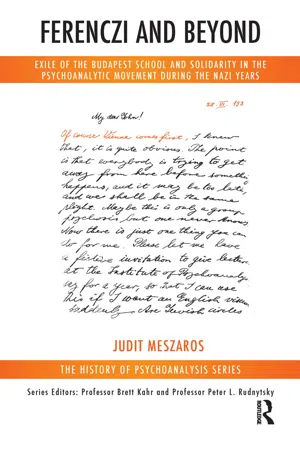
Ferenczi and Beyond
Exile of the Budapest School and Solidarity in the Psychoanalytic Movement During the Nazi Years
- 304 pages
- English
- ePUB (mobile friendly)
- Available on iOS & Android
eBook - ePub
Ferenczi and Beyond
Exile of the Budapest School and Solidarity in the Psychoanalytic Movement During the Nazi Years
About this book
This book explores how the Budapest School of Psychoanalysis took shape and examines the role played in it by Sandor Ferenczi. It integrates the Hungarian story of the "exile of the Budapest School" with an American perspective on "solidarity in the psychoanalytic movement during the Nazi years".
Information
Chapter One
Towards psychoanalysis (1897–1908)2
“Authoritarian arguments carry little weight”
(Ferenczi, 1999a[1899])
Sándor Ferenczi’s early writings foreshadow not only Ferenczi’s character and scholarly and therapeutic orientation as a psychoanalyst, but also the unique perspectives that would emerge in the Budapest School. These initial studies speak volumes about the thinking of a young professional in the process of finding his way. This was the process that virtually predestined him to stake out the fundamental questions of modern psychoanalysis and, at the same time, to become the “wise baby” and even the enfant terrible3 of psychoanalytic history, although this was never his intention—indeed, it is safe to say this ran very much counter to his wishes.
A decade (1897–1908) of publications by Ferenczi—spanning both clinical topics and broader issues in healthcare—provide an insight into his early way of thinking and medical approach. Directions took shape that would become defining elements in his later writing on psychoanalysis. First and foremost, we see his constant need to experiment and to maintain a critical attitude of self-reflection—both in the interests of effective healing. The “maturity” grounded in the sensitivity of the “wise baby”, on the one hand, and the unusual shifts in perspective and express resistance to being integrated into a senseless “order” represented by authority on the part of the “enfant terrible”, on the other hand, constituted the basic features of Ferenczi’s personality.
A critical attitude, self-reflection, and autonomous and creative thinking also left their mark on the work of the analysts that formed the Budapest School. For example, Ferenczi thought it perfectly natural that he should admit his own diagnostic errors—as an exercise in lessons learnt and with no sense of shame. In his view, it was hypocrisy that one should feel ashamed, because this throws up roadblocks to acknowledgement and creates distrust among people.
Ferenczi saw the most effective way to cure illness as being within a collaborative doctor–patient relationship. With this understanding, he broke away from the system of his day, which derived from an authoritarian way of thinking, subordinated the patient to the physician, and positioned the physician in a strict hierarchy. He proceeded gently, using his writings to revolt, and to incite revolt, against any form of subordination that stifled autonomous thinking. He sympathised with peers who advocated an independent way of thinking on behalf of the patient. For him, the illness could neither be separated from the patient nor from her or his personality, way of life, culture, or, indeed, sex. In his understanding, these two, the individual and her or his illness, formed a single system—and it was this complex structure that the physician encountered. Curing and being cured were, therefore, based on collaboration between doctor and patient.
However, the incongruity between Ferenczi’s need for intellectual freedom and his desire for attachment to charismatic people represented a major source of tension that would accompany him to the end of his life. At times, maintaining his freedom meant that he lost favour with others. The fact that this incongruity was never overcome rendered Ferenczi’s life often painful, even bitter towards the end, because of his inability to resolve emotional conflicts, and, indeed, fatal for his relationship with Freud—as attested by his last major study, Clinical Diary.4
It is important to take a closer look at this early pre-psychoanalytic, or pre-analytic, phase because it is in these writings that we uncover traces of the internal process that would eventually give shape to psychoanalytic thinking. The term pre-analytic is, therefore, descriptive, not evaluative; it designates a period which ended on 2 February 1908 with the meeting between Freud and Ferenczi. Pre-analytic is more accurate than more conventional descriptors such as as a young man, his early work, and his beginnings. Indeed, one would be hard-pressed to refer to an adult as being young throughout the course of a decade, to describe all the work that spans that period as early, or to speak, ten years into a person’s career, of his beginnings.
An examination of this period enables us to link pre-analytic seeds of thought with the therapeutic and theoretical approaches initiated by Ferenczi, the mature psychoanalyst. This is particularly so because one can identify a consistent line that lent Ferenczi’s oeuvre exceptional stability. At the same time, this line—as we will see—would have great significance in the Hungarian psychoanalytic community that formed around Ferenczi. Furthermore, the impact of the line was still being felt and could be observed in the approach among members of the Budapest School, once forced to emigrate.
The emotional and intellectual milieu of the relatively large Ferenczi family shaped the character of each member. Born to this liberal-minded, intellectual Jewish family in the north-eastern Hungarian city of Miskolc on 7 July 1873, Sándor Ferenczi was the eighth of eleven children. His father, Baruch Fraenkel/Fränkel5 (1830–1889), had moved his family from Cracow in Poland to Hungary and fought in the country’s Revolution and War of Independence of 1848–1849. He had trained to be a book merchant and became the proprietor of his own bookshop by 1856. His second wife, Róza Eibenschütz, had grown up in Vienna. The multilingual family thus knew Hungarian, German, Yiddish, and Polish. Sándor himself was bilingual, speaking Hungarian and German, and later learnt English and French. As an expression of assimilation into Hungarian society, his father Hung-arianised the family name to Ferenczi in 1879. As Sándor had been born six years earlier, his family name was entered as Fränkel in the birth records of the Miskolc synagogue.
The family’s bookshop played a key role in the cultural life of the city. Beyond selling and even lending books, it also dealt with publishing and planning cultural events, activities in which Ferenczi’s mother played a key role (Kapusi, 2000). The bookshop saw a steady stream of famous writers, poets, and artists, who aroused Ferenczi’s interest and had an impact on the range of friendships he would later nurture. Ferenczi was often seen reading perched on the ladder used for the tall shelves, and we know from his own writing that he had an inquisitive mind that was given to experimentation: at sixteen, he attempted to hypnotise an assistant at the bookshop (Ferenczi, 1910). After completing secondary school, he studied medicine in Vienna, earning a degree in 1894. During the Vienna years, He was strongly influenced by the views of Professor Richard von Krafft-Ebing on sexual disorders, by Darwin’s natural selection, and by the teachings of Jean-Baptiste Lamarck and Ernst Haeckel on phylogenesis and ontogenesis.
“Unconscious and semi-conscious”: occultism, hypnosis, and the interpretation of dreams
Both occultism and unconscious or “semi-conscious” (Ferenczi, 1999b [1899], p. 47) manifestations of psychic processes aroused Ferenczi’s interest in his twenties, and he was far from alone in this regard at the turn of the century. The major scientific discoveries of the nineteenth century—Darwin’s theory of natural selection, Haeckel’s theory on ontogenesis, and the law of conservation of energy—brought about revolutionary changes in the natural sciences and fundamental shifts in world view. This had a seesaw effect. In response to the ascendance of materialism, experiments were being conducted with renewed vigour to prove the immortality of the soul. At spiritist séances, mediums relayed signs from the beyond and communicated with spirits of the deceased.6 The ancient desire for immortality reached a fever pitch in the late 1900s, with enthusiasts launching movements that spanned continents. This was when spiritism took root in Europe, having originated in North America. While Freud opened the door to a new era with his book The Interpretation of Dreams (Freud, 1900a), Heavenly Light, the journal of the Hungarian Association of Spiritists, was first published in Hungary in 1900. Thus, in an unconscious common pursuit at the fin de siècle, answers were being sought to phenomena that had slipped from the control of the human spirit—or human consciousness, in today’s understanding—but emerged in hypnosis, dreams, and the occult, and even in the rich and varied symptoms of hysteria.
What was so unusual about a young man, having studied in Vienna and now embarking on his medical career in Budapest, showing an interest in all the phenomena that held the public in their mystical spell? It was not the object of his interest that was unusual; it was his approach. Ferenczi never joined the vocal ranks of either believers or doubters. He found another path: that of experimentation. As he put it, why not investigate disputed phenomena from the position of the unbiased experimenter? According to Ferenczi, “[t]he method of combat used by those opposed to spiritism should not be to reject it before, or without, investigating it” (Ferenczi, 1999a[1899], p. 29). He felt that one must rather set about conducting a critical study of the facts “with the objectivity of a true scholar” (1999a[1899], p. 29). Between 1897 and 1899, Ferenczi himself attended spiritist séances in the Budapest villa of noted professor of chemistry Emil Felletár (Hidas & Mészáros, 1988), and, based on his experience, encouraged his peers as follows: “Don’t be reluctant to sit at the rapping table . . . Because I believe that there is truth to it even if it is subjective and not objective truth” (Ferenczi, 1999a[1899], p. 29, my italics). He went on to say,
Psychology as a natural science is still in its childhood years, so to speak. . . . But what we know today proves without any doubt that the mental functioning includes a great deal of unconscious and semi-conscious elements. And that we perform many logical actions and have thoughts of which our consciousness remains unaware. (pp. 29–30)
Ferenczi concluded that there are cracks in the functioning of the human psyche and that only a portion of one’s experiences enters the “focus of the mirror of the conscious and the rest functions unconsciously” (Haynal, 1995, p. 20). Ferenczi contrasted contemporary discoveries in the natural sciences with the backward state of psychology in his day. According to him, “we have yet to see the Darwin and Haeckel of psychology. The ontogenesis and phylogenesis of the mind have still not been created” (Ferenczi 1999c[1900], p. 46).
In Ferenczi’s argumentation, the elements of the development of the self-conscious mind were to be sought in the past. Here, Ferenczi was not referring to the personal past of the individual. He was, rather, expanding on Haeckel’s theory of ontogenetic evolution to include the development of human consciousness. Thus, the development of the human mind carried the stages of the consciousness of various species. Ferenczi attempted to grasp the operation of living beings—including man—in generally understandable principles by applying knowledge gained through the most recent scientific discoveries. This effort is also characteristic of Freud’s way of thinking in that his theory of the libido—his theory of the conversion of sexual energy into mental energy—shows clear signs of the general law of conservation of energy. A survey of the intersections of psychoanalysis and scientific discoveries motivated one of Ferenczi’s essential later writings. In his bioanalysis within his book Thalassa: A Theory of Genitality (Ferenczi, 1989[1924]), he described the melding of the biological and psychological functioning of the human being. This work, which would become known simply as Thalassa,7 discusses the concurrent emergence of the onto- and phylogenetic instinctive tendencies in the human sexual drive.
Ferenczi’s writing is characterised by an implicitly monistic way of thinking. Body and mind create one unit, and the physical and psychological processes flow into each other (Pfitzner, 2005, pp. 38–48). If we add to this Haeckel’s theory of onto- and phylogenesis and the symbolic expression of psychological problems in physical symptoms, we arrive at the approach through which Ferenczi considered the cooperation between body and mind, psychosomatic phenomena, and illness. According to this, the depth of psychological regression could be understood in or through symbols of physical manifestations. If regression was expanded from the level of ontogenesis—when earlier stages of the development of the ego appeared in the regressive state—to the phylogenetic level, we would arrive at the bioanalysis proposed by Ferenczi and one of its particular features, which came to be known as the “Thalassal regression”: through intercourse one can reach not only to the beginning of individual life, the womb, but symbolically to the beginning of life itself, to the primordial sea of Thalassa.
Many of Ferenczi’s earlier writings maintained the basic elements of his later thinking. In his first scholarly publication, an article entitled “Spiritism”, he stressed the idea of subjective truth, separated psychic expressions of the unconscious and semi-conscious, and contrasted respect for facts arrived at through experimentation with a prejudicial way of thinking. These intellectual considerations can be found in all his later writing. The acceptance of subjective truth, for example, represented a conceptual departure in psychoanalysis and also plays a key role in the paradigm shift in Ferenczi’s trauma theory (Mészáros, 2002; 2004b, 2010a).
Experiment and self-reflection in the service of recognition and healing
Experimentation, relations of reflective and self-reflective understandings, and the need for authentic expression are among the core values of Ferenczi’s functioning, and they represent values that can be detected in the approach taken by the Budapest School.
For Ferenczi, the method for revealing truth was experimentation. By nature, Ferenczi was playful, creative, and drawn to experimentation. It characterised him in his early years as much as in his later years. At first, he attempted to capture the unconscious forces of the mind through automatic writing (Ferenczi, 1999a)[1899]. Like Freud, he also experimented with thought transference, with the active technique in the 1920s to enhance the effectiveness of psychoanalysis, and then later with mutual analysis. This is how mutual analysis with the patient became one of the most widely debated experiments in the history of psychoanalysis (Ferenczi, 1988[1932]). The idea of mutual analysis is not Ferenczi’s. Freud and later all the first-generation psychoanalysts applied this method, and this is how they learnt from and trained one another.8 However, Ferenczi was the only one to consider the patient to be equal when he sensed his own blockage in therapy, and, in order to raise the quality of psychoanalytic processes, he conducted experiments in mutual analysis with patients. He kept a clinical diary of his experiences in 1932 and even included the negative impact of his method. His purpose was to achieve the highest level of trust with the patient,
a total immersion, right down ‘to the mothers’, impossible unless the analyst becomes an open book, that is to say, not only formally and professionally nice and polite but even harmless, by communicating his suppressed and repressed selfish, dangerous, brutal, and ruthless tendencies. (Ferenczi, 1988[1932], p. 74)
Truth is revealed through the careful examination of material obtained through experimentation and experience, but to glimpse facts it is indispensable to have an unbiased attitude, which also happens to be an essential condition for recognising mistakes. Ferenczi consciously represented these principles. As he put it,
[o]ur memories carefully safeguard our successes, but our mistakes are covered by the veil of forgetting. How much could the medical sciences gain if we were able to systematise our mistakes . . . or blunders! Or if at least our own mistakes could remain engraved in our memories! (Ferenczi, 1999k[1903], p. 175)
In the service of science, in addition to all this, one must have inner strength that enables the practitioner not only to record mistakes quietly, but also to share them with others. Ferenczi’s unusual candour was not a manifestation of the rebellious youth, the “enfant terrible”, pitting himself against the establishment, but, rather, an expression of the autonomy of the mature person capable of in-depth and self-reflective thinking. As he wrote in his 20s,
[i]t has long been known that we learn the most from our mistakes. However, we jealously guard the lessons we learn this way because we all consider it significant to appear in the eyes of our fellow man as being more clever and infallible. This is how it is in social life as well, especially in medical practice. (Ferenczi, 1999e[1900], p. 63)
After...
Table of contents
- Cover
- Half Title
- Title Page
- Copyright Page
- Contents
- Acknowledgements
- About the Author
- Series Editor’s Foreword
- Foreword
- Introduction
- Chapter One Towards psychoanalysis (1897–1908)
- Chapter Two The forming of the Budapest School (1908–1918)
- Chapter Three “Budapest will now become the headquarters of our movement”
- Chapter Four The first wave of emigration in the early 1920s
- Chapter Five A period of consolidation
- Chapter Six The USA’s immigration policy: the sum of conflicting vectors
- Chapter Seven “Your Committee”: the Emergency Committee on Relief and Immigration of the American Psychoanalytic Association
- Chapter Eight The time has come (1938–1941): the second wave of emigration
- Chapter Nine Emigration: losses and gains
- Epilogue
- Notes
- References
- Index
Trusted by 375,005 students
Access to over 1.5 million titles for a fair monthly price.
Study more efficiently using our study tools.
Frequently asked questions
Yes, you can cancel anytime from the Subscription tab in your account settings on the Perlego website. Your subscription will stay active until the end of your current billing period. Learn how to cancel your subscription
No, books cannot be downloaded as external files, such as PDFs, for use outside of Perlego. However, you can download books within the Perlego app for offline reading on mobile or tablet. Learn how to download books offline
Perlego offers two plans: Essential and Complete
- Essential is ideal for learners and professionals who enjoy exploring a wide range of subjects. Access the Essential Library with 800,000+ trusted titles and best-sellers across business, personal growth, and the humanities. Includes unlimited reading time and Standard Read Aloud voice.
- Complete: Perfect for advanced learners and researchers needing full, unrestricted access. Unlock 1.5M+ books across hundreds of subjects, including academic and specialized titles. The Complete Plan also includes advanced features like Premium Read Aloud and Research Assistant.
We are an online textbook subscription service, where you can get access to an entire online library for less than the price of a single book per month. With over 1.5 million books across 990+ topics, we’ve got you covered! Learn about our mission
Look out for the read-aloud symbol on your next book to see if you can listen to it. The read-aloud tool reads text aloud for you, highlighting the text as it is being read. You can pause it, speed it up and slow it down. Learn more about Read Aloud
Yes! You can use the Perlego app on both iOS and Android devices to read anytime, anywhere — even offline. Perfect for commutes or when you’re on the go.
Please note we cannot support devices running on iOS 13 and Android 7 or earlier. Learn more about using the app
Please note we cannot support devices running on iOS 13 and Android 7 or earlier. Learn more about using the app
Yes, you can access Ferenczi and Beyond by Judit Meszaros in PDF and/or ePUB format, as well as other popular books in Psychology & 20th Century History. We have over 1.5 million books available in our catalogue for you to explore.