- 286 pages
- English
- ePUB (mobile friendly)
- Available on iOS & Android
eBook - ePub
About this book
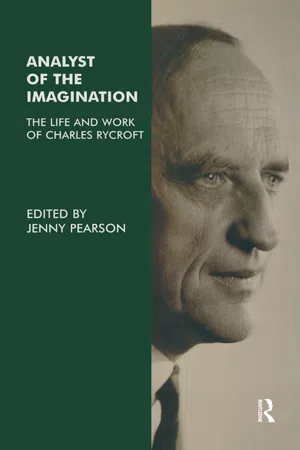
Charles Rycroft's lucid jargon-free approach to psychoanalysis inspired a whole generation. Taking inspiration from many fields outside psychoanalysis, including history, literature, linguistics and ethology, he established the important link between mental health and the imagination, creating a broader perspective and encouraging free thinking. This solitary and creative "rebel" rarely received the recognition he deserved, but this collection of articles and papers by people who felt the benefit of his ever-curious, expanding wealth of knowledge, goes some way to acknowledging the debt owed to him, and introducing a new generation to this innovative analyst.
Information
Chapter One
Charles Rycroft: a memoir
It is just about thirty years ago that Charles Rycroft and I became friends. For a while, he almost became part of our extended family: for he used to come and stay in our Welsh cottage during family holidays. I remember that, on the first occasion, he feared the cold of Snowdonia and came equipped with an electric blanket. One night this caught fire, which filled the room with smoke and was very alarming: but Charles adroitly threw the blackened remnant out of the window, so no great harm was done. It seemed out of character for Charles to have such a modern device as an electric blanket. Gadgets were not his scene. He regarded our dishwasher with the utmost suspicion, and I completely failed to persuade him that using a word processor was preferable to doing everything by hand.
It was on these holidays that I learned how good he was with children. He seemed to have a natural sympathy with the young, which he retained even into old age, so that one had no qualms about referring quite young patients to him, even when he was in his seventies. He was never in the least patronizing and so did not talk down to the young, who consequently felt at home with him.
I admired many things about Charles. First, the sharpness of his intellect. He had a highly critical mind, which manifested itself early in his life, when he got a first in Economics Part I at Cambridge. I don’t think economics played a great part in his later life, but he retained a strong interest in history, which he also read at Cambridge, and in which he continued to read for pleasure into his old age. His critical intelligence manifested itself in an intolerance of slipshod thinking and writing, and greatly contributed to his independence of mind.
Second, I enormously admired him as a writer. Analysts are not always noted for the clarity of their writing—think of Lacan. But Charles’s writings are crystal clear. He was, rightly, uneasy about Freud’s ambivalent attitude to phantasy; and many of Charles’s best writings are concerned with the positive aspects of the creative imagination, which he refused to dismiss as escapist, as Freud tends to do. His paper of 1962, “Beyond the Reality Principle”, has become a classic. In it, he criticises Freud’s division of mental functioning into the two varieties that Freud named “primary” and “secondary” process. Charles objected to Freud’s dismissal of primary processes as “archaic, unrealistic and inherently non-adaptive” and pointed out that the healthy person integrates phantasy with abstract, rational thought in such a way that “phantasy continues to engage external reality (objects), enriches it and enables the imaginative elaborations of personal relationships to be understood and appreciated”.
Charles had a keen appreciation of literature, which is reflected in the elegance of his writings. He was widely read and had a lively interest in both prose and poetry. I think it was Charles’s appreciation of literature that made him dissatisfied with Freud’s interpretation of the writer’s art, and which led Charles to write: “The aim of psycho-analytical treatment is not primarily to make the unconscious conscious, nor to widen and strengthen the ego, but to reestablish the connexion between dissociated psychic functions, so that the patient ceases to feel that there is an inherent antagonism between his imaginative and adaptive capacities.” He goes on to quote the famous passage of E. M. Forster, which begins “Only connect the prose and the passion…”, which, I am sure, is familiar to you all.
Charles’s book Anxiety and Neurosis was first published in 1968. It is a pioneer interpretation of anxiety in terms of biology and, as such, was ahead of its time. Charles regards anxiety as a heightened sense of vigilance, which is originally protective in function as a response to threat but becomes distorted in neurotic behaviour, giving rise to defensive manoeuvres of an hysterical, obsessional, or schizoid kind. Re-reading this book recently demonstrated to me the depth of Charles’s understanding of defence mechanisms. It is a brilliant book, perhaps still not sufficiently appreciated. As he wrote himself, the book shows “that anxiety and the neuroses are phenomena which can be understood imaginatively as exaggerations of tendencies that are present in all of us and intellectually as manifestations of well-known biological principles”.
In his book The Innocence of Dreams (1979), Charles reverts to one of his main preoccupations: Freud’s distinction between primary and secondary mental processes. Once again, he is at pains to point out that, unlike Freud, he does not regard these two forms of mental functioning as antagonistic. He compares dreaming with waking imaginative activity and concludes that they have in common the fact that they both create images independently of the will. But dreaming is also a communication from the dreamer to himself and is thus too private to be universally comprehensible. Charles’s treatment of dreams, as is the case with his other writings, is both imaginative and rational: a perfect example of that fusion between primary and secondary process that he admired in others.
None of us can be sure that our writings will survive our deaths for very long: but Charles’s Critical Dictionary of Psychoanalysis (1968b) is likely to last as long as interest in Freud and his writings continues. His definitions of what are often extremely difficult concepts to formulate are impeccable and will be found invaluable by anyone writing on psychoanalysis, whether or not the writer is an analyst.
Now, it is not often that one turns to the writings of psychoanalysts in search of a good laugh; but if you are in need of cheering up, please read or re-read Charles’s essay in his book Psychoanalysis and Beyond titled “Memoirs of an Old Bolshevik” (1985). This gives a hilarious account of Charles’s recruitment into and membership of the Communist Party, which lasted all of two years while he was an undergraduate at Trinity College, Cambridge. A short passage from it will illustrate what I mean:
I should explain that the university Communist Party was at that time divided into two schools of thought, which were widely known as the gospels of St Matthew and St Mark, Mark being an intellectual Jesuit, Matthew a romantic puritan. Matthew believed that the bourgeoisie were damned, but that individual bourgeois could be saved if they were prepared to give up everything for the Party and throw in their lot with the working class. Ideally they should renounce their private incomes or give their capital to the Party, but failing that they should at least change their accents and their clothes and sound and look like proletarians. Matthew, who came from an upper-middle-class family well known for its high culture and intelligence, had made this sacrifice himself, but he never quite believed that anyone else had done so sincerely; in which he was perhaps right, since the romantic appeal of undergoing a class metamorphosis attracted imitators whose motives were affected rather than sincere. Among his converts there were both true and false Matthewians; the latter were camp-followers and “camp-communists”.
Mark, on the other hand, believed that communism was the heir to all that was best in liberalism, socialism, conservatism, rationalism, catholidsm, and anglicanism. It was “Forward from Everything”, and he encouraged his recruits to continue to live exactly as they had before their conversion. It was, he believed, their revolutionary duty and destiny to spread the gospel from whatever station it had pleased the dialectic of history to call them to. He also held that culture was a weapon in the class struggle and that even research in aesthetics was a legitimate form of revolutionary activity. Prolonged meditation on the foot of a Chippendale chair would, I once heard him say, bring a Marxist to a closer understanding of the class structure of eighteenth-century England.
Mark’s view of communism suited me down to the ground. I continued to hunt during the vacation and justified doing so by displaying in my rooms in college a poster issued by the Society of Cultural Relations with the USSR advertising the facilities for fox-hunting offered by the Georgian Soviet Republic. Nor was I alone in being attracted by Mark’s all-embracing interpretation of the nature of revolutionary pastoral activity—which was, I now realize, the Marxist equivalent of St Augustine’s “Love God and do what you will.” Such an opportunity for having everything both ways was too good to be missed, and it became fashionable in my college to join the Party. Doing so became, indeed, a recognized form of social climbing.
Some of Charles contemporaries were afterwards unmasked as traitors, of whom the most notable was Antony Blunt. The security services continued to take an interest in Charles for many years after he had left the Party; and he was more than once interviewed in case he could throw any light upon who might have been the fourth, fifth, or sixth man in the array of spies.
Charles sometimes gave the impression of being diffident, but he possessed an unusual degree of intellectual self-confidence. This accounted for the characteristic that I most admired in him: his independence of mind. Wittgenstein once wrote: “It is good that I did not let myself be influenced.” Charles might justly have written the same about himself. Psychoanalysts are usually profoundly influenced by their training and seldom entirely succeed in resolving the transferences they develop towards their training analyst. Not so Charles. He was analysed by Ella Sharpe and Sylvia Payne, but I doubt if either lady deeply affected him. His supervisor, Marion Milner, was, I think, much more important to him. He always spoke warmly of her insight and continued to seek her advice on difficult problems throughout his life.
He always retained complete intellectual independence. He acknowledged a debt to both Winnicott and Milner, but he had little patience with those who idolized one or other of the leading members of the psychoanalytic establishment. He was especially critical of Melanie Klein, whom he regarded as both narcissistic and dogmatic. He had a soft spot for brilliant eccentrics like Masud Khan—perhaps because he identified himself with their rebelliousness. This may also have accounted for his acceptance of R. D. Laing as a trainee. The analysis may not have been a total success, as Laing’s subsequent career indicates; but Charles, in the face of considerable opposition, firmly supported Laing’s candidacy as a psychoanalyst and wrote warmly of his intelligence and independence of mind.
Another example of his sympathy with rebels is his Fontana Modern Master on Wilhelm Reich (1971). As you may remember, Reich had the distinction—probably the unique distinction—of being expelled both from the International Institute of Psychoanalysts and from the Communist Party. Towards the end of his life he was prosecuted and imprisoned by the American authorities because he refused to recognize their dismissal of his so-called “orgone boxes” as fraudulent. Reich was later moved to a mental hospital, where he died. Charles regarded Reich’s life as “tormented, persecuted, and futile” but, at the same time, extended a quite remarkable degree of understanding and sympathy towards him. In fact, Charles had a striking capacity for empathy with psychotics, which is also demonstrated in his paper “On the Defensive Function of Schizophrenic Thinking and Delusion-Formation” (1960). Most of us have difficulty in entering the distorted world of the schizophrenic patient, but Charles was able to appreciate and explain delusional thinking in such a way that it becomes comprehensible.
In recent years, since I moved from London to Oxford, I saw much less of Charles. But if I had to go to London, I would telephone him, and we would have dinner at the Savile Club, of which we are both members. I notice I am not so keen to go there any more because Charles won’t be there to meet me. He was a very dear friend, and I greatly miss him. Everyone here will join me in extending our deepest sympathy to his son and his daughters, and especially to his wife, Jenny, who did so much for him.
Note
An address given at a the Memorial Meeting organized by the family and held at Burgh House, Hampstead, on 7 November 1998.
References
Rycroft, C. (1960). On the defensive function of schizophrenic thinking and delusion-formation. International Journal of Psycho-Analysis, 43.
Rycroft, C. (1962). Beyond the reality principle. In: Imagination and Reality. London: Hogarth Press.
Rycroft, C. (1968a). Anxiety and Neurosis. London: Allen Lane/Penguin, 1971: London: Kamac, 1988.
Rycroft, C. (1968b). A Critical Dictionary of Psychoanalysis. London: Nelson/Penguin, 1970.
Rycroft, C. (1971). Reich. London: Fontana.
Rycroft, C. (1979). The Innocence of Dreams. London: Hogarth Press.
Rycroft, C. (1985). Memoirs of an old Bolshevik. In: Psychoanalysis and Beyond. London: Hogarth Press.
Chapter Two
Outstanding within the “impossible” profession
Within the “impossible” profession of psychoanalysis, Charles Rycroft was an outstanding, if mercurial, figure. Bom into the heart of the English Establishment, he was by nature a radical who in the 1930s saw the menace of Fascism long before most members of his class paid it any heed. At Cambridge he briefly joined the Communist Party (although he claimed it took little moral courage, since it was the fashionable thing to do at the time), visited the Soviet Union, and then, as part of a Bloomsbury milieu, which included Virginia Woolf’s brother Adrian Stephen, became interested in the subversive discipline of psychoanalysis.
Rycroft’s father was Sir Richard Nelson Rycroft Bt. Charles Rycroft was the second son of his second marriage. Although intended for the Army, he chose Cambridge, where he took a first in Economics in Part I and was awarded an Exhibition. In Part II he read History and was then awarded a research studentship. In his postgraduate year he applied for psychoanalytic training.
Ernest Jones, the leading figure in British psychoanalysis at the time, suspected him of being a dilettante but told him that he might be accepted if he qualified in medicine. Rycroft applied to University College Hospital and, at the age of 23, he began a double training in medicine and psychoanalysis.
Once he was doubly qualified, he both practised psychoanalysis and did a variety of administrative jobs for the British Psychoanalytical Society until 1961, acting as scientific secretary for three years. His lucidity was a blessing to more than one of his audience, who often felt that they had understood a paper only after Charles had contributed to the discussion.
Through the 1950s he gradually became disillusioned with the infighting and rivalry between Kleinian and Freudian factions that characterized the British Psychoanalytical Society at that time—despite valiant efforts on the part of his second analyst, Sylvia Payne, to heal the rifts. He began, well before his time, to question the scientific basis of psychoanalysis and its intellectual isolation. He therefore made what he called a “strategic withdrawal” from the society and concentrated instead on writing reviews and articles for the wider public. Some felt that he did his cause (and that of psychoanalysis) a disservice by this, but Rycroft, a sensitive and shy man, preferred guerrilla warfare to full-scale confrontation. The idea of “Rycroftism” and forming yet another faction was anathema to him.
As a psychoanalyst he avoided jargon, and in his theoretical writing he always simplified Freud’s technical terms and discarded whatever seemed to him inappropriately brought in from sciences such as physics. He related human behaviour to biology and in...
Table of contents
- Cover
- Half Title
- Title
- Copyright
- Dedication
- CONTENTS
- ACKNOWLEDGEMENTS
- EDITOR AND CONTRIBUTORS
- Introduction
- 1 Charles Rycroft: a memoir
- 2 Outstanding within the “impossible” profession
- 3 Charles Rycroft’s contribution to contemporary psychoanalytic psychotherapy
- 4 Charles Rycroft and ablation
- 5 The development of Charles Rycroft’s thought
- 6 Insiders and outsiders
- 7 The question of independence in psychotherapy
- 8 Rebel Rycroft
- 9 A brief history of illusion: Milner, Winnicott, Rycroft
- 10 On bridging continuity and precision: the hidden music of psychoanalysis
- 11 Charles Rycroft and the historical perspective
- 12 The innocence of Charles Rycroft
- 13 Glimpses of a life
- 14 Further glimpses
- 15 The last word …
- INDEX
Trusted by 375,005 students
Access to over 1.5 million titles for a fair monthly price.
Study more efficiently using our study tools.
Frequently asked questions
Yes, you can cancel anytime from the Subscription tab in your account settings on the Perlego website. Your subscription will stay active until the end of your current billing period. Learn how to cancel your subscription
No, books cannot be downloaded as external files, such as PDFs, for use outside of Perlego. However, you can download books within the Perlego app for offline reading on mobile or tablet. Learn how to download books offline
Perlego offers two plans: Essential and Complete
- Essential is ideal for learners and professionals who enjoy exploring a wide range of subjects. Access the Essential Library with 800,000+ trusted titles and best-sellers across business, personal growth, and the humanities. Includes unlimited reading time and Standard Read Aloud voice.
- Complete: Perfect for advanced learners and researchers needing full, unrestricted access. Unlock 1.5M+ books across hundreds of subjects, including academic and specialized titles. The Complete Plan also includes advanced features like Premium Read Aloud and Research Assistant.
We are an online textbook subscription service, where you can get access to an entire online library for less than the price of a single book per month. With over 1.5 million books across 990+ topics, we’ve got you covered! Learn about our mission
Look out for the read-aloud symbol on your next book to see if you can listen to it. The read-aloud tool reads text aloud for you, highlighting the text as it is being read. You can pause it, speed it up and slow it down. Learn more about Read Aloud
Yes! You can use the Perlego app on both iOS and Android devices to read anytime, anywhere — even offline. Perfect for commutes or when you’re on the go.
Please note we cannot support devices running on iOS 13 and Android 7 or earlier. Learn more about using the app
Please note we cannot support devices running on iOS 13 and Android 7 or earlier. Learn more about using the app
Yes, you can access Analyst of the Imagination by Jenny Pearson in PDF and/or ePUB format, as well as other popular books in Psychology & Social Science Biographies. We have over 1.5 million books available in our catalogue for you to explore.