Hiring the Best Staff for Your School moves beyond typical hiring tools—résumés, applications, transcripts, portfolios, and artifacts—and adds effective strategies to the educational leader's recruiting and hiring toolbox. Jetter hones in on the most crucial but often neglected element of talent searches—knowing candidates' attitudes and dispositions about students, learning and instruction, leadership, and other crucial educational topics which affect schools today—and provides an innovative model for hiring the best candidates. This book presents a recruitment and hiring process that uses narratives to help school and district leaders delve deeper into understanding the emotions, ideas, reactions, and problem-solving insights of candidates. The ready-to-use resources found in this book, including real examples of the narrative process in action, dialogues, and as a training process, are easy to implement and will strengthen the hiring process to ensure that you recruit and retain the best staff members for any position within your school or district.
eBook - ePub
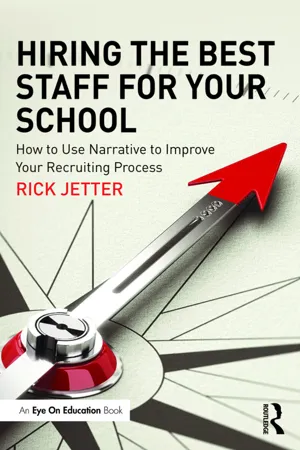
Hiring the Best Staff for Your School
How to Use Narrative to Improve Your Recruiting Process
- 156 pages
- English
- ePUB (mobile friendly)
- Available on iOS & Android
eBook - ePub
Hiring the Best Staff for Your School
How to Use Narrative to Improve Your Recruiting Process
About this book
Information
| 1 | Putting the “Best” Back Into Hiring |
To all school and school district leaders, principals and superintendents, higher education faculty, teachers and teacher aides, custodians and cafeteria monitors: something is still missing from our recruitment and hiring processes when selecting the next “best” hire to work along-side you in your school or institution.
As schools and school districts across the nation engage in recruitment and hiring practices, often a typical summer-time task for hiring educators, the entire process sometimes feels like drudgery involving sifting through a long mailing list of résumés, and documents for any number of applicants. Those involved in the complicated decision-making mechanics of hiring sometimes end up filtering some of the “humanness” out of the very human business of finding the best teacher to educate our children. We all have good intentions in what we do as educators and we hope to find a candidate who will be exceedingly instrumental in providing the very best education for our schools and organizations. We hope to find that best fit, the one who comes out on top from a field of applicants that we have to somehow manage and rank. But, how do we get there and feel confident that we used as many multiple measures as we could to carry out a successful talent search?
What if, after all your hard work, you find yourself collaborating with fellow staff members who have very different attitudes and dispositions about education than you initially thought you “purchased” through your hiring process and, ultimately, after the final job offer to a candidate? So much “human” research has been presented with the claim that “nothing is more important to the overall success of a school than selecting excellent teachers and leaders” (Danielson & McGreal, 2000; Fullan, 2001; Marzano, Pickering, & Pollock, 2001; Stronge, 2002; and Kersten, 2008). Don’t get me wrong: while I agree with this statement, usually the connotation behind finding excellent teachers or the best school staff member has to do with the quality of their knowledge, skills, and abilities.
Adding an Additional Multiple Measure for Hiring the “Best”
This book puts back some of the “humanness” that is inadvertently lost from hiring practices across the nation. What if the old adage “students deserve to have the best educators” could now be transformed into the statement “students deserve to have the best educators who also have impeccable attitudes and dispositions about students, learning, assessments, and the culture of your school?” (These four SLAC creeds will be discussed later in this book.)
But, how in the world can this be accomplished? How can you measure attitudes and dispositions? And, what does the word “attitudes” really mean? How can we locate, make sense of, or even evaluate a candidate’s attitudes and dispositions in some sort of standardized or scientific way? It sounds like quantifying something that can’t be quantified. Can we put a price tag on love? Can we put a price tag on a new teacher being hired for a hopeful and bright long-lasting career? Maybe hiring a teacher is a $2,000,000 investment over the course of a career and you certainly don’t want to spend this amount of money on someone who has poor attitudes about students, learning, achievement, or the culture of a school, along with any other educational topic or dilemma that exists in education. It is substantially important that you have some good insights about the person you desire to hire and go beyond the interview suit that was worn or the typical questions that we ask.
Can we rate the importance of someone’s entire life achievements on a scale of 1–10? This is something that is immeasurable unless you establish some criteria for evaluating life and do it in a standardized way for everyone across the board. That can be hard though, and sometimes controversial.
So, how do we get to the heart of uncovering someone’s attitudes and dispositions? Narratives can help. We can draw out and even seek to measure someone’s true underlying attitudes to match your organization’s hiring criteria through their stated and expressed beliefs, experiences, responses to, or declaration of feelings and emotions about any topic in the world by using the art and science of narrative. I will use the words “stories” and “narratives” interchangeably within this book.
Human Feelings Elicit Attitudes
We all tell stories. We love stories. We laugh at them, cry when hearing some of them, and we might even relate to or argue about something that someone is telling us through a story. We remember stories. They resonate with us. Language empowers us. Humans use metaphors to relate to one another. Stories bend us, shape us, and make us more human as we share the world with one another through our “told stories.” The story-teller gets just as much out of the story exchange as the story-receiver does. It is a dialogic process for learning and reflection which is an interactive, human process (Bakhtin, 1981).
Stories draw out what we believe, who we are, and who we want to become. Stories go beyond seeking the knowledge, skills, and abilities that we all want for hiring not only the best teachers, but for hiring the best educators and school staff.
So why don’t we invite storytelling into our own hiring practices when searching for excellent educators and school staff? It’s human. It’s reflective. And, it’s easy. It can tell you a lot about a candidate that you cannot glean from an application, résumé, other application documents, or within a brief 40-60 minute interview of your candidates. And, you cannot interview everyone who has applied for a position either. That would take days. Months. Even longer.
Remember, the process outlined in this book will not discriminate against anyone in any way, nor will it insist that using narrative theory models for interviewing candidates should be the only deciding factor for whom you ultimately hire. Rather, it will seek to separate potentially poor candidates from the potentially quality candidates who exhibit incredible attitudes and dispositions that match your organization’s goals, beliefs, and focus.
As you read this book, I’d like for you to remember two main themes as I outline a process that can work for your school or district:
1. We need to have a window into the souls of the professionals who work in educational settings. Without it, we take a gamble on attitudes that only become even more “hardened” over time. Knowledge can be explored, skills can be taught, and abilities can be practiced. Attitudes can’t be taught. Attitudes can also be hard to remediate.
2. This book describes a process that can work in your organization, small or large. If stakeholders from your organization are not involved, you will see no benefit to using, authoring, and assessing narratives or the attitudes of your candidates.
Proven Success
While there is limited research in the field for using narrative theory models within hiring processes, some work has been done in New York State and is reported in this book when describing various school districts—which are protected by pseudonyms so information does not lead to an identification of specific employees by releasing private personnel information.
In order to provide further insights into the process of using narratives and how they can be applied to a school district recruiting or hiring process, two school districts, given the pseudonyms of the Elm Grove Central School District and the Gardenville City School District, illustrate how a narrative process unfolds in two different demographic situations, in two different sized districts, and fostered in schools that have different hiring needs.
Data has been extracted from these school districts which determine a significant qualitative correlation between the success rates on narrative models and the success of a candidate in his or her new position.
Have fun reading the narratives within this book as they offer a lot of scenarios that you might be thinking about or have experienced, yourself, as a school professional.
What if candidates were to create or respond to narratives on various relevant educational topics that “measured” the quality of their attitudes and dispositions in a manner that matched the hiring criteria set by your schools? What if the hiring process of those believed to be quality candidates—in terms of traditional knowledge, skills, and abilities—could add a dose of attitudinal analysis for you and your hiring committees? That would ultimately lead to better hiring decisions, happier employees, increased student achievement, and more staff support for the school goals that you wish to implement. Narrative theory not only adds flavor to your hiring palate but also becomes a science, something that can actually be measured.
What Does the Word “Best” Really Mean?
It is semantics, I guess, but let’s break it down. My children call me the “world’s greatest dad” on Father’s Day. Isn’t “great” better than “good,” especially when we think about Jim Collins’ book, Good to great: Why some companies make the leap . . . and others don’t? So, isn’t “best” better than “better?” If I was the “world’s best dad,” would that mean more to the dad? I think it would. “World’s better dad” just doesn’t sound too good. I mean, “sound too great.”
When you think about hiring the “best” school staff, it is important for you to think about what “best” really means. It is not a fancy word used in the title of the book simply to sell more books. Instead, think about these three characteristics of “best” when you read all of the narratives within this book:
1. Your job is to find the “best” hire, not the “better” hire.
2. The word “best” will now mean that you are looking at attitudes and dispositions in addition to the knowledge, skills, and abilities of your job applicants/candidates.
3. The word “best” also means that whomever you hire will also be the “best” fit for your school or district. I don’t believe in creating robots in your school where everyone must think the same about a topic or issue, but let’s face it: sometimes we think about people as not being the “best” fit for our organizations and sometimes it’s too late to remediate someone’s attitudes about something that comes from inside them.
Let’s start the process by first identifying some of the challenges of traditional talent searches in order to understand how narrative tools, now more than ever, are so important during the recruitment, screening, and interviewing process of schools and districts. Attitudes can be uncovered very easily if you follow the simple eight-step process outlined below:
1. Assemble a talent search team.
2. Determine how you will use powerful, narrative tools.
3. Align those tools with specific attitudes that you wish to glean from your candidates.
4. Implement the four SLAC creeds (students, learning, achievement, and culture) as a guide for authoring your narrative tools.
5. Select a writer from your school, district, or team who will write the actual narratives to be used.
6. Craft your narratives and gather responses.
7. Assess your responses.
8. Determine next steps by using your new information as an additional multiple measure for deciding your BEST hire!
References
Bakhtin, M. M. (1981). The dialogic imagination: 4 Essays by M. M. Bakhtin, M. Holquist (ed.). Austin: University of Texas Press.
Collins, J. (2001). Good to great: Why some companies make the leap . . . and others don’t. New York: HarperCollins.
Danielson, C., & McGreal, T. (2000). Teacher evaluation to enhance professional practice. Alexandria, VA: Association for Supervision and Curriculum Development.
Fullan, M. (2001). Leading in a culture of change. San Francisco: Jossey-Bass.
Kersten, T. (2008). Teacher hiring practices: Illinois principals’ perspectives. The Educational Forum, 72, 355–368.
Marzano, R., Pickering, D., & Pollock, J. (2001). Classroom instruction that works. Alexandria, VA: Association for Supervision and Curriculum Development.
Stronge, J. (2002). Qualities of effective teachers. Alexandria, VA: Association for Supervision and Cu...
Table of contents
- Cover Page
- Half Title page
- Title Page
- Copyright Page
- Contents
- Preface
- Acknowledgements
- Meet the Author
- 1 Putting the “Best” Back Into Hiring
- 2 Some Challenges With Traditional Educational Talent Searches
- 3 Why Narratives?
- 4 Getting Your Resources and Team Ready
- 5 Thinking About Your Recruitment Process and Who Is Exempt
- 6 Assessing Candidates for Attitudes and Dispositions
- 7 Hiring the Best in the Elm Grove Central School District
- 8 Hiring the Best in the Gardenville City School District
- 9 PPCs and FAQs
- Finding the “Best” by the End of Your Hiring Process
Trusted by 375,005 students
Access to over 1.5 million titles for a fair monthly price.
Study more efficiently using our study tools.
Frequently asked questions
Yes, you can cancel anytime from the Subscription tab in your account settings on the Perlego website. Your subscription will stay active until the end of your current billing period. Learn how to cancel your subscription
No, books cannot be downloaded as external files, such as PDFs, for use outside of Perlego. However, you can download books within the Perlego app for offline reading on mobile or tablet. Learn how to download books offline
Perlego offers two plans: Essential and Complete
- Essential is ideal for learners and professionals who enjoy exploring a wide range of subjects. Access the Essential Library with 800,000+ trusted titles and best-sellers across business, personal growth, and the humanities. Includes unlimited reading time and Standard Read Aloud voice.
- Complete: Perfect for advanced learners and researchers needing full, unrestricted access. Unlock 1.5M+ books across hundreds of subjects, including academic and specialized titles. The Complete Plan also includes advanced features like Premium Read Aloud and Research Assistant.
We are an online textbook subscription service, where you can get access to an entire online library for less than the price of a single book per month. With over 1.5 million books across 990+ topics, we’ve got you covered! Learn about our mission
Look out for the read-aloud symbol on your next book to see if you can listen to it. The read-aloud tool reads text aloud for you, highlighting the text as it is being read. You can pause it, speed it up and slow it down. Learn more about Read Aloud
Yes! You can use the Perlego app on both iOS and Android devices to read anytime, anywhere — even offline. Perfect for commutes or when you’re on the go.
Please note we cannot support devices running on iOS 13 and Android 7 or earlier. Learn more about using the app
Please note we cannot support devices running on iOS 13 and Android 7 or earlier. Learn more about using the app
Yes, you can access Hiring the Best Staff for Your School by Rick Jetter in PDF and/or ePUB format, as well as other popular books in Education & Education General. We have over 1.5 million books available in our catalogue for you to explore.