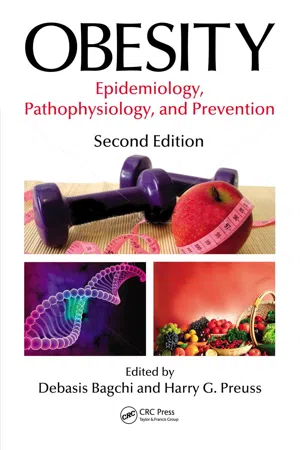
The World Health Organization (WHO) has declared obesity a global epidemic. Its prevalence has more than doubled since 1980, causing a myriad of health problems for children and adults. Obesity: Epidemiology, Pathophysiology, and Prevention, Second Edition explores the molecular mechanisms and pathophysiology leading to obesity and metabolic disord
eBook - PDF
Obesity
Epidemiology, Pathophysiology, and Prevention, Second Edition
- 993 pages
- English
- PDF
- Available on iOS & Android
eBook - PDF
Obesity
Epidemiology, Pathophysiology, and Prevention, Second Edition
About this book
Information
Table of contents
- Front Cover
- Contents
- Preface
- Editors
- Contributors
- Chapter 1 - Epidemiology of Obesity: Current Status
- Chapter 2 - Epidemiology of Type 2 Diabetes and Obesity
- Chapter 3 - Global View on the Development of Noncommunicable Diseases: Where Are We Going?
- Chapter 4 - Evidence for Refined Food Addiction
- Chapter 5 - Disruption of Development by Environmental Estrogens: Adult Obesity and Metabolic Disease
- Chapter 6 - Cigarette Smoking, Inflammation, and Obesity
- Chapter 7 - Role of Neurotransmitters in Obesity Regulation
- Chapter 8 - Neurobiology of Obesity
- Chapter 9 - Leptin as a Vasoactive Adipokine: Link between Metabolism and Vasculature
- Chapter 10 - Leptin-Induced Inflammation: A Link between Obesity and Cancer
- Chapter 11 - Overview of Ghrelin, Appetite, and Energy Balance
- Chapter 12 - Molecular Genetics of Obesity Syndrome: Role of DNA Methylation
- Chapter 13 - Sleep and Obesity
- Chapter 14 - Oxidative Stress Status in Humans with Metabolic Syndrome
- Chapter 15 - Obesity and Type 2 Diabetes
- Chapter 16 - Inflammation: A Hallmark of Obesity in Conflict with Wound Healing
- Chapter 17 - Angiogenesis-Targeted Redox-Based Therapeutics
- Chapter 18 - Obese and Overweight: New Sensitive Population for Drug and Chemical Toxicities?
- Chapter 19 - Genomic Imprinting Disorders in Obesity
- Chapter 20 - Adipose Drug Targets for Obesity Treatment
- Chapter 21 - History and Regulation of Prescription and Over-the-Counter Weight Loss Drugs
- Chapter 22 - Safety of Obesity Drugs
- Chapter 23 - Historical Perspective, Efficacy of Current Drugs, and Future Directions in the Management of Obesity
- Chapter 24 - Essential Role of Exercise and Physical Activity in Weight Management
- Chapter 25 - Role of Exercise in Diet and Weight Loss
- Chapter 26 - Role of Exercise in Weight Management and Other Health Benefits: Emphasis on Pedometer-Based Program
- Chapter 27 - Overview of Nutritional and Dietary Approaches for Weight Control
- Chapter 28 - Gender Effects on Adiposity
- Chapter 29 - Beyond Obesity Prevention: The Antiaging Effects of Caloric Restriction
- Chapter 30 - Carbohydrate Digestion Inhibitors: A Focus on Natural Products
- Chapter 31 - Vegetarian Diets in the Prevention and Treatment of Obesity
- Chapter 32 - Atkins Paradigm
- Chapter 33 - Nature vs. Nurture: Role of Plant-Based Diet in Obesity Management
- Chapter 34 - Glycemic Index: Issues and Concepts
- Chapter 35 - Chromium (III) in Promoting Weight Loss and Lean Body Mass
- Chapter 36 - Overview on (−)-Hydroxycitric Acid in Weight Management
- Chapter 37 - Review of the Safety and Efficacy of Bitter Orange (Citrus aurantium) and Its Primary Protoalkaloid, p-Synephrine, in Weight Management
- Chapter 38 - Antiobesity Effects of Conjugated Linoleic Acid: Fact or Fiction?
- Chapter 39 - Role of Tea in Weight Management
- Chapter 40 - Laboratory and Clinical Studies of Chitosan
- Chapter 41 - Role of Curcumin, the Golden Spice, in Obesity and Associated Chronic Diseases
- Chapter 42 - Role of Caralluma fimbriata in Weight Management
- Chapter 43 - Glucomannan in Weight Loss: A Review of the Evidence
- Chapter 44 - Role of Medium-Chain Triglycerides in Weight Management
- Chapter 45 - Antiobesity by Marine Lipids
- Chapter 46 - Dairy Foods, Calcium, and Weight Management
- Chapter 47 - Lessons from the Use of Ephedra Products as a Dietary Supplement
- Chapter 48 - Coleus forskohlii Extract in the Management of Obesity
- Chapter 49 - Curcumin: Potential Role in Obesity and Obesity-Related Metabolic Diseases
- Chapter 50 - Review of the Safety and Efficacy of Banaba (Lagerstroemia speciosa L.) and Its Major Constituents, Corosolic Acid and Ellagitannins, in the Management of Metabolic Syndrome
- Chapter 51 - Appetite, Body Weight, Health Implications of a Low-Glycemic-Load Diet
- Chapter 52 - Herbals and Dietary Nutrients Associated with Weight Loss
- Chapter 53 - Calcium and Obesity: A Microcosm of the Nutrient Problem
- Chapter 54 - Dietary Supplementation in Weight Loss: A Dietitian’s Perspective
- Chapter 55 - Beyond Glycemic Index and Glycemic Load: Horizons for Long-Term Weight Management
- Chapter 56 - Challenges to the Conduct and Interpretation of Weight Loss Research: Reflections on 35 Years of Weight Loss Research
- Chapter 57 - Obesity and Disordered Eating in Youth
- Chapter 58 - Childhood Obesity: Exercise Physiologists’ Viewpoints
- Chapter 59 - Impact of Childhood Obesity on Musculoskeletal Growth, Development, and Disease
- Chapter 60 - New Directions in Childhood Obesity
- Chapter 61 - Thinking Outside the Box: The TEEEN Program, a Primary Care Approach to Address the Public Health Concern of Pediatric Obesity
- Chapter 62 - Bariatric Surgery and Reversal of Metabolic Disorders
- Chapter 63 - Bariatric Surgery in Pediatric Weight Management
- Back Cover
Trusted by 375,005 students
Access to over 1.5 million titles for a fair monthly price.
Study more efficiently using our study tools.
Frequently asked questions
Yes, you can cancel anytime from the Subscription tab in your account settings on the Perlego website. Your subscription will stay active until the end of your current billing period. Learn how to cancel your subscription
No, books cannot be downloaded as external files, such as PDFs, for use outside of Perlego. However, you can download books within the Perlego app for offline reading on mobile or tablet. Learn how to download books offline
Perlego offers two plans: Essential and Complete
- Essential is ideal for learners and professionals who enjoy exploring a wide range of subjects. Access the Essential Library with 800,000+ trusted titles and best-sellers across business, personal growth, and the humanities. Includes unlimited reading time and Standard Read Aloud voice.
- Complete: Perfect for advanced learners and researchers needing full, unrestricted access. Unlock 1.5M+ books across hundreds of subjects, including academic and specialized titles. The Complete Plan also includes advanced features like Premium Read Aloud and Research Assistant.
We are an online textbook subscription service, where you can get access to an entire online library for less than the price of a single book per month. With over 1.5 million books across 990+ topics, we’ve got you covered! Learn about our mission
Look out for the read-aloud symbol on your next book to see if you can listen to it. The read-aloud tool reads text aloud for you, highlighting the text as it is being read. You can pause it, speed it up and slow it down. Learn more about Read Aloud
Yes! You can use the Perlego app on both iOS and Android devices to read anytime, anywhere — even offline. Perfect for commutes or when you’re on the go.
Please note we cannot support devices running on iOS 13 and Android 7 or earlier. Learn more about using the app
Please note we cannot support devices running on iOS 13 and Android 7 or earlier. Learn more about using the app
Yes, you can access Obesity by Debasis Bagchi, Harry G. Preuss, Debasis Bagchi,Harry G. Preuss in PDF and/or ePUB format, as well as other popular books in Medicine & Nutrition, Dietics & Bariatrics. We have over 1.5 million books available in our catalogue for you to explore.