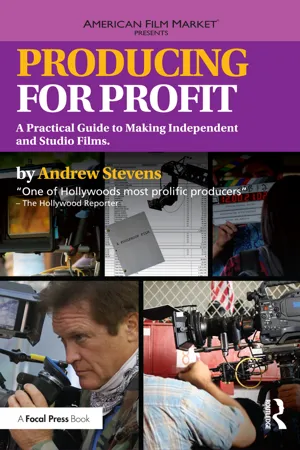
In Producing for Profit: A Practical Guide to Making Independent and Studio Films, Andrew Stevens provides real-world examples and his own proven techniques for success that can turn passion into profit. Far more than just theory, the book outlines practical applications that filmmakers of all levels can use to succeed in today's ever-changing marketplace. Readers will learn how to develop screenplays that are commercial, and how to negotiate, finance, cast, produce, sell, distribute, and market a film that will make a profit. The book contains numerous examples from the author's own films, including sample budgets, schedules, and a variety of industry-standard contracts. This is the definitive book that every producer must have!
eBook - ePub
Producing for Profit
A Practical Guide to Making Independent and Studio Films
- 348 pages
- English
- ePUB (mobile friendly)
- Available on iOS & Android
eBook - ePub
About this book
Information
Chapter 1
What Is a Producer?
If you ask twenty different people in the entertainment industry, you might get twenty different answers. In feature films, the producer, in the mainstream, traditional sense, is a creative and business-minded general who interfaces with agents, attorneys, managers, financiers, and distributors on the administrative side, and then with writers, directors, actors, and technical crew on the creative and physical production side.
Essential Responsibilities
Below is a list of everything a producer should do, though only a handful possesses the knowledge and applicable skill sets.
Unless an employee for hire, the producer is commonly involved in procuring the financing and distribution of the motion picture. Generally, he or she hires the director and the writer, oversees the casting and reports to the studio or distributor. The producer is the “last man standing” when wrap is called at the end of production and all other itinerant employees go on to their next job. The director then works with an editor and edits his or her director’s cut, but unless that director is a very prominent, established, star director, he or she will not be granted final cut. The producer then performs the final cut in accordance with the expectations of the distributors, buyers, or financiers, usually in accordance with their notes and requested changes. Sometimes the producer and director present a unified front and collaborate through the final cut, and sometimes the director may have an agenda that is in conflict with the producer’s delivery obligations, in which case the producer steps in to recut the film accordingly.
A true producer should be a good communicator, charismatic leader, and confident decision-maker on all fronts. A producer should understand story and structure and be able to give astute and insightful creative notes on a story, treatment, or screenplay. A producer must also suggest or dictate and implement script changes and revisions, in order to solve not only creative issues but the limitations of the budget and physical production of the picture as well. A producer should understand camera, shots, angles, coverage, special effects, actors’ performances, and all facets of post-production and music. A producer should be well versed in the vernacular of the director, so that he or she can effectively communicate with the director and his or her crew. In cases where the producer must make an overriding decision, he or she must understand what shots or scenes are absolutely necessary to complete or tell the story cinematically, and what shots and/or scenes might be eliminated in order to meet the exigencies of production and the constraints of time, budget, and schedule. In post-production, a producer must understand and speak the technical language of labs, editors, digital and emerging media, music, special visual effects, and sound processes.
Look at it this way: each film has a finite box (i.e., the budget and schedule) within which it must operate in order to be successfully completed and profitable. A producer must be able to multi-task and make immediate, spontaneous decisions when necessary and stick to them, based on his or her global knowledge of what will ultimately best serve the film, while at the same time staying within the box he or she has created or been given. A producer must be versatile and innovative when dealing with crises as they arise. A producer must possess tremendous financial knowledge in terms of budgeting and finance, negotiating skills (to save money), and the malleability to borrow from one category in order to have additional money to spend in another, without compromising the ultimate quality of the picture. An independent producer should have knowledge of non-union crews and talent, as well as all applicable union and guild contracts and collective bargaining agreements and levels or tiers for each. (In Chapter 10, I will go into more detail on lower-budget union tiers, which allow union pictures to be produced more cost-effectively.)
A good producer should have a strong editorial sense and knowledge. Unless a director has final cut, the producer follows the director into the editing room to execute the producer’s cut, or the cut desired by the production company, distributor, or studio. The producer should be skilled and able to communicate concisely, using the language and terminology of film editing, and have a working knowledge of how to cut a motion picture dynamically. A producer should understand creative editorial techniques, such as transposing the order of scenes, using flashbacks or flash-forwards, intercutting, creating moments by double-cuts, changing frame rate, and myriad other effective editorial devices. A producer should have a strong knowledge of music, as well as special effects. A musical score is critical to almost every film. Music underscores, supports, and enhances emotion and adds subliminal depth to an audience’s perceptions, as well as to actors’ performances. Often the internal pace or sustained tension of a picture is created, dictated, or greatly enhanced by music. Judiciously knowing when a scene might play better or more effectively “dry”—without music—is valuable as well.
Special effects and new media and technology have evolved quickly over the last ten years and are continuing to evolve. A producer should stay abreast of current technologies and computer-generated imagery (CGI) techniques, as well as all new and emerging technologies and forms of new media. On the technical side, a producer should also be knowledgeable in all technical elements of filmmaking, and the constantly emerging digital formats and new resolutions from 4K and future successor formats. A producer should also be knowledgeable about all current and new, emerging sound formats as well as new and emerging post-production and digital delivery formats. (The foregoing knowledge is essential for every picture that is produced.)
A producer should have good relationships with at least one insurance company that provides production, negative, and errors and omissions (E&O) insurance for films, and must stay aware of the best prevailing rates. A producer should have at least a cursory legal knowledge and must be able to read and understand contracts, as well as nuances to which a producer, production company, distributor, or studio might ultimately be legally bound. A good producer must be able to hold firm in such knowledge when negotiating with agents, managers, or attorneys who may represent talent, as well as during negotiations with crew, vendors, and unions.
Explaining the Producer’s Role to Laymen
How does one explain job descriptions in moviemaking to people not in the film business? I have often likened making a film to building a house. The architectural plans are the screenplay. The builder is the producer. The foreman overseeing the job and instructing the subcontractors is the director (admittedly not the best analogy for a director, but one that a non-entertainment person understands). The budget for building a home is very similar to a motion picture budget. Both contain bids, estimates, and prices from vendors, crews, and subcontractors on material, equipment, and other components, which all appear as line items in a budget. Both builders and producers move money around within their respective budgets—that is, costs that might be less than originally estimated in certain categories might be used to cover costs that may be higher than originally estimated in others. Ideally, global costs will balance out in the end, and the film (or house) will be finished on budget, on time, and on schedule.
For the producer and home builder, there are always occurrences beyond their control that affect time, schedule, and budget. This is why all industry-standard film budgets and most home construction budgets include a contingency, which in the case of film is usually 10 percent. Both film projects and real estate projects should have insurance policies for protection in the event of accident or disaster; and in the case of a motion picture, there is often reinsurance, in the form of a completion bond, which guarantees completion of the film if the producer or director should fail. Building a film, like building a house, requires a strong, definitive leader with a vision and the ability to get it done on time and on budget. A good producer must be adept at maintaining the vision and aesthetics of the director and screenwriter, just as a good builder adheres to the aesthetics and materials required to carry out an architect’s plans and vision.
My goals are to demystify the movie business and how it really works; to teach the reader how to do cursory due diligence or market research; and to offer guidance on how to tap into the marketplace in order to get your film made and distributed and make a profit.
Inexperience and the Three Rs
Just as there are countless men and women of all ages running around Hollywood and New York (and anywhere else that has an entertainment hub) claiming to be writers, directors, actors, and actresses, there are proportionate numbers of those who run around claiming to be producers. A person might try their entire life to get a script made into a movie and never succeed. As with any business opportunity, often one must adhere to what I call the “three Rs”: being at the Right place at the Right time, and being Ready. If you happen to be at the right place at the right time but you are not ready to assume all the responsibilities required of a producer, and you do not possess the underlying knowledge to do so, an opportunity may be squandered and never come again.
I once read a quote from someone who advised people who aspire to be in the movie business to tell others, “I am a producer.” Further, if asked what they have produced, they were advised to say, “I have many projects in development at this time.” An inexperienced and naive aspiring producer may be associated with or attached to any number of scripts but possess no knowledge or expertise of how to get a movie made, what constitutes a commercial and saleable film in the foreign and domestic marketplaces, and generally is unaware of current market values. These people have likely never produced a film yet put together voluminous lists of attachments, such as directors, line producers, co-producers, directors of photography, art directors, composers, and others, which I usually consider to be encumbrances, not value added. I don’t want any attachments. Why? Because I want to hire my own people with whom I have relationships and whom I trust. With only rare exception, in the independent film world, I personally don’t trust anyone’s taste or experience other than my own. Most often, inexperienced people’s salary expectations are also out of line and unrealistic. Anyone who comes to me with a “packaged” picture, with predetermined department heads (other than possibly a director), is an immediate turnoff. I generally won’t even look at the material. If a director is attached, I make sure that his or her expectations and capabilities are realistic and sound, and that we share the same vision. Otherwise, I want my own production people, whom I trust.
Budgets created by inexperienced “producers” are almost uniformly unrealistic. Those with no experience or expertise have no clue as to what can actually be done and for what price. They have usually paid someone equally uninformed to create a budget for them based on very little, if any, realistic knowledge, and they almost always err vastly, on either the high or the low side. Also, in many cases, essential line items have been omitted and essential elements necessary to complete delivery of a film are nowhere to be found. I trust only my budgets, my expertise, and my knowledge of vendor deals, rates, and prices, based on my experience and knowledge. My advice is never trust someone else’s “budget.” Create your own.
The same can be said for schedules, which are almost always pie-in-the-sky, with an unrealistic number of shooting days (usually far too many). There is an art to creating a schedule, based on consolidating and possibly “cheating” certain locations in order to group blocks of scenes together and reduce company moves, as well as shortening actors’ and stunt players’ schedules and manipulating their days worked wherever possible, in what is called a day out of days, into a more cost-effective shooting plan.
Most people with a “great script” who claim to be producers have probably been turned down by almost everyone, and there is generally a good reason for it. (Note, however, that there are exceptions to every rule. So, no matter what anyone’s past experience dictates, and no matter what holds true 99 percent of the time, something that goes against all conventional knowledge, wisdom, and experience may occur.)
Employees
A generally misunderstood fact is that the majority of producers are employees. Almost all studio pictures (with the exception of negative pickups, meaning payment on delivery of a completed picture by a distributor or production company for a specific sum of money in return for specific rights) are produced by employees of the studios or their various affiliated or subsidiary entities that are formed for the purpose of the production of their movies. This is true for the majority of the network producers as well. Likewise, the Producers Guild of America (PGA) comprises, almost entirely, “employee producers” who rely on studios, networks, and production companies to pay them salaries and make pension, health, and welfare contributions to the PGA, which affords them a medical plan as well as disability and retirement benefits. These producers are dependent upon “pitching” (orally presenting) their projects, scripts, or story ideas to studio or network executives or financiers, in the hope that the studio or network will pay for the development of a screenplay and, if they’re lucky, the subsequent production of the film or television show, thereby by creating employment for the producer. Often, producers are also simply hired by the majors and networks for green-lit projects (those that have already received approval of production finance, thereby allowing them to move forward from the development phase to pre-production and ultimately into production). However, studio or television employee producers are at the mercy and whim of corporate executives, and vulnerable to the frequent regime changes at most networks and studios. New executives often toss out projects developed by their predecessors.
Although less prevalent today than in days past, certain high-level studio producers have overall deals that pay for their overheads, recoupable against producer fees when pictures are actually made. There is nothing wrong with being an employee producer, but you must understand that your fate rests in the hands of other people, and their decisions directly affect your livelihood. It is important to note that, unlike independent entrepreneur producers, employee producers rarely, if ever, risk their own money or their own personal livelihood on the production of a film, and they are almost entirely reliant on the creative and financial decision-making of the major studios, production companies, networks, or risk-taking independent companies that hire them.
In the past decade or so, as the entertainment business has consolidated, many former high-level studio producers who formerly had overhead deals that have expired, are now freelance independent producers. This has been a rude awakening for many big-name producers who once relied on studio dollars to fund their overheads, including cushy offices and staffs.
I have done many negative pickup deals with studios, and their business-affairs executives and attorneys have often used my expertise to produce films far more cost-effectively than they ever could have under a studio’s auspices. An independent producer can find ways to produce a film non-union, whereas a studio cannot, as all studios are signatories to the major unions’ collective bargaining agreements. From 2005 to 2009, I produced fifteen films independently and sold them as negative pickups to Sony Home Entertainment. Sometimes negative pickups are structured prior to, or even during, production, and sometimes they occur after a studio or distributor has viewed the finished film.
The Independent Entrepreneur Producers
A true independent producer is, by my definition, an entrepreneur who is not reliant on a studio and/or network for the financing of a picture. Independent producers are innovative go-getters who explore every possible avenue for the development and financing of independent motion pictures. Those avenues include both foreign and domestic sales and pre-sales, subsidies and/or tax rebates, private equity, limited partnerships, co-productions, venture capital, deferments, and usually a combination of the above. Occasionally, as I have often done, an independent producer will take a personal financial risk and invest personal funds in the financing or co-financing of a film. The independent entrepreneur producer must have knowledge of the current foreign and domestic marketplace, as well as available subsidies and how to secure them. The independent entrepreneur producer is a tenacious street fighter who continually bucks the system and exists in spite of the odds. Independent entrepreneur producers are most often the employer, not the employee, as well as the final decision-maker, and quite often (sometimes with partners) the owner of the completed film, the copyright, and the distribution rights. Decide who you are and which you are content with being. The independent entrepreneur producer is the victor over, not the victim of, the whims and decisions of others. They retain control over their own fate, and create their own destiny, fortune, and livelihood.
Producer Credits: What Do They Mean in Film?
Producer
I have given a fairly extensive overview of what I believe are the definition, scope, and duties of the producer as well as the knowledge that I believe is essential for a producer to be viable and successful. As evidenced by the proliferation of producer credits over the past two decades, the entertainment industry has gone “producer credit crazy”—on some projects, I have seen as many as twenty credited “producers” of various types. Both the PGA and the Academy of Motion Picture Arts and Sciences have, in recent years, tried to limit excessive numbers of credited “producers.” While I agree with limiting the number of gratuitous credits in order to protect the integrity of my profe...
Table of contents
- Cover
- Title
- Copyright
- Contents
- Foreword
- Prologue
- 1 What Is a Producer?
- 2 Changes to the Independent Marketplace
- 3 The Global Marketplace
- 4 How to TAP into the Marketplace
- 5 The Domestic Market, Festivals, and Market Value
- 6 Identifying and Developing a Film Based on Trend and Analysis
- 7 Now That I Have My Script, What Do I Do?
- 8 Investors, Actors, Attorneys, Agents, Managers, Business Managers
- 9 Film Production Basics
- 10 How to Manage Production Costs
- 11 Mounting a Production
- 12 Navigating the Actors’ Union
- 13 Respect for the Dollar
- 14 The Internet and New Media
- 15 Marketing and Publicity
- 16 Recap
- Appendix A: Major Entertainment Conglomerates and their Holdings as of 2013
- Appendix B: IFTA Model Sales Agency Agreement Completed Picture: Basic Form
- Appendix C: IFTA Model Sales Agency Agreement Completed Picture: With Advance
- Appendix D: Sales Projections and Participation Statement
- Appendix E: Sample Collection Agreement
- Appendix F: Sample Writer Option Purchase Agreement
- Appendix G: Sample Writer Work for Hire Agreement
- Appendix H: Sample Writer Step Deal Agreement
- Appendix I: Sample Post-production Schedule
- Appendix J: Sample Delivery Schedule
- Appendix K: Full Non-union Budget
- Appendix L: Non-union Top Sheet
- Appendix M: Union Comparison Top Sheet
- Appendix N: Standard Terms
- Appendix O: SAG Studio Zone Map
- Appendix P: Sample Shooting Schedule
- Appendix Q: Sample Call Sheet
- Appendix R: Sample Production Report
- Appendix S: Sample Composer Agreement
Trusted by 375,005 students
Access to over 1.5 million titles for a fair monthly price.
Study more efficiently using our study tools.
Frequently asked questions
Yes, you can cancel anytime from the Subscription tab in your account settings on the Perlego website. Your subscription will stay active until the end of your current billing period. Learn how to cancel your subscription
No, books cannot be downloaded as external files, such as PDFs, for use outside of Perlego. However, you can download books within the Perlego app for offline reading on mobile or tablet. Learn how to download books offline
Perlego offers two plans: Essential and Complete
- Essential is ideal for learners and professionals who enjoy exploring a wide range of subjects. Access the Essential Library with 800,000+ trusted titles and best-sellers across business, personal growth, and the humanities. Includes unlimited reading time and Standard Read Aloud voice.
- Complete: Perfect for advanced learners and researchers needing full, unrestricted access. Unlock 1.5M+ books across hundreds of subjects, including academic and specialized titles. The Complete Plan also includes advanced features like Premium Read Aloud and Research Assistant.
We are an online textbook subscription service, where you can get access to an entire online library for less than the price of a single book per month. With over 1.5 million books across 990+ topics, we’ve got you covered! Learn about our mission
Look out for the read-aloud symbol on your next book to see if you can listen to it. The read-aloud tool reads text aloud for you, highlighting the text as it is being read. You can pause it, speed it up and slow it down. Learn more about Read Aloud
Yes! You can use the Perlego app on both iOS and Android devices to read anytime, anywhere — even offline. Perfect for commutes or when you’re on the go.
Please note we cannot support devices running on iOS 13 and Android 7 or earlier. Learn more about using the app
Please note we cannot support devices running on iOS 13 and Android 7 or earlier. Learn more about using the app
Yes, you can access Producing for Profit by Andrew Stevens in PDF and/or ePUB format, as well as other popular books in Media & Performing Arts & Film & Video. We have over 1.5 million books available in our catalogue for you to explore.