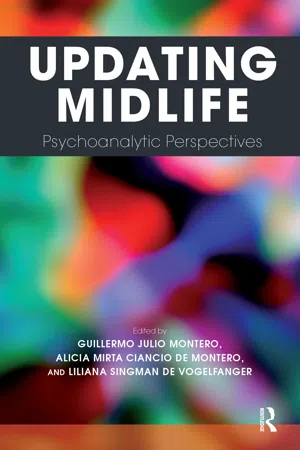
"Midlife" is a concept used everywhere and from many different vertexes, though mostly imprecisely, even within the psychoanalytic paradigm. This book tries to settle its proper meaning through the challenge of laying the foundations for the development of a true psychoanalytic metapsychology for "midlife", something that the editors believe in psychoanalysis was lacking. From this viewpoint, they invited fourteen renowned psychoanalysts to share their ideas about the issue. The outcome of that work is Updating Midlife: Psychoanalytic Perspectives, which, in addition to the various contributions, includes an introductory paper by the editors. This book is a true step forward in the development of a specific metapsychology for "midlife".
eBook - ePub
Updating Midlife
Psychoanalytic Perspectives
- 208 pages
- English
- ePUB (mobile friendly)
- Available on iOS & Android
eBook - ePub
Updating Midlife
Psychoanalytic Perspectives
About this book
Information
CHAPTER ONE
Midlife and finitude
Thinking about midlife by interviewing professionals from different backgrounds and perspectives is a new challenge brought by Guillermo Julio Montero. After reading through the original interview again, I decided to include several ideas I had previously left aside. The following text is a combination of our spontaneous conversation and a creation of some theoretical framework.
Freud (1912f) stated that he had made a great discovery, though he also mentioned that there was a lot more to find out, and that it was in the hands of future generations to do so. The journey of life, ageing, and the end of life are part of these new explorations. These subtle topics are examined by contemporary psychoanalysis through interweaving technique and analytical practice.
Midlife is a complex concept. One perspective links it with the stages in life. It splits life in two halves by a hypothetical line. In this way, it is possible to assign an age and a number to it. Thirty? Forty? Fifty? Hence, midlife would depend on chronological time. Fulfillment and transience of life become conscious during midlife. The real comprises both the awareness of the experience of being alive and its transient condition.
Dividing existence into two chronological halves is an illusion based on a deceitful life average. For example, Erikson (1997) describes a vital cycle of nine stages; however, not every human being goes through them in order, as there are diverse psychopathologies and defensive mechanisms which may generate alternative paths, including halting some stages or developing tailored ones. Life cycle is not an even process: longevity and short life alternate without clear rules.
Chronological time interacts with the unconscious processes. The unconscious is timeless. The conceptualisation of an “out of time midlife” shows several metapsychological components which will, without doubt, be the object of future studies.
Midlife may manifest itself in different ways. Everybody has a midlife experience at some point in life. Any event may work as a trigger, may awake the quiet consciousness and shock the psychic apparatus. Furthermore, there are some reactive ways of going through midlife featured by different pathological mechanisms, such as the obsessive, hysterical, and phobic ones.
I wonder why psychoanalysis has not investigated transience in depth and why it assumed death’s representation to be repressed. As Freud (1923b) insisted on the idea of the non-existence of such representation, he cut off any further investigations on the subject. It is my idea that we mix up experience with representation. Our own death has no direct representation, for the simple fact of not having been experienced. On the other hand, there are many indirect representations of death which Freud (1913f) referred to when he wrote: “dumbness must be interpreted as a sign of being dead” (p. 295), or later, when talking about the content of popular tales: “dumbness is to be understood as representing death” (p. 296). According to Freud, paleness, muteness, silence, cut flowers, are death’s representations. In earlier works, I have exposed (Alizade, 1995) that “there are no representations of death itself but there are representations about death” (p. 47).
Genitality, a goal that any patient might achieve, was based on an intense sexual life, emotional and material success. Nothing was mentioned about the path from life to death. Could it be that, dealing with this topic, psychoanalysis would be pushed too close to being existential or spiritual?
Consciousness is a main concept. It was part of one of Freud’s metapsychologycal works that he destroyed or, as a colleague told me, it remained “sleeping” in the archives due to its polemical potential. What would Freud want to tell us about conscience? Have we thoroughly invested in the unconscious but forgotten conscience’s fundamental role? Its work is not just to make conscious the unconscious. Its role is bigger and it is not completely known yet.
Not every human being can carry out the effort of transforming their conscience. Furthermore, experiences of greater reality in different degrees may happen at any time; it does not depend on age.
New theoretical and clinical links with respect to midlife and finitude’s anxieties must be added to Freud’s psychoanalytical frame of work: the development of goodness, transformation of narcissism, positivity in psychoanalysis (Alizade, 2010), relativity, renewal, and joy are some of them.
Becoming conscious in midlife may produce either healthy or pathological transformations. Amongst the healthy ones we find: narcissism transformation, detachment, the work of consciousness, an increase of intelligence and maturational processes, the working through of impermanence, and a wider view of the world (greater reality principle). The pathological ones encompass: horror of old age, fear of death, pathological attachment, and fear of abandonment.
Midlife pathologies bring out defensive mechanisms such as denial or hypomania to the rejection of unbearable representations of transience. These mechanisms lead to power pathologies, cruelty to others, excessive attachment to material goods, abusive aesthetic practices, risky counterphobic enactments (the practicing of dangerous sports), and to the use of toxic substances as palliative measures (drugs and alcohol).
In my clinical work with patients “about to die” (Alizade, 1995) I have seen mature men behaving like frightened children or denying their diseases, as well as young people being aware of the approach of death. Accidents, catastrophes, migrations, menopause, diseases, provide an opportunity to think about our human condition. Ageing is an opportunity to work through our life, though not everybody takes advantage of it. These facts of life face us with reality and shake the mind. The psyche finds itself between the opposites of mortality and immortality hardly trying to grasp the experience. Healthy minds find it easier to accept and understand the wonderful fact of being a living individual.
Is there any specific feature for midlife as there is for adolescence? From my experience, maturational processes and acknowledgement of reality do not depend on physical time. Transformation of narcissism, mourning, and renewal processes do not have a specific age. Chronological midlife and the starting of the growing old activity may or may not help with these processes. Montero (2005) adds that Jaques (1965), from a Kleinian perspective, states that schizoid-paranoid processes come to surface during adolescence, and depressive stages take place in midlife. However, I have observed that there are wise youngsters and ignorant elders.
There is a very important work about transience (1916a [1915]), where Freud talks about mourning and renewal. He explains that when everything is lost, after a war or a catastrophe, for example, it ensues joy in renewal after mourning. And he adds: “in so far as we are still young and active.” (p. 307). What type of youth is Freud referring to? The idea of renewal is implicit in the text; life cycle reproduces itself once again.
The experience of transience eases the working-through process about the relativity of all things, something that helps mourning with less libido viscosity to the object. Pathologically, too much attachment produces intense mourning processes, something that blocks creativity.
The nostalgia for old times is often described as a lower melancholy built by a series of losses coming from everyday existence. To accept that life is a transient journey, a sort of wheel where different generations pass along through the years, demands the working-through process of detachment, to one’s own self, to material objects, to money, to loved individuals and earthly spaces. If there is an excessive attachment, the self-preservation drive joins life drive which rejects and denies death through diverse defensive mechanisms. Following these considerations it is important to differentiate death drive from destruction drive. The first one, natural and universal, accompanies the individual all along his life. However, the second one breaks interpersonal and intrapersonal trophic links and joins instinct to master evil pathologies.
Mental growth in an intelligent way requires not forgetting the transient dimension. A constant and sustained work of detachment makes life stages lighter. Defensive mechanisms and mental habits insist on its reinstallation. They foster deceptive thoughts, imaginary ideals, and useless suffering. The protective attachment to the object comes up and must be overcome once again in a constant swing of attachment and detachment.
Psychoanalysis should pay more attention to the negative effects of focusing too much on the patient’s negativity, ignoring preserved healthy areas. I have proposed the concept of positivity in psychoanalysis, as I have already stated in this paper, which alerts to possible clinical iatrogenic consequences due to the insistence on trauma, suffering, and deficiencies. The trauma about our own future death that Montero (2005) poses, springing from archaic fears, reduces its traumatic strength when life is put into perspective, and relativity and pleasure for living prevail over concerns about no future life.
Working-through with the idea of death is a gradual work that requires reviewing some intense convictions some primitive ones about death as a misfortune and a punishment. Some religions increase this fear of death by threat and guilt, hence intensifying its traumatic side. Everyone can achieve some preparation and acceptance, even partial, of his own death.
The psychological work on the idea of mortality is rich in clinical consequences. As humans and non-eternal subjects we need to acknowledge our mortal condition and, at the same time, we need to preserve a part of ourselves from death through the alternation between ideal ego and ego ideal requirements. P. Aulagnier (1979) accurately distinguishes the ego’s right to claim for a small portion of immortality as well as for the truth of mortality.
As long as consciousness can control the unconscious narcissistic system that claims for ego’s immortality (Freud 1914c), dying will not be a tragedy. This faculty requires transformation of narcissism towards a type of narcissism that I posed as tertiary narcissism. It could also be named “beyond narcissism”. This sort of narcissism overcomes the interaction between ego libido and object libido. The narcissistic circle gradually opens up and the individual puts narcissism out of himself. His libidinal interest expands and narcissism turns towards exogamy, towards others, people who will never be met though they become a source of interest (far-off objects). There could also appear feelings and actions of solidarity through generational transference. Due to dispossession of the self, the ego becomes aware of a new dimension and its belonging to humanity’s common destiny. Kohut (1971) worked on this topic and he was one of the sources for my work. While explaining his idea of narcissistic transformation he pointed out an emerging acceptance of finitude, humour, and wisdom as a result of this psychic movement. He also mentioned that it was a difficult process and that “the achievement of wisdom is a feat that we must not expect from our patients, nor, indeed, necessarily from ourselves. Since its full attainment includes the emotional acceptance of the transience of individual existence, we must admit that it can probably be reached by only a few and that its stable integration may well be beyond the compass of man’s psychological capacity” (p. 327).
I am convinced that, though difficult, the psychoanalyst should approach midlife process to patients with art and patience by overcoming symptoms and conflicts. Ideally, the analyst would help the patient to obtain some sort of wisdom.
Although the transformation of narcissism is more frequent in late youth or maturity, it does not exclude young people. I recall a thirty-year-old patient who died of AIDS. The disease triggered his mature development in an astonishing way. The patient kept calm before death, took decisions about his will, increased his narcissistic transformation, and, finally, went through a beautiful death characterised by a beneficial union between death and life drive.
There are different ways of dying. Ariès (1975) classified death by periods and highlighted the importance of social customs for the internalisation of a group’s superego. For example, the accepted death of the medieval knight, which was a solemn transcendent act where kids and adults participated in a sort of farewell, was completely different from the contemporary western death, a “forbidden” death as Ariès said, where not even the name can be mentioned.
The taboo of death may have contributed to psychoanalysis not considering death as a whole clinical value. The observation of unweaned children is part of the curriculum for future therapists but the observation of people about to die is not.
Psychic work triggered by midlife brings man near to what is unthinkable and impossible to represent. The psychic surprise produced by the certainty of one day not being on this earth anymore provokes the emergence of signifiers of transformation (Anzieu, 1987), such as turning a glove inside out or a support that gives in. It is possible to experience dizziness and transitory feelings of confusion. Building up this knowledge in a constant and experiential way is part of the understanding of the human condition.
It may sound like a paradox but analysing finitude’s anxieties bring peace and joy to the mind. Someone who can process transience goes through moving, enlightening moments. This lucidity impacts on the psychic system and reorganises relations between ego, superego, and id. Projects are put into perspective and certainty of death reduces narcissistic demands and expectations which most of the time keep up unconscious fantasies of immortality. Narcissistic tensions of recognition and fame which hold the anxiety of being mortal give way, relieving the mind and achieving a greater everyday pleasure.
Fear of the unknown is different from the actual experience of dying. Dr. Gauvain-Picard, of the Gustave Roussy Institute of Oncology in Paris, used to say to frightened patients that death was one thing, another was the real moment of dying. In this way, she pointed out the operative distance between the actual fact and imaginary representations.
The...
Table of contents
- Cover
- Half Title
- Title Page
- Copyright Page
- Table of Contents
- Acknowledgements
- About the Editors and Contributors
- Foreword
- Introduction
- Chapter One Midlife and finitude
- Chapter Two Interview with Christopher Bollas (England)
- Chapter Three Interview with Stefano Bolognini (Italy)
- Chapter Four Interview with Calvin Anthony Colarusso (USA)
- Chapter Five Interview with Franco de Masi (Italy)
- Chapter Six Interview with Cláudio Laks Eizirik (Brazil)
- Chapter Seven The inevitable ordinary human suffering
- Chapter Eight Interview with Glen O. Gabbard (USA)
- Chapter Nine Interview with Charles M. T. Hanly (Canada)
- Chapter Ten Interview with Luis Kancyper (Argentina)
- Chapter Eleven Interview with Norberto Carlos Marucco (Argentina)
- Chapter Twelve Elements for a metapsychology about midlife
- Chapter Thirteen Interview with Leo Rangell (USA)
- Chapter Fourteen Answers to the questionnaire
- Index
Trusted by 375,005 students
Access to over 1.5 million titles for a fair monthly price.
Study more efficiently using our study tools.
Frequently asked questions
Yes, you can cancel anytime from the Subscription tab in your account settings on the Perlego website. Your subscription will stay active until the end of your current billing period. Learn how to cancel your subscription
No, books cannot be downloaded as external files, such as PDFs, for use outside of Perlego. However, you can download books within the Perlego app for offline reading on mobile or tablet. Learn how to download books offline
Perlego offers two plans: Essential and Complete
- Essential is ideal for learners and professionals who enjoy exploring a wide range of subjects. Access the Essential Library with 800,000+ trusted titles and best-sellers across business, personal growth, and the humanities. Includes unlimited reading time and Standard Read Aloud voice.
- Complete: Perfect for advanced learners and researchers needing full, unrestricted access. Unlock 1.5M+ books across hundreds of subjects, including academic and specialized titles. The Complete Plan also includes advanced features like Premium Read Aloud and Research Assistant.
We are an online textbook subscription service, where you can get access to an entire online library for less than the price of a single book per month. With over 1.5 million books across 990+ topics, we’ve got you covered! Learn about our mission
Look out for the read-aloud symbol on your next book to see if you can listen to it. The read-aloud tool reads text aloud for you, highlighting the text as it is being read. You can pause it, speed it up and slow it down. Learn more about Read Aloud
Yes! You can use the Perlego app on both iOS and Android devices to read anytime, anywhere — even offline. Perfect for commutes or when you’re on the go.
Please note we cannot support devices running on iOS 13 and Android 7 or earlier. Learn more about using the app
Please note we cannot support devices running on iOS 13 and Android 7 or earlier. Learn more about using the app
Yes, you can access Updating Midlife by Guillermo Julio Montero, Alicia Mirta Ciancio de Montero, Liliana Singman de Vogelfanger, Guillermo Julio Montero,Alicia Mirta Ciancio de Montero,Liliana Singman de Vogelfanger in PDF and/or ePUB format, as well as other popular books in Psychology & Developmental Psychology. We have over 1.5 million books available in our catalogue for you to explore.