- 179 pages
- English
- ePUB (mobile friendly)
- Available on iOS & Android
eBook - ePub
About this book
To Freud, female sexuality remained something of a mystery: a riddle and a dark continent. He urged his female colleagues to enlighten him. Many have since done so - and this book is a most vivid and illuminating contribution to the field. The author explores why the quality of their bodies is fundamental to women's psychology; how this may lead to self-mutilation; and how such perverse behavior may also be aimed at objects which women see as their own creations, specifically, their babies. The potential causes and consequences of these conditions, including maternal and paternal incest and its frequent aftermath, prostitution, are also discussed.
Information
1 Female Sexual Perversion
I HAVE FOUND MY SELF recalling a remark made to me a long time ago by a man given to reflections on the oddities of the human race. He thought it remarkable that, even though the two sexes had looked at each other throughout all recorded time, they still seemed unable to understand each other. I wonder if this sour half-truth is not partly justified by the tendency of each sex to project on to the other its expectations of its own kind? In a world where it has been the prerogative of men to teach and to write books, this would partly account for the continued poverty of our understanding about the predicaments of women. It is not that women have been neglected, rather that false assumptions have been made and women as well as men have been ready to accept them. However, these assumptions may have different origins.
Psychoanalysis gave us access to the unconscious mind and to the motivations underlying our actions. Then we optimistically believed that we had been enriched in our understanding of the opposite sex and were nearer to a mutual self-knowledge. This proved to be a premature assumption; the search for this enlightenment is still in a developmental stage.
Freud — the originator of ail these invaluable discoveries — though a genius, was as a man unable to convey a full understanding of the complexities in the libidinal developments of the two genders. He made the Oedipus complex, based on the male model, the bedrock of normal libidinal development. According to Freud, this complex occurs ín the phallic stage, between the ages of three and five. It is based on a dual desire: firstly for the parent of the opposite sex, and secondly for the death of the parent of the same sex, which will then enable the boy to possess his mother. The child fears the father's retaliation for these murderous wishes; castration seems the unavoidable outcome. The only satisfactory way to resolve castration anxieties is to renounce the incestuous object, so the Oedipus complex comes to an end and the boy enters the latency period. This is a traditional theory which is still used by many practitioners, not only in relation to normal sexuality but also in the understanding of its perverse manifestations.
This theory has two main foci: firstly the phallus as the genital organ, and secondly the position of the child in a triangular relationship in which he first tries to conquer his mother, but eventually has to accept a position outside the parental unit. It was first applied to the boy's libidinal development, but was soon transplanted to the girl's. A 'parallel' situation to that in boys was created in girls with the inception of 'penis-envy'. The girl enters into the Oedipus complex directed by the castration complex. She changes not only her sexual object from mother to father, but also her wish for the penis her mother never gave her for a wish to have a baby by her father. The symbolic equivalence of penis and baby was created.
Freud himself thought that female sexuality was a 'riddle'. He asked his women colleagues to enlighten him about their own sexuality since he thought they had the advantage of being suitable 'mother-substitutes' during the transference process with their patients. This was in itself an odd request since, as Schafer has noted, '... He [Freud] continued to neglect the essentially androgynous role of the psychoanalyst in the transference ... There is little evidence of Freud's having been alert to or impressed by maternal transference to the male analyst — or, for that matter, by maternal counter-transference on the part of the male analyst' (1974, p. 477). And later:
Freud was not prepared to think about mothers very far.,. he showed virtually no sustained interest in their subjective experience - except for their negative feelings about their own femininity and worth and their compensatory cravings to be loved and impregnated, especially with sons... It seems that he knew the father and the castrate in himself and other men but not the mother and the woman, (p. 482)
The response of Freud's female colleagues was overwhelming. Many women psychoanalysts were stimulated to come forward with new ideas full of originality and richness, some agreeing and others disagreeing with Freud's postulations. It was most unfortunate, though, that these were not heard as voices of legitimate female self-assertion, but instead were taken as voices of dissent. Among the first to speak out was Horney who, in her paper 'On the genesis of castration complex in women', says '... an assertion that one half of the human race is discontented with the sex assigned to it and can overcome this discontent only in favourable circumstances — is decidedly unsatisfying, not only to feminine narcissisms but also to biological science' (1924, p. 38).
Many papers and books have recently been published showing that women psychoanalysts made important contributions, Riviere (1929), Brierley (1932, 1936), and Payne (1935) among them. At the same time Deutsch (1925, 1930) and Lampl de Groot (1928,1933), and later Brunswick (1940) — all women psychoanalysts, acknowledged the influence of the pre-oedipal mother and noted Freud's failure to pay sufficient attention to the obvious effect the archaic, powerful, controlling mother has on the child (see Barglow and Schaefer, 1970).
For their part, Horney (1924, 1926, 1932, 1933), Muller (1932), and Barnett (1966), rather than simply seeing the little girl as lacking a penis, wrote about her experiencing vaginal sensations and impulses that made her feel feminine from the beginning. From her own clinical experiences with adult women, Greenacre (1950) developed the view that vaginal awareness is present in females well before puberty.
These professional women offered important insights about the functioning female body and its symbolic operation in a woman's inner world. Together they can be said to have established an alternative theoretical system. But it was to no avail. The psychoanalytical world of ideas by then belonged to men — the supremacy of the phallus had won unlimited, unquestionable, and irrefutable acceptance. Traditional psychoanalysis seemed not to be influenced by what these women had to say, although their ideas about their own territory were so much more sophisticated and innovative than what men had previously said. Within the psychoanalytical movement these ideas appeared in obscure papers which attracted little attention. Indeed, women psychoanalysts were relegated to practice in their field as 'mother-substitutes' and caretakers of patients; they were not supposed to postulate new theories. Whereas the penis is considered as an anatomical reality, the term 'phallus' is used as an embracing symbol meaning all power; such was the dominance of men in the world of ideas and philosophy, it became natural to accept the superior power of the phallus. The women's theories have been revived only in the past two decades, mostly as a result of pressures from the women's movement rather than from the world of psychoanalysis. Before then women had to listen to and acquiesce in the theories of the male masters. Other workers in this field still refer to the disagreements over female sexuality between Freud (1905, 1931, 1933) and Jones (1927), but their female contemporaries' ideas are treated with ignorance or patronizing indifference.
The relative positions of the two sexes in society are very different, as clearly indicated by Erikson: 'Woman, through the ages (at any rate, the patriarchal ones), has lent herself to a variety of roles conducive to an exploitation of masochistic potentials: she has let herself be confined and immobilized, enslaved and infantilized, prostituted and exploited, deriving from it at best what in psychopathology we call "secondary gains" of devious dominance' (1968, p. 284). Or, as Schafer puts it, '. . . human sexuality is indeed psychosexuality . . . Psychosexuality means mental sexuality, that is, a sexuality of meanings and personal relationships that have developed and been organized around real and imagined experiences and situations in a social world,, . This centring on ultimate procreative genitality explains some of the imperfections of Freud's psychology of women ...' (1974, pp. 472-3, author's italics).
It is only within the past fifteen years that important theories about female sexuality and perversions postulated by female colleagues such as Chasseguet-Smirgel (1985a, 1985b) and McDougall (1986) have been published and taken seriously by our profession. They have had an enormous and welcome influence on both ideas and practice.
Within the traditional psychoanalytical framework — that is, Freud's theories — perversion in males is viewed as the result of an unresolved Oedipus complex which has castration anxiety as its central and main component. When the oedipal male reaches manhood, he is unable to reach genital primacy with a person of the opposite sex, since his mother is still in his unconscious mind, and he feels in extreme anxiety of being castrated by his father. He then denies the differentiation of the sexes and creates a phallic mother.
The traditional theory with its 'imposed parallelism' between boys and girls was abandoned by other investigators in the light of the systematic studies of observations of the mother-baby unit and the awareness of the importance for both sexes of the period of attachment to the mother, the so-called 'pre-oedipal' phase. This phase is currently thought to account for perverse psychopathology of males, in which the psychogenesis is deeply related to intense fears of being either abandoned or seduced by the mother. There is still no acknowledgement of female perversion, though the evidence is that male perversion is often the result of early faulty mothering. Why is it so difficult to conceptualize the notion of perverse motherhood and other female perverse behaviour according to a separate, completely different psychopathology which originates from the female body and its inherent attributes? Male assumptions have made it difficult to understand some female behaviour, including female perversions, sometimes to the extent of denying all evidence that female perversions exist. Perhaps the reason why the female experiences identified in the chapters that follow have only rarely been diagnosed is that there is a long tradition of seeing women's sexual development as parallel to men's — whatever was considered normal for men was supposed to be so for women.
This book is a study of the neglected area of female perversions, based on twenty years of clinical work with women patients. Before we come to the detailed argument, it is important to recognize that there is a difference between the everyday and psychoanalytical uses of the term 'perversion'. Whereas ordinarily the word is supposed to be pejorative and carries moral implications, in psychoanalysis it means simply a dysfunction of the sexual component of personality development. (In contrast, 'deviation', a term often used interchangeably with 'perversion', implies a statistical abnormality; it describes an act not usually performed in certain circumstances within a given cultural milieu. I must stress that I use 'perversion' in the psychoanalytical sense. This is very different from a classical neurotic or psychotic condition, which is why I shall insist on using the term 'perversion', for it defines the existence of some specific and characteristic features. However, Storr, among other authorities, prefers to use the term 'deviation' when referring to perversion. He says: 'It is the compulsive substitution of something else for heterosexual intercourse in circumstances where the latter is available which chiefly characterizes the behaviour we call sexually deviant' (1964, p. 13, my italics).
Perversion is any form of adult sexual behaviour in which heterosexual is not the preferred goal', as simply described by Rycroft (1968, p. 116). The definition of perversion varies slightly from author to author. For I. Rosen (1979a, p. 32) it should always include the final pathway of sexual discharge leading to genital orgasm, whereas Laplanche and Pontalis have a more comprehensive view: they see perversion as encompassing 'the whole of psychosexual behaviour that accompanies such atypical means of obtaining sexual pleasure' (1973, p. 306). The former descriptions fit men. However, they become almost impossible to apply to women since they sometimes use the function of 'heterosexual intercourse' for perverse aims. It is well known that the definition of 'true sexual perversion' should always include the participation of the body. In other words, fantasies about bizarre or perverse actions are not enough to be labelled as perverse. The 'body barrier' means that the individual must use the body for the perverse action. However, I believe that the term 'body' in the definition of perversion has been mistakenly identified exclusively with the male anatomy and physiology, specifically with the penis and genital orgasm. How could we otherwise have overlooked the fact that women's bodies are completely taken over in the course of their inherent functioning by procreative drives, sometimes accompanied with the most perverse fantasies, whose outcome materializes in their bodies?
Since men had appealed to perversion as a way to deal with the fears of losing their penis, women were left in a position in which perversions were not available to them. As women do not have a penis, so the argument went, they must have a different type of Oedipus complex and castration anxiety. Hence the then popular view that 'Women can't have sexual perversions since they don't possess a penis' was seldom questioned. Freud theorized that the Oedipus complex was resolved in little girls when they fantasized having Daddy's babies inside themselves. Developing his ideas, we could say provocatively that 'Women can't have perversions because they can have babies.'
In trying to describe perversion, I shall place the main emphasis on understanding the perverse individual. We shall look at some landmarks in psychological development, and I shall speculate on how these link with the form and content of the perverse action. At the same time we shall have to bear in mind that, in both sexes, perversion involves a deep split between genital sexuality as a living — or loving — force and what appears to be sexual, but actually corresponds to much more primitive stages where pregenitality pervades the whole picture.
In male perversion this profound split is between what the individual experiences as his anatomical maturity, and his mental representations of his body in which he sees himself as a raging and desperate baby. Hence, although he responds physically with a genital orgasm, the fantasies in his mind belong to pre-oedipal stages.
Later on in life, when he appears very much an adult, he is ready for revenge. He is not consciously aware of this hatred. Indeed, usually he does not understand what 'is taking him over' or why he does 'those things' which actually provide him with no pleasure beyond a short-lived feeling of well-being, though that lasts long enough for him to experience a sense of relief from his mounting anxiety. He does not know why a particular, sometimes bizarre activity, which he knows is wrong, makes him feel better. It is all the more puzzling to him when there are so many alternatives which would obviously be more satisfactory and more socially acceptable. He is only too painfully aware of the compulsion to repeat the action, but he is quite oblivious of the hostility that causes it. Furthermore, knowledge of whom he hates and on whom he wants to take revenge remains deep in his unconscious.
So far what I have said refers to both sexes, but I shall have to introduce some modifications in order to illustrate what goes on in the female world. Accurate diagnosis of these conditions in women has hitherto been lacking; it was as if we were afraid of reaching a deeper understanding — perhaps because, as I have suggested, women were seen as being incapable of committing perversions.
As a clinician I have observed that the main difference between a male and female perverse action lies in the aim. Whereas in men the act is aimed at an outside part-object, in women it is usually against themselves, either against their bodies or against objects which they see as their own creations: their babies. In both cases, bodies and babies are treated as part-objects.
For the purpose of authenticity and emphasis, I shall use the 'uncustomary' pronoun 'she' when referring to patterns of feeling or behaviour that apply equally to both sexes.
The perverse person feels that she has not been allowed to enjoy a sense of her own development as a separate individual, with her own identity; in other words she has not experienced the freedom to be herself. This creates in her the deep belief that she is not a whole being, but her mother's part-object, just as she experienced her mother when she was a very young infant. From early on in her life she felt unwanted, undcsired, and ignored, or alternatively a very important but almost unidentifiable part of her parents' lives (usually her mother's). In this last case she will feel smothered and 'overprotected' (which actually means totally unprotected). Both situations create enormous insecurity and vulnerability, and induce an intense hatred of the person who inflicted them on her, and who was the most important being when she was a baby — her mother.
From being victims, such people become the victimizers. In their actions they are the perpetrators of the victimization and humiliation previously inflicted on them. They treat their victims in the same way they felt treated themselves: as part-objects who are there only to satisfy their whims and bizarre expectations. Such apparent sexual acting-out is a manic defence against formidable fears related to the threat of losing both mother and a sense of identity.
The main feature of perversion is that, symbolically, the individual through her perverse action tries to conquer a tremendous fear of losing her mother. As a baby she never felt safe with her mother, but instead at her most vulnerable, experiencing her mother as a very dangerous person. Consequently the underlying motivation in perversion is a hostile, sadistic one. This unconscious mechanism is characteristic of the perverse mind.
My argument is drawn entirely from my own clinical experience. But now that it has led me to some understanding of female perversion and the causes of it, not least in inadequate mothering, it is evident to me that some of the difficulties that have so far prevented the evidence from being accepted for what it is arose from a particular and social milieu. It is not my intention to write social history, but it is hard to avoid the conclusions that in our time we have witnessed grave inconsistencies in the way we view women, their emotional needs, and their biological-reproductive functions.
For example, I remember all too clearly the 1960s and the way Laing's (1961) theory about 'schizophrenogenic' mothers was misinterpreted and used by both professional and lay persons to blame such women. The theory claimed that these mothers were sending contradictory messages (which Bateson (1956) had earlier termed 'double bind') to their babies. Consequently, confusion prevailed in those babies' minds; they felt their mothers never allowed them to know what was right or wrong. A psychotic organization of their minds was beginning. At the time, both professional and lay opinion was that an 'understanding' of these schizophrenic patients had now become easily available, so much so that they became 'the prophets of a new world'. But what about their mothers? They were automatically considered responsible for their children's condition. They got no real or compassionate understanding; they were to be 'condemned' for their 'bad' behaviour. But only a few outside the clinical profession remembered that these mothers had been through traumatic experiences earlier in their own lives, which had partly led to 'double bind' attitudes towards their children. They had been victims and in turn were producing more victims.
Again in the 1960s, we neglected to acknowledge what really happened with 'battered babies'; nobody, even experienced physicians, could believe that those babies' injuries had been caused by their mothers. No one see...
Table of contents
- Cover
- Title
- Dedication
- Foreword
- Preface
- Acknowledgements
- Contents
- 1 Female sexual perversion
- 2 Sexuality and the female body
- 3 The power of the womb
- 4 Motherhood as a perversion
- 5 Mothers who commit incest: the surrogacy of the child
- 6 The symbolic mother as a whore: whose control is it anyway?
- 7 Substitute motherhood The whore as an incest survivor: whose responsibility is it anyway?
- Epilogue
- Bibliography
- Index
Trusted by 375,005 students
Access to over 1.5 million titles for a fair monthly price.
Study more efficiently using our study tools.
Frequently asked questions
Yes, you can cancel anytime from the Subscription tab in your account settings on the Perlego website. Your subscription will stay active until the end of your current billing period. Learn how to cancel your subscription
No, books cannot be downloaded as external files, such as PDFs, for use outside of Perlego. However, you can download books within the Perlego app for offline reading on mobile or tablet. Learn how to download books offline
Perlego offers two plans: Essential and Complete
- Essential is ideal for learners and professionals who enjoy exploring a wide range of subjects. Access the Essential Library with 800,000+ trusted titles and best-sellers across business, personal growth, and the humanities. Includes unlimited reading time and Standard Read Aloud voice.
- Complete: Perfect for advanced learners and researchers needing full, unrestricted access. Unlock 1.5M+ books across hundreds of subjects, including academic and specialized titles. The Complete Plan also includes advanced features like Premium Read Aloud and Research Assistant.
We are an online textbook subscription service, where you can get access to an entire online library for less than the price of a single book per month. With over 1.5 million books across 990+ topics, we’ve got you covered! Learn about our mission
Look out for the read-aloud symbol on your next book to see if you can listen to it. The read-aloud tool reads text aloud for you, highlighting the text as it is being read. You can pause it, speed it up and slow it down. Learn more about Read Aloud
Yes! You can use the Perlego app on both iOS and Android devices to read anytime, anywhere — even offline. Perfect for commutes or when you’re on the go.
Please note we cannot support devices running on iOS 13 and Android 7 or earlier. Learn more about using the app
Please note we cannot support devices running on iOS 13 and Android 7 or earlier. Learn more about using the app
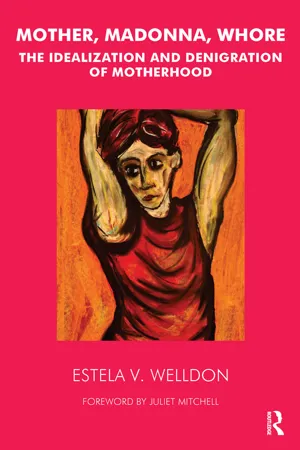
Yes, you can access Mother, Madonna, Whore by Estela V. Welldon in PDF and/or ePUB format, as well as other popular books in Psychology & History & Theory in Psychology. We have over 1.5 million books available in our catalogue for you to explore.