eBook - ePub
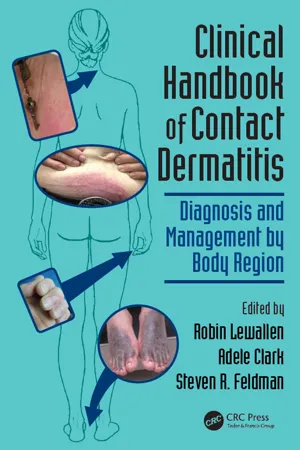
Clinical Handbook of Contact Dermatitis
Diagnosis and Management by Body Region
- 92 pages
- English
- ePUB (mobile friendly)
- Available on iOS & Android
eBook - ePub
Clinical Handbook of Contact Dermatitis
Diagnosis and Management by Body Region
About this book
The Clinical Handbook of Contact Dermatitis: Diagnosis and Management by Body Region uses a succinct approach to help clinicians manage this multifaceted condition. Organized by body region, the handbook presents the most common allergens and irritants for a given location. It discusses products containing common allergens and irritants such as top
Information
CHAPTER 1
Introduction to contact dermatitis
Contact dermatitis is a common skin condition frequently seen by physicians. It affects approximately 20% of people in the United States. It is responsible for 70 to 80% of all reported occupational skin diseases, and it is a frequent chief complaint of clinic visits.1 There are two main types of contact dermatitis: irritant contact dermatitis and allergic contact dermatitis. Irritant contact dermatitis (ICD) is far more frequent than allergic contact dermatitis (ACD). While the clinical appearance may be similar, allergic contact dermatitis differs from irritant dermatitis in many ways (Table 1.1).
Table 1.1 – Allergic versus irritant contact dermatitis
Allergic contact dermatitis | Irritant contact dermatitis | |
Definition | An acquired inflammatory response to an allergen that occurs only in individuals who have been sensitized to the allergen | A nonspecific immune reaction of the skin to a substance that results in a skin eruption in any individual exposed to a high enough concentration |
Molecular mechanism | Cell-mediated hypersensitivity through Langerhans cells and CD4+ T cells after contact with a specific allergen (delayed Type IV hypersensitivity reaction) | Skin barrier disruption and cellular damage of the keratinocyte membrane from contact when an irritant activates the innate immune system |
Time between exposure and cutaneous manifestation | Hours to days | Within minutes to several hours |
Body location | Scalp is uncommon | Hands and face are common |
Symptoms | Itching | Pain and burning |
Factors that alter severity of reaction | Concentration of allergen and length of exposure Atopic patients are reported to be less likely to have ACD | Dry skin and thicker skin reacts less severely Atopic patients react more severely due to reduced barrier function |
Common allergens/irritants | Top 10 allergens from patch test results2: nickel sulfate, balsam of Peru (Myroxylon pereirae), fragrance mix, quaternium-15, neomycin sulfate, bacitracin, formaldehyde, cobalt chloride, methyldibromo glutaronitrile, and p-phenylenediamine | Top irritants3,4: low humidity, heat, water, detergents, solvents, oils, heat and sweating, dust and fibers, acids, and alkalis |
Histology | Acute: epidermal spongiosis with superficial dermal edema, eosinophils, and mild perivascular lymphocytic infiltrate in the upper dermis; vesicles can contain neutrophils Chronic: psoriasiform changes | Varies depending on the severity and chronicity of exposure Low concentrations: mimics acute ACD High concentrations: epidermal necrosis, which can be full thickness with balloon degeneration |
Testing | Patch test Photopatch test Provocative use test | None |
The list of allergens that cause ACD continues to grow. There are over 3,500 environmental contact allergens reported in the literature.5 Exposure to a particular allergen can occur for years before developing a delayed hypersensitivity immune response. After sensitization occurs, subsequent exposure to the allergen may result in ACD even if used in small concentrations.6 Poison ivy (urushiol) is another common allergen but is not included in typical testing or in the frequency results by the North American Contact Dermatitis Group (NACDG). Topical medications are a common cause of contact dermatitis, including antibiotics (58%), corticosteroids (30%), and anesthetics (6%). This generates a conundrum when selecting treatments for contact dermatitis, as upwards of 30% of patients with a medication allergy had a positive patch test to a topical corticosteroid, either the steroid or the vehicle.7 Many of the products that are used on a daily basis contain one or more potential allergens (Table 1.2).
While ACD is a specific reaction to an allergen that occurs only in sensitized individuals, ICD can occur in anyone exposed to an irritant at a high concentration or for a significant length of time. There are many substances that can disrupt the skin’s barrier and activate the innate immune response. Occupational dermatitis, which is in large part caused by irritant dermatitis, costs up to $1 billion annually from medical bills, medications, worker’s compensation, and lost work hours.8
Table 1.2 – Products containing common allergens
Product | Allergen |
Metals | Nickel, cobalt, sodium gold thiosulfate, potassium dichromate |
Fragrance | Balsam of Peru (Myroxylon pereirae), ylang-ylang oil, jasmine Fragrance mix I (cinnamic aldehyde, cinnamyl alcohol, hydroxycitronellal, isoeugenol, eugenol, oak moss absolute, α-amyl cinnamic aldehyde, geraniol) Fragrance mix II (Lyral®, citral, farnesol, citronellol, hexyl cinnamic aldehyde, coumarin) |
Rubber accelerators and latex | Carba mix, mercaptobenzothiazole (MBT), thiuram mix, mercapto mix, black rubber mi... |
Table of contents
- Cover
- Half Title
- Title Page
- Copyright Page
- Table of Contents
- Acknowledgments
- Chapter 1 Introduction to contact dermatitis
- Chapter 2 Scalp
- Chapter 3 Face
- Chapter 4 Eyelids
- Chapter 5 Mouth, lips, and perioral region
- Chapter 6 Neck
- Chapter 7 Hands
- Chapter 8 Extremities
- Chapter 9 Feet
- Chapter 10 Trunk
- Chapter 11 Anogenital region
- Chapter 12 Patch testing
- Chapter 13 Treatment considerations
- Quick Reference
- Index
Trusted by 375,005 students
Access to over 1.5 million titles for a fair monthly price.
Study more efficiently using our study tools.
Frequently asked questions
Yes, you can cancel anytime from the Subscription tab in your account settings on the Perlego website. Your subscription will stay active until the end of your current billing period. Learn how to cancel your subscription
No, books cannot be downloaded as external files, such as PDFs, for use outside of Perlego. However, you can download books within the Perlego app for offline reading on mobile or tablet. Learn how to download books offline
Perlego offers two plans: Essential and Complete
- Essential is ideal for learners and professionals who enjoy exploring a wide range of subjects. Access the Essential Library with 800,000+ trusted titles and best-sellers across business, personal growth, and the humanities. Includes unlimited reading time and Standard Read Aloud voice.
- Complete: Perfect for advanced learners and researchers needing full, unrestricted access. Unlock 1.5M+ books across hundreds of subjects, including academic and specialized titles. The Complete Plan also includes advanced features like Premium Read Aloud and Research Assistant.
We are an online textbook subscription service, where you can get access to an entire online library for less than the price of a single book per month. With over 1.5 million books across 990+ topics, we’ve got you covered! Learn about our mission
Look out for the read-aloud symbol on your next book to see if you can listen to it. The read-aloud tool reads text aloud for you, highlighting the text as it is being read. You can pause it, speed it up and slow it down. Learn more about Read Aloud
Yes! You can use the Perlego app on both iOS and Android devices to read anytime, anywhere — even offline. Perfect for commutes or when you’re on the go.
Please note we cannot support devices running on iOS 13 and Android 7 or earlier. Learn more about using the app
Please note we cannot support devices running on iOS 13 and Android 7 or earlier. Learn more about using the app
Yes, you can access Clinical Handbook of Contact Dermatitis by Robin Lewallen, Adele Clark, Steven R. Feldman, Robin Lewallen,Adele Clark,Steven R. Feldman in PDF and/or ePUB format, as well as other popular books in Medicine & Dermatology. We have over 1.5 million books available in our catalogue for you to explore.