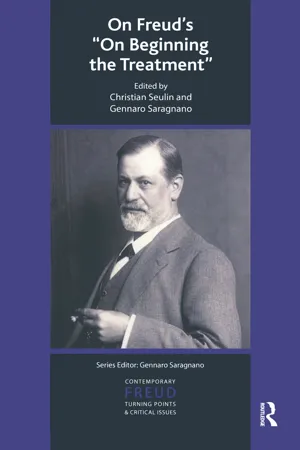
Like his other papers on technique, Freud's 1913 essay "On beginning the treatment" had an enduring influence on psychoanalysts for generations to come, providing them with a solid and worldwide-accepted conceptual basis on how to initiate psychoanalytic treatments. After a century of clinical experience and theoretical research, are all of Freud's rules and advice still valid today? The authors have asked ten eminent analysts to comment upon this seminal paper of Freud's, each of them focusing on one of the fundamental issues originally propounded by the "father of psychoanalysis". The result is an overall and careful view on the actuality of the technical bases of analysis, in what can be considered a good introduction to contemporary psychoanalytic theory and practice.
eBook - ePub
On Freud's On Beginning the Treatment
- 224 pages
- English
- ePUB (mobile friendly)
- Available on iOS & Android
eBook - ePub
On Freud's On Beginning the Treatment
About this book
Information
Part I
"On beginning the treatment"
(1913c)
Sigmund Freud
On Beginning the Treatment1
(Further Recommendations on the Technique of Psycho-Analysis I)
ANYONE who hopes to learn the noble game of chess from books will soon discover that only the openings and end-games admit of an exhaustive systematic presentation and that the infinite variety of moves which develop after the opening defy any such description. This gap in instruction can only be filled by a diligent study of games fought out by masters. The rules which can be laid down for the practice of psycho-analytic treatment are subject to similar limitations.
In what follows I shall endeavour to collect together for the use of practising analysts some of the rules for the beginning of the treatment. Among them there are some which may seem to be petty details, as, indeed, they are. Their justification is that they are simply rules of the game which acquire their importance from their relation to the general plan of the game. I think I am well-advised, however, to call these rules 'recommendations' and not to claim any unconditional acceptance for them. The extraordinary diversity of the psychical constellations concerned, the plasticity of all mental processes and the wealth of determining factors oppose any mechanization of the technique; and they bring it about that a course of action that is as a rule justified may at times prove ineffective, whilst one that is usually mistaken may once in a while lead to the desired end. These circumstances, however, do not prevent us from laying down a procedure for the physician which is effective on the average.
Some years ago I set out the most important indications for selecting patients2 and I shall therefore not repeat them here. They have in the meantime been approved by other psychoanalysts. But I may add that since then I have made it my habit, when I know little about a patient, only to take him on at first provisionally, for a period of one to two weeks. If one breaks off within this period one spares the patient the distressing impression of an attempted cure having failed. One has only been undertaking a 'sounding' in order to get to know the case and to decide whether it is a suitable one for psychoanalysis. No other kind of preliminary examination but this procedure is at our disposal; the most lengthy discussions and questionings in ordinary consultations would offer no substitute. This preliminary experiment, however, is itself the beginning of a psycho-analysis and must conform to its rules. There may perhaps be this distinction made, that in it one lets the patient do nearly all the talking and explains nothing more than what is absolutely necessary to get him to go on with what he is saying.
There are also diagnostic reasons for beginning the treatment with a trial period of this sort lasting for one or two weeks. Often enough, when one sees a neurosis with hysterical or obsessional symptoms, which is not excessively marked and has not been in existence for long—just the type of case, that is, that one would regard as suitable for treatment—one has to reckon with the possibility that it may be a preliminary stage of what is known as dementia praecox ('schizophrenia', in Bleuler's terminology; 'paraphrenia', as I have proposed to call it1), and that sooner or later it will show a well-marked picture of that affection. I do not agree that it is always possible to make the distinction so easily. I am aware that there are psychiatrists who hesitate less often in their differential diagnosis, but I have become convinced that just as often they make mistakes. To make a mistake, moreover, is of far greater moment for the psycho-analyst than it is for the clinical psychiatrist, as he is called. For the latter is not attempting to do anything that will be of use, whichever kind of case it may be. He merely runs the risk of making a theoretical mistake, and his diagnosis is of no more than academic interest. Where the psycho-analyst is concerned, however, if the case is unfavourable he has committed a practical error; he has been responsible for wasted expenditure and has discredited his method of treatment. He cannot fulfil his promise of cure if the patient is suffering, not from hysteria or obsessional neurosis, but from paraphrenia, and he therefore has particularly strong motives for avoiding mistakes in diagnosis. In an experimental treatment of a few weeks he will often observe suspicious signs which may determine him not to pursue the attempt any further. Unfortunately I cannot assert that an attempt of this kind always enables us to arrive at a certain decision; it is only one wise precaution the more.1
Lengthy preliminary discussions before the beginning of the analytic treatment, previous treatment by another method and also previous acquaintance between the doctor and the patient who is to be analysed, have special disadvantageous consequences for which one must be prepared. They result in the patient's meeting the doctor with a transference attitude which is already established and which the doctor must first slowly uncover instead of having the opportunity to observe the growth and development of the transference from the outset. In this way the patient gains a temporary start upon us which we do not willingly grant him in the treatment.
One must mistrust all prospective patients who want to make a delay before beginning their treatment. Experience shows that when the time agreed upon has arrived they fail to put in an appearance, even though the motive for the delay—i.e. their rationalization of their intention—seems to the uninitiated to be above suspicion.
Special difficulties arise when the analyst and his new patient or their families are on terms of friendship or have social ties with one another. The psycho-analyst who is asked to undertake the treatment of the wife or child of a friend must be prepared for it to cost him that friendship, no matter what the outcome of the treatment may be: nevertheless he must make the sacrifice if he cannot find a trustworthy substitute.
Both lay public and doctors—still ready to confuse psychoanalysis with treatment by suggestion—are inclined to attribute great importance to the expectations which the patient brings to the new treatment. They often believe in the case of one patient that he will not give much trouble, because he has great confidence in psycho-analysis and is fully convinced of its truth and efficacy; whereas in the case of another, they think that he will undoubtedly prove more difficult, because he has a sceptical outlook and will not believe anything until he has experienced its successful results on his own person. Actually, however, this attitude on the part of the patient has very little importance. His initial trust or distrust is almost negligible compared with the internal resistances which hold the neurosis firmly in place. It is true that the patient's happy trustfulness makes our earliest relationship with him a very pleasant one; we are grateful to him for that, but we warn him that his favourable prepossession will be shattered by the first difficulty that arises in the analysis. To the sceptic we say that the analysis requires no faith, that he may be as critical and suspicious as he pleases and that we do not regard his attitude as the effect of his judgement at all, for he is not in a position to form a reliable judgement on these matters; his distrust is only a symptom like his other symptoms and it will not be an interference, provided he conscientiously carries out what the rule of the treatment requires of him.
No one who is familiar with the nature of neurosis will be astonished to hear that even a man who is very well able to carry out an analysis on other people can behave like any other mortal and be capable of producing the most intense resistances as soon as he himself becomes the object of analytic investigation. When this happens we are once again reminded of the dimension of depth in the mind, and it does not surprise us to find that the neurosis has its roots in psychical strata to which an intellectual knowledge of analysis has not penetrated.
Points of importance at the beginning of the analysis are arrangements about time and money.
In regard to time, I adhere strictly to the principle of leasing a definite hour. Each patient is allotted a particular hour of my available working day; it belongs to him and he is liable for it, even if he does not make use of it. This arrangement, which is taken as a matter of course for teachers of music or languages in good society, may perhaps seem too rigorous in a doctor, or even unworthy of his profession. There will be an inclination to point to the many accidents which may prevent the patient from attending every day at the same hour and it will be expected that some allowance shall be made for the numerous intercurrent ailments which may occur in the course of a longish analytic treatment. But my answer is: no other way is practicable. Under a less stringent régime the 'occasional' non-attendances increase so greatly that the doctor finds his material existence threatened; whereas when the arrangement is adhered to, it turns out that accidental hindrances do not occur at all and intercurrent illnesses only very seldom. The analyst is hardly ever put in the position of enjoying a leisure hour which he is paid for and would be ashamed of; and he can continue his work without interruptions, and is spared the distressing and bewildering experience of finding that a break for which he cannot blame himself is always bound to happen just when the work promises to be especially important and rich in content. Nothing brings home to one so strongly the significance of the psychogenic factor in the daily life of men, the frequency of malingering and the non-existence of chance, as a few years' practice of psycho-analysis on the strict principle of leasing by the hour. In cases of undoubted organic illnesses, which, after all, cannot be excluded by the patient's having a psychical interest in attending, I break off the treatment, consider myself entitled to dispose elsewhere of the hour which becomes free, and take the patient back again as soon as he has recovered and I have another hour vacant.
I work with my patients every day except on Sundays and public holidays—that is, as a rule, six days a week. For slight cases or the continuation of a treatment which is already well advanced, three days a week will be enough. Any restrictions of time beyond this bring no advantage either to the doctor or the patient; and at the beginning of an analysis they are quite out of the question. Even short interruptions have a slightly obscuring effect on the work. We used to speak jokingly of the 'Monday crust' when we began work again after the rest on Sunday. When the hours of work are less frequent, there is a risk of not being able to keep pace with the patient's real life and of the treatment losing contact with the present and being forced into by-paths. Occasionally, too, one comes across patients to whom one must give more than the average time of one hour a day, because the best part of an hour is gone before they begin to open up and to become communicative at all.
An unwelcome question which the patient asks the doctor at the outset is: 'How long will the treatment take? How much time will you need to relieve me of my trouble?' If one has proposed a trial treatment of a few weeks one can avoid giving a direct answer to this question by promising to make a more reliable pronouncement at the end of the trial period. Our answer is like the answer given by the Philosopher to the Wayfarer in Aesop's fable. When the Wayfarer asked how long a journey lay ahead, the Philosopher merely answered 'Walk!' and afterwards explained his apparently unhelpful reply on the ground that he must know the length of the Wayfarer's stride before he could tell how long his journey would take.1 This expedient helps one over the first difficulties; but the comparison is not a good one, for the neurotic can easily alter his pace and may at times make only very slow progress. In point of fact, the question as to the probable duration of a treatment is almost unanswerable.
As the combined result of lack of insight on the part of patients and disingenuousness on the part of doctors, analysis finds itself expected to fulfil the most boundless demands, and that in the shortest time. Let me, as an example, give some details from a letter which I received a few days ago from a lady in Russia. She is 532 years old, her illness began twenty-three years ago and for the last ten years she has no longer been able to do any continuous work. 'Treatment in a number of institutions for nervous cases' have not succeeded in making an 'active life' possible for her. She hopes to be completely cured by psycho-analysis, which she has read about, but her illness has already cost her family so much money that she cannot manage to come to Vienna for longer than six weeks or two months. Another added difficulty is that she wishes from the very start to 'explain' herself in writing only, since any discussion of her complexes would cause an explosion of feeling in her or 'render her temporarily unable to speak'.—No one would expect a man to lift a heavy table with two fingers as if it were a light stool, or to build a large house in the time it would take to put up a wooden hut; but as soon as it becomes a question of the neuroses—which do not seem so far to have found a proper place in human thought—even intelligent people forget that a necessary proportion must be observed between time, work and success. This, incidentally, is an understandable result of the deep ignorance which prevails about the aetiology of the neuroses. Thanks to this ignorance, neurosis is looked on as a kind of 'maiden from afar'.1 'None knew whence she came'; so they expected that one day she would vanish.
Doctors lend support to these fond hopes. Even the informed among them often fail to estimate properly the severity of nervous disorders. A friend and colleague of mine, to whose great credit I account it that after several decades of scientific work on other principles he became converted to the merits of psycho-analysis, once wrote to me: 'What we need is a short, convenient, out-patient treatment for obsessional neurosis.' I could not supply him with it and felt ashamed; so I tried to excuse myself with the remark that specialists in internal diseases, too, would probably be very glad of a treatment for tuberculosis or carcinoma which combined these advantages.
To speak more plainly, psycho-analysis is always a matter of long periods of time, of half a year or whole years—of longer periods than the patient expects. It is therefore our duty to tell the patient this before he finally decides upon the treatment. I consider it altogether more honourable, and also more expedient, to draw his attention—without trying to frighten him off, but at the very beginning—to the difficulties and sacrifices which analytic treatment involves, and in this way to deprive him of any right to say later on that he has been inveigled into a treatment whose extent and implications he did not realize. A patient who lets himself be dissuaded by this information would in any case have shown himself unsuitable later on. It is a good tiling to institute a selection of this kind before the beginning of the treatment. With the progress of understanding among patients the number of those who successfully meet this first test increases.
I do not bind patients to continue the treatment for a certain length of time; I allow each one to break off whenever he Likes. But I do not hide it from him that if the treatment is stopped after only a small amount of work has been done it will not be successful and may easily, like an unfinished operation, leave him in an unsatisfactory state. In the early years of my psycho-analytic practice I used to have the greatest difficulty in prevailing on my patients to continue their analysis. This difficulty has long since been shifted, and I now have to take the greatest pains to induce them to give it up.
To shorten analytic treatment is a justifiable wish, and its fulfilment, as we shall learn, is being attempted along various fines. Unfortunately, it is opposed by a very important factor, namely, the slowness with which deep-going changes in the mind are accomplished—in the last resort, no doubt, the 'timelessness' of our unconscious processes.1 When patients are faced with the difficult...
Table of contents
- Cover
- Half Title
- Title
- Copyright
- Contents
- CONTEMPORARY FREUD IPA Publications Committee
- ACKNOWLEDGEMENTS
- EDITORS AND CONTRIBUTORS
- Introduction
- PART I "On beginning the treatment" (1913c)
- PART II Discussion of "On beginning the treatment"
- REFERENCES
- INDEX
Trusted by 375,005 students
Access to over 1.5 million titles for a fair monthly price.
Study more efficiently using our study tools.
Frequently asked questions
Yes, you can cancel anytime from the Subscription tab in your account settings on the Perlego website. Your subscription will stay active until the end of your current billing period. Learn how to cancel your subscription
No, books cannot be downloaded as external files, such as PDFs, for use outside of Perlego. However, you can download books within the Perlego app for offline reading on mobile or tablet. Learn how to download books offline
Perlego offers two plans: Essential and Complete
- Essential is ideal for learners and professionals who enjoy exploring a wide range of subjects. Access the Essential Library with 800,000+ trusted titles and best-sellers across business, personal growth, and the humanities. Includes unlimited reading time and Standard Read Aloud voice.
- Complete: Perfect for advanced learners and researchers needing full, unrestricted access. Unlock 1.5M+ books across hundreds of subjects, including academic and specialized titles. The Complete Plan also includes advanced features like Premium Read Aloud and Research Assistant.
We are an online textbook subscription service, where you can get access to an entire online library for less than the price of a single book per month. With over 1.5 million books across 990+ topics, we’ve got you covered! Learn about our mission
Look out for the read-aloud symbol on your next book to see if you can listen to it. The read-aloud tool reads text aloud for you, highlighting the text as it is being read. You can pause it, speed it up and slow it down. Learn more about Read Aloud
Yes! You can use the Perlego app on both iOS and Android devices to read anytime, anywhere — even offline. Perfect for commutes or when you’re on the go.
Please note we cannot support devices running on iOS 13 and Android 7 or earlier. Learn more about using the app
Please note we cannot support devices running on iOS 13 and Android 7 or earlier. Learn more about using the app
Yes, you can access On Freud's On Beginning the Treatment by Gennaro Saragnano, Christian Seulin, Gennaro Saragnano,Christian Seulin in PDF and/or ePUB format, as well as other popular books in Psychology & History & Theory in Psychology. We have over 1.5 million books available in our catalogue for you to explore.