- 320 pages
- English
- ePUB (mobile friendly)
- Available on iOS & Android
eBook - ePub
About this book
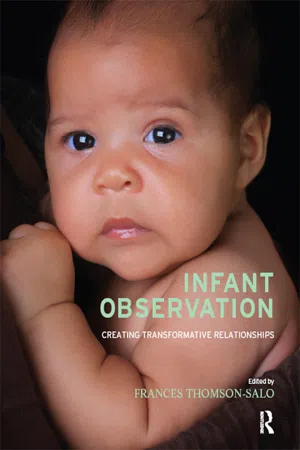
Seminal and representative papers have been chosen to illustrate the vital importance of infant observation in psychoanalytic training, tracing influences on the practice of infant observation and contemporary developments. The book outlines the thinking that has evolved since Esther Bick's introduction of this innovative component in Tavistock child psychotherapy and British Psychoanalytical Society training.
Information
PART I
INFANT OBSERVATION
CHAPTER ONE
Introduction to infant observation: an infant’s inner world
Esther Bick’s innovation of psychoanalytic infant observation described in her 1964 paper, Notes on Infant Observation in Psycho-Analytic Training (Chapter Two), launched a cascade of clinical and theoretical learning of extraordinary vibrancy over the following fifty years. In 1948 Bick, in response to a request by John Bowlby to start the child psychotherapy training at the Tavistock Clinic, building on a tradition of closely observing infants that had been a strength of Melanie Klein’s (1952), developed an approach to observing an infant in their home as part of the first year of child psychotherapy training. From 1960 infant observation became an integral part of the first year curriculum of the British Psychoanalytical Society and then of the Hampstead Child-Therapy course. Having spread to Europe, North, and South America, infant observation is practised worldwide and is a vital component for many clinical trainings, enabling psychoanalysts and psychotherapists to experience and contain powerful emotions, and process them as part of training. The importance of infant observation for psychoanalysis lies in its potential to enable observers to become increasingly receptive to the impact and meaning of emotional experience, transference, countertransference and projective identification, and to thoughtfully contain the impact of the information that these convey about unconscious mental content. It seems fitting at this point in time to acknowledge how monumental an achievement Bick’s introduction of infant observation was, and how powerful and transformative infant observation can be.
Recognition of the importance in training of infant observation, often referred to as “psychoanalytic infant observation” as opposed to a more laboratory-based way of recording an infant’s behaviour, in enabling observers have a fuller, more empathic understanding of an infant’s experiences, continually grows. (Bick’s doctorate in Vienna, under Charlotte Bühler, was based on standardised laboratory observations of babies, and inspired her wish for a more naturalistic observation.) The method, its setting and process, are briefly introduced in this chapter; developments in the approach and the literature are covered in later chapters. Bick (1964) described six aims of infant observation, including helping students to “conceive vividly” (p. 558) the infantile experience of their child patients, increasing their understanding of a child’s nonverbal behaviour, helping them understand better a child’s history when interviewing a parent, giving them a unique opportunity to observe an infant’s development from birth, and comparing observations with fellow students.
There has been a stream of publications since Closely Observed Infants (Miller et al., 1989), with an integrative theoretical chapter by Shuttleworth and eight infant observation case studies. This was followed by Susan Reid’s (1997) edited book on developments in the Tavistock model, Stephen Brigg’s (1997) study of risk and resilience in vulnerable families, and Andrew Briggs’s (2002) edited “festschrift” for Esther Bick, and Janine Sternberg’s two books, Infant Observation at the Heart of Training (2005) and, with Cathy Urwin, Infant Observation and Research: Emotional Processes in Everyday Life (2012). The Infant Observation Journal, published three times a year since 1997, explores and sustains the broad traditions of infant observation, and regular conferences for infant observation teachers take place. The practice of infant observation has become so extensive since Bick’s time that it is difficult to do justice to published papers and any overview risks losing their depth of insight and subtlety. Papers have been chosen to illustrate the importance of infant observation in psychoanalytic training, in research, and in applied settings, and are written both by experienced therapists and trainees. The focus is on the younger infant rather than the older infant to illumine earlier processes better. While psychoanalytic infant observation linked to object relations theory first spread to areas that had adopted that approach, it has recently gained a wider momentum (Gilmore, 2009) particularly in Europe in countries such as Italy, Belgium, and France and papers from Europe (Chapter Seven) and America (Chapter Thirteen) are included. Papers about infant observation in Latin America from centres in Argentina, Brazil, and Chile have recently been more widely published. Infant observation is a rapidly evolving field so that some aspects of the papers may seem dated but they have been included because of their place in the field or the seminal points they make. While published accounts of observational experiences that the observers found enjoyable exist, written at times with lyricality (Waddell, 2006), many of the observation experiences were challenging.
Infant observation in the tradition of Esther Bick
Psychoanalytic infant observation was developed from 1948 onwards by Bick (1964) at the Tavistock Clinic in London to enable child psychotherapy trainees to learn about normal development. In contrast to what she felt was the more rigid way that she had been trained to make observations in measured time sequences (A. Briggs, 2002), she developed infant observation as a naturalistic observation. Gradually over the course of the observation, a picture of the infant’s personality builds up so that an observer feels they know the infant in greater depth. Other psychoanalysts integrated observations of infants with psychoanalytic theory: Anna Freud (1973) made detailed observations of infants’ behaviour from the 1930s, particularly in the Hampstead War Nurseries, which vividly conveyed their experiences of separations. Winnicott (1941) as a paediatrician and psychoanalyst described observing 60,000 babies and their parents in the course of his work.
Bick (1964) defined the aims of infant observation as the refinement of observational skills and a capacity to think about what is observed and experienced. The process increases the observer’s understanding of the infant’s mind and how this develops over time with experience. An observer shares the emotional impact of being in a family without the responsibility of making interpretations or otherwise intervening. A central part is to develop greater understanding of relationships, transference feelings, countertransference, and unconscious affective responses to another person. Infant observation helps trainees learn how to observe in detail without being in the role of an expert or friend, which is an important part of the analytic attitude. As part of pre-clinical training, it has been found to be a relatively accurate predictor of how well candidates might succeed in clinical training (Spillius, 1977).
In arranging an observation it is helpful if someone whom the parents trust makes the initial approach on the observer’s behalf. Being approached by a health professional allows parents, as Watillon-Naveau (2008) in Belgium found in her research, to consciously maintain that they had agreed because it was requested of them, rather than having to acknowledge their wish for an observer’s support. It is important that a family do not have a perceived feeling of obligation to the observer. The family should not be known to the observer, and not connected in any way that they may feel that their privacy could be at risk, or that the observer feels inhibited in what they think and discuss as a result of their observations. If the family is known to the observer, complications in this relationship and in the observer role are almost inevitable. Observers may find it a surprisingly anxious time arranging to observe a family, with parallels to the anxieties and phantasies experienced in pregnancy. How observations are set up will to some extent vary according to the local context, although Michel Haag (2010) and his colleagues made a plea for more uniformity in those observations that are set up for training as a psychoanalyst or psychotherapist.
Seminar leaders may prepare observers to begin the observational task immediately or to reduce observers’ anxieties they may start with some introductory literature, relevant film or art work (Blessing, 2011). Observers are guided about to how to find a family who are expecting the birth of a baby, and how to present themselves as an observer, as well as some possible difficulties (Desnot, 2008). As the aim in training is to observe more or less “ordinary” development, observers try to set up an observation with a family who are not experiencing difficulty and are not high risk. The infant does not have to be a first born. If twins are born, an observer usually observes both babies (Davison, 1992).
As part of many psychoanalytic or psychotherapy trainings observers make weekly observations if possible from just before the birth of the infant for the first year of life and sometimes for the second year. A prospective observer would arrange an introductory visit to the family, preferably to meet both parents, which may involve an evening visit, giving the family the chance to meet the observer before the baby’s birth and to see whether it could meet the observer’s learning needs. The observer outlines that he or she would like to follow an infant throughout the first year to learn about development and the infant’s relationships. The visits last an hour and are not usually shortened or lengthened so as not to arouse anxiety. If the observer plans to have holiday breaks, they give the family advance notice.
The observer has no responsibility to gain detailed information, only to be receptive to what the parents feel comfortable to share. Parents have the right to know some basic facts about whom they are admitting into their home. If asked personal questions, an observer would answer with what they feel is appropriate; their role is not that of a therapist but of privileged observer. They might indicate that parents often find an observation a positive experience. There is enormous variation in these first contacts—from parents who hardly ask anything about the prospective observer, consenting quickly as if giving little thought to a decision already taken, to those who question the observer exhaustively, perhaps even negatively, indicating high levels of anxiety while being protective of the family. The range of these responses has led some seminar leaders to role-play the first contact with the parents. The observer asks to be contacted as soon as the family feel ready after the birth. During visits there is no expectation that the family inconvenience themselves for the observer, only that they arrange a suitable time, and do what they would be doing if the observer were not present.
Whereas Bick (1964) focussed more on the mother’s role and contribution the observer indicates that they are also interested in observing the baby with their father. The reality is that fathers are often not present. Blatt’s observation (Chapter Four) where a father enjoyably looked after his baby in most visits is one exception. More often, negative effects of the absence of a father in a baby’s life are described in the literature, sometimes with extremes such as a mother’s sexualisation of her baby and harshness in handling him (Yarrington, 1999). If a mother plans to return early to work, an observer would need to discuss with the parents how they envisage the future situation before deciding whether they would gain the experience they seek.
It is particularly important with a male observer to respect the father’s attitude when the observer may be observing intimate situations including breastfeeding. There are aspects which may present more difficulty for a male observer than a female observer, which include setting up an observation in a context of current societal concern about men’s intimacy with children, and sexual overtones for mother and observer, particularly in the absence of an involved father (Jackson, 1998). If a father is able to use a male observer’s reliability there can be considerable gains, for example, lessening the need to project into the baby to defend against a sense of deprivation (Duggins, 2008). The effect of gender on the observer-infant dyad, in particular how an observer’s masculinity affects an infant, remain to be further explored. The relative neglect of the father’s role by clinicians working with parents and infants (Barrows, 1999) may be linked with the relative absence of fathers in infant observation.
The role of the observer
Infant observation takes place along a continuum with an observer trying to stay more in the role of observer than participant. Bick conveyed a more flexible approach in her 1964 paper than has sometimes been interpreted. Initial anxieties for observer and for mother in her new role as mother and in offering an observational placement usually subside considerably in the first month. An observer tries to find a space, physically and emotionally, from which to see the baby, a psychological position from which to observe whatever there is to be observed at the time of the visit, being as non-intrusive as possible while remaining emotionally engaged at a deep level, open to distress and pain. If an observer declines to sit close so as not to be “in the baby’s face” there may be an anxiety about coming into close contact. Bick stressed that an observer’s task was to be a container and support for the infant and the family as much as possible (Magagna, 1987), which can include containing the mother’s anxieties about being rejected, the infant’s anxieties about not being emotionally held, and the father’s jealousy. While experiencing first-hand the relationships in the family, observers try to resist being drawn in. They have no responsibility for giving advice or intervening. This stance allows them to concentrate on observing in as detailed a way as possible, reflecting on the infant’s emotional experiences, as well as their own feelings, while monitoring how identified they become with infant or parent.
As the observation is a naturalistic one, an observer is involved to some degree and the observer stance cannot be a fixed one but will depend on the personality of the observer and the family members, and the events occurring in the observation and on the seminar group. For many families, the regular weekly visit involves more frequent contact than with other family members and friends. Observing a one-year-old who is mobile and initiates interaction is very different from observing an immobile infant and it may be hard to maintain a role of minimal participation. There is a paradox in that a naturalistic observation might appear to be a social occasion, while there is a task to be followed and at the end of the hour the observer leaves promptly. An observer follows the mother’s lead, being courteous in their responses, recognising that it is a privilege to be invited into the family, without being overly self-disclosing, while at times feeling under pressure to reveal more than they feel comfortable with.
Observers convey to the parents that they are interested in all aspects of the infant’s experience. Mindful that they have been invited into the home they aim for a firm but not rigid frame, and not to be seen as someone for whom the parent feels that their baby has to put on a performance. They are not there as an expert or as a therapist; while some parents may ask for advice about issues such as sleep schedules it is usually possible to think with parents about how to access help from other health professionals. Some observers sensing an underlying deprivation in the family have felt the need to be nurturing such as bringing biscuits to ensure an observation does not break down. Sometimes observers set up a very formal frame stating that they will not hold the baby or interact; this may be appropriate to some observations but in others may be unnecessary or not work well for the family. Above all, the observer would be authentic and respond appropriately to the infant. Whether an observed incident will form part of the trajectory of that infant’s development or remains an isolated event may only become clear over time. Rather than focus on this question it is important that the stance is one of observing what is happening in the present moment and staying open to emerging feelings.
The conscious and unconscious reasons why parents agree to have an observer include viewing the observer in the “good grandmother” transference, who would help a mother to see the baby’s perspective, or be a container for the mother’s fears for the baby (Parr, 2011). Mothers may want to be helpful to a student or have strong narcissistic wishes (Watillon-Naveau, 2002). In infant observation literature the effect of a traumatic birth is increasingly noted, which may contribute to maternal ambivalence and to the reasons why some families agree to an observer for support. A father may hope for support if his partner has difficulties, or for the observer to be supportive in his absence, sometimes to the extent of recreating the experience of a couple which may be lacking in the parental relationship (see Chapter Eleven). Sometimes the reasons do not become clear. The observer’s profession may reassure the parents or initially raise anxiety such as in fantasies about a protective services worker removing the infant from the parents’ care or a therapist “analysing” the infant. Often there are striking similarities between the way a mother relates to an observer and how she relates to her infant, which may unconsciously determine how mother and observer “choose” the other. If a mother is distant towards both baby and observer and cannot keep her baby in mind, it may be harder for the observer to keep the baby in mind. There may be uncanny coincidences in the unconscious fit in an observer’s choice of a family. A naturalised Greek health professional arranged to observe a mother whose partner was Greek although she was unaware of that and after starting the observation she learnt that they both had brothers who were thirteen years younger whom they had helped to care for. If details of a mother or father’s life replicate too closely those of the observer, “ghosts in the nursery” (Fr...
Table of contents
- Cover
- Half Title
- Title Page
- Copyright Page
- Table of Contents
- ACKNOWLEDGEMENTS
- ABOUT THE EDITOR AND CONTRIBUTORS
- PART I: INFANT OBSERVATION
- PART II: SIGNIFICANT DEVELOPMENTS OF INFANT OBSERVATION AS A METHOD WITHIN PSYCHOANALYTIC TRAINING
- PART III: RESEARCH IN INFANT OBSERVATION
- PART IV: PROBLEMATIC ASPECTS OF INFANT OBSERVATION
- PART V: DEVELOPMENTS OF THE INFANT OBSERVATION MODEL
- AFTERWORD
- SELECTED MAJOR PAPERS AND BOOKS
- INDEX
Trusted by 375,005 students
Access to over 1.5 million titles for a fair monthly price.
Study more efficiently using our study tools.
Frequently asked questions
Yes, you can cancel anytime from the Subscription tab in your account settings on the Perlego website. Your subscription will stay active until the end of your current billing period. Learn how to cancel your subscription
No, books cannot be downloaded as external files, such as PDFs, for use outside of Perlego. However, you can download books within the Perlego app for offline reading on mobile or tablet. Learn how to download books offline
Perlego offers two plans: Essential and Complete
- Essential is ideal for learners and professionals who enjoy exploring a wide range of subjects. Access the Essential Library with 800,000+ trusted titles and best-sellers across business, personal growth, and the humanities. Includes unlimited reading time and Standard Read Aloud voice.
- Complete: Perfect for advanced learners and researchers needing full, unrestricted access. Unlock 1.5M+ books across hundreds of subjects, including academic and specialized titles. The Complete Plan also includes advanced features like Premium Read Aloud and Research Assistant.
We are an online textbook subscription service, where you can get access to an entire online library for less than the price of a single book per month. With over 1.5 million books across 990+ topics, we’ve got you covered! Learn about our mission
Look out for the read-aloud symbol on your next book to see if you can listen to it. The read-aloud tool reads text aloud for you, highlighting the text as it is being read. You can pause it, speed it up and slow it down. Learn more about Read Aloud
Yes! You can use the Perlego app on both iOS and Android devices to read anytime, anywhere — even offline. Perfect for commutes or when you’re on the go.
Please note we cannot support devices running on iOS 13 and Android 7 or earlier. Learn more about using the app
Please note we cannot support devices running on iOS 13 and Android 7 or earlier. Learn more about using the app
Yes, you can access Infant Observation by Frances Thomson-Salo in PDF and/or ePUB format, as well as other popular books in Psychology & Education in Psychology. We have over 1.5 million books available in our catalogue for you to explore.