eBook - ePub
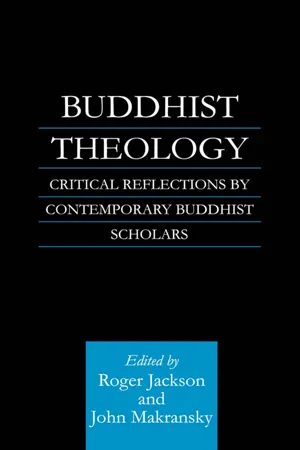
Buddhist Theology
Critical Reflections by Contemporary Buddhist Scholars
- 422 pages
- English
- ePUB (mobile friendly)
- Available on iOS & Android
eBook - ePub
Buddhist Theology
Critical Reflections by Contemporary Buddhist Scholars
About this book
Scholars of Buddhism, themselves Buddhist, here seek to apply the critical tools of the academy to reassess the truth and transformative value of their tradition in its relevance to the contemporary world.
Information
PART I
BUDDHIST THEOLOGY:
WHAT, WHY, AND HOW?
One
Buddhist Theology in the Academy1
BUT THEOLOGY?
Anyone at all familiar with the tenets of Buddhism will undoubtedly find it strange that a group of specialists in the field, after many years of attempting to purge the study of Buddhism of Western theistic terminology and presuppositions, should now be claiming that the time is ripe for the emergence of Buddhist theology as a discipline. Theology connotes, at least etymologically, the study of the nature of God. Given that this is the most common sense of the word, it might be useful to begin by explaining why, in my usage, “Buddhist theology” is not an oxymoron. I will discuss in more detail below what I take theology to be: roughly, a form of normative discourse, self-avowedly rooted in tradition, with certain formal properties. But for now, suffice it to say that I take theology not to be restricted to discourse on God, nor to presuppose the notion of an omnipotent, creator God. I take “theology” not to be restricted to its etymological meaning. In that latter sense Buddhism is of course atheological, rejecting as it does the notion of God. Understood rhetorically, however, as a kind of discourse with certain formal properties, and functionally, as having certain applications and purposes in the context of culture, “theology” can be meaningfully modified by the adjective “Buddhist.”2
If, as appears to be the case, the word “theology” is so heavily laden with classically theistic semantic implications, might it not be less hazardous and more straightforward simply to opt for a different term? There are three reasons for not doing so: one practical, one theoretical, and one “political.” (1) I do not believe that there is a practical equivalent to the word “theology.” A term like philosophy simply will not do, since it, unlike theology, is neutral in regard to the religious affiliation of the agent engaged in the enterprise. On the other hand, new nomenclature (like dharmo/alogy and buddho/alogy), besides being infelicitous, will become meaningful only through consensual use, which in any discipline is difficult to achieve. (2) Even if we were to find such a term and agree to it, there is a theoretical reason for rejecting it. What I here term “Buddhist theology” is functionally equivalent to much of what is termed Christian or Jewish or Islamic theology; which is to say that this type of discourse functions for Buddhists in a way similar to its counterparts in other religious contexts. (3) Finally, there is a political reason for not abandoning the term “theology.” The present project has as one of its chief goals the promotion of Buddhist theological discourse within the academy. To situate Buddhist theology within the academy is to suggest, as a political move, that it deserves a place within the field of Buddhist Studies and alongside the field of, for example, academic Christian theology. The use of the word “theology” is strategically important in accomplishing both of these aims.
I have chosen to adopt such a term, therefore, principally for practical, functional and politically expedient reasons (upayically, to coin a Buddhist term). Critical discourse that unapologetically locates itself within the Buddhist tradition (i.e., Buddhist theology) should be considered on a par with Christian theology as far as the academy is concerned; Christian theology should not be privileged over Buddhist theology; and indeed all such forms of discourse, regardless of their religious affiliation, should be given a proportionately equal voice in the academy so long as they can subscribe to the norms of open, rational inquiry. So much for terminological questions, now to substance.
A VOID IN DISCOURSE
A vacuum in discourse yearns as much to be filled as a vacuum in space. First, I seek to identify a form of discourse related to Buddhism – a form of discourse to be situated in the academy, but one that is presently all but absent there. Second, I suggest how this vacuum should be filled by commencing the process of laying the groundwork for the field of academic Buddhist theology. Buddhist Studies as an academic discipline has come a long way since its inception in the early nineteenth century.3 But despite the strides, both quantitative and qualitative, the field has been reluctant to allow for the development of theological discourse as a scholarly option.4 The reasons are varied and complex, and beyond the scope of this essay. Suffice it to say that I believe that the banishment of Buddhist theology from the discipline of Buddhist Studies has its roots in a positivistic ideology that pervades the discipline even to this day.5 Imbued with the secularist ethos of the Enlightenment, and entrenched, albeit subtly at times, in the now passé world-view that scholarship in the humanities is to be modeled on that of the natural sciences,6 the discipline has too often been content to focus on the linguistic aspects of texts to the exclusion of seriously engaging their doctrinal and practical content. When it has taken doctrine and practice seriously as objects of study, it has too often sought to engage these at most descriptively, eschewing attempts to treat them normatively.7 Based on the naive assumption that the natural sciences are objective, and on the further false presupposition that religious adherents are subject to prejudices that make objectivity impossible, the discipline has also been reticent to take seriously the scholarship of believers, even, per imposibile, were they to deal openly, critically and rigorously with their subject matter, especially with normative questions. Because of the way it considers the object of research (doctrinal, ethical and practice-related claims as historical or cultural artifacts, and not as candidates for truth), the method used to analyze that object (descriptively, and not for their normative value), and the subject qua analyst (the objective, neutral researcher vs. the religiously committed, and therefore “contaminated,” believer), Buddhist Studies has, whether consciously or not, banished Buddhist theology to a nether-land beyond the boundaries of what it considers true scholarship.
Apart from the fact that this has made believers feel a bit timid in the academy,8 even when engaged in classical buddhological discourse, all of this has had little effect on the Buddhist world. In other venues Buddhists continue to engage in the art of theology and its ancillary sub-disciplines like catechesis, exegesis and polemics. In Asia, and in recent decades in the West, Buddhists persist in the practice of explaining their religion, demonstrating the relevance of their doctrines and practices to the present age, and defending the tenets of their faith vis a vis the challenges of competitors (e.g., those of other religious views and of secular modernity). But in the West this form of theology has often been uncritical. With few exceptions, it has either recapitulated traditional Asian Buddhist views with little thought to analyzing their relevance or worth in their new historical and/or cultural milieu, or it has, in the name of making Buddhism acceptable to the widest possible audience, commodified it, in the process draining the religion of all (or most) meaningful content, making it just one more strategy for living a stress-free life.
It can now be gleaned that is how the vacuum has been created: in the void of a triangle formed by the positivism of the discipline of Buddhist Studies at one corner, the often anachronistic, expository mode of traditionalist scholarship at another, and the commodified discourse of much of the popularist literature at the third. My purpose here is not to suggest that each of these forms of discourse has no place in the understanding and appropriation of Buddhism,9 but that they should not impede the development of a new form of discourse that is equally important: that of academic Buddhist theology. Put another way, my intention is not to dismiss these forms of discourse generally – indeed, I believe that each, in its own way, contributes to the academic Buddhist theological enterprise – but only to suggest (a) that none of the three are substitutes for the form of discourse I am calling for here, and (b) that each needs to be purged of the implicit ideologies that, reductionistically, assume their respective discourses to be uniquely valid, thereby impeding alternatives discursive options.
A detailed critique of the ideologies endemic to the reductionistic versions of these forms of discourse would take us too far afield from the present task. Suffice it, then, to offer these brief remarks by way of suggesting at least the direction of such a critique. To the positivist, the theologian should reply (a) that commitment to the tradition does not prevent a critical perspective any more than a lack of commitment guarantees it, and (b) that after the work of philology is done, there still remains the question of the truth of doctrine; to the traditionalist, that even when doctrine is understood, there is still the issue of relevance: what aspects of Buddhist doctrines and of its technologies of practice should be given priority, and how these are to be appropriated, both individually and communally, in the contemporary cultural milieu; and to the popularist, (a) that it will not suffice to focus arbitrarily on aspects of the tradition to the exclusion of others, or worse, to allow the consumerist demands of our culture to dictate our theological agenda, and (b) that even once that agenda has been rigorously circumscribed, there still remains the task of arguing for it using all of the scholarly tools at our disposal.
Of course, the reductionistic ideologies present in these three forms of discourse are problematic not only because they stand in the way of the emergence of academic Buddhist theology as a discipline, but for other independent reasons. Positivism lacks sufficient awareness of subjectivity. Being naive about the role of the subject in its own discourse, it portrays itself as an objective enterprise vis a vis the scholarship of the religiously committed, and thus to summarily dismiss the latter. Traditionalism, to the extent that it conflates exegesis and criticism, believes that the mere explanation of doctrine is all that is required of the theologian. Lacking, as it does, a nuanced notion of history, it fails to pay sufficient attention to the fact that doctrine and practice can be appropriated only in specific contexts. Popularism, to the extent that it succumbs to consumerist demands, at its best simply lacks intellectual rigor, while at its worst goes beyond mere sloppiness to a kind of anti-intellectualism that makes careful, critical scholarship superfluous, anathema or both. It shows little concern for the detailed scholarship that has been done on texts. It also lacks sufficient commitment to the tradition as a whole. Suffering from a pick-and-choose mentality that it justifies in the name of relevance, it is too ready to arbitrarily dismiss doctrines that are problematic or that on the surface appear anachronistic, thereby evincing as well a kind of intellectual defeatism.
But if these three modes of discourse themselves fail to be sufficiently academic, or Buddhist or theological, and if in their more extreme, reductionistic versions they actually impede the emergence of academic Buddhist theology, it should also be clear that each of the three suggests to theologians positive qualities that are crucial to their enterprise. Rigorous text-critical work that pays attention to historical and cultural context, as well as the commitment to free and open inquiry (both the legacy of Buddhology), are pivotal to the theological task; equally important is the critical spirit, the piety, the devotion to practice and the commitment to tradition that derives from the inspiration of traditional scholarship; finally, the popular literature reminds us that the theologian’s task is a constructive one that seeks to make Buddhist doctrine relevant to contemporary circumstances. While the three modes of discourse described above create the vacuum that I suggest ought to be filled by academic Buddhist theology as an enterprise, they also inform that undertaking in positive ways.
PRECURSORS TO AN ACADEMIC BUDDHIST THEOLOGY
It is, of course, an overstatement to claim that academic Buddhist theology has been utterly nonexistent as a form of discourse. In the literature of each of the three areas just described we find some examples of work that approaches academic theological discourse, some, more limited, examples that exhibit many of the features of this form of discourse, though perhaps not recognizing themselves as theological per se, and even a very few that do.
As I have pointed out elsewhere (Cabezón 1995: 258n), even while depicting their work as descriptive and analytically objective, Buddhologists sometimes cross the line, tentatively and cautiously, into normative, quasi-theological discourse (see Schmithausen: 2, 56).10 Other works in the field of Buddhist Studies, while perhaps not recognizing themselves as theological, are less reticent to engage in academic theological discourse. Fenner, for example, clearly situates his work as the result of his experience as a practicing Buddhist (xvii) and sees his task to be that of “producing an intelligible and relevant interpretation of Middle Path analysis” (xviii) using a system-cybernetics model. Similarly, Guenther and Thurman use Buddhist parallels to other strands in Western philosophy as a way of making Buddhist ideas both accessible and acceptable to a Western (particularly an intellectual) audience. Whether these various works succeed in their reading of Buddhism through their respective Western hermeneutical lenses may be questioned, as may be the need for such a reading to the task of Buddhist theology.11 Be that as it may, each of these works has at the very least strong affinities to the enterprise of academic Buddhist theology, whether or not they recognize themselves as theological.
There is, moreover, some scholarly work that does recognize itself to be explicitly theological. In feminist scholarship in the field of Buddhist Studies, particularly in the work of Rita Gross, we find operative, from an early date, a self-avowedly theological agenda (see Gross 1984, 1986, 1987, 1993). No less theological, though arguably less explicitly so, is the work of Anne Klein.12 More recently, John Makransky sees the impetus behind his work on the Mahayana doctrine(s) of buddhahood, which is primarily devoted to a careful study of the classical sources, to be in large part theological (xiii-xiv), at least in so far as it is for him motivated by overtly religious questioning.13
As is the case with literature that situates itself in the discipline of Buddhist Studies, there is also to be found, in the work of several eminent, contemporary, traditional scholars, literature that is paradigmatic of constructive theological inquiry, despite the fact that most of it does not rely upon a formal Western scholarly apparatus. Examples include much of the work of His Holiness, the Dalai Lama (1988, 1996a, 1996b, 1996c, forthcoming), Thich Nhat Hanh (1987, 1992a, 1992b, 1993), Sulak Sivaraksa (1985, 1986) and Ajahn Buddhadasa. While maintaining a strong commitment to their respective traditions, because of their willingness to reach beyond the historical horizons of the texts and the boundaries of their own cultures, each of these influential Buddhist teachers (and there are others as well) directly confront, in much of their writing, the issue of the relevance of Buddhist doctrine and practice to the modern world. In so doing, they avoid succumbing to the problematic form of traditionalism described above.
Several of these figures have themselves been concerned with the applicability of Buddhism to the social and political realms.14 Among the more notable examples of w...
Table of contents
- Cover
- Half Title
- Title Page
- Copyright Page
- Table Of Contents
- Preface
- Editors’ Introduction
- PART I. BUDDHIST THEOLOGY: WHAT, WHY, AND HOW?
- PART II. EXERCISES IN BUDDHIST THEOLOGY
- PART III. CRITICAL RESPONSES
Trusted by 375,005 students
Access to over 1.5 million titles for a fair monthly price.
Study more efficiently using our study tools.
Frequently asked questions
Yes, you can cancel anytime from the Subscription tab in your account settings on the Perlego website. Your subscription will stay active until the end of your current billing period. Learn how to cancel your subscription
No, books cannot be downloaded as external files, such as PDFs, for use outside of Perlego. However, you can download books within the Perlego app for offline reading on mobile or tablet. Learn how to download books offline
Perlego offers two plans: Essential and Complete
- Essential is ideal for learners and professionals who enjoy exploring a wide range of subjects. Access the Essential Library with 800,000+ trusted titles and best-sellers across business, personal growth, and the humanities. Includes unlimited reading time and Standard Read Aloud voice.
- Complete: Perfect for advanced learners and researchers needing full, unrestricted access. Unlock 1.5M+ books across hundreds of subjects, including academic and specialized titles. The Complete Plan also includes advanced features like Premium Read Aloud and Research Assistant.
We are an online textbook subscription service, where you can get access to an entire online library for less than the price of a single book per month. With over 1.5 million books across 990+ topics, we’ve got you covered! Learn about our mission
Look out for the read-aloud symbol on your next book to see if you can listen to it. The read-aloud tool reads text aloud for you, highlighting the text as it is being read. You can pause it, speed it up and slow it down. Learn more about Read Aloud
Yes! You can use the Perlego app on both iOS and Android devices to read anytime, anywhere — even offline. Perfect for commutes or when you’re on the go.
Please note we cannot support devices running on iOS 13 and Android 7 or earlier. Learn more about using the app
Please note we cannot support devices running on iOS 13 and Android 7 or earlier. Learn more about using the app
Yes, you can access Buddhist Theology by Roger Jackson, John Makransky, Roger Jackson,John Makransky in PDF and/or ePUB format, as well as other popular books in Theology & Religion & Buddhism. We have over 1.5 million books available in our catalogue for you to explore.