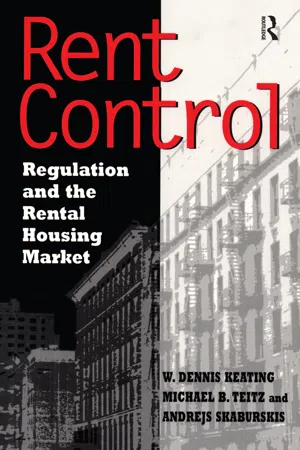
eBook - ePub
Rent Control in North America and Four European Countries
Regulation and the Rental Housing Market
- 260 pages
- English
- ePUB (mobile friendly)
- Available on iOS & Android
eBook - ePub
Rent Control in North America and Four European Countries
Regulation and the Rental Housing Market
About this book
Rent control, the governmental regulation of the level of payment and tenure rights for rental housing, occupies a small but unique niche within the broad domain of public regulation of markets. The price of housing cannot be regulated by establishing a single price for a given level of quality, as other commodities such as electricity and sugar have been regulated at various times. Rent regulation requires that a price level be established for each individual housing unit, which in turn implies a level of complexity in structure and oversight that is unequaled.Housing provides a sense of security, defines our financial and emotional well-being, and influences our self-definition. Not surprisingly, attempts to regulate its price arouse intense controversy. Residential rent control is praised as a guarantor of affordable housing, excoriated as an indefensible distortion of the market, and both admired and feared as an attempt to transform the very meaning of housing access and ownership.This book provides a thorough assessment of the evolution of rent regulation in North American cities. Contributors sketch rent control's origins, legal status, economic impacts, political dynamics, and social meaning. Case studies of rent regulation in specific North American cities from New York and Washington, DC, to Berkeley and Toronto are also presented. This is an important primer for students, advocates, and practitioners of housing policy and provides essential insights on the intersection of government and markets.
Information
1
Rent Control: Its Origins, History, and Controversies
INTRODUCTION
Residential rent control, the public regulation of the rent charged to tenants for housing accommodation, occupies an anomalous position, both in housing policy and in the broader realm of regulation. As housing policy, it has been hailed and denounced. Almost universally, economists and owners of rental housing have opposed rent control since its first appearance in the United States in the early twentieth century. Tenants and their advocates have supported it, though not everywhere and not without reservations. Housing policy makers have regarded rent control with some suspicion, rarely making it a central focus of their activity. Thus, as a policy issue, rent control has stood somewhat apart from the larger housing debates in the United States and Canada. Yet, over the past eighty years, it has continued to be a matter of contention in housing policy, stubbornly refusing to disappear.
As a form of regulation, rent control occupies a similarly anomalous status. From the Progressive period in the late nineteenth century onward, Americans have wrestled with the issue of controlling the negative aspects of capitalism—especially the effects of monopolies and market failures that impose burdens on specific groups or on society in general while generating benefits for others. Regulation as a response to market failure has a checkered history, with periods of intense activity and enthusiasm, followed by reversals and deregulation. The past two decades in the United States have seen the deregulatory impulse ascendant. Nonetheless, the powerful exceptions of environmental preservation and consumer safety make it clear that the issue remains unsettled, and probably will remain so for the foreseeable future.
Over the years, price regulation has been enacted and implemented primarily at the federal and state levels of government, and has generated an immense amount of debate, study, and literature. Within that very large domain, residential rent control—which is typically implemented at the local government level—occupies only a small niche. Yet it presents an interesting case in which regulation operates directly to control prices charged by a large number of sellers to an even larger number of buyers. Because residential rent control operates within a political and organizational framework that is largely local, it rarely turns on the great issues of economic efficiency that tend to dominate the larger regulatory debates. In fact, it may be argued that residential regulation offers an example of a modern attempt to create a “just price” that hearkens back to a much older tradition of equity and social solidarity. In an era of rising inequality, that may become a key issue for regulation in the future.
This book addresses residential rent control in terms of both housing and regulatory policy, at a time when some of the conventional arguments, both for and against rent control, are showing signs of change. Hard experience and constitutional limitations have led advocates of rental regulation to modify both their expectations and their policy recommendations. “Second-generation” rent controls are very different from their predecessors. Empirical research, new theory, and a deeper understanding of housing market behavior and complexity have led some economists to revisit the original hypotheses about the nature and impact of rental regulation. Now may be the time for a reconsideration of rent control—the time to ask how it works in practice, what its real impacts are, and whether there can be a serious theoretical basis for such regulation. Our aim is not to present another polemical tract for or against regulation in this field; of those, there is no shortage. Rather, our goal is to provide a balanced view of rental regulation in the United States, with attention also to Canada. To this end, we first look at the economic, legal, and political aspects of rent control in the twentieth century, seeking to lay out the character of this form of regulation. Comparative case studies then provide examples of several types of rent control in practice and illustrate the issues discussed in the earlier chapters. The case studies are drawn from California (Berkeley and Los Angeles), New Jersey, New York City, Ontario (Toronto), and Washington, D.C.
We make no claim to be entirely unbiased. In the postmodern world, such a claim makes little sense. It will be clear from the case study chapters that the authors of this book come from varying policy positions in relation to rent control. Nonetheless, we have sought to describe the character of this policy realm as best we can, neither concealing its flaws nor falsely advertising its virtues. We leave it to our readers to judge for themselves the wisdom or the folly of enacting rent controls.
THE ORIGINS AND DEVELOPMENT OF RENT CONTROL
A product of crisis, rent controls typically have been imposed during periods of wartime housing shortages or peacetime inflation when rents increased beyond the ability of many tenants to pay without hardship. Tenant demands that government institute rent control to protect them against rents perceived as exorbitant, against further rent increases, and/or eviction have generally encountered well-organized resistance by landlords, which in turn has resulted in often vitriolic debate and intense political conflict.
The heat generated by the debate over rent control has produced little agreement about its impact on tenants, landlords, or rental housing markets. Disagreement over the social and economic impacts of rent control, whether short-term or long-standing, continues, despite numerous studies. Experts disagree over data, methodology, and the interpretation of research results. From the outset, many of the policy issues raised by rent regulation have been decided by the courts, rather than by the administrative or legislative branches of government, as those frustrated in other arenas have sought redress in legal forums.
Rent Control in the United States
Although rent control has a long history in Europe, in North America its origins date back to World War I. In the face of tenant complaints about rapidly rising rents amid a growing housing crisis, the U.S. Federal Bureau of Industrial Housing and Transportation promoted the formation of committees against rent profiteering in many localities (Drellich and Emery 1939). In England, striking munitions workers protesting landlord “profiteering” had forced the British government to enact temporary wartime rent controls (Albon and Stafford 1987,68). Although the U.S. government never considered the imposition of federal rent controls (its main concern was the threat to industrial production posed by the shortage of affordable rental housing available to war workers), the pressures on the rental housing market led several local jurisdictions in the United States to adopt temporary emergency controls. The most notable examples were New York City (1920) and Washington, D.C. (1918) (Schaub 1920).
Landlords immediately challenged the constitutionality of rent controls, but in 1921 the United States Supreme Court upheld their legality as a temporary emergency measure. As the rental housing shortage subsided, however, emergency rent control in Washington, D.C., was invalidated by the Supreme Court in 1924 and terminated in New York City in 1929 by preemptive state legislation (Baar and Keating 1975).
Rent control reappeared as a national emergency measure in 1942, shortly after the United States was drawn into World War II. The U.S. government imposed a wartime rent freeze in designated defense rental areas, and the constitutionality of this action was again upheld by the Supreme Court as a wartime emergency measure (Baar and Keating 1975).
These federal wartime rent controls were extended temporarily after the war’s end in 1945 because of the continuing housing shortage, which was exacerbated by the demobilization of the armed forces. Federal controls were later relaxed, but the outbreak of hostilities in Korea in 1950 resulted in their retightening. It wasn’t until after the election of a conservative Republican president in 1952 and the subsequent Korean truce that federal rent controls were eliminated. States and municipalities, however, had the option of substituting their own controls as the federal regulations expired. Many jurisdictions briefly imposed such regulations, but by the mid 1950s rent control had disappeared entirely in the United States—with one notable exception. New York State maintained rent control in selected cities, including New York City, the largest city in the country.
Meanwhile, in the rest of the country, the postwar building boom of the 1950s eased the housing shortage considerably. Federal housing insurance and subsidy programs also made homeownership possible for millions who had hitherto been unable to afford it, especially World War II veterans.
Second-Generation Rent Controls in the United States
New York’s extension of rent control remained an anomaly until the late 1960s, when a combination of rent inflation and a growing tenants’ movement in the United States led to demands for rent control in “tight” rental housing markets. The movement’s first success came in Massachusetts, when the state adopted local-option rent control in 1969. Tenants succeeded in enacting local rent control legislation in Boston, Brookline, and Cambridge. In contrast to wartime rent freezes, these so-called second-generation rent controls allowed for across-the-board rent increases, usually annually (see chapter 2).
Temporary federal rent controls reappeared unexpectedly with the August 14,1971 imposition of federal price controls by President Richard Nixon. These controls, which included rent stabilization, were designed to counteract rapid inflation as the Vietnam conflict continued and energy prices soared. Nixon’s peacetime rent stabilization program was terminated in January 1973, following his landslide election in November 1972.
With the lifting of the temporary federal rent control, localities, under pressure from tenants, again began to impose their own rent control. Municipal rent control mushroomed in New Jersey in the 1970s, for example (Baar 1977), and the newly authorized home rule government of the District of Columbia enacted rent control in 1975 (Diner 1983).
Berkeley, California, also enacted a renter-sponsored initiative in 1972, but this initiative was ruled unconstitutional by the California Supreme Court in 1976. In the wake of a property tax revolt in California in 1978, however, tenants—denied the promised benefits of a constitutional rollback of significant property tax increases—organized again for rent control. In short order, such major cities as Los Angeles, San Francisco, and San Jose passed moderate second-generation rent controls. The most restrictive rent controls were enacted by renter-sponsored initiatives in the cities of Berkeley and Santa Monica. In addition, many California communities enacted mobile home rent controls (Keating 1985; Baar 1992), giving the price regulation a new aspect. In these and other mobile home communities, landlords own the mobile home parks; tenants own the mobile homes and rent space in the parks.
In the 1980s and 1990s, a backlash against state and local rent controls emerged in some jurisdictions. President Ronald Reagan (former governor of California) attempted unsuccessfully to impose federal preemption of state and local rent control. In 1980, California’s real estate industry conducted a statewide initiative campaign to preempt what it regarded as unduly restrictive municipal rent control. This battle continued in the California legislature for a decade and a half. Finally, in 1995, the California legislature mandated that localities with rent controls allow landlords to raise rents when rent-controlled units were vacated, beginning in 1999.
Landlords in New York City also won some concessions in the 1990s, and Massachusetts landlords launched a successful statewide referendum in November 1994 to eliminate the local rent controls that had existed in the cities of Boston, Brookline, and Cambridge for a quarter-century (Cantor 1995). The backlash was not completely successful, however. In 1995, a statewide landlord initiative designed to preempt local mobile home rent control laws was defeated by California voters.
As this brief account indicates, the political fortunes of landlords and tenants have waxed and waned as the debate over rent control has continued in the United States. By and large, the debate has taken place at the state and local levels. No federal rent control has been imposed in the United States since 1973—not even during the rampant inflation of the late 1970s. However, the U.S. Department of Housing and Urban Development (HUD) sets “fair market” rent ceilings for the privately owned rental units it subsidizes.
Rent Control in Canada
The Canadian experience with rent controls closely mirrors that of the United States. The depressed economic activity of the 1930s and the onset of World War II led to the beginning of federal government involvement in housing issues in Canada. As the war effort accelerated, the prices of goods and services, including the costs of rental accommodation in most urban centers, reached hardship levels. In response, the federal government imposed wage and price controls (including a rent freeze) as an emergency wartime measure. Through a program of selective controls, fifteen local markets saw their rental rates frozen at January 1940 levels; the market was then regulated by a local rent committee that had the power to approve rent increases and vary rent maximums, as we...
Table of contents
- Cover
- Half Title
- Title Page
- Copyright Page
- Contents
- Preface
- Acknowledgments
- 1 Rent Control: Its Origins, History, and Controversies
- 2 Rent Control Legislation and Administration
- 3 The Courts and Rent Control
- 4 The Economics of Rent Regulation
- 5 The Politics of Rent Control
- 6 A Social Perspective on Rent Control
- 7 The Success and Failure of Strong Rent Control in the City of Berkeley, 1978 to 1995
- 8 Moderating Market Pressures for Washington, D.C., Rental Housing
- 9 Rent Stabilization in Los Angeles: A Moderate Approach to Regulation
- 10 New Jersey’s Rent Control Movement
- 11 Rent Regulation in New York City: A Protracted Saga
- 12 Toronto’s Changing Rent Control Policy
- 13 Controlling “Im”Mobile Home Space Rents
- 14 Conclusion
- Bibliography
- Law Cases
- Contributors
- Index
Trusted by 375,005 students
Access to over 1.5 million titles for a fair monthly price.
Study more efficiently using our study tools.
Frequently asked questions
Yes, you can cancel anytime from the Subscription tab in your account settings on the Perlego website. Your subscription will stay active until the end of your current billing period. Learn how to cancel your subscription
No, books cannot be downloaded as external files, such as PDFs, for use outside of Perlego. However, you can download books within the Perlego app for offline reading on mobile or tablet. Learn how to download books offline
Perlego offers two plans: Essential and Complete
- Essential is ideal for learners and professionals who enjoy exploring a wide range of subjects. Access the Essential Library with 800,000+ trusted titles and best-sellers across business, personal growth, and the humanities. Includes unlimited reading time and Standard Read Aloud voice.
- Complete: Perfect for advanced learners and researchers needing full, unrestricted access. Unlock 1.5M+ books across hundreds of subjects, including academic and specialized titles. The Complete Plan also includes advanced features like Premium Read Aloud and Research Assistant.
We are an online textbook subscription service, where you can get access to an entire online library for less than the price of a single book per month. With over 1.5 million books across 990+ topics, we’ve got you covered! Learn about our mission
Look out for the read-aloud symbol on your next book to see if you can listen to it. The read-aloud tool reads text aloud for you, highlighting the text as it is being read. You can pause it, speed it up and slow it down. Learn more about Read Aloud
Yes! You can use the Perlego app on both iOS and Android devices to read anytime, anywhere — even offline. Perfect for commutes or when you’re on the go.
Please note we cannot support devices running on iOS 13 and Android 7 or earlier. Learn more about using the app
Please note we cannot support devices running on iOS 13 and Android 7 or earlier. Learn more about using the app
Yes, you can access Rent Control in North America and Four European Countries by William Smith,Michael Teitz in PDF and/or ePUB format, as well as other popular books in Politics & International Relations & Housing & Urban Development Law. We have over 1.5 million books available in our catalogue for you to explore.