eBook - ePub
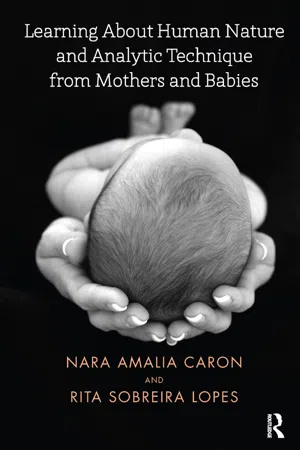
Learning About Human Nature and Analytic Technique from Mothers and Babies
- 282 pages
- English
- ePUB (mobile friendly)
- Available on iOS & Android
eBook - ePub
Learning About Human Nature and Analytic Technique from Mothers and Babies
About this book
We have much to learn from mothers and babies, not just about early life psychic phenomena that are active in us, but also about the analytic technique, when the internal setting becomes more important than the analyst's interpretative capacity. The infant observation method is a useful tool for the refinement of psychoanalytic listening of primitive phenomena and for the development of the containment and receptive capacity in the analyst, or any professional who is dedicated to the early stages of development. This book is a living testimony of years of observation work with the Bick method, including pregnancy and delivery, and much more spent in the working through of this material, in these unforgettable - and usually inaccessible - first three years of life.
Information
PART I
THEORETICAL AND METHODOLOGICAL FOUNDATIONS
CHAPTER ONE
A place where verbalisation has no meaning
Mephistopheles. Not glad do I reveal a loftier mystery–
Enthroned sublime in solitude are goddesses; Around them is
no place, a time still less;
To speak of them embarrasses.
They are the Mothers!
Faust [terrified]. Mothers!
Mephistopheles. Do you fear?
Faust. The Mothers! Mothers! Strange the word I hear
Mephistopheles. Strange is it. Goddesses, to men unknown
Whom we are loath to name or own.
Deep must you dig to reach their dwelling ever;
You are to blame that now we need their favour
Faust. Whither the way?
Mephistopheles. No way! To the Unexplorable
Never to be explored; to the Unimplorable,
Never to be implored. Are in the mood?
There are no locks, no bars are to be riven;
Through solitudes you will be whirled and driven
Can you imagine wastes and solitude?
(Goethe, 2007, Faust II, Act I: Dark Gallery)
It will be observed that I am taking you to a place where verbalization has no meaning. What connection can there be, then, between all of this and psychoanalysis, which has been built on the process of verbal interpretations of verbalized thoughts and ideas? (Winnicott, 1988a, p. 92)
We intend to take you to this essentially feminine place where human beings begin their developmental journey and explore all the richness, vicissitudes, and demands of mothers who make themselves emotionally available for caring for their babies, there, where words have no meaning. Life starts in the maternal womb. It is our first home. Therefore, we invite you to enter this home, and we thank the mothers who generously opened this door for us.
When Winnicott1 invited us to this “unknown” place, he already had outstanding clinical experience, including more than forty years of intensive clinical work, 60,000 treatments of adults, children, adolescents, and mother–infant duos. He was secure enough to confirm his discoveries and to declare that the inevitable had happened: psychoanalysts could no longer ignore the human being’s dependence and primitive stages of development. He warned us about the psycho-analyst’s own resistances to enter this space, and also how they would have to face external opposition. Both the internal and external resistances transformed the mother–infant relationship into a sacred, forbidden place:
it is as if a work of art was being subjected to an analytic process. Can one be sure that the capacity to fully appreciate this work of art will not be destroyed by the search-light that is played upon the picture? It could indeed be well argued that these very early phenomena ought to be left alone, and I, who have found myself making a study of them, could not but insist that what we think we know about these intimacies is not useful reading material for artists, or for young mothers. The sort of thing that can be discussed when we look at these early phenomena cannot be taught. (Winnicott, 1989a, p. 251)
Winnicott gave a lot of careful thought to the study of early psychic phenomena. He was concerned not to interfere in them, and proceeded with caution, but he saw, in the subtleties of the mother– infant relationship, a great opportunity to learn about human nature:
we shall be caught up in the immense needs of the dependent infant and, in the countertransference, with the massive responsive processes which show us, to some extent, what is happening to parents when they have a child. (Winnicott, 1989a, p. 252)
Through the contact with the baby and the mother, he also saw the opportunity to learn about psychotic pathology and about the technique with these patients:
from schizoid patients, we can learn to observe mothers and infants, seeing more dearly what is found there. But essentially, however, it is from the mothers and the babies that we learn about the needs of psychotic patients or patients in psychotic phases. (Winnicott, 1988a, p. 101)
There are many challenges to anyone who decides to enter the “sacred area” of the mother–infant relationship, opening a field to important discoveries about human nature that can greatly contribute to the study of normal and pathological development, as well as to the analytic technique. First, you must have interest, curiosity, and courage to embark on the quest of the unknown and meet with the primitive, this place “inaccessible” by verbal language, memory, and other cognitive processes. We must also recognise the unknown and assume there is a lot to observe and learn.
It is worth remembering that it was in this spirit of curiosity about the depths of the soul that Freud, when working on the investigation of the unconscious, embarked on a fascinating and endless journey in search of the unknown in human beings. He emphasised that he had “learned the importance of observation as one of the best means to gratify his curiosity” (Freud, 1925d, p. 18). This great observer quality of psychic phenomena also developed thanks to Freud’s contact in Salpêtrière with Charcot, his great teacher and role model for his journey into psychoanalytic observation, which requires, in the words of Borgogno (2004), “A long inner journey … based on direct, uninterrupted and unique experience, love and dedication to the object of study” and whose product is “a knowledge that comes through a relationship that is the result of a deep contact and intense personal involvement” (p. 18, translated for this edition).
Freud (1923a) had already emphasised that psychoanalysis was defined as a method of investigation of mental processes that are inaccessible by any other means. Only in a second stage of the theory, after having conducted many investigations, did he face the challenge of turning these findings into a treatment technique, emphasising again the empirical roots of this science. He also highlighted that psychoanalysis is not a clearly defined system of basic concepts.
On the contrary, it keeps close to the facts in its field of study, seeks to solve the immediate problems of observation, gropes its way forward by the help of experience, is always incomplete and always ready to correct or modify its theories. (1923a, p. 253)
Freud’s genius, with his innate curiosity and few limits to his observations of psychic life, allowed him to capture a wide range of human phenomena in an extraordinary way. However, due to the difficult challenge of developing a theory and a technique, he had to ignore many aspects in order to focus more on others. Thus, evidencing that psychoanalysis is not intended to answer questions in a saturated way, he left many potentialities open so that other researchers could continue to advance and deepen psychoanalytic theory, as he himself had done throughout the development of it.
The “sacred area” of the early mother–infant relationship is an example of a potentiality in psychoanalysis that had to wait for future developments. Borgogno (2004) describes Freud’s special receptivity to the mother–infant relationship, its rhythms and primitive qualities, considered as a prototype of the hypnotist–hypnotised relationship. In 1892, at the beginning of his psychoanalytic career, Freud (1892–1893) describes a clinical treatment and an understanding of the vicissitudes of the mother–infant relationship for the first time. This is a case of a parturient with problems breastfeeding her baby, seen by him at home and written up as “A case of hypnotic healing”. Perhaps understanding the specific context in which the patient developed hysterical postpartum symptoms, Freud diagnosed her as “histérique d’occasion”. With this brief and early “descent to the realm of the mothers”, an expression created by Goethe in Faust and later adopted by Breuer and Freud, he left “a legacy of great responsibility … from which he distanced himself thanks to his leading spirit of investigator and conqueror” (Borgogno, 2004, p. 39, translated for this edition).
We should also remember Freud’s familiar proposition (1926d) that “there is much more continuity between intrauterine life and earliest infancy than the impressive caesura of the act of birth would have made us believe” (p. 137). Thus, the legacy left by Freud almost a century ago lay dormant for some time and was explored later, through the interest of some analysts in the earliest stages of human development, by means of psychotic pathology and, especially, through infant observation.
Esther Bick’s method of infant observation
Winnicott’s contemporary, Esther Bick2 not only invited us to enter this “sacred place” but offered us a method to observe the phenomena found there. She also believed that we had a lot to learn from mothers and infants, but not much to teach them.
When she presented her doctoral thesis on the development of twins, in Vienna, 1936, she was asked to use a stopwatch to measure the interaction between twins, count the number of social responses produced by each twin, and then compare them. Not satisfied with that experience and concerned about the training of child psychotherapists, she concluded that, in order to understand the development of the human personality, not taking into account the prevailing theories and methods, she should study the baby’s daily life in the family environment. Thus, she created the infant observation method which offers another way to delve deep into the human soul, have direct contact with the first infant experiences and interactions with his mother, and with the most primitive experiences in his natural environment3—the family—from birth up to two years of age.
We believe that the psychoanalytic method of infant observation created by Esther Bick in 1948 at the Tavistock Clinic in London Wick, 1964) is a royal road to the primitive in human beings and a great opportunity for analysts—not only those specialising in child or adolescent analysis, but also adult analysts—to develop certain refined listening capacities necessary to establish contact with the psychic phenomena of early life. She stated that this experience was important for many reasons, but mainly so that students in this area could more clearly understand the infantile experience of their young patients. They could better understand the non-verbal behaviour of children in their play, as well as children who neither speak nor play. Finally, the method provides for each observer an excellent opportunity to observe the development of a baby from birth, in his home setting, and in his relationship with the family, discovering for himself4 how such relationships originate and develop.
As far as professional training is concerned, Esther Bick also wished to provide the therapist with proper tools to better deal with the intense anxieties provoked by the work on primitive levels of emotional functioning.
Entering the depths of the Bick method, it is important to remember that it is divided into three stages: observation, written report, and seminar group supervision, in a series of challenges that we describe below.
First stage: observation5
During the first stage (the observation), with a pre-established internal and external setting for weekly visits at a specific time and place and a non-intrusive attitude, the observer begins her journey, which will be of two-year duration and in which she will observe the development of a baby inside his own home and with the family. Consistent with psychoanalytic listening based on evenly suspended attention, the observer—just as the analyst in the analytic session—does not take notes during the observation, or formulate hypotheses or a priori categories of facts to be observed.
Just as the analyst in the analytic process, the observer is invited, as much as possible, to step aside from her theories and merely observe, as proposed by Freud (1914d, p. 22): “I learned to control the speculative tendencies and follow my master’s Charcot not forgotten advice; to look at the same things again and again until they start to speak for themselves”.
In Bick’s (1964) words, in order to observe,
The observer must attain detachment from what is going on. Yet he must, as in the basic method of psychoanalysis, find a position from which to make his observations, a position that will introduce as little distortion as possible into what is going on in the family. He has to allow some things to happen and to resist others. Rather than actively establishing his own personality as a new addition to the family organization, he has to allow the parents, particularly the mother, to fit him into her household in her own way. But he must resist being drawn into roles involving intense infantile transference and therefore countertransference. (p. 559, my italics)
There can be many problems linked to intense transference which can be understood in the observer’s supervision or analytic treatment.
It is important to remember that the opportunity to follow the patterns that unfold and the baby’s emerging personality in interaction with his carers is anchored in a setting. This shows the close link with psychoanalysis; in other words, the same frequency and duration of sessions in the same place, attention to detail and to everything, the type of contract, continuous supervision, preferably with an experienced analyst, and understanding of conflicts and feelings with their dynamics.
The main difference between the observer-analyst in the infant observation setting and in the analytic setting is that in the former he is stripped of the interpretative tools usually used in the latter and becomes available to live an experience with the baby and the mother as a “participant observer” (Bick, 1964). This helps the observer to immerse himself in the emotional experience while strictly respecting the setting, and, at the same time, to be fully engaged in registering every event of life and indication of emotion.
One of the major challenges of this first stage—observation—is the intense internal activity caused by the live experience of the mother–infant dyad: the observer is thrown into a world of sensations, emotions, and primitive anxieties that have an impact in different ways and degrees, according to her personal makeup. Due to her non-interventionist attitude, she is in a privileged position to capture the mother–infant non-verbal communication through her own body and mind. The observer comes into contact with primitive states of helplessness and loneliness, usually experienced as strange-familiar or “uncanny”, to use Freud’s (1919h) expression.
The observer is in intense mental activity while listening; she is passive only in abstaining from action. This might help in understanding why Bick (1964) considered the observer as participant and, therefore, privileged. Thus, one could question the common criticism made that the observer “just looks” for two years. Listening involves all the senses. The presence of a baby stimulates regression to primitive states of mind and coenesthetic (bodily aware) communication, generating intense and wordless emotional experiences and physical sensations in the observer. She faces the challenge of living an experience together with the mother and the baby.
When Michel Haag went to London to do infant observation under Esther Bick’s supervision, he mentioned that Bick always began supervision with the words “I know nothing … I want to see … What is fundamental to teach on observation is to not jump into any conclusion, to come as a tabula rasa … you do not know and that is all” (Haag & Haag, 1997, p. 3, translated for this edition). For Haag, this was “Bick’s spirit”, and rule number one for the observer. The second rule for the observer is the attitude of non-interference, which overlaps with Freud’s abstinence rule and then of neutrality:
… The observer should only be a receiver; never ask for a change, no matter what it is (or even ask a question), or interfere, because if you modify the situation you will no longer observe it just as it is. (Haag & Haag, 1997, p. 4, translated for this edition)
It is a great challenge to be in the position of not knowing anything, like a tabula rasa, to be only a receiver, without intervening. Stripped of her interpretative tools, the observer is in a similar situation to the mother, who suffers changes in her body, relaxing and expanding to gradually give way to the baby.
The observer is also at the mercy of intense and often unspoken feelings: he feels tired, hungry, is invaded by a variety of physical sensations, and might feel like leaving. It is interesting to note that the observer, when immersed in the first stage (observation), does not mind at all this lowering of defences. He accepts “wearing the clothes” the observation situation provides for him.
This attitude of the observer–analyst requires great attention. In effect, she is using her own zoom to choose what to focus on in different situations: to focus, approach, specifying the detail, while simultaneously distancing herself in order to capture the whole. It is an alternating micro- and macroscopic looking, focused and evenly suspended attention, in which the observer can turn her emotional kaleidoscope to capture the subtlety of the images that emerge. To develop this multiplicity of attention while maintaining continuity between the different situations and understand the emotional resonance within the viewer is a true experience of evenly suspended attention...
Table of contents
- Cover
- Half Title
- Title Page
- Copyright Page
- Table of Contents
- About the Authors
- Dedication
- Preface
- Part I Theoretical and Methodological Foundations
- Part II Mothers’ and Babies’ Journeys in the First Three Years of Life
- Part III Back to the Beginning
- Notes
- References
- Index
Trusted by 375,005 students
Access to over 1.5 million titles for a fair monthly price.
Study more efficiently using our study tools.
Frequently asked questions
Yes, you can cancel anytime from the Subscription tab in your account settings on the Perlego website. Your subscription will stay active until the end of your current billing period. Learn how to cancel your subscription
No, books cannot be downloaded as external files, such as PDFs, for use outside of Perlego. However, you can download books within the Perlego app for offline reading on mobile or tablet. Learn how to download books offline
Perlego offers two plans: Essential and Complete
- Essential is ideal for learners and professionals who enjoy exploring a wide range of subjects. Access the Essential Library with 800,000+ trusted titles and best-sellers across business, personal growth, and the humanities. Includes unlimited reading time and Standard Read Aloud voice.
- Complete: Perfect for advanced learners and researchers needing full, unrestricted access. Unlock 1.5M+ books across hundreds of subjects, including academic and specialized titles. The Complete Plan also includes advanced features like Premium Read Aloud and Research Assistant.
We are an online textbook subscription service, where you can get access to an entire online library for less than the price of a single book per month. With over 1.5 million books across 990+ topics, we’ve got you covered! Learn about our mission
Look out for the read-aloud symbol on your next book to see if you can listen to it. The read-aloud tool reads text aloud for you, highlighting the text as it is being read. You can pause it, speed it up and slow it down. Learn more about Read Aloud
Yes! You can use the Perlego app on both iOS and Android devices to read anytime, anywhere — even offline. Perfect for commutes or when you’re on the go.
Please note we cannot support devices running on iOS 13 and Android 7 or earlier. Learn more about using the app
Please note we cannot support devices running on iOS 13 and Android 7 or earlier. Learn more about using the app
Yes, you can access Learning About Human Nature and Analytic Technique from Mothers and Babies by Nara Amelia Caron,Rita Sobreira Lopes in PDF and/or ePUB format, as well as other popular books in Psicología & Psicología del desarrollo. We have over 1.5 million books available in our catalogue for you to explore.