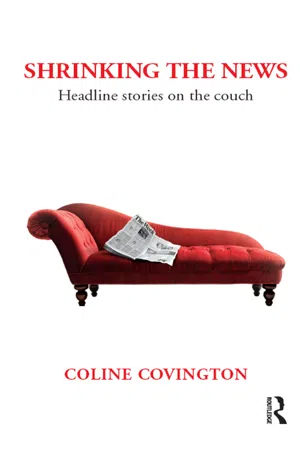
Shrinking the News brings together the author's wide range of articles from her regular column in the online newspaper, The Week. The articles cover current events from October 2008 until December 2010, concluding with more recent articles from 2013. These articles form a fascinating psychoanalytic insight on crime, politics, the economy, sports and stardom, and the quirky, bizarre events and trends that make up our daily life. The widespread popularity of these articles is a testimony to the public's interest in a psychoanalytic view of the world around us and why people do the things they do.
- 256 pages
- English
- ePUB (mobile friendly)
- Available on iOS & Android
eBook - ePub
About this book
Information
Shrinking the News

1
Why Palin appeals to shell-shocked Americans
She is the perfect leader for Americans eager to apportion blame for the Wall Street crisis
In the immediate aftermath of 9/11, nearly every American house and apartment building flew the national flag, and US foreign policy became in some respects as nationalistic and isolationist as it had during the McCarthy era. This was the first attack that the US had suffered on home soil since Pearl Harbor, and Americans felt more vulnerable than ever before.
This vulnerability was only exacerbated by the fact that capturing Osama bin Laden and conquering the forces of al-Qaeda were simply not happening the way they were meant to.
In the past weeks, we have witnessed an even greater attack on the US in the form of the collapse of its financial markets. What were once considered “safe-as-houses” investments are now suddenly in the high-risk category. Humpty-Dumpty has indeed had a great fall.
As a result, the US is suffering from narcissistic shell-shock. When the over-confident individual suffers a life blow that is beyond his control, his first response is usually to attempt to regain an illusion of control by blaming the “other”, whomever that “other” might be. Then, as a consequence of projecting blame onto others, the individual becomes paranoid about anything “other” or foreign, and this in turn can be used to justify further attacks. Finally, he retrenches into the stronghold of narcissistic behaviour and its promise of safety in power.
Because the financial crisis has been spawned from within the US, and not by outside enemies, it is trickier to deal with than 9/11. The “blame” is much harder to push onto “others”. One way of dealing with this kind of internal disaster/attack is by treating it as a kind of tsunami, or a phenomenon that is beyond our control and in the hands of God, nature, or fate.
Who could be better at spearheading this approach than Sarah Palin, McCain’s choice as vice-presidential candidate? She has deliberately perpetrated the image of the frontierswoman at a time when it is bound to be most appealing to members of a country that feels itself to be fighting against all the odds and that is anxious not only about losing ground (and face) but about what might be coming over the next hill.
The frontier spirit is just what is needed. The American Indians have been replaced by the Iraqis, ecological concerns have been wiped off the slate altogether under the “hand of God” approach, while the collapse of the financial markets can be understood as a temporary blip that simply needs tweaking to ensure continuing belief in a free-market economy.
Behind her policies, there is an assumption, as in the days of the American frontier, that there are endless possibilities for conquest, a wilderness with a surfeit of wildlife in no need of protection, and endless national resources to be tapped so that Americans can continue to drive huge cars on endless motorways, use air conditioning in the summer and winter, and get fat on a limitless supply of hamburgers and fake foods.
This belief in the bounty of the US is reassuring to say the least. When bounty fails and it is attributed to fate, this is also reassuring. The narcissist does not need to question his own role in destructiveness or as the cause of any problems; he can confer these neatly on to others or other reasons that do not incur his responsibility.
Most important, the narcissist does not need to accept limitations; he can remain omnipotent and maintain the illusion that he is at the centre of the world. This is very reassuring when things aren’t going so well, but it also has the unfortunate side effect of fostering paranoia.
Freud first came up with the idea of the “narcissism of minor differences” in 1918 when he was writing about sexual difference and extended this idea to encompass the paranoia and hatred that can emerge most fiercely among neighbours in times of crisis. Freud makes the link between narcissism and intolerance explicit in his 1930 essay Civilisation and Its Discontents, in which he explains our aversion towards strangers as a defensive function, or as a form of narcissism, in the service of self-preservation.
We try to ensure our self-preservation by projecting our aggression into the “other”, whether it is an individual or a group, so we can remain protected from it. When the crisis is within, the “stranger” is found within the group, creating a split between the good and bad, the powerful and the weak.
A consequence of the current financial crisis is that voters are now targeting Wall Street bankers as the new enemy within. Blame is not shared, nor is responsibility; it is pushed onto the “other”.
We can see Palin rising like Athena from Zeus’s brow ready to enter into battle to preserve the narcissism of the nation. She aims to maintain the purity of the frontier and the people by attacking the scientists, the educators, the politicians, and the economists—and let’s not forget the ecologists—who threaten the frontier movement by pointing out its limitations and its hazards.
1 October 2008
2
The danger of a banker with a power complex
The “do-something” culture of the financial world is ill-equipped to deal with panic
There is no petrol in the state of Tennessee. And for the first time in four years, the Dow Jones has fallen below the critical 10,000 mark. In London, too, shares fell yesterday to a four-year low. In short, panic has set in with the result that people are buying feverishly or not at all.
Our word “panic” comes from the Greek god Pan, the herdsman, who was famous for being able to inspire fear and disorder among people. The Olympian victory over the assault of the Titans was attributed to Pan’s power to create a “panic”. Whoever falls under the spell of a “panic” is in serious trouble.
The collapse of the financial markets has created a worldwide panic with inevitable repercussions. Even those who may be relatively untouched by what is going on have cause to worry. Individuals and institutions express their panic in one of two ways, with strikingly similar effects. There is the lemming-like behaviour in which, pressed to survive, the individual will carry on regardless of the circumstances, continuing to be active until he has actually jumped off the cliff into the icy waters to reach the other side. A perilous decision but one that is, ironically, in keeping with the way many financial institutions are run. In retrospect, Lehman Brothers’ plummet seems to fall into just this kind of category.
There is a well-established ethos in the City that is at the core of free-market capitalism and that is to be active, to produce, to acquire, to grow, to be in control. In short, it is to be powerful. The ones who get to the top are often, or at least so the mythology goes, the ones who are most driven and ruthless and, significantly, most active. They do more deals, make more money, and increasingly take more risks. We are now seeing this spiral unravelling with a trajectory just as breathtaking as its rise.
When those who are most driven and who are most anxious about staying in control face imminent danger, the reaction is more often than not to do something—in other words, to continue to drive on even harder. There are plenty of examples of investors who suddenly pull out of their rapidly dwindling investments and gamble on dark horses and back runners, only to lose the lot. They wave their arms around to show how much they are achieving in the midst of a crisis, and we can see many of them waving their arms as they race towards the cliff’s edge and fall off. In fact, it makes one wonder whether all this phallic behaviour has not been a major contributing factor in what may be the demise of capitalism as we know it.
The other reaction we are witnessing is perhaps more subtle but every bit as destructive. This is the individual who feels that the collapse of the market reflects his own failure and ineptitude and who voluntarily offers himself as a sacrificial lamb on the altar of financial recovery. Or, in other words, in anticipation of being laid off, this is the individual who offers to resign. We could call this the “inverse lemming” position.
The lemming in the first instance tries to allay his fears and those of others by becoming even more active in the deluded idea that he can reverse the trend by running even harder. The inverse lemming, on the other hand, is equally omnipotent in his thinking, but this takes the form of overwhelming responsibility and guilt that can only be alleviated by diving over the cliff, but this time by walking backwards.
Fortunately, not everyone in the financial world behaves like lemmings. There are some who manage to keep their heads amid the panic and lie in wait without having to do something to prove they are potent. But this is a position that requires a certain degree of passivity, which in itself is antithetical not only to the culture concerned but also extremely hard to maintain in the face of an adrenaline rush.
Being passive does not mean doing nothing. It means keeping a space open in our minds to observe what is happening and to think until the time is right to act. Then we can engage with the crisis rather than being driven to the brink by it, as captives of Pan.
7 October 2008
3
Frieze Art Fair: artistic or autistic?
Symptoms of autism among the Frieze artworks
Entering the huge Frieze Art Fair pavilion in Regent’s Park, you hear the sound of trickling water, an installation by Pavel Bucher. This is the first clue that nature and the environment are going to feature as a noticeable theme this year. But what is surprising is the particular way in which the environment is perceived and portrayed.
There are numerous examples of actual environments that have been re-assembled into art installations. The most striking is the Icelandic exhibit of an art bar, Sirkus, taken lock, stock, and barrel from Reykjavik by the gallery Kling and Bang and re-assembled next to the Caprice food concession.
Sirkus is a bar run by artists that opened in 1987 and recently closed. The structure and its contents, including barman and performance artists, have been faithfully re-created, and there is a long queue of fair-goers waiting to go in. The gallery claims that it has managed to create the environment of the original bar but in a different context. Nevertheless, this bar is for sale at £350,000, not including transport or VAT.
There are other examples of environments that have been similarly “airlifted” into the fair: a rubbish dump from the Appetite Gallery in Buenos Aires, with the artists rummaging through the garbage; a man in a suit—from the Fair Gallery—standing with a sign-board hung around his chest saying, “Help me to Find a Wife”.
While these installations have a humorous side, they came across like a pack of tourist postcards, simply replicating different environments and experiences. Rather than invite you into a world of fantasy and feeling, they distance the viewer from experiencing the actual threat our environment is under. So much so, that after several turns around Frieze, I began to feel I was surrounded by autistic objects in an autistic world.
In child development, autism is a normal state of mind in infancy in which pleasure is sought through bodily sensations, and objects in the external environment are used for this purpose and are not perceived as having a life of their own. It is a state of omnipotence over the environment that obliterates separation and relationship.
Autism becomes abnormal when an infant needs to defend himself against being left too much alone to cope with the hazards of the environment. This is experienced as a traumatic separation and loss. Then the infant retreats into a sealed-off world in which he tries to re-create this earlier sense of omnipotence.
It is a sensual world totally within his control. The environment is nothing more than a collection of objects, stripped of meaning except for the sensual pleasure they may give. This is why children and adults who suffer from autism are so impenetrable and so hard to relate to.
As well as the “airlifted” installations, environmental awareness is evident at Frieze in other pieces such as a water condensation chamber, constructed by the artist Tue Greenfort, that siphons off body moisture emitted by the fair-goers into plastic water bottles; a photograph of dead skinned bears nailed to a plank from the Moscow gallery Regina; a video of rats packed into a glass container trying to claw their way out, from another Moscow gallery, XL.
While these are all striking, and in some cases repellent, pieces, their conception is so concrete that they verge on the kitsch. But while it might be easy to classify them as merely ineffectual or “bad” art, seen together they convey something more disturbing to do with a desire to possess and control the environment so that it is reduced to an object, becoming two-dimensional.
Could this be a response to our increasing awareness of the lack of control we have over our environment, and to our fear of what we have already destroyed? Or is this an “autistic” response—an attempt to freeze time and space so that nothing can change or impinge on us or our worldview?
In the midst of the many two-dimensional objects and installations at Frieze, there are notable exceptions. The piece that seemed to stand out as a true expression of the pain and isolation of an autistic world was a sculpture by Anselm Kiefer, titled Paete non dolet (“She who cannot be touched does not grieve”), from White Cube.
The sculpture, made of plaster of Paris and fabric, shows a woman draped in a wedding dress, much like a caryatid, with a tangled cluster of barbed wire in place of her head. The juxtaposition of the inviting drapes surrounding the woman’s body and the barbed, impenetrable mental space portrays the pai...
Table of contents
- Cover
- Half Title
- Title Page
- Copyright Page
- Table of Contents
- About the author
- Preface
- 1 Why Palin appeals to shell-shocked Americans
- 2 The danger of a banker with a power complex
- 3 Frieze Art Fair: artistic or autistic?
- 4 The new feminism: how Michelle Obama is changing the rules
- 5 For glamour models, sex is in the eye of the camera
- 6 Financial failure is simply the final, fatal blow
- 7 Don’t bank on the buffalo: why we need to adapt or die
- 8 How can an Oxbridge Bishop deny the Holocaust?
- 9 Roman Abramovich and Chelsea: it’s all dad’s fault
- 10 Why Tzipi Livni craved the danger of a spy’s double life
- 11 Why Josef Fritzl thought rape was a “lovely idea”
- 12 How Jade Goody became the new Princess Diana
- 13 Nicholas Hughes was killed by Sylvia Plath, his envious mother
- 14 Inside this head: how paranoia turned Phil Spector into a killer
- 15 Why Britain’s Got Talent’s Susan Boyle makes people weep
- 16 Torturing terrorists is bad for your health
- 17 The psychological trauma behind surrogate pregnancies
- 18 Farrah Fawcett in denial as she films cancer battle
- 19 Why swine flu and torture provoke witch hunts
- 20 Ireland needs courage to change cycle of abuse
- 21 Why Americans can’t handle John Ensign’s affair
- 22 Pygmalion complex of the tennis parents who can never be satisfied
- 23 Miscavige’s reign of terror over Scientology
- 24 Narcissistic obsessions killed the Man in the Mirror
- 25 Antichrist director Lars von Trier plays god to create a new morality
- 26 Madness of wanting to be normal: Nancy Garrido’s make-believe family
- 27 What Hitler and Aids have in common
- 28 Why the world is scared of hermaphrodites
- 29 The fear behind Japan’s flourishing rent-a-friend business
- 30 What were Geimer and Shields’ mothers thinking?
- 31 Women paedophiles come out of hiding
- 32 The new trend in beards raises awkward questions
- 33 Radovan Karadžić: all the signs of a psychopath
- 34 You’re the one! Dangers of internet dating
- 35 Is Khmer Rouge jailer Duch just a nobody?
- 36 Why some women bosses turn into bullies
- 37 What deniers of climate change are really denying
- 38 Jessica Davies’ heady cocktail of sex and pain
- 39 Edlington brothers: why boredom turns to torture
- 40 Pope John Paul II: saint or closet masochist?
- 41 Sports stars lose out to philanthropists as today’s heroes
- 42 Tokyo: when a “splitter-upper” goes too far
- 43 The biggest bully is inside Gordon Brown’s head
- 44 Less clever men are more likely to cheat. Really?
- 45 Why Jon Venables wants to reveal his true identity
- 46 Chatroulette and perverts who want to attack mother
- 47 The spread of rape spells madness in the Congo
- 48 None of the party leaders is offering us charisma
- 49 TV’s virgin auctions: who pays the highest price?
- 50 Derrick Bird: mentality of a suicide bomber
- 51 Congress vs. Hayward: how it became a witch hunt
- 52 Aimee Sword: the hate that turned to incestuous love
- 53 Joanne Lee suicide pact: the comfort of strangers
- 54 The guilt that binds Ed and David Miliband together
- 55 Does Julian Assange suffer from being a mama’s boy?
- 56 Why the world will weep for Nelson Mandela
- 57 Criado-Perez scare: what turns men into misogynist bullies?
- 58 Ed Miliband and the problems of being Ralph’s heir apparent
Trusted by 375,005 students
Access to over 1.5 million titles for a fair monthly price.
Study more efficiently using our study tools.
Frequently asked questions
Yes, you can cancel anytime from the Subscription tab in your account settings on the Perlego website. Your subscription will stay active until the end of your current billing period. Learn how to cancel your subscription
No, books cannot be downloaded as external files, such as PDFs, for use outside of Perlego. However, you can download books within the Perlego app for offline reading on mobile or tablet. Learn how to download books offline
Perlego offers two plans: Essential and Complete
- Essential is ideal for learners and professionals who enjoy exploring a wide range of subjects. Access the Essential Library with 800,000+ trusted titles and best-sellers across business, personal growth, and the humanities. Includes unlimited reading time and Standard Read Aloud voice.
- Complete: Perfect for advanced learners and researchers needing full, unrestricted access. Unlock 1.5M+ books across hundreds of subjects, including academic and specialized titles. The Complete Plan also includes advanced features like Premium Read Aloud and Research Assistant.
We are an online textbook subscription service, where you can get access to an entire online library for less than the price of a single book per month. With over 1.5 million books across 990+ topics, we’ve got you covered! Learn about our mission
Look out for the read-aloud symbol on your next book to see if you can listen to it. The read-aloud tool reads text aloud for you, highlighting the text as it is being read. You can pause it, speed it up and slow it down. Learn more about Read Aloud
Yes! You can use the Perlego app on both iOS and Android devices to read anytime, anywhere — even offline. Perfect for commutes or when you’re on the go.
Please note we cannot support devices running on iOS 13 and Android 7 or earlier. Learn more about using the app
Please note we cannot support devices running on iOS 13 and Android 7 or earlier. Learn more about using the app
Yes, you can access Shrinking the News by Coline Covington in PDF and/or ePUB format, as well as other popular books in Psychology & History & Theory in Psychology. We have over 1.5 million books available in our catalogue for you to explore.