At a time when strategic spatial planning is undergoing a renaissance in Europe, The Visual Language of Spatial Planning makes a unique contribution to this rapidly growing area of teaching and research. Discussing the relevant theoretical perspectives on policy-making and planning, combined with cartographic communication and the use of cartographic representations in the planning process, Stephanie Duhr provides conceptual and practical tools to help students and practitioners better understand maps and visualizations in strategic spatial planning.
The book is the first to review the form, style and use of cartographic representations in strategic spacial plans in the Netherlands, Germany and England as well as at European level. Significant differences between planning traditions and the impact of these on transnational planning processes are highlighted. It concludes by discussing the practical implications for future strategic spacial planning processes in Europe and the best use of cartographic representations to reach agreement and to focus dialogue.
CHAPTER 1 EUROPEAN SPATIAL DEVELOPMENT AND CARTOGRAPHIC REPRESENTATIONS
CARTOGRAPHIC REPRESENTATIONS IN SPATIAL PLANNING IN EUROPE
The conceptualisation of the territory through spatial images is an integral part of spatial planning. In most traditions of spatial planning1 in Europe, planning policy documents involve a symbolic representation of the territory in the form of icons, diagrams and maps. The illustration of spatial policy options through maps and other cartographic representations2 can be very powerful both in the planning process and in communicating the key messages of planning strategies. Drawn images are used to support verbal statements of policies, or they directly express policies (Faludi, 1996a), and through their communicative power and clarity might ‘contribute more to achieving certain political goals than legal and financial instruments’ (Kunzmann, 1996: 144).
During the planning process, communicating policy objectives through policy maps can help to reach agreement by revealing different parties’ priorities for spatial strategies for the territory. They are furthermore said to assist in mediating conflicting interests (Healey et al., 1997), setting agendas and shaping attention (Forester, 1989), and can help to incorporate different viewpoints (Robbins, 1997). Cartographic representations can help to focus dialogue and to shape discourses, but they may also be used to manipulate other participants in the process by distorting or highlighting certain facts (Pickles, 1992; Neuman, 1996, 2000). Setting up a certain form of discourse through visualisation as the central instrument of communicative interactions sets limits, defines agendas, and creates social hierarchies. Thus, the illustration of spatial policies can act as an instrument of cultural power (Robbins, 1997). The decision on what should be ‘put on the map’, and how it is going to be presented, opens up great potential to shape discourse, to empower some parts of the public or the territory, and to disadvantage others. The product of the planning process – the final key diagram or policy map – again can help to raise awareness of the planning strategy and the policy objectives. As a product, cartographic representations can help to shape attention for relevant spatial issues, to communicate messages and to stimulate action at lower tiers of government, or within the private sector.
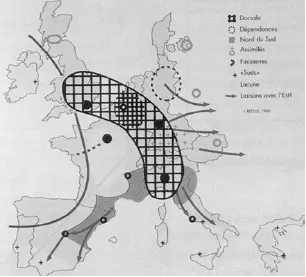
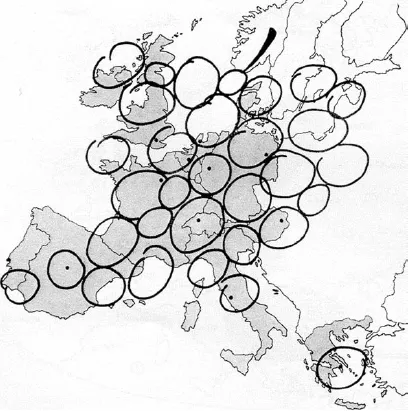
There are examples of cartographic illustrations, notably the metaphor of the ‘Blue Banana’ (Reclus, 1989) (see Figure 1.1), that have been very successful in raising awareness and understanding about complex spatial development trends at European level. The ‘Blue Banana’ identifies a highly developed area stretching from the south-east of England to the north of Italy. The ‘Blue Banana’ has often been criticised for the rather simplistic representation of core and periphery in Europe. Nevertheless, this powerful image has become central to transnational and national planning discourses, and has prompted an increasing number of alternative spatial conceptualisations of the European territory, such as the ‘European Bunch of Grapes’ (see Figure 1.2), which, rather than conceptualising economic realities, present a desirable (or normative) future for Europe by visualising a polycentric structure of competitive urban agglomerations instead of one economic core region (Kunzmann and Wegener, 1991).
Figure 1.1 ‘Dorsale Européenne’ or the ‘Blue Banana’
Source: Reclus (1989); reproduced in VROM, 2000: 25
The need for collaboration amongst countries and regions because of the increasingly transboundary nature of urban and regional development, and the growing interdependence of nations, is promoted by both the European Union and the Council of Europe. Transboundary collaboration, consequently, has steadily expanded at the European, multilateral and bilateral levels since the beginning of the 1990s. Cartographic illustrations are a central communication medium for the planning discipline, and their potential role in transnational spatial planning processes outside a formal legal competence and established planning discipline is unquestionable. In transnational planning processes, the use of cartographic representations can help to frame spatial policies (Faludi 1996a) for an ‘unexplored’ territory (i.e. an area outside the ‘normal’ sphere of action of planners). Other authors have recognised that the use of images can support institution-building (Neuman, 1996, 2000) and help to overcome language barriers (Sinz, 1997; Kunzmann, 1996) when discussing policy options at supranational scale.
Figure 1.2 The ‘European Bunch of Grapes’
Source: Kunzmann and Wegener (1991: 67)
However, conceptualisation and visualisation can be very difficult in multilateral strategic spatial planning processes, where different planning cultures come together (Zonneveld, 2000). The discussion of policy maps for the first ever spatial strategy for the EU territory, the ‘European Spatial Development Perspective’ (ESDP) (CSD, 1999), for example, was accompanied by controversial debates on the cartographic representation of future scenarios for the European territory. This potential for conflict might be rooted in different planning cultures: there are significant differences in how planning is conducted in different European member states, and these differences also extend to the form, style and use of cartographic representations in different spatial planning systems.
These differences in European countries’ approaches to visualising spatial policy, and the influence of these differences on transnational spatial planning processes, are the focus of this book. In the following sections, the European territorial co-operation agenda will be discussed, followed by a review of experiences with visualising the European territory in transnational and national spatial strategies to date.
EUROPEAN INTEGRATION AND SPATIAL DEVELOPMENT
Intergovernmental co-operation on the use of European space has a long tradition, and some agreements, such as the Rhine Treaty, date back to the nineteenth century. The interest in co-operation between European countries increased significantly after World War II, and the first supranational administrative authorities were set up in the 1950s. Many bilerateral co-operation agreements between European countries, for instance the Benelux countries, have been in place now for several decades, and some multilateral conferrals have been institutionalised early on (for example the Conference on Spatial Planning in North West Europe, CRONWE, in 1962). The main reasons for these co-operation efforts can be found in the rapid urbanisation and industrialisation in north-west Europe, and the effects on the economy and standard of living that this implied.
However, a specific interest in supranational spatial development and European initiatives directly focusing on spatial planning only gained more importance during the 1990s. This growing interest in European spatial planning was fuelled by the recognition that in the light of ongoing European integration and EU enlargement there is a need to co-ordinate objectives and policies across the European territory (CEC, 1998). Territorial development effects stemming from globalisation, the Economic and Monetary Union (EMU) and the completion of the Single Market, the enlargement of the EU to twenty-five members in 2004, and the increasing functional interdependences of regions and nation-states due to technological changes in communication and transport are all reasons for improved European co-operation. The issue of spatial disparities and concern about the impact of global economic change are at the heart of European policy-making. Although this is not always explicitly referred to as spatial policy, there is growing recognition amongst policy- and decision-makers in Europe that sectoral policies have (sometimes counterproductive) spatial impacts and that spatial planning might provide a mechanism for co-ordinating the territorial impacts of various sectoral policies – both horizontally across different sectors as well as vertically among different levels of government (Williams, 1996).
THE COMPETENCE ISSUE: THE LEGAL BASIS FOR SPATIAL PLANNING AT EU LEVEL
Despite this increasing understanding of interdependences of the spatial impacts of policy sectors, the European Community has no legal competence in spatial planning. One of the main reasons for this are the very divergent views on the necessity, function and institutional capacity of a European spatial policy amongst the different EU member states (cf. Faludi, 2003). Yet, while there is no direct competence, there is a certain consideration of ‘spatial planning’ issues in the European Treaties, which are often related to the EU’s regional policy or other spatially relevant policy areas such as environment or transport.
The European Regional Development Fund (ERDF) was initiated on the basis of Art. 235 of the Treaty of Rome by a 1975 Council decision in order to deal with regional economic disparities within the European Community (Fit and Kragt, 1994). The regional policy objectives were reinforced in the Single European Act (1987), which stated that ‘the Community shall aim at reducing disparities between the levels of development of the various regions and the backwardness of the least-favoured regions’ (Art. 130a). The Single European Act removed restrictions and trade barriers in many areas of European activity. The ‘four freedoms’ of the single market were expected to contribute to economic growth, though mainly in the inner core of Europe and thus possibly leading to a more uneven distribution of development potential (Faludi and Waterhout, 2002).
The Treaty of Maastricht on the European Union of 1992 provided for a ‘Cohesion Fund’, which financially contributes to projects in the field of the environment, and in the area of transport infrastructure to Trans-European Networks (TENs). The Treaty of Maastricht gave a new emphasis to European spatial development policy by:
increasing democratic control by the European Parliament in the form of a right of veto over the formulation of the structural funds (Art. 130d EU Treaty);
introducing the principle of subsidiarity3 (Art. 3b EU Treaty); and
establishing the Committee of the Regions (CoR) consisting of regional and local authorities (Art. 198a–c EU Treaty).
Beyond that, the treaty contained general ideas on the spatial development of the Union regarding ‘the creation of an area without borders’ and ‘the promotion of economic and social cohesion’, to be achieved through the following objectives and measures:
reducing disparities between the levels of development of the various regions (Art. 130a EU Treaty);
development of Trans-European Networks (Art. 129b, para. 1 EU Treaty);
preserving, protecting and improving the quality of the environment (Art. 130r, para. 1 EU Treaty);
prudent and rational utilisation of natural resources (Art. 130r, para. 1 EU Treaty); and
respecting the national and regional cultural diversity (Art. 128, para. 1 EU Treaty).
The Maastricht Treaty also for the first time mentions ‘town and country planning’ (Art. 130s EU Treaty) explicitly, although this is done under the environment title. However, the treaty clarifies that town and country planning is restricted to unanimous voting of the member states, and that therefore any future decision related to planning matters could be subject to a national veto of a single country.
The Amsterdam Treaty (1997) acknowledged the harmonious, balanced and sustainable development of the European territory as one of the essential aims of the European Community. One of the most significant aspects of the Amsterdam Treaty is that it introduced the term ‘territorial cohesion’ in Art. 16 of the consolidated version4 (which has since replaced the term ‘spatial planning’ in the European Commission’s vocabulary, albeit a clear definition of territorial cohesion is yet missing (cf. Faludi, 2005)). Whereas the promotion of social and territorial cohesion is a Community and member state task within their respective competences, the Amsterdam Treaty emphasised the significance of environmental protection and of improvement in environmental quality as Community tasks (Art. 2) (CSD, 1999).
The Treaty of Nice (2000) laid the ground for keeping European institutions well balanced in the light of enlargement of the EU. In May 2003 the Convention on the Future of Europe formally submitted a wide range of proposals for EU policy-making, the division of powers, the functioning of European institutions and voting systems. The draft ‘Treaty establishing a Constitution for Europe’ includes a clearer reference to the territorial dimension of cohesion, and defines territorial cohesion as one of the goals of the EU besides economic and social cohesion (Art. 3) and as a competence shared between the Union and the member states (Art. 13). However, many proposals in the draft Constitution have caused significant debate, and, following rejection of the Constitutional Treaty by France and the Netherlands in 2005, the process of ratification has been delayed.
INITIATIVES ON EUROPEAN SPATIAL PLANNING
Although the European Community has no direct competence for spatial planning, there are a number of initiatives that are relevant for the spatial development of the European territory. In 1968 the Council of Europe (CoE) recommended the setting up of a permanent Conference of Ministers (CEMAT), which held its first conference in 1970, and has convened regularly since. In 1983 the European Charter for Spatial Planning (the ‘Torremolinos Charter’) was adopted, which set out an agreement on common principles for spatial policy to be pursued in the member countries of the Council of Europe. The charter promoted the idea that planning was an important political matter for all authorities from local to European levels, that it should seek co-ordination between policy sectors, and that it should be democratic, comprehensive, functional and future-oriented in order to contribute to a better organisation of the European territory (Williams, 1996). Based on the ‘Torremolinos Charter’, the legally non-binding ‘Guiding Principles for Sustainable Spatial Development of the European Continent’ (CEMAT, 2000) were approved by the forty-one member states of the Council of Europe in September 2000.
Within the EU, the joint elaboration and co-ordination of spatial policy and action across national boundaries increased considerably during the 1990s following the ratification of the Maastricht Treaty and the political support given to spatial planning initiatives at cross-border and transnational level. The need to develop strategies to guide the development of the European territory has since emerged as an important issue in the policy debate. The European Commission analysed spatial development trends primarily through the documents Europe 2000 (CEC, 1991) and Europe 2000+ (CEC, 1994). Europe 2000 stated that ‘it makes no sense for planning to stop artificially at national borders’ (CEC, 1991: 3), and this made a significant contribution to raising awareness about the wider processes which shape development at the transnational and European scale. At the root of initiatives that encourage transnational or European co-operation on spatial planning is the recognition that there are some issues that countries cannot take on independently, such as cross-national infrastructure, flood prevention, environmental pollution or ecological networks.
In the absence of a clear competence for spatial planning for the European Commission, the Europe 2000-studies recognised the importance of national and regional planning systems and policies for transnational planning initiatives. However, variations in the way the systems operate, and differences in the meaning of spatial planning across member states, were recognised as presenting a considerable challenge for further co-operation across national borders. A better understanding of the meaning and operation of planning systems in other countries was therefore seen as a prerequisite to more effective transnational working, and fuelled the interest in comparative studies. The EU Compendium of Spatial PlanningSystems and Policies (CEC, 1997) was commissioned by the European Commission in order to provide a comparative perspective on the planning systems of the EU-15 member states.
The fall of the Iron Curtain and German reunification in the early 1990s presented new challenges for European co-operation in the field of spatial planning. The Ministers of EU member states responsible for spatial planning ther...
Table of contents
Cover Page
Title Page
Copyright Page
ILLUSTRATIONS
ACKNOWLEDGEMENTS
ABBREVIATIONS
CHAPTER 1: EUROPEAN SPATIAL DEVELOPMENT AND CARTOGRAPHIC REPRESENTATIONS
CHAPTER 2: THEORETICAL PERSPECTIVES ON POLICY-MAKING AND PLANNING, CARTOGRAPHIC COMMUNICATION AND THE USE OF CARTOGRAPHIC REPRESENTATIONS IN THE PLANNING PROCESS
CHAPTER 3: CONCEPTUALISING THE CONTEXT, FORM AND USE OF CARTOGRAPHIC REPRESENTATIONS IN FORMAL AND INFORMAL PLANNING PROCESSES
CHAPTER 4: THE STYLE AND CONTENT OF CARTOGRAPHIC REPRESENTATIONS IN STRATEGIC SPATIAL PLANNING IN THE NETHERLANDS, GERMANY AND ENGLAND
CHAPTER 5: THE USE OF CARTOGRAPHIC REPRESENTATIONS IN THE PREPARATION OF THE EUROPEAN SPATIAL DEVELOPMENT PERSPECTIVE
CHAPTER 6: THE VISUAL LANGUAGE OF SPATIAL PLANNING IN EUROPE: CONCLUDING REMARKS
APPENDIX: NOTES ON CONTRIBUTORS
NOTES
REFERENCES
Trusted by 375,005 students
Access to over 1.5 million titles for a fair monthly price.
Study more efficiently using our study tools.
Frequently asked questions
Yes, you can cancel anytime from the Subscription tab in your account settings on the Perlego website. Your subscription will stay active until the end of your current billing period. Learn how to cancel your subscription
No, books cannot be downloaded as external files, such as PDFs, for use outside of Perlego. However, you can download books within the Perlego app for offline reading on mobile or tablet. Learn how to download books offline
Perlego offers two plans: Essential and Complete
Essential is ideal for learners and professionals who enjoy exploring a wide range of subjects. Access the Essential Library with 800,000+ trusted titles and best-sellers across business, personal growth, and the humanities. Includes unlimited reading time and Standard Read Aloud voice.
Complete: Perfect for advanced learners and researchers needing full, unrestricted access. Unlock 1.5M+ books across hundreds of subjects, including academic and specialized titles. The Complete Plan also includes advanced features like Premium Read Aloud and Research Assistant.
Both plans are available with monthly, semester, or annual billing cycles.
We are an online textbook subscription service, where you can get access to an entire online library for less than the price of a single book per month. With over 1.5 million books across 990+ topics, we’ve got you covered! Learn about our mission
Look out for the read-aloud symbol on your next book to see if you can listen to it. The read-aloud tool reads text aloud for you, highlighting the text as it is being read. You can pause it, speed it up and slow it down. Learn more about Read Aloud
Yes! You can use the Perlego app on both iOS and Android devices to read anytime, anywhere — even offline. Perfect for commutes or when you’re on the go. Please note we cannot support devices running on iOS 13 and Android 7 or earlier. Learn more about using the app
Yes, you can access The Visual Language of Spatial Planning by Stefanie Dühr in PDF and/or ePUB format, as well as other popular books in Architecture & Architecture General. We have over 1.5 million books available in our catalogue for you to explore.