eBook - ePub
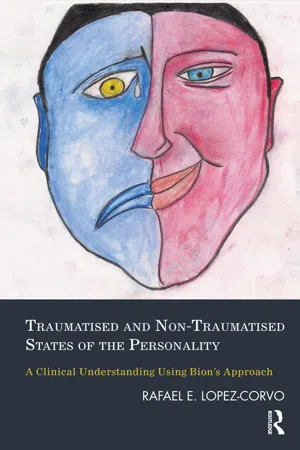
Traumatised and Non-Traumatised States of the Personality
A Clinical Understanding Using Bion's Approach
- 368 pages
- English
- ePUB (mobile friendly)
- Available on iOS & Android
eBook - ePub
Traumatised and Non-Traumatised States of the Personality
A Clinical Understanding Using Bion's Approach
About this book
This book provides, using Bion's insightful legacy, a practical and useful instrument to safely navigate the psyche. It offers an original conception of trauma and of the working mind between "traumatised" and "non-traumatised" states based on essentials taken from Bion's contributions.
Information
CHAPTER ONE
“Evicted from life”: time distortion between pre-conceptual and conceptual traumas*
You were not even able to see life, how can you see death? Death is more subtle.—Osho
Tao: The Pathless Path (p. 27)
We live a rented life from which we will be eventually evicted, all that we can hope for is that the eviction won’t be too tormenting.—Emilia
“Trauma entanglement”
Is it the present that provides meaning to the past or is it the other way around? Laplanche and Pontalis (1967) stated:
It is not lived experiences in general that undergoes a deferred revision but, specifically, whatever it has been impossible in the first instance to incorporate fully into a meaningful context. The traumatic event is the epitome of such unassimilated experience. (p. 112)
I distinguish between “conceptual” and “pre-conceptual” traumas, as events that take place at different times. The first represents emotional reactions that take place at an adult age, when due to frustration intolerance, conscious alpha function falls short in containing and metabolising a given traumatic situation. There is a large literature on “post traumatic stress disorders” (PTSD). “Pre-conceptual traumas”, on the other hand, take place at an early age, when a mind capable of metabolising the facts was not yet present and the mother’s reverie or unconscious alpha function failed. I have chosen an expression used in quantum physics—“quantum entanglement”—to refer to the correlation or interconnection between objects that make up a system, even if the individual objects are spatially separated.1 Very often some situations that take place at a mature age can become traumatic mostly because they automatically elicit emotions that echo similar or “entangled” feelings from previous pre-conceptual traumas,2 which seem to remain always lying in waiting. From this statement we could conjecture, as Freud (1895) stated, that “conceptual traumas” always contain “deferred actions”, or better, “deferred emotions” from “pre-conceptual” traumas. This is an old assumption already introduced by Freud in 1896 in “The etiology of hysteria”, where he established that:
We have learned that no hysterical symptom can arise from a real experience alone, but that in every case the memory of earlier experiences awakened in association to it plays a part in causing the symptom. (p. 197)
Although the adult mind has the capacity to use “discontinuous”3 forms of symbolisation to contain primitive emotions and change them into alpha elements, the ego can, nonetheless, become overwhelmed by a present situation and feelings of helplessness, hopelessness, and nameless dread, similar to those which ruled the ego at an early age. These feelings might appear again with almost the same effect, as if time has not elapsed. It is a condition directly related to intolerance of frustration and hate of reality, present in a mind dominated by the traumatised state of the personality. In this situation, when the adult ego fails to tolerate a frustration from reality, unconscious emotional aspects from the pre-conceptual trauma take over automatically, and the original trauma is again re-experienced before the alpha function can intervene. It is a mechanism Bion referred as “reversal of alpha function”, which I have mentioned in the Introduction and which will be considered in detail at the end ofChapter Three. Such conditions will require an exercise of immediate reverie and containment from the alpha function present in the non-traumatised adult element towards the child (traumatised) part. I believe that what opposes reality is not a satisfaction of drives, but a high level of frustration intolerance induced in the ego when unassisted by the conscious alpha function. A dialectic is then established as a form of reality testing between the actual situation that inundates the ego and pre-conceptual traumas stored as beta elements; it bears some similarity to Freud’s theory of signal anxiety. The correlation is not between pleasure and reality, but between “being-dreaming” or “being awake”, contingent on the existence of an alpha function and contact barrier. “Being-dreaming” stands for something similar to what Plato stated in the “Allegory of the Cave”, whereby one is driven by lies or distortion of the facts, because of poor frustration tolerance and terror of the violence of truth.
There are two forms of “deferred emotions”, depending on the intensity of pre-conceptual and conceptual traumas: a) one subtle and continuously performed through reality testing, where the ego either succeeds or fails in discriminating between outside reality from the present and inside reality (pre-conceptual trauma) from the past. This form of deferred action hinges on the quality and intensity of pre-conceptual traumas; b) there is also another kind, resulting from conceptual traumas triggering unconscious emotions from pre-conceptual traumas. This form of deferred action depends more on the quality and intensity of conceptual traumas.
In Chapter Eight, I refer to the change in emotional links, from negative to positive, needed in order for adults to modify the negative impact of their experience of parents during childhood, when their pre-conceptual trauma took place. Such early identifications have been stored in the adult superego and are unconsciously acted out now in later life between internal part objects, in a similar fashion to the way they were once acted out by the parents towards the child. A short vignette will be helpful. After seven years of analysis, Patty, a patient who had used intellectualisation as a central form of defence, was referring to a significant change of attitude towards her mother, and older brother, whom she deeply resented because she felt he was her mother’s favourite while she felt always excluded. She read from a very touching letter she had just received from her ageing mother, thanking her for a card the patient had send her for her birthday, something she had seldom done before. I sensed in the countertransference the sadness elicited by the message, but Patty started to laugh compulsively. I asked her why she was laughing if there was nothing funny, and then she burst into painful tears. Laughing was a defence, a fearful denial of wounding emotions; but it was also the expression of an attitude towards a hurt, sad, lonely “child element” in her, as if the “out of place laugh” represented an internal callous and ignorant element, analogous to a mother who could have laughed at her child’s emotional misery. It was as if there was not proper containment from the “adult part” towards the sad “child element” in her, and a lack of positive emotions of self love and concern. She was now repeating in her own mind—through the interaction between a superego traumatic, callous element and an ego helpless, submissive part—the same situation she had continuously complained about during the analysis, namely, that which had taken place between her mother and herself as a child.
In this chapter I will present a clinical case to investigate how pre-conceptual traumas obstruct the possibility of dealing with the emotions that a true and violent threat of death can produce. Intense feelings linked to the phenomenology of early traumatic events obscured the true facts of the condition present at the time of the patient’s analysis. Before I deal with the clinical material it will be helpful for us to first consider some aspects related to death and the death drive.
The death drive
There are two conditions linked with existence which human beings never seem able to get fully accustomed to, and to whose presencewe always react with utter surprise, even dealing with them as if they were absolutely new and unfamiliar: one is related to the beginning of life and the other to its end; one related to coitus and sex, the other with death.4 Although Freud acknowledged sexuality very early, he did not recognise the significance of the “death instinct”’ until 1920, when it was already too late for its phenomenology to acquire the same relevance that “libido” previously had. Peter Gay (1988) has presented this situation as follows:
What came to puzzle him, [Freud] then, as it puzzled others, was only why he should hesitate to elevate aggressiveness into a rival of libido. “Why have we ourselves,” he asked later, looking back, “needed such a long time before we decide to recognize an aggressive drive?” A little ruefully he recalled his own defensive rejection of such drive when the idea first appeared in the psychoanalytic literature, and “how long it took before I became receptive to it”… In those years [concluded Gay] Freud had simply not been ready. (p. 396)
But besides its late recognition, there were also other complications. Awareness of the existence of the “death drive” was a slow process in Freud’s investigations. “It is essential, in addition,” said Laplanche and Pontalis (1967), “to relate the concept of the death instinct to the evolution of Freud’s thought, and to discover what structural necessity its introduction answers to in the context of the more general revision known as the turning-point of the 1920s” (1967, p. 97), when he finally introduced the notion of this drive as we know it at present. The death instinct remains to this day as controversial as it was in 1920. In a previous publication I expressed the following:
The first attempt to describe the death instinct on equal footing with the sexual was not from Freud, but produced by Sabina Spielrein, a Russian doctor who, after a psychotic break [hysterical?], was “successfully” analyzed by Jung at Burgholzli from 1904 to 1908, becoming afterwards his mistress. In 1911 she presented a paper to Freud and his group at the Wednesday meeting in Vienna, with the suggestive title of “Destruction as the Cause of Becoming”,5 about which, in a letter to Jung dated March 21, 1912, Freud stated: “As for Spielrein’s paper, I know only the one chapter that she read at the Society. She is very bright; there is meaning in everything she says; her destructive drive is not much to my liking, because I believe it is personally conditioned. She seems abnormally ambivalent” (Van Waning, 1992, p. 405). (López-Corvo, 1995, pp. 114–115)
Freud had a similar disagreement with Adler around the same time, arguing that he was overemphasising the importance of aggression. Gay (1988) had this to say:
He [Freud] had long patiently listened to Adler, but no more. In this mood, he could not recognize that some of Adler’s ideas, like his postulate of an independent aggressive drive, might be valuable contributions to psychoanalytic thought. Rather, he bestowed on Adler the most damaging psychological terms in his vocabulary. (pp. 222–223)
In 1920, when Freud finally changed from a monistic to a dualistic conception of his theory of drives, he provided in a footnote written in Chapter Six of “Beyond the pleasure principle”, some recognition of the work of Spielrein:
A considerable portion of these speculations have been anticipated by Sabina Spielrein (1912) in an instructive and interesting paper which, however, is unfortunately not entirely clear to me. She there describes the sadistic components of the sexual instinct as “destructive.” (1920, p. 55)
Ten years later, in 1930, in “Civilization and its discontents”, Freud confessed: “I remember my own defensive attitude when the idea of an instinct of destruction first emerged in psychoanalytic literature and how long it took before I became receptive to it” (p. 120). I have previously stated that
[o]thers believe, although Freud himself denied it, that it took a worldwide conflagration such a World War I for Freud to become aware of the inconceivable amount of aggression harboured within the human spirit. Perhaps it was difficult to imagine such wrath during the epoch of a peaceful Europe and a gentle Vienna, where the main clinical issues brought to the consulting room were the fear of pregnancy in an already large family, onanism, repressed sexuality, hysterical symptomatology, and psychosis. (López-Corvo, 1995, p. 116)
Klein, on the other hand, gave the death instinct an even greater relevance, by making it emblematic in her contributions to the metapsychology of envy. Obviously, we also have to consider that times have changed and sexuality does not suffer the same severity of repression as it did during the Victorian period, making aggression, as a consequence, a more present drive during our everyday psychoanalytic work.
About death
I believe that what makes sex and death be experienced as always something new, is repression; perhaps more death than sex. Buddhism, for instance, has alerted us to the tendency to make death unfamiliar and to deny its fatalistic presence. In the Añguttara-Nikaya (iii. 35),6 one of the sacred books of Buddhism, King Yama argues with his priests about their ignorance and fear of death:
Death has three messengers … Did you not see the first of death’s messenger visibly appear among men? He replies: “Lord I did not” … Oh man! Did you not see among men and women eighty or ninety or a hundred years of age, decrepit … bowed down, leaning on a staff, trembling as he walked …? He replies, “Lord, I did” … Oh man! Did you not see the second of death’s messengers visibly appear among men? “Lord, I did not” … Oh man! Did you not see among women or men, diseased, suffering, grievously sick …? He replies, “Lord, I did” … Oh man! Did you not see the third death’s messenger visibly … “Lord, I did not” … Did not you see … a woman or man that has been one day dead, or two days dead … and had been swollen, black … He replies, “Lord, I did” … Oh man! Did it not occur to you, being a person of mature intelligence and years, “I also am subject to [old age, to disease] to death, and in no way exempt …?” … “Lord I did not think”. (pp. 94–95)
There are recorded deaths of well known personalities in history that portray a “full command” of the facts around their own death; one, well known, is Socrates’ execution, documented by Plato in Phaedo, where the philosopher’s sheer serenity in facing the end of his existence is enough to make anybody wonder. Another is the well known Scottish philosopher David Hume’s death, taking place in 1776 in his native Edinburgh, that has been well recorded by Boswell (1971) and Ignatieff (1984).
Such testimonies, secured for posterity by reliable frontline witnesses, induce afterward a sort of suspicious inquiry about the true stance that these individuals might really have displayed while facing their last moments of life. There is no reason to doubt that such transcriptions were not also a close and reliable portrait of the truth. However, regardless of what the facts might have been, I use them now as possible paradigms of a remarkable and unusual attitude present in certain individuals, who were perhaps capable of transcending their fear of death. I will use them in comparison with other individuals who, due to particular circumstances surrounding their personal histories, were not capable of freeing themselves from the nameless terror of death. I will add that in order to face natural death, like Socrates and Hume, it is absolutely indispensable to achieve a profound unconscious sense “of being alive”, or, to express it in Osho’s (2002) words: “How can you see death if you have not seen life, death is more subtle”. I would like now to attempt a psychoanalytic investigation of the meaning of such awareness and what sort of circumstances might hinder or enhance the capacity to achieve a substantial and determinant sense of aliveness.
Alive vs. inanimate
Pre-conceptual traumas are organised internally as a kind of envious and cruel internal object that could deprive the individual, among other things, of a sense of unconditionality, meaning to feel loved for what you are and not for what you do or have (López-Corvo, 2006). Bion used the word “reverie”, meaning “‘day-dreaming”, to emphasise the importance of the mother’s capacity to rely on natural and intuitive means to communicate with her baby, in a similar way to how non-human animals relate to their offspring. I would like to add that reverie should also imply not only an intuitive endeavour but also an authentic humility and absolute respect. This form of communication will be established as the mother allows herself to be contained by her baby—and not the other way around—in a fashion which could be described according to the notion of “a child being pregnant with his/her mother”.
According to Bion, the reverie function refers to the mother’s competence to develop a psychological receptor organ capable of metabolising the baby’s sensuous information presented as projective identifications, that she will be able—with the use of her alpha function—to transform into “alpha-elements” (López-Corvo, 2003, pp. 167–168). For Bion (1967) “reverie is a factor of the mother’s alpha-function … her love is expressed ...
Table of contents
- Cover
- Half Title
- Title Page
- Copyright Page
- Dedication
- Table of Contents
- Acknowledgements
- About the Author
- Preface
- Introduction
- Chapter One “Evicted from life”: time distortion between pre-conceptual and conceptual traumas
- Chapter Two The mark of Cain: ego and superego narcissistic identifications with pre-conceptual traumas
- Chapter Three The conceptualisation of pre-conceptual traumas
- Chapter Four The unconscious: the messenger of truth from Bion’s perspective of container–contained interaction
- Chapter Five Transformation of pre-conceptual traumas: heteromorphic or homeomorphic symbolisations
- Chapter Six “Deferred action” (“après coup”) and the emotional interaction between pre-conceptual and conceptual traumas
- Chapter Seven Pre-conceptual traumas as the tyrannical presence of absences
- Chapter Eight Negative and positive links as a form of communication in the traumatised and non-traumatised states (TS ⇔ N-TS)
- Chapter Nine The traumatised ego and the traumatising superego
- Chapter Ten Acting out pre-conceptual traumas: interruption of therapy and “catastrophic change”
- Chapter Eleven Pre-conceptual traumas: inflicted by chance and repeated by compulsion
- Chapter Twelve The world of sigma (Σ)
- Chapter Thirteen The triangle’s entrapment: pre-conceptual traumas and the oedipal condition
- Chapter Fourteen All pregnancies are twins: one baby in the uterus and one baby in the mind—pre-conceptual traumas and infertility
- Chapter Fifteen Children from the claustrum: pre-conceptual traumas and addiction
- Chapter Sixteen Pre-conceptual traumas and somatic pathology: the body’s attempt to dream a repetitious undreamed dream
- Chapter Seventeen Pre-conceptual traumas and totalitarianism
- Notes
- References
- Index
Trusted by 375,005 students
Access to over 1.5 million titles for a fair monthly price.
Study more efficiently using our study tools.
Frequently asked questions
Yes, you can cancel anytime from the Subscription tab in your account settings on the Perlego website. Your subscription will stay active until the end of your current billing period. Learn how to cancel your subscription
No, books cannot be downloaded as external files, such as PDFs, for use outside of Perlego. However, you can download books within the Perlego app for offline reading on mobile or tablet. Learn how to download books offline
We are an online textbook subscription service, where you can get access to an entire online library for less than the price of a single book per month. With over 1.5 million books across 990+ topics, we’ve got you covered! Learn about our mission
Look out for the read-aloud symbol on your next book to see if you can listen to it. The read-aloud tool reads text aloud for you, highlighting the text as it is being read. You can pause it, speed it up and slow it down. Learn more about Read Aloud
Yes! You can use the Perlego app on both iOS and Android devices to read anytime, anywhere — even offline. Perfect for commutes or when you’re on the go.
Please note we cannot support devices running on iOS 13 and Android 7 or earlier. Learn more about using the app
Please note we cannot support devices running on iOS 13 and Android 7 or earlier. Learn more about using the app
Yes, you can access Traumatised and Non-Traumatised States of the Personality by Rafael E. Lopez-Corvo in PDF and/or ePUB format, as well as other popular books in Psychology & History & Theory in Psychology. We have over 1.5 million books available in our catalogue for you to explore.