eBook - ePub
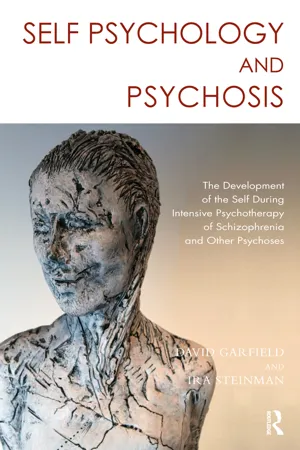
Self Psychology and Psychosis
The Development of the Self During Intensive Psychotherapy of Schizophrenia and other Psychoses
- 208 pages
- English
- ePUB (mobile friendly)
- Available on iOS & Android
eBook - ePub
Self Psychology and Psychosis
The Development of the Self During Intensive Psychotherapy of Schizophrenia and other Psychoses
About this book
In this groundbreaking volume, the authors bring us into the immediacy of the analyst's consulting room in direct confrontation with the thought disorder, delusions and hallucinations of their patients grappling with psychosis. From the early days of psychoanalysis when Freud explicated the famous Schreber case, analysts of all persuasions have brought a variety of theories to bear on the problem of schizophrenia and the other psychoses. Here, as William Butler Yeats notes, "the centre cannot hold" and any sense of self-esteem - positive feelings about oneself, a continuous sense of self in time and a functional coherence and cohesion of self - is shattered or stands in imminent danger. What makes psychoanalytic self psychology so compelling as a framework for understanding psychosis is how it links together the early recognition of narcissistic impairment in these disorders to the "experience-near" focus which is the hallmark of self psychology.
Information
Part I
Mirroring
Chapter One
The opening phase—the case of Judith
Judith was a lithe, petite, blue eyed blonde woman in her early twenties when Dr. Steinman first met her in a psychiatry emergency room; blood oozed from four deep self inflicted cuts on her left forearm. She was sitting demurely in an uncomfortable wooden chair, her face bland and remote. Dr. Steinman began . . . .
“What happened?” Dr. Steinman asked her.
“Nothing.”
He persisted: “Surely something happened.”
“I don’t know” She remained impassive.
“Did something bother you?”
“Uh huh,” she responded in a meek, barely perceptible voice.
“What was it?”
“I didn’t feel good.”
“Where?”
“Here,” and she pointed to her abdomen.
Dr. Steinman wanted to continue this developing line of exploration. Why, he wondered, would she cut herself? There must be a lot bothering this very young looking woman; even though her voice was calm and timorous, cutting herself was an emotion filled act—or one intended to stop emotions.
But the blood was seeping onto the floor of the shabby emergency room Dr. Steinman had begun to work at three weeks earlier at the end of his psychiatry residency. He had trained at a hospital that had a rather large staff for the psychiatry emergency room. But now, trying to support his young family, he was working with only a nurse’s aide on duty with him. Before the blood became a problem, Dr. Steinman walked Judith across the street to a fully operational hospital emergency room where her wounds were sutured and butterflies applied.
After Judith’s cuts were cared for, he pursued the conversation.
“Has there been any recent change in your life?”
“No; I don’t think so.”
“Do you live alone?”
“With roommates.”
“Everything okay there?”
“Yeah.”
“Anyone leave? Or go away on vacation?”
“My psychiatrist has been away for two weeks.”
“Have you seen him for long?”
“I’ve seen her for five years.”
“How often do you see her?”
“Oh, every day; and in group too.”
“Any thoughts or feelings about your psychiatrist being away?”
“No” as she averted her eyes.
Even then, Dr. Steinman had seen a number of people in the crisis clinic or hospital who were upset about the absence of a treating therapist. In general, he knew that Judith must be reacting to her psychiatrist’s vacation; this would be even more likely with such a strong—five days a week—therapeutic involvement.
Her looking away seemed pertinent; he’d often noticed that people who were very upset frequently looked away when they had complicated thoughts and feelings they were unwilling or unable to divulge.
“You mentioned that you had some feelings when you cut yourself, feelings in your abdomen. What were they like?”
“I don’t know; just feelings.”
“Happy, sad, nervous, tense, lonely, angry? Maybe something else? What do you think?”
“I guess sad and lonely.”
“Any idea what that was about? Were you thinking of anything or anyone in particular at the time?”
“Well, I miss my psychiatrist” Judith said, looking at the floor and sighing; “And I wish she’d hurry back; she’ll be here in three more days.”
“Do you think your cutting yourself had anything to do with missing her and maybe some other feelings about your psychiatrist?”
“Maybe; I haven’t really thought about it.”
How can someone do something so self-destructive without any understanding of her actions I wondered to myself.
This is the essence of an exploratory psychodynamic psychotherapy, to help a person understand his or her life history and to bring into consciousness previously unconscious material, such as fantasies, wishes and feelings; an intensive psychotherapy that connects the dots between what goes on inside and behavior can lead to transformation, healing, perhaps even a cure.
Affect: the circulatory system of the self
Affects circulate through the mind like blood circulates through the body. With Judith, Dr. Steinman is absorbed by both and he engages both. He immediately notices how, in the midst of her body losing this vital substance that Judith’s self appears to have lost the vital substance of its affectivity—she expresses no distress, no anger, no embarrassment, but rather her face is bland and her facial expression, remote.
From the vantage point of self psychology, if an analytic/therapeutic relationship is to be established, the doctor must engage the patient at an affective level. Whereas in neurosis, pain is often contained, in psychosis it can spurt all over—hallucinations, word salad, delusional proclamations or, in Judith’s case, grossly disorganized behavior. One must actively get a firm grasp on the where and what of emotion in acute states like this and Judith’s affect was in her body’s bleeding. Thus, Dr. Steinman tends to her mind by first tending to her body because that is where the vital component of her body/mind/spirit-her self-resides.
First, her cuts. All four of them. But there is more. As all doctors inquire as to where the pain is, so does Dr. S. and he immediately finds out that it is in her abdomen. The reason that self psychologists define the self in terms of body, spirit, and mind is due to the ongoing co-mingling of their ingredients. Central to the clinical endeavor of psychoanalytic self psychology in psychosis, is subjectivity, and central to the concept of subjectivity is the notion of “feelings.” Feelings, of course, must be “felt” and if they are felt, they must be felt somewhere. That somewhere is the body. Here we have the most “experience near” location of subjectivity, the body. Exactly what was Judith feeling in her abdomen?
A language for emotion: from the outside to the inside
It is well known in psychiatry and psychology, that the inability to express emotions in words-alexithymia—is closely associated with psychosomatic disorders (Nemiah & Sifneos, 1970). Judith doesn’t feel good in her abdomen—Dr. Steinman wants her to get more specific. Notice how in the investigation of the precipitating event, Dr. Steinman attempts to first collect the who, what, where, when, and how of what has recently afflicted the patient. He asks about people who might be important to her like roommates, but all is well on that front. However, she mentions that her psychiatrist is away. In wanting her to get more specific with her feeling experience, he gives her a menu of feeling words and she picks lonely and sad. It could be argued that this collection of external data violates one of the primary modes of knowing about the patient vis a vis the tenets of self psychology, that is, empathy and vicarious introspection. Yet, these kinds of “objective” questions are actually perquisite to vicarious introspection and empathic attunement. Without knowing the specific circumstances of where the patient has lost their footing, it impossible to put oneself in their “shoes.” Thus, an exploration of the precipitating event is the first step of an empathic process. Once the clinician obtains this vicarious balance, he is much more able to reflect on how it feels to be in those shoes. The clinician, through this process of attunement, engages his own affects as imagined and will use these as the basis for establishing rapport or a feeling connection to the patient.
Modern neuropsychology might point to the ubiquity of “mirror neurons” (Gallese, 2001) as being vital to our ability to develop empathy. Here, when an other’s behavior is observed, “mirror neurons” fire adjacent to those very same motor neurons responsible for the observed movement inside our own brains. Perhaps, mentally “going through the motion” without enacting it allows us to better understand the emotion of the patient. At the very least, we develop an orientation to the position of the patient in their own world as we imagine it. Interestingly, there may be a separate set of “mirror neurons” specifically for emotion (Gallese, 2001).
This “front of mind” awareness of the body in psychosis is a slightly different focus for self psychologists who typically work with neurotic or borderline patients. Because the circulatory system of the self is one of affects and because the extreme fragmentation, discontinuity and loss of a positive state of well being (Stolorow & Lachmann, 1980) is pathognomonic of psychotic states, it becomes incumbent upon the analyst to quickly locate and secure these feelings in the body. As Freud (1923) emphasized, the first ego is a body ego. For self psychologists, these affect body locations are the vital signs of the self and, therefore, are one of our first orders of business.
Self reflection and mobilization into an analytic process
Dr. Steinman was a psychiatrist who came to psychoanalysis already prepared for the “widening scope of analysis” (Stone, 1954) convinced that an intensive psychoanalytic psychotherapy would help even the most disturbed.
Yet, here was Judith—with five years of daily supportive/educational therapy—cutting herself and blandly reporting that she had no idea why she did it. Being a little annoyed that someone could be so oblivious to her motivation—Dr. Steinman reflected that he wasn’t sure if he was irritated at her or her therapist. He wanted to see if Judith could understand that cutting herself was associated with feelings that were uncomfortable to her.
“Have you ever cut yourself before?”
The answer was not so surprising.
“When I was in the hospital and they gave me shock treatment, I cut HURT on my stomach.”
“What made you do that?”
“I don’t know,” she said softly.
“Did you discuss it with your psychiatrist or the hospital staff?”
“No, we never talked about it.”
For most analysts, the central purpose of psychiatric treatment is to help people understand themselves; yet, according to Judith, the patient’s psychiatrist and the hospital staff hadn’t inquired into the meaning of her cutting. Most psychiatrists believe that there isn’t much you can do with very disturbed people except give them medications and place them in groups or day hospitals. Most analysts believe there is meaning in a person’s actions, thoughts, hallucinations, and delusions and try to decipher these meanings, using medication judiciously. It has been suggested (Ellenberger, 1970), that psychoanalysis contains both an investigative and a therapeutic impulse. There are those clinicians who focus on the “why” and those who don’t and who primarily care, simply, that things get better. Psychoanalysis, as Ellenberger pointed out grew out of the belief that the investigative process was curative. Here, “making the unconscious conscious” was the therapeutic mechanism of change. Yet, psychoanalytic self psychology comes at cure slightly differently. Although, self understanding and interpretation are necessary ingredients, they are not sufficient. Something else is required. In “How does analysis cure” (1984), Kohut points out that it is a “strengthening of the self” that is essential to healing. As Tolpin (2002) points out, this occurs through a re-engaging of the thwarted developmental emotional needs of the patient. Later, we will discuss more about the therapeutic mechanism by which psychotic patients emerge from the grip of their hallucinations and delusions, but first, the restoration of patient’s full “self circulatory system” requires that affects must be engaged.
As their first encounter progressed, Dr. Steinman figured that he would try a slightly different tack from the one to which Judith was accustomed.
“You cut yourself four times; does that have any meaning for you? Why four and not some other number? What does four mean to you?”
“I don’t know,” Judith said vaguely, then stopped short and looked perplexed; she was not accustomed to exploring the meaning of her behavior. She hadn’t questioned, she merely acted. Then, slowly, she said, I guess it reminds me of being four years old.
“What was going on in your life at the age of four?”
Again, she had no idea. But she was physically OK for the time being and Dr. Steinman didn’t expect to see her again since she had such a long standing and intense relationship with her therapist; He wished her well, told her that the emergency room was open twenty-four hours a day, and that she should return if she ran into trouble before her psychiatrist came back.
Evidently, several months later, Judith began to discuss, with her therapist and parents, the idea of beginning treatment with Dr. Steinman.
Several months after that, when the treating psychiatrist concurred, Judith and her parents contacted Dr. S. and she began an analytic psychotherapy aimed at clarifying and understanding her thoughts and behavior within the context of her life’s experiences, emotions and psychological ways of dealing with pain. It became an effort that revealed much more clearly what her thinking was and how it arose.
The previous therapist had viewed Judith as essentially psychotic and in need of supportive care, for she had several diagnoses of acute, now chronic schizophrenia, on both psychiatric assessment and psychological testing.
Such a “supportive” treatment approach is anything but supportive of the individual. “Supportive” treatment can lead to warehousing— putting patients in custodial care where their symptoms may be less but the beliefs persist; it is an attempt to cover over the symptoms and disordered thinking. Sometimes it works and the psychosis goes into apparent remission, leaving the patient in a fragile condition dependent on medication and often regressing when unresolved issues erupt and overwhelm them; sometimes this covering over approach doesn’t work at all.
Almost all psychoanalytic treatments believe in the idea that normal development can run into problems and become “fixated,” “ar...
Table of contents
- Cover
- Half Title
- Title
- Copyright
- Contents
- ACKNOWLEDGEMENTS
- ABOUT THE AUTHORS
- PREFACE Coming to self psychology
- INTRODUCTION Self psychology and psychosis
- PRELUDE AND ENTRE Cross modal attunement and revitalization of the self
- PART I: MIRRORING
- PART II: IDEALIZING
- PART III: ALIKENESS (TWINSHIP)
- REFERENCES
- INDEX
Trusted by 375,005 students
Access to over 1.5 million titles for a fair monthly price.
Study more efficiently using our study tools.
Frequently asked questions
Yes, you can cancel anytime from the Subscription tab in your account settings on the Perlego website. Your subscription will stay active until the end of your current billing period. Learn how to cancel your subscription
No, books cannot be downloaded as external files, such as PDFs, for use outside of Perlego. However, you can download books within the Perlego app for offline reading on mobile or tablet. Learn how to download books offline
Perlego offers two plans: Essential and Complete
- Essential is ideal for learners and professionals who enjoy exploring a wide range of subjects. Access the Essential Library with 800,000+ trusted titles and best-sellers across business, personal growth, and the humanities. Includes unlimited reading time and Standard Read Aloud voice.
- Complete: Perfect for advanced learners and researchers needing full, unrestricted access. Unlock 1.5M+ books across hundreds of subjects, including academic and specialized titles. The Complete Plan also includes advanced features like Premium Read Aloud and Research Assistant.
We are an online textbook subscription service, where you can get access to an entire online library for less than the price of a single book per month. With over 1.5 million books across 990+ topics, we’ve got you covered! Learn about our mission
Look out for the read-aloud symbol on your next book to see if you can listen to it. The read-aloud tool reads text aloud for you, highlighting the text as it is being read. You can pause it, speed it up and slow it down. Learn more about Read Aloud
Yes! You can use the Perlego app on both iOS and Android devices to read anytime, anywhere — even offline. Perfect for commutes or when you’re on the go.
Please note we cannot support devices running on iOS 13 and Android 7 or earlier. Learn more about using the app
Please note we cannot support devices running on iOS 13 and Android 7 or earlier. Learn more about using the app
Yes, you can access Self Psychology and Psychosis by Ira Steinman,David Garfield in PDF and/or ePUB format, as well as other popular books in Psychology & Abnormal Psychology. We have over 1.5 million books available in our catalogue for you to explore.