eBook - ePub
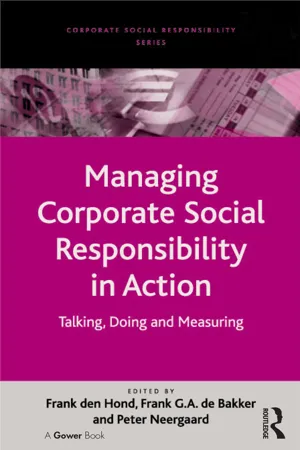
Managing Corporate Social Responsibility in Action
Talking, Doing and Measuring
- 280 pages
- English
- ePUB (mobile friendly)
- Available on iOS & Android
eBook - ePub
Managing Corporate Social Responsibility in Action
Talking, Doing and Measuring
About this book
Since the mid 1990s political and public debates about the social responsibilities of firms have gained renewed force. Although CSR seems to be a well defined concept in management literature, in its diverse applications the CSR concept loses much of its pertinence. In Managing Corporate Social Responsibility in Action, the authors focus on different aspects of managing CSR in action to capture differences between discourse and practice. By examining the question from three angles - talking about CSR, doing CSR and measuring CSR - they attempt to make sense of the difference between practice and reality. This volume considers ways to overcome the difficulties that arise around CSR in action.
Chapter 1
Introduction to Managing Corporate
Social Responsibility in Action:
Talking, Doing and Measuring
Introduction
As early as in the 18th century, companies have acted in socially responsible manners by building houses and schools for their employees and their children (Cannon 1994, Carroll and Buchholtz 1999). Michell (1989) traced the emergence of corporate social responsibility as a concept back to the 1920s. He sees the discussion as an ideological movement to legitimize the power of large corporations. However, since the mid 1990s, political and public debates about the social responsibilities of firms have gained renewed force. Increasing numbers of companies are beginning to realize that they can no longer ignore the moral expectations society places on them. Many firms are working to deal with a variety of often inconsistent and conflicting norms and demands placed upon them. They struggle with the question of how to define their role as good corporate citizens. They respond to societal demands by endorsing standards, adopting a code of conduct, or reporting on social or environmental performance according to norms proposed by the Global Reporting Initiative (GRI) or the AA 1000 framework
Various types of actors have assumed increasingly important roles in influencing the demands and norms that define socially acceptable corporate behaviour: not only national governments, but also supra-national bodies such as the United Nations and the European Union, and various non-corporate actors in the civil society. They stimulate firms to increase transparency on social issues, require them to disband detested practices, push them to adopt other practices that are more ‘socially beneficial’, and urge national governments to define and enforce minimum standards of corporate social responsibility (CSR). CSR has thus become an important concept on the public agenda and continues to be a topic of interest in different spheres of society. In parallel, the concept has also gained a prominent position in academic work, both by theory-oriented scholars, such as in business ethics (Carroll 1999; Joyner and Payne 2002; Zadek 1998) and management (Lockett, Moon and Visser 2006; Whetten, Rands and Godfrey 2002), as well as by practice-oriented scholars, as shown for instance by the many studies on different ‘business and society’ initiatives (Austin 2000; Selsky and Parker 2005).
This development reflects a broader trend to see business and society as being interwoven. It is increasingly argued that firms need to manage their social responsibilities to remain legitimate. The CSR literature contains a broad array of suggestions on how to organize CSR (for example De Bakker, Groenewegen and Den Hond 2005; Epstein and Roy 2001; Lockett, Moon and Visser 2006). However, the question of how to manage CSR in specific situations remains quite poorly addressed, as different firms face different problems and opt for different solutions. Although sometimes the CSR concept seems to be a well-defined, unequivocal concept, in its diverse applications the concept loses much of its definitional pertinence. ‘The term is a brilliant one; it means something, but not always the same thing, to everybody’ (Votaw 1973: 11).
How could such a popular and seemingly well–received concept cause so much confusion, and what could firms learn from insights in different management practices? In the opening volume of this series on CSR, Crowther and Rayman-Bacchus (2004b: 14) stated that their aim was ‘to present a spectrum of approaches from a variety of scholars from different countries and from different disciplines in order to show the diversity of the debate and the diversity of contributors.’ In this volume, we build on this diversity in practices. The contributions in this volume focus on different aspects of managing CSR in action to capture differences in discourses and practices around CSR. What are firms talking about when they mention CSR? What are they doing? And what is the role of measuring? Before introducing the chapters in the three main parts of this volume, we briefly review the debate on CSR and discuss its current popularity.
The Changing Popularity of CSR
A wide variety of corporate practices has been developed under the vignette of CSR, most often in reference to acts of responsibility. Etymologically, to be responsible is to be answerable (Lucas 1993), to be able and willing to answer. As a matter of moral principle, being or acting ‘responsible’ is good. But things change once the principle is turned into practice. Immediately, many questions rise, for example regarding the realm for which responsibility is to be assumed, and the manners by which it is to be expressed. And things get worse once multiple responsibilities towards different stakeholders have to be addressed, all the more so if these responsibilities are incompatible or conflicting. Indeed, various corporate audiences express different expectations regarding how firms should assume their social responsibilities. The differences between principle and praxis are all the more visible once the CSR debate is examined at different levels of abstraction. If the CSR debate is examined at a high level of abstraction, there are two different positions. These are (1) firms do not and should not have any social responsibilities beyond maximizing shareholder value (Friedman 1962; Jensen 2002), versus, (2) firms do have such responsibilities and should act accordingly (Quazi and O’Brien 2000; Roberts 2003).
According to the first position ‘the social responsibility of business is to increase profits’ (Friedman 2001: 29). ‘The business of business is business’ is an often used quote from Friedman. Jensen further elaborates this viewpoint by stating that ‘200 years’ worth of work in economics and finance indicate that social welfare is maximized when all firms in an economy maximize total firm value’ (2002: 239). In this perspective any investments in CSR will be theft of shareholders’ money. The position is firmly based in contractual theory. The argument is often repeated in the business press that a particular company is striving to maximize shareholder return.
The second position states that companies, because of the impact they have, should act socially responsible. Although within this position there is some variety in concepts, definitions, and interpretations (Carroll 1999; van Marrewijk 2003), fundamentally, concepts such as corporate social responsibility, corporate social performance, stakeholder management, corporate citizenship, business virtue, business ethics, or corporate sustainability all are manifestations of one and the same underlying position, namely that corporate decisions have moral consequences and that therefore corporate decision makers should consider the moral consequences of their decisions (Freeman 1994).
However, the two positions are less conflicting if the former is reformulated to stress the firm’s obligation to act socially responsible if doing so maximizes shareholder value, and if the latter is believed, as many observers have suggested, to result in outcomes beneficial to the firm, if not in the short term, then at least in the long term. The claim has often been made that firms practicing CSR are more successful than others, for instance in terms of financial performance (Orlitzky, Schmidt and Rynes 2003; Waddock and Graves 1997). Companies that meet the expectations of stakeholders and society at large are expected to gain a competitive advantage over other firms (Sinding 2000). If this is the case, there would not be a conflict between the practice of CSR and maximizing shareholder value. Because creating value for shareholders seems to be dominant for management today, ‘many contemporary advocates of CSR have implicitly accepted Friedman’s position that the primary responsibility of companies is to create wealth for their shareholders’ (Vogel 2005: 27). For that reason, business is turning to the research community to provide the ‘business case’ for CSR. However, attempts to provide evidence for a positive correlation between CSR and financial performance have not been that successful up till now (Margolis and Walsh 2003).
Expressions of the position that companies should act responsible are plentiful: the overview in Appendix 1.1 displays an apparent consensus among governments, leading firms, and NGOs about the abstract principle that firms should behave responsibly towards their social, economic, and physical environments.
If it is the case that indeed greater responsiveness to stakeholder demands leads to increased financial performance and competitive advantage, at least for some firms in some situations, then it is understandable that firms would like to retain control over how and to what extent they invest in CSR. Thus, it has been suggested that self-regulation in CSR may provide win-win-win solutions for both companies, regulatory authorities and society at large (Elkington 1994; Porter and Van der Linde 1995; Neergaard and Pedersen 2003):
• firms see advantage in self-regulation because it prevents them from public regulation and outside pressure from various stakeholders;
• regulatory authorities see advantage in self-regulation because it reduces the need to implement unpopular and costly command and control policies;
• society sees advantage in self-regulation through CSR because it results in social and environmental standards that exceed the requirements of government regulation.
Nevertheless, there is debate and struggle once it comes to the implementation of this broad consensus in specific situations. For example, in the UN Global Compact, policymakers, businesses and some NGOs signed a set of principles concerning environmental protection, labour rights and human rights (Kell 2003), but this initiative also was met with criticism from other NGOs (Hoedeman 2002), as is the entire concept of CSR (Christian Aid 2004; Corporate Watch 2006). Apparently, consensus exists regarding the fact that principles of responsibility are important in a business setting, but disagreement arises once it comes to practicing such a principle. For instance, as Fauset (2006, II) of Corporate Watch argued: ‘Ultimately, CSR is not a step towards a more fundamental reform of the corporate structure but a distraction from it. Exposing and rejecting CSR is a step towards addressing corporate power.’
From a historical perspective, there are striking parallels between the current and earlier debates. Publications on CSR have been around since at least the 1950s (Carroll 1999). At that time, the debate was centred on the same two positions identified above. Authors such as Bowen (1953) and Davis (1960) held a pro-social responsibility position, whereas Levitt (1958) and especially Friedman (1962) are still cited today for the strong stance they took to defend the opposite position. Since then, much research has been done to provide support for the moral superiority of the pro-responsibility position, as well as to prove its instrumental value in creating long–term economic profits to firms. The proliferation of concepts that Carroll (1999) refers to can be interpreted as a consequence of the ongoing attempts to increase the plausibility of the moral legitimacy and the instrumental value of this pro-responsibility position (de Bakker et al. 2005; Rowley and Berman 2000).
These developments leave the CSR debate in a curious position. On the one hand, at a general and abstract level of discourse, consensus seems to have been established regarding the relevance of addressing issues of corporate responsibility. Some criticisms have been raised at this level, both from neo-liberals – if CSR is not hypocrisy, it is at best nothing more than a reconfirmation of the benefits of self-regulation in a free market context – and anti-capitalists – if CSR is not hypocrisy, it is at its worst nothing more than the empty promise of the illusory benefits of self-regulation in a free market context. On the other hand, at the more concrete level of implementing CSR in a specific context, many different interpretations of CSR seem to be around. Once it is put into practice, the seemingly single-faced concept of CSR breaks down into a concept that is variegated, sundry, and fragmented.
The overall question that we seek to address in this volume therefore can be formulated as how we can make sense of this difference. By presenting a collection of studies, we want to come to terms with this remarkable difference by scrutinizing in three subsequent parts: the abstract discourse in which CSR is given a broad and general meaning, a number of contexts in which CSR is actually implemented and thus obtains a locally circumscribed meaning, and finally the way that measuring and measures of CSR form a connection between the general and the specific, the global and the local meanings of CSR. As there is both a broadly shared understanding of the overall concept of CSR, as well as a range of contextual differences that emerges upon the implementation of the concept in particular contexts, the question rises how the two observations are connected. We address this question by comparing and contrasting the meaning of CSR, or of what is presented in its name, in various contexts, thereby subscribing to a form of discourse analysis, which is based on ‘the structured and systematic study of collections of interrelated texts and processes of their production, dissemination, and consumption’ (Phillips 2002: 24). Applying such a discursive approach allows us to gain an understanding of how the CSR concept is given meaning in interaction. How do interrelating actors together shape and modify a sense of what could be regarded as socially responsible corporate behaviour? The first two parts of this volume address such questions, but at different levels of analysis. The third part of the volume concerns elements of CSR measurement, as measuring CSR, and making CSR measurable, play critical roles in any attempts to reconcile the gap between the abstract discourse and its meaning in praxis. After all, it is through measurement that definitions and practices are reinforced and legitimated. The overall analysis in these three parts thus delivers a rich understanding of the mixed endorsement of CSR among firms, governments and NGOs, and the ways in which different actors are involved in shaping CSR, and thereby provides a better understanding of the actual implementation of this important concept.
Part 1 – Talking: CSR in Discourse
From observing the CSR debate, one gets the impression that representations of CSR are highly similar (see also Appendix 1.1). Whether one considers policy documents, corporate statements, or some NGO claims; they all use similar language, make similar claims and express similar ideas. In that sense, CSR has characteristics of a popular management concept, such as ‘total quality management’, ‘business process re–engineering’ or ‘new public management’. They all address some general concern to management (such as: quality, cost control, or in the case of CSR, social legitimacy) in a combined problem-solution package, with general relevance for many firms across a wide range of industries and countries, and whose adoption by managers adds to their reputation of being ‘good’, that is modern and rational, managers (Abrahamson 1991). New concepts and catchy abbreviations provide consultants with new services to sell to companies. As Peters recently claimed: ‘Social responsibility is good capitalism. Or, put the other way, good capitalism is socially responsible’ (2004: 215). Although anti-capitalist critics maintain that ‘CSR enables business to propose ineffective, voluntary, market-based solutions to social and environmental crises under guise of being responsible’ (Fauset 2006: II), the concept has become quite popular. How did this apparent conceptual homogeneity come about, how is it reinforced and can it be observed across different national settings? The first part of this volume focuses on the CSR discourse at a broad, general level of analysis. Three chapters discuss how CSR is represented in different contexts by analysing CSR–related discourses in the business press and in corporate annual reports, as well as the role of consultants in the construction and diffusion of CSR.
Buhr and Grafström ask how the CSR concept spread and gained legitimacy. Their take is original in considering the role of print media in legitimating the CSR discourse. They analyze how CSR is represented in the Financial Times. Buhr and Grafström subscribe to the view that the business press is an important arena for the development and diffusion of CSR. Within this arena, management models, including CSR, are shaped, edited and translated. By assessing how the content of CSR was constructed within and by this influential newspaper, they contribute to understanding the process of agenda–setting of CSR in a business context.
Windell discusses how consultants in Sweden contributed to the construction and spread of CSR and how they created a market for CSR services. Central in her chapter is a distinction between two types of consultants, the so-called world–saviours and the money–makers, reflecting both the ethical and instrumental motive to CSR. Both types of consultants have very different ideas about what CSR encompasses. By viewing consultants as agenda–setters and institutional entrepreneurs, Windell discusses how different societal expectations and demands are put forward by different actors and packaged under a new label, CSR, by consultants. Yet, the worldviews of the two types of consultants influences what exactly gets packaged under the label, depending on whether the consultants seek to promote other interests than commercial ones alone.
De Bakker et al. conclude the first part of this volume. Through a longitudinal, lexicological study they analyze how major stock–listed companies in Sweden, the Netherlands, and Canada represent the relationship of their firms with the social, economic and natural environments in their annual reports over time. The analysis of De Bakker et al. is based on ten–year intervals to track changes. The chapter makes clear that dramatic changes occurred in representations in annual reports, as is testified by the joint emergence of terms such as ‘sustainability’ and ‘environment’ as examples of a developing CSR discourse, by the increased use of a term like ‘globalization’, and by the simultaneous decrease in terms referring to a national political and economic discourse, such as national authorities or trade unions.
Although some variation is visible, at the discourse level, the suggestion of homogeneity of the CSR concept thus can be confirmed, as is the tenet of the first part of this volume. However, the same level of homogeneity is not to be expected once CSR is actually implemented in specific contexts of place and time. Once talking shifts to doing, different contexts in which firms operate therefore become more influential. CSR as a management concept to effectively deal with different pressures is thus likely to result in varying outcomes. This is the topic of the second part of this volume.
Part 2 – Doing: CSR in Praxis
The second part of t...
Table of contents
- Cover Page
- Title Page
- Copyright Page
- Contents
- List of Figures
- List of Tables
- Notes on Contributors
- Foreword
- Acknowledgements
- List of Abbreviations
- 1 Introduction to Managing Corporate Social Responsibility in Action: Talking, Doing and Measuring
- PART 1: TALKING: CSR IN DISCOURSE
- PART 2: DOING: CSR IN PRAXIS
- PART 3: MEASURING: CSR IN SCALES
- CONCLUSION
- Bibliography
- Index
Trusted by 375,005 students
Access to over 1.5 million titles for a fair monthly price.
Study more efficiently using our study tools.
Frequently asked questions
Yes, you can cancel anytime from the Subscription tab in your account settings on the Perlego website. Your subscription will stay active until the end of your current billing period. Learn how to cancel your subscription
No, books cannot be downloaded as external files, such as PDFs, for use outside of Perlego. However, you can download books within the Perlego app for offline reading on mobile or tablet. Learn how to download books offline
Perlego offers two plans: Essential and Complete
- Essential is ideal for learners and professionals who enjoy exploring a wide range of subjects. Access the Essential Library with 800,000+ trusted titles and best-sellers across business, personal growth, and the humanities. Includes unlimited reading time and Standard Read Aloud voice.
- Complete: Perfect for advanced learners and researchers needing full, unrestricted access. Unlock 1.5M+ books across hundreds of subjects, including academic and specialized titles. The Complete Plan also includes advanced features like Premium Read Aloud and Research Assistant.
We are an online textbook subscription service, where you can get access to an entire online library for less than the price of a single book per month. With over 1.5 million books across 990+ topics, we’ve got you covered! Learn about our mission
Look out for the read-aloud symbol on your next book to see if you can listen to it. The read-aloud tool reads text aloud for you, highlighting the text as it is being read. You can pause it, speed it up and slow it down. Learn more about Read Aloud
Yes! You can use the Perlego app on both iOS and Android devices to read anytime, anywhere — even offline. Perfect for commutes or when you’re on the go.
Please note we cannot support devices running on iOS 13 and Android 7 or earlier. Learn more about using the app
Please note we cannot support devices running on iOS 13 and Android 7 or earlier. Learn more about using the app
Yes, you can access Managing Corporate Social Responsibility in Action by Frank de Bakker, Frank den Hond in PDF and/or ePUB format, as well as other popular books in Business & Business General. We have over 1.5 million books available in our catalogue for you to explore.