The fifth edition includes new sections on the use of adverse outcome pathways, how climate change changes how we think about toxicology, and a new chapter on contaminants of emerging concern. Additional information is provided on the derivation of exposure-response curves to describe toxicity and they are compared to the use of hypothesis testing. The text is unified around the theme of describing the entire cause-effect pathway from the importance of chemical structure in determining exposure and interaction with receptors to the use of complex systems and hierarchical patch dynamic theory to describe effects to landscapes.
eBook - ePub
Introduction to Environmental Toxicology
Molecular Substructures to Ecological Landscapes, Fifth Edition
- 470 pages
- English
- ePUB (mobile friendly)
- Available on iOS & Android
eBook - ePub
Introduction to Environmental Toxicology
Molecular Substructures to Ecological Landscapes, Fifth Edition
About this book
Information
CHAPTER 1
Introduction to Environmental Toxicology
As all textbooks do, this book reflects the points of view of each of the authors developed from being active researchers, teachers, and participants in various professional societies and governmental panels. Since the early 1990s at Huxley College, there has been a two-course fundamental introduction to the science of environmental toxicology for which this book was originally developed. That series is supplemented by courses in aquatic toxicology, risk assessment, fate and transport, and contaminated site restoration. Since its first edition, this book was designed to provide a keystone resource for the program in environmental toxicology.
The approach is to blend the classic aspects of the field with new developments as they prove fundamental to the understanding of environmental toxicology. Our approach is quantitative, recognizes the connection between molecular interactions and alterations of ecological functions, and understands that the findings of the field should have major implications for the making of environmental policy. We begin by defining the field of environmental toxicology.
1.1 ENVIRONMENTAL TOXICOLOGY AS AN INTERDISCIPLINARY SCIENCE
Environmental toxicology is the study of the effects of pollutants upon the structure and function of ecological systems. For the purposes of this book, the emphasis will be upon ecological structures, from the molecular to the individual organism to the community and to the ecosystem and finally the landscape. The broad scope of environmental toxicology requires a multidisciplinary approach from a variety of specialists. These specialists interact with a variety of other people, including decision and policy makers, the public, educators, and other key individuals in making decisions about the management of ecological systems and the services they provide. This breadth of scope of environmental toxicology and its application as a management tool make the field both a basic and an applied field of study.
Environmental toxicology takes and assimilates from a variety of disciplines. Terrestrial and aquatic ecologists, chemists, molecular biologists, geneticists, and mathematicians play an important role in the evaluation of the impacts of chemicals on biological systems (Figure 1.1). Ecology provides the bases of our ability to interpret the interactions of species in ecosystems and the impacts that toxicants may have upon the function and structure. Molecular biology and pharmacokinetics operate at the opposite end of the biological hierarchy, describing the interactions of an organism with a toxicant at the molecular level. Analytical chemistry provides data on the environmental concentration of a compound and can also be used to estimate dose to an organism when tissues are analyzed. Organic chemistry provides the basic language and the foundation of both the abiotic and biotic interactions within an ecosystem. Biostatistics, the application of statistics to biological problems, provides the tools for data analysis and hypothesis testing. Mathematical and computer modeling enables the researcher to predict the effects and to increase the rigor of a hypothesis. Evolutionary biology provides the data for establishing comparisons from species to species and describes the adaptation of species to environmental change. Microbiology and molecular genetics may not only help the environmental toxicologist to understand the fate and transformation of environmental pollutants, but may provide the science to create efficient tools to clean up and restore an ecosystem. The science of risk assessment as applied to environmental toxicology forms the framework to guide research, develop specific testable hypotheses, and inform decision-making.
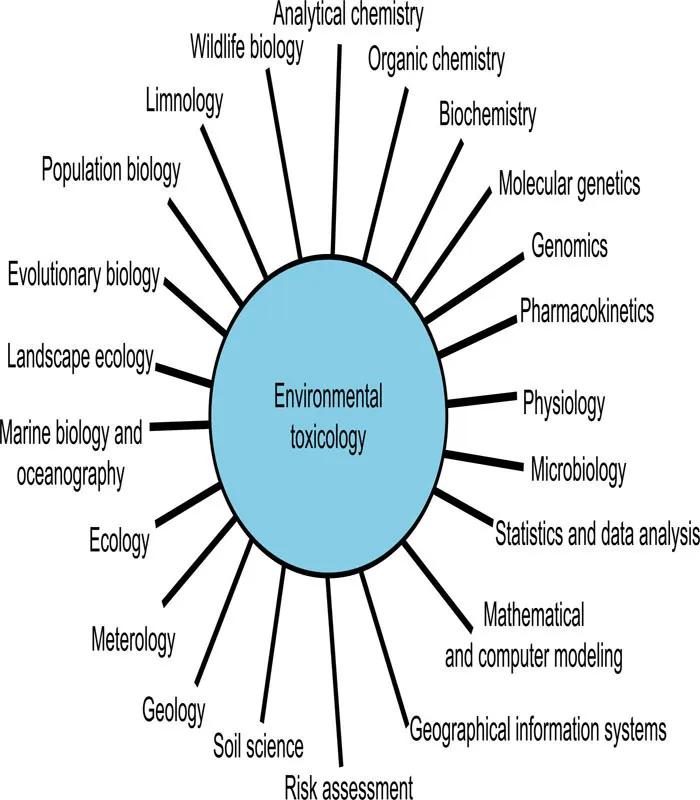
Figure 1.1 The components of environmental toxicology. Environmental toxicology borrows heavily from a variety of scientific disciplines. The very nature of the field is multidisciplinary, making a basic knowledge of the basics of biology, chemistry, mathematics, and physics essential. Add risk assessment in a broader sense as a component and tools such as the weight of evidence.
Critical to the field are data analysis and the discovery of patterns of data that are of varied types and structures. The fundamental interaction of environmental toxicology is at the molecular level, yet the effects are far ranging and across many biological and physical scales. First, the field has to understand the tools for understanding the fundamentals of exposure–response, and then adopting new tools will lead to new insights into the interaction of chemicals with ecological structures.
1.2 A BRIEF HISTORY AND ORGANIZATIONS IN ENVIRONMENTAL TOXICOLOGY
As a discipline, environmental toxicology is relatively new. As of 2016, the 37th annual meeting sponsored by the Society of Environmental Toxicology and Chemistry (SETAC) in North America on environmental toxicology was held. The science evolved from the efficacy testing of pesticides in the 1940s to the cleanup of burning rivers, polluted lakes, and wildlife kills of the 1960s. The passage of the National Environmental Policy Act and the establishment of the United States Environmental Protection Agency (USEPA) forced the rapid development of the field. The Clean Air and Clean Water standards were required by law to be protective of human health and the environment. The Pellston workshops of the early 1970s provided a focal point for the discussion and consolidation of environmental toxicology. As standards development became important, a relationship with the American Society for Testing and Materials evolved, which has resulted in Committee E-47—Environmental Fate and Effects. This committee is responsible for the writing of many of the important methods used by environmental toxicologists worldwide. The Organization for Economic Co-operation and Development serves a similar role in Europe. In 1979, SETAC was founded as a scientific society to support the growing needs of the field. In 1980, 85 persons attended the first SETAC Annual Meeting in Washington, DC. In 1991, 2230 scientists and policy makers attended in Seattle, WA, and 3000 attended the 2016 meeting in Orlando, FL.
SETAC is now an international society with geographic units in North America, Europe, South America, Africa, and Asia/Pacific. Geographic units can have chapters, such as the Pacific Northwest Chapter of the SETAC that the authors participate in.
The Society for Risk Analysis (SRA) focuses on all types of risk assessment from human health and the environment to engineering and risk communication. The journal has a section devoted to ecological risk assessment that discusses a number of wide ranging topics, including risks due to chemicals to those posed by forest fires and invasive species.
1.3 INTERACTIONS AND CONNECTIONS OF ENVIRONMENTAL TOXICOLOGY TO THE MANAGEMENT OF ECOLOGICAL SYSTEMS
There are many types of interactions that make up the field of environmental toxicology (Figure 1.2). Some are typical to fields of basic research but because of the use of the information in decision-making, there is a broad regulatory interest. Each type of interaction is described in Sections 1.3.1, 1.3.2, 1.3.3, 1.3.4, 1.3.5, 1.3.6.
1.3.1 Research Programs
This is the most fundamental part of the field of environmental toxicology. This segment includes the identification of toxicity and the causal basis. The effects include changes at the molecular level to changes in function and structure of ecological systems. Particularly important are the development of testing methods, analytical tools, and statistical techniques that allow the acquisition of data from such a diverse set of subjects. Underlying all of this is the formation of useful paradigms and models that connect the observations into an integrated structure. The integrated structure can then be useful in formulating predictions about how ecological impacts are caused by chemicals being introduced into the environment.
In order to accomplish these diverse functions, it takes a social network of collaboration and expertise, an interactive scientific community.
1.3.2 Scientific Community
The scientific community is the intellectual and industrial force behind the conduct of the research. Part of the function of the scientific community is the publication of papers in peer-reviewed journals, books, and other publications that report the information generated by the research programs. Participation in the scientific community includes participation in the peer review process, which is a vital but not perfect means of ensuring the quality of the research presented in the literature. Often members of the scientific community participate on review panels examining research priorities, plans and results for government agencies, industry, and nongovernmental organizations (NGOs).
An exciting part of participating in the scientific community is attending the variety of scientific symposia and conferences held across the world. These meetings sponsored by scientific societies such as the SETAC, the Society of Toxicology (SOT), the SRA are places to present research results, discuss papers and the implications, meet other researchers, and establish career long collaborations and friendships. After a postgraduate education, these meetings are vital means of keeping up with new developments, including new techniques and the overthrow of paradigms that are a part of a vital science.
Much of the consolidation of new developments within the field of environmental toxicology into frameworks and paradigms occurs at workshops sponsored by a variety of organizations. Among these workshops are the various Pellston Workshops coordinated by SETAC, the Symposia sponsored by American Society for Testing and Materials (ASTM) International, and meetings organized and sponsored by many other associations. These workshops are generally smaller than the annual meetings and are of a much narrower scope. However, most of the participants are specialists in the narrow scope of these types of meetings. Typically a special report, summary publication, or even a special journal issue summarizes the papers presented and the major findings or conclusions of the workshop. These publications often serve as landmarks in the development of the field of environmental toxicology and serve as departure points for future research.
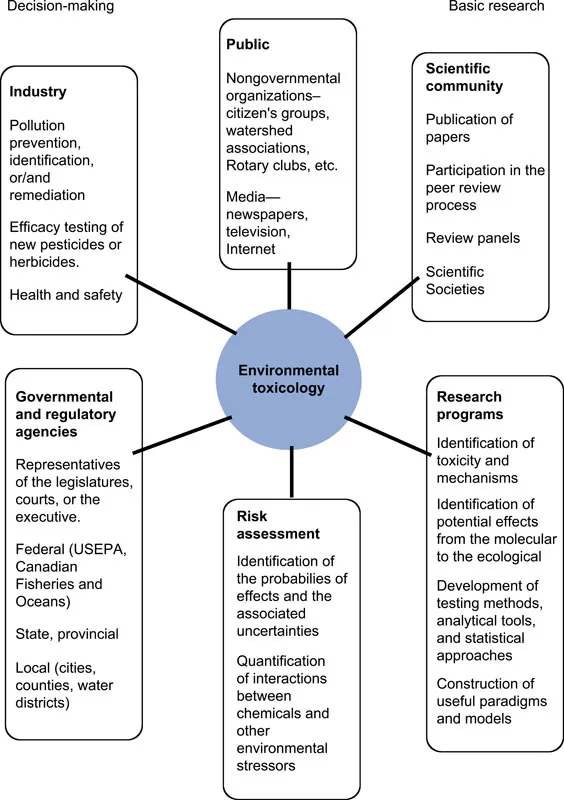
Figure 1.2 Interactions and connections of environmental toxicology to the management of Ecological Systems. Environmental toxicology borrows heavily from a variety of scientific disciplines. The very nature of the field is multidisciplinary, making a basic knowledge of the basics of biology, chemistry, mathematics, and physics essential.
1.3.3 Risk Assessment
Increasingly, risk assessment is the tool for translating the research in the field of environmental toxicology into predictions of environmental effects and making public policy. Before continuing the discussion, it is critical to understand the term risk as it is used in the field of risk assessment.
The technical definition of risk is the probability of an effect on one or more specific endpoints due to a specific stressor or stressors. In other words, how often a specific change or changes in the environment will affect something of value to society, such as human health, outdoor recreation, or the survival of an endangered species. The term implies a probability sometimes as a frequency but more exactly as a probability distribution. The distribution is calculated most often by a combination of modeling and data. Risk is also tied to an estimation of uncertainty. Uncertainly is perhaps best thought of as a map of what is known and how well it is known, not an emotion. Uncertainty is described in more detail in Chapter 15 of this book.
Risk assessment is a broad field of study that incorporates risks due to transportation, disease, social decisions, and even terrorism. In the context of environmental toxicology, risk assessment provides predictions of effects as probabilities and reports the associated uncertainties associated with the prediction. The use of a probabilistic framework allows the quantification of the interactions between chemicals, other environmental stressors, and the target biological or ecological system. A vital part of the risk assessment process is the interaction with decision and policy makers whether they are located in industry, government, or the general public.
The subarea of risk assessment that deals with the effects of chemicals upon the environment is known as environmental risk assessment or ecological risk assessment. This subarea deals with effects on nonhuman species to entire ecological systems at landscape and regional scales. Risk assessment as applied to environmental toxicology is discussed extensively in Chapter 15.
As noted earlier, risk assessment provides a linkage from the science of environmental risk assessment to the making of environmental policy. Policy is made by a variety of groups, including the general public, a variety of governmental entities, and industry.
1.3.4 Governmental and Regulatory Agencies
Governmental agencies at the federal, state and provincial, and local levels have been a major driver for the development of environmental toxicology. These agencies act as the representatives of the legislatures, courts, or the executive in setting environmental policy and rules. These agencies often set standards for chemical concentrations in air, water, soil, sediment, and tissue that are judged to safeguard human health and the valued functions of ecological systems.
In the United States of America, the USEPA is often seen as setting important regulations. But many states may have even stricter standards for a variety of chemicals. States may even differ in their approach to setting toxicity limits or in the process of conducting risk assessment. Many other agencies are also involved in setting standards for the protection of wildlife and ecological function. Along with the USEPA, the Department of Fish and Wildlife, the U.S. Army Corp of Engineers, the National Marine Fishery Service, and the U.S. Coast Guard all have some jurisdiction over the release and cleanup of chemicals found in the environment. In the State of Washington, the Department of Ecology, Department of Fish and Wildlife, Department of Natural Resources, and the Puget Sound Partnership are all charged with various aspects of environmental protection.
In Canada, the Federal Department of Fisheries and Oceans has broad powers to protect fish in both marine and freshwater environments. However, Provinces also have regulatory ministries, such as the British Columbia Ministry of Water, Land, and Air Protection, with broad responsibilities and powers to regulate chemicals in the environment.
Each of these regulatory groups typically has a cadre of environmental toxicologists, risk assessors, and consultants that provide input to the setting of regulatory concentrations of chemicals. Likewise, the industry regulated by these agencies als...
Table of contents
- Cover
- Half Title
- Title Page
- Copyright Page
- Table of Contents
- Acknowledgments
- About the Authors
- Chapter 1 Introduction to Environmental Toxicology
- Chapter 2 Frameworks and Paradigms for Environmental Toxicology
- Chapter 3 Overview of Toxicity-Testing Methods
- Chapter 4 Analysis of Exposure-Response
- Chapter 5 The Fate and Transport of Contaminants
- Chapter 6 Uptake and Modes of Action
- Chapter 7 Modification in Toxic Responses, Mixtures, and Climate Change
- Chapter 8 Inorganic Gaseous Pollutants
- Chapter 9 Fluoride as a Contaminant of Developing Economies
- Chapter 10 Metals
- Chapter 11 Emerging Contaminants
- Chapter 12 Biotransformation, Detoxification, and Biodegradation
- Chapter 13 Ecological Effects from Biomarkers to Populations
- Chapter 14 Ecological Effects: Community to Landscape Scales of Toxicological Impacts
- Chapter 15 Ecological Risk Assessment
- Index
Trusted by 375,005 students
Access to over 1.5 million titles for a fair monthly price.
Study more efficiently using our study tools.
Frequently asked questions
Yes, you can cancel anytime from the Subscription tab in your account settings on the Perlego website. Your subscription will stay active until the end of your current billing period. Learn how to cancel your subscription
No, books cannot be downloaded as external files, such as PDFs, for use outside of Perlego. However, you can download books within the Perlego app for offline reading on mobile or tablet. Learn how to download books offline
Perlego offers two plans: Essential and Complete
- Essential is ideal for learners and professionals who enjoy exploring a wide range of subjects. Access the Essential Library with 800,000+ trusted titles and best-sellers across business, personal growth, and the humanities. Includes unlimited reading time and Standard Read Aloud voice.
- Complete: Perfect for advanced learners and researchers needing full, unrestricted access. Unlock 1.5M+ books across hundreds of subjects, including academic and specialized titles. The Complete Plan also includes advanced features like Premium Read Aloud and Research Assistant.
We are an online textbook subscription service, where you can get access to an entire online library for less than the price of a single book per month. With over 1.5 million books across 990+ topics, we’ve got you covered! Learn about our mission
Look out for the read-aloud symbol on your next book to see if you can listen to it. The read-aloud tool reads text aloud for you, highlighting the text as it is being read. You can pause it, speed it up and slow it down. Learn more about Read Aloud
Yes! You can use the Perlego app on both iOS and Android devices to read anytime, anywhere — even offline. Perfect for commutes or when you’re on the go.
Please note we cannot support devices running on iOS 13 and Android 7 or earlier. Learn more about using the app
Please note we cannot support devices running on iOS 13 and Android 7 or earlier. Learn more about using the app
Yes, you can access Introduction to Environmental Toxicology by Wayne Landis,Ruth Sofield,Ming-Ho Yu in PDF and/or ePUB format, as well as other popular books in Biological Sciences & Environmental Science. We have over 1.5 million books available in our catalogue for you to explore.