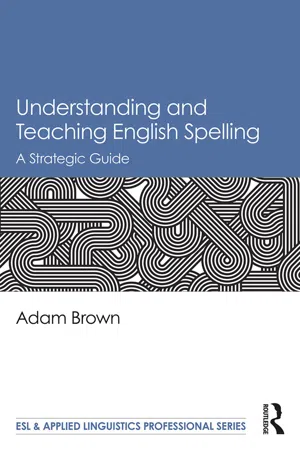
Concise and engaging, this text provides pre-service and practicing English language teachers with the knowledge they need to successfully teach the spelling of English. Offering context and explanation for the English spelling system as well as uniquely addressing specific problems in learning the spelling of English words, this book empowers readers with strategies for coping with these problems. Divided into six accessible sections, Brown covers the history of English spelling, the influence of technology on spelling, the role of punctuation, the features of present-day English spelling, teaching strategies for coping with difficult spelling, and the future of spelling and literacy. The short, digestible chapters include practical learning objectives and end-of-chapter exercises to help teachers understand and explain English spelling concepts.
- 316 pages
- English
- ePUB (mobile friendly)
- Available on iOS & Android
eBook - ePub
About this book
Information
Section 1
Background
1 Introduction
The palest ink is stronger than the clearest memory.
Chinese proverb
Learning Objectives
At the end of this chapter, readers will be able to:
• explain the primacy of spoken language
• make a case for the importance of accurate spelling
• show how spelling relates to punctuation and typography.
Introduction
The subject matter of this book is the spelling system of English, its features and patterns, and how teachers should go about teaching it in class. In various places in the book, we will be reminding readers that the spelling system being discussed is that of English, and that the features and problems found in English spelling do not necessarily exist in the spelling systems of other languages. It is really surprising that many books that cover the English spelling system and how to teach it do not even contain the word English in their titles. This gives the impression that English spelling is somehow representative of all spelling systems, and that is certainly not the case. In many respects, English spelling is an outlier in terms of the spelling systems of languages worldwide, as will become apparent in later chapters.
As this is a book aimed at teachers of English, rather than applied linguists and academics, the word spelling is used mostly throughout, as it is a common, everyday word which teachers understand. A more technical-sounding word – orthography – is often used in more academic works, but is generally avoided here. Spelling is what ordinary people do every day when writing, and what learners do in class. Orthography, on the other hand, is a more abstract term for the writing system of a language, and encompasses not only spelling, but also other aspects of written language such as the use of hyphens, capital letters, word divisions, punctuation marks, and typographical devices available on computer including the choice of font, font size, italics, bold, and color. These features are touched on in this book, partly because they are often overlooked by teachers. However, other aspects of the writing process, such as handwriting, are not covered.
The term orthography may also carry connotations of correctness. In fact, this is the historical origin (etymology) of the word. It comes from the Greek orthos, “correct,” and graphein “to write.”
To avoid all these implications, the term spelling is used in this book. One can, for instance, talk about misspellings and spelling mistakes, as often made by learners and other users, but the terms misorthography and orthography mistake are never found.
The term traditional orthography (TO) is commonly encountered and is used in this book to refer to standard modern spelling, especially when in contrast to reformed spelling (see Chapter 29).
The remainder of this chapter introduces a number of basic points that need to be made before delving into the English spelling system.
The Primacy of Spoken Language
In discussing any language, we can use two dichotomies. Firstly, are we talking about producing the language, or receiving and interpreting it? Secondly, in what form is the language being transmitted? The two main media through which a language can be conveyed are the spoken and the written, although others exist, such as Braille, a tactile medium.
These two dichotomies thus give us what (in language teaching circles) are known as the four skills: reading, writing, speaking, and listening (Table 1.1).
Which of these two media is the more important? Many people will answer “the written medium,” because it has, for some centuries, been considered the only form worthy of scholarly study. Writing, being marks on paper, is more tangible than the ephemeral sounds of spoken language. Dictionaries have until recently tended to concentrate on written (spelled) forms, and meanings, often saying little if anything about pronunciation.
However, modern descriptive linguistics, pioneered by figures such as Ferdinand de Saussure (1957–1913), Edward Sapir (1884–1939) and Leonard Bloomfield (1887–1949), pointed out that there were many reasons why the spoken form of the language should be considered to have primacy.
Table 1.1 The four language skills

• Historical: All human languages have a spoken form, but not all human languages have a written form.
• Biological: All humans without physical or psychological defects learn to speak their native language, but not all humans learn to write it.
• Instructional: Children acquire the spoken form of their native language by exposure to it, while the process of learning to write the language is one of conscious instruction. The age at which children master the medium differs too, spoken language being acquired in the home much earlier than written language, which is typically learned once they start school.
• Structural: There is no restriction on the combination of letters in writing, but there are awkward combinations of sounds in pronunciation.
• Functional: The spoken medium is used more often, and for more purposes, than the written.
In light of all the above, the spoken form of a language is considered by linguists to have primacy. In short, writing, including the spelling system, is not “the language.” If anything, speech is the language, and writing is simply another method of manifesting the language. Bloomfield (1933, p. 21) wrote, “Writing is not language, but merely a way of recording language by means of visible marks.” During the 20th century, various approaches and methods for teaching English (and potentially other languages) were proposed, emphasizing the importance of initial teaching of the spoken form: the reform movement and the International Phonetic Association, the natural/direct method, audiolingualism, total physical response, the silent way, humanistic methods, communicative language teaching, etc. (see Brown, 2014; Larsen-Freeman & Anderson, 2011; Richards & Rogers, 2001). Eventually, dictionaries included comprehensive information about the pronunciation of words, and grammars, previously seen as relevant only to written language, were published examining the grammar of speech, e.g. Biber, Johansson, Leech, Conrad & Finegan, 1999; Carter & McCarthy, 2006; Palmer, Blandford & Kingdon, 1976.
However, before it is assumed that writing is unimportant, two caveats must be presented. Firstly, there are counterarguments against a strong view that writing is merely a medium for representing speech, and emphasizing the importance and nature of writing.
• Some uses of writing could not be spoken, e.g. timetables.
• The differences between speech and writing are much greater than most non-linguists realize.
• The social prestige of writing is often higher than that of speech, e.g. their legal status.
• Loanwords (Chapter 16) may enter the language first through written language.
• The speech of many literate speakers is heavily influenced by written language.
Also, is it correct to claim nowadays that “The spoken medium is used more often, and for more purposes, than the written”? With technological advances over the last couple of decades, of texting, social media, etc., and in the light of commentators’ common criticism that younger people nowadays are spending a lot of their lives reading and writing on devices, and conversely lacking face-to-face spoken interactional skills, it may be the case that written language is more commonly used than spoken for some people.
Secondly, even if we accept that spoken language is primary because, among other reasons, children acquire speech at an earlier age than writing, this does not necessarily imply that people should learn second languages the same way. This assumption has underlain several of the approaches and methods introduced above. However, second language learners have already learned what language is in general and what it is used for; the features of their native language; and what written language is, including the Roman alphabet, if appropriate. They do not come to second language learning as a clean slate, the way native children do. While many learners require good speaking skills, many do not put great emphasis on speaking because of job requirements. Throughout this book, we will be talking about “learners,” but that description covers both native-speaking children and non-native L2 learners, and the two groups differ in certain crucial respects.
The Purpose of Spelling
At the outset of this book, it is appropriate to ask a very fundamental question that underlies much of what will appear in subsequent chapters: “What is the purpose of a spelling system for a language?”
Exercise
Consider the following suggested answers and state whether you agree or disagree...
Table of contents
- Cover Page
- Understanding and Teaching English Spelling
- ESL & Applied Linguistics Professional Series
- Title
- Copyright
- Contents
- Preface
- Section 1 Background
- Section 2 Technology
- Section 3 Punctuation
- Section 4 Features of Present-day English Spelling
- Section 5 Strategies for Teaching and Testing English Spelling
- Section 6 The Future
- Appendix 1: Sound-to-spelling Correspondences for British English
- Appendix 2: Surnames Exemplifying Spelling Rules
- Appendix 3: The Main Uses of Punctuation in English
- Appendix 4: Answers
- Glossary
- Index
Trusted by 375,005 students
Access to over 1.5 million titles for a fair monthly price.
Study more efficiently using our study tools.
Frequently asked questions
Yes, you can cancel anytime from the Subscription tab in your account settings on the Perlego website. Your subscription will stay active until the end of your current billing period. Learn how to cancel your subscription
No, books cannot be downloaded as external files, such as PDFs, for use outside of Perlego. However, you can download books within the Perlego app for offline reading on mobile or tablet. Learn how to download books offline
Perlego offers two plans: Essential and Complete
- Essential is ideal for learners and professionals who enjoy exploring a wide range of subjects. Access the Essential Library with 800,000+ trusted titles and best-sellers across business, personal growth, and the humanities. Includes unlimited reading time and Standard Read Aloud voice.
- Complete: Perfect for advanced learners and researchers needing full, unrestricted access. Unlock 1.5M+ books across hundreds of subjects, including academic and specialized titles. The Complete Plan also includes advanced features like Premium Read Aloud and Research Assistant.
We are an online textbook subscription service, where you can get access to an entire online library for less than the price of a single book per month. With over 1.5 million books across 990+ topics, we’ve got you covered! Learn about our mission
Look out for the read-aloud symbol on your next book to see if you can listen to it. The read-aloud tool reads text aloud for you, highlighting the text as it is being read. You can pause it, speed it up and slow it down. Learn more about Read Aloud
Yes! You can use the Perlego app on both iOS and Android devices to read anytime, anywhere — even offline. Perfect for commutes or when you’re on the go.
Please note we cannot support devices running on iOS 13 and Android 7 or earlier. Learn more about using the app
Please note we cannot support devices running on iOS 13 and Android 7 or earlier. Learn more about using the app
Yes, you can access Understanding and Teaching English Spelling by Adam Brown in PDF and/or ePUB format, as well as other popular books in Didattica & Didattica generale. We have over 1.5 million books available in our catalogue for you to explore.